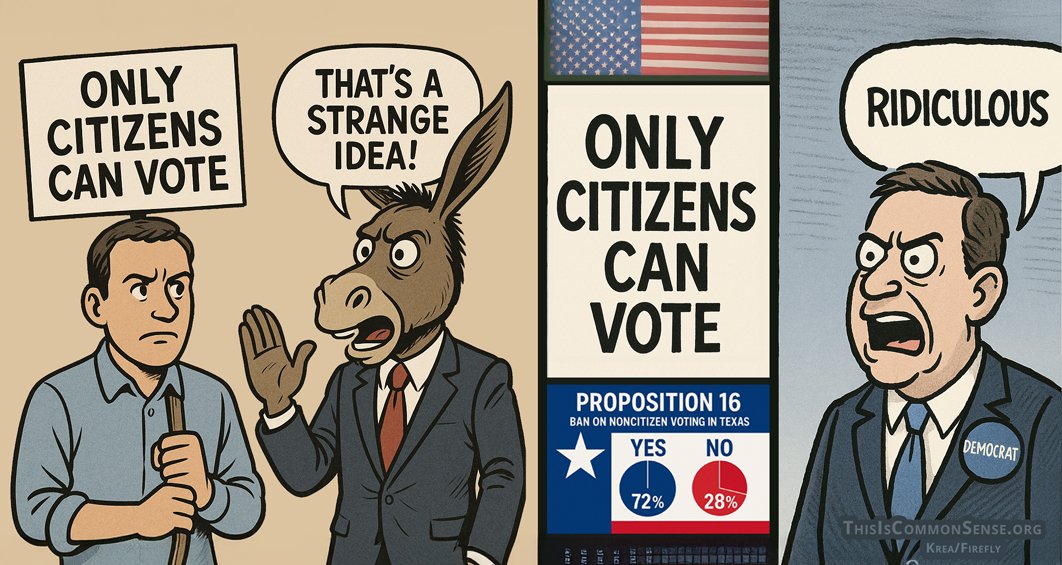
Talk about a blowout: a few days ago, Texans overwhelmingly supported Proposition 16 to amend their state constitution to clarify that noncitizens cannot vote in state and local elections in Texas. The vote: Yes, 72%; No, 28%.
Not everybody is happy.
Jeff Forrester, who happens to be running against Rep. Candy Noble, a major sponsor of this very amendment — just a coincidence I’m sure — professes confusion about why anybody would care about this question. He asserts that the state constitution already prohibits noncitizen voting and has flung himself into a major Twitter‑X tussle over the matter with the group I lead, Americans for Citizen Voting.
Per Forrester, the Texas constitution “already states that no one other than U.S. citizens can vote” in Texas elections.
But as we point out, prior to passage of the present amendment, the state constitution only explicitly protected the rights of U.S. citizens to vote. It did not “reserve the right to vote to only [U.S.] citizens.… It didn’t prohibit Dallas from giving the right to noncitizens to vote in local elections.”
Similarly deficient provisions in the constitutions of other states have also failed to prevent cities from allowing noncitizen voting on local matters. Now, with passage of Prop 16, there is no way for noncitizens to legally vote in Texas.
Those who assert that the Prop 16 amendment is pointless protest too much. If it’s so durn redundant, why isn’t the response to this voter-endorsed clarification simply a shrug?
Instead, we get finger-wagging opposition.
Very “mysterious.”
This is Common Sense. I’m Paul Jacob.
Illustration created with Krea and Firefly
See all recent commentary
(simplified and organized)
See recent popular posts
7 replies on “A Puzzling Protest”
What business is it of “Americans” in general who gets to vote not just in Texas state elections but in Laredo or San Antonio local elections? Seems like that should respectively be up to Texans and to residents of Laredo and San Antonio.
Mr Knapp, the governing structures of America are not simply set-up to such that institutions of joint governance simply handle cross-jurisdictional issues. And if you want to play the anarchist card, then all talk of elections is absurd.
Moreover, a person outside of one jurisdiction always has the prerogative of urging change in another.
That’s what 2 million Texans just did. After legislators from both parties supported placing the issue on the ballot. Voters decided to support a clear policy of allowing only U.S. citizens to vote in state and local elections in Texas. And we/they/the voters won.
The voters in Austin voted themselves the power to decide who gets to be a voter in San Antonio’s local elections.
Should the voters of Boise, Idaho and Butte, Montana and Naples, Florida all get a voice in whether you’re allowed to vote in your town? Or should maybe the people who actually live in your town decide that?
Mr Knapp, that’s already been answered, but let me explain more brutally.
The prerogatives and responsibilities of the state of Texas are not limited to dealing with inter-county matters. Indeed, Article IV § 4 of the US Constitution does not permit constituent states to adopt such a form of government.
Instead, if a county sheriff or board of supervisors or board of elections or even a plurality of its voters does something knavish or foolish, then the rôle — not just the prerogative but the responsibility — of the state of Texas is to step into the situation. And if a governing institition of a city or township does something knavish or foolish, and the county government cannot or will not set things right, then again the rôle of the state of Texas is to step into the situation.
Adopting a voting system that is especially inclined to produce perverse outcomes is at best foolish, and more typically knavish. If you want to argue for allowing non-citizens to vote, it cannot be on a basis that locals get to do whatever they want, but that the outcomes are no more likely to be perverse.
(By the way, a tangential but important point: When an internal investigation by local officials is improperly conducted, the governor and state attorney general have an obligation to step into the situation. They should have their careers ended by failure to do so.)
Shocked!
Shocked, I tell you…to find that gambling has been going on in this establishment.
Hahaha love that quote