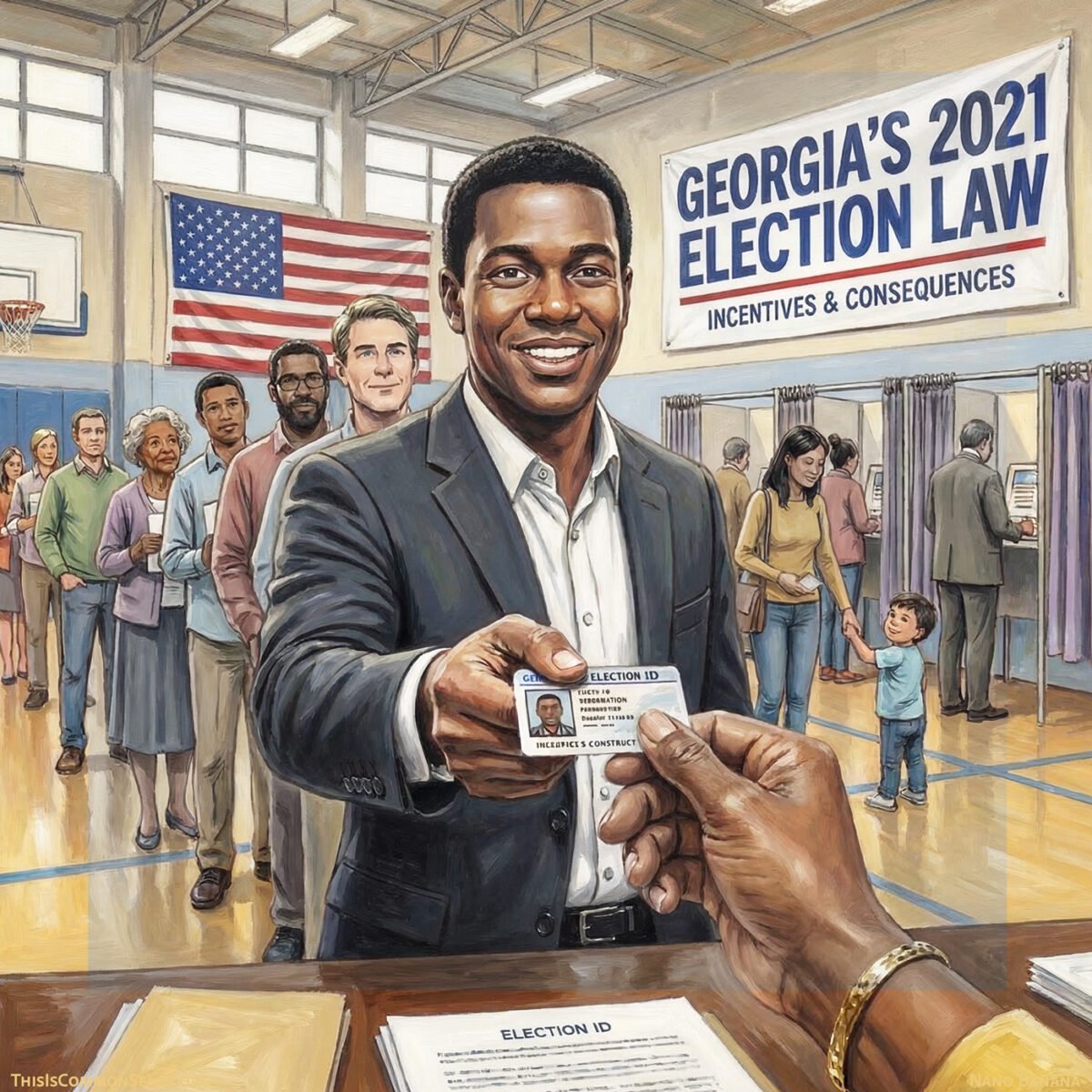
“In any other area of life — boarding a plane at DSM, picking up Cyclone tickets at will-call, or even buying Sudafed — showing a photo ID is a non-event,” Luke Martz writes in the Des Moines Register. “It is the baseline of participation in a modern society.”
The Republican political consultant, who has “served as an international election observer in Europe and the Middle East,” compares Iowa’s election system with “the mess currently unfolding in Minnesota,” where “Gov. Tim Walz signed a law authorizing illegal immigrants to obtain driver’s licenses.”
Mr. Martz points out the “logical fallacy,” which he says has “effectively undermined their own arguments against voter ID.” How so? “If activists believe requiring a document to drive is reasonable,” he argues, “then their claim that requiring a document to vote is a ‘racist barrier’ collapses.”
Indeed. He notes that the idea “that certain Iowans are somehow incapable of obtaining a free state ID” is precisely the “soft bigotry of low expectations,” highlighted by President George W. Bush decades ago.
Lastly, Martz addresses the “‘voter suppression’ narrative,” which “has always had one major flaw: reality.”
Remember the hullabaloo over Georgia’s 2021 election law? Former President Sleepy Joe Biden called it “Jim Crow 2.0” and the politicians running Major League Baseball canceled the All-Star Game in Atlanta as punishment, only to see voter turnout in Georgia’s next election “more than 50% higher than in the previous midterm election of 2018.”
Martz shares Iowa’s story, where “doomsayers predicted a collapse in participation” after passage of voter ID. “Instead, we saw the exact opposite. In 2018, the first general election with the law, Iowa saw its highest midterm turnout in decades. In 2020, we shattered records with over 1.7 million ballots cast.”
Let’s not suppress reality.
This is Common Sense. I’m Paul Jacob.
Illustration created with Nano Banana
See all recent commentary
(simplified and organized)
See recent popular posts
4 replies on “Logic Suppression”
Research from multiple reputable sources shows that voter fraud in elections in the United States is exceedingly rare, and when it does occur it represents only a tiny fraction of the votes cast — far too small to change the outcome of a federal or statewide election. 
📊 Estimated Rates of Voter Fraud
Here are some estimates based on detailed studies of U.S. elections:
• Overall voter fraud is minuscule: Analyses of historical data going back decades suggest extremely low fraud rates — on the order of 0.0000845 % of votes in one long-running study of multiple elections, meaning less than one fraudulent vote per million ballots cast. 
• **News21 (Arizona State University) found around 2,068 alleged voter fraud cases between 2000 and 2012 out of roughly 146 million registered voters — roughly 0.000003 cases per vote. 
• Mail-in voting fraud is extremely uncommon: Recent studies estimated about 0.000043 % of mail ballots may involve fraud — roughly four cases per 10 million mail votes. 
• Other comprehensive research gives similar figures: fraud estimates often range between 0.00004 % and 0.0009 % of votes cast in different settings. 
📌 What Does This Mean?
• Fraud occurs, but very rarely: Instances do happen — for example, prosecutors across states may refer a few dozen cases of possible fraud in a given election year — but these are an extraordinarily tiny share relative to millions or hundreds of millions of votes. 
• No evidence of widespread fraud that alters outcomes: Federal officials including former U.S. Attorneys General have noted that there is no evidence of fraud on a scale large enough to change the outcome of a federal election.”
“ Summary
“In short, voter fraud in the U.S. has been documented at only very low rates — fractions of a percent, often measured in millionths of votes — based on extensive research covering many elections. These rates are far below what would be required to affect election results, and most credible research concludes that systemic or widespread fraud is not supported by evidence.”
Pam,
If you are truly interested in seeking the truth, ask your AI for the counter-arguments. Read them and see if you can summarize them.
Trying to summarize the wall of (AI generated) text that you posted would have given you a chance to think more carefully about the arguments.
Key to effective AI use: ask your AI for better summaries (that you can understand and explain), and … always ask the next question.
A driver’s license is not primarily a means or personal identification needed in order to drive a car; it is a certification of competency in order to drive safely on public motorways. One does not need to present it in order to get into the driver’s seat, start, and operate the car. On the other hand, a personal identification card to be presented in order to vote carries no certification of competency in anything whatever. Voting incompetently does not endanger those around one, but incompetently operating a vehicle does. The two uses of that card are entirely different. Attempting to show equivalence is like attempting to show equivalency between a plate and the food one puts upon it.
Mr Fleischer, in all 50 of the constituent states, failure to present a driver license is an offense when stopped for an infraction or otherwise for probable cause. The severity of offense depends upon the state. In some states a “fix-it ticket” is issued; in others it is a traffic infraction; in some it is a misdemeanor. One can, of course, evade detection of failure to have the license on one’s person exactly as one can evade detection of not having qualified in the first place.
If a driver license were a certification of competence, then renewal would always require a renewed demonstration of competence.