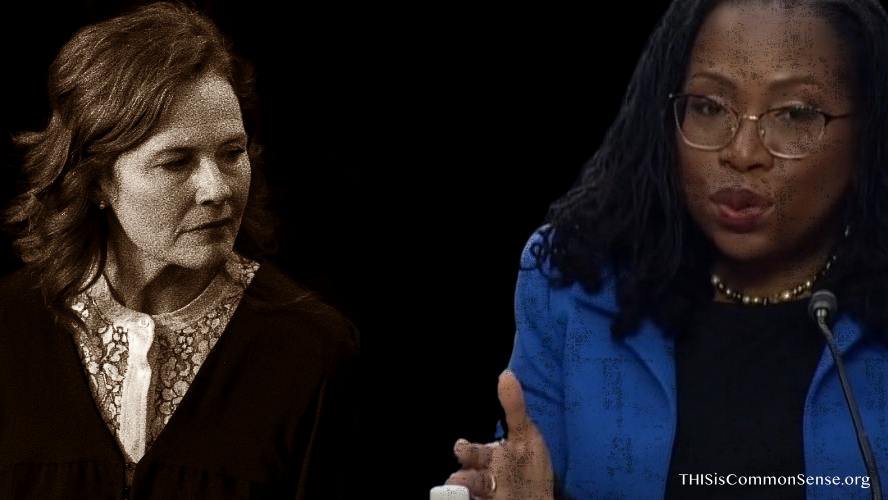
Today’s “Thought” (see below) features Supreme Court Associate Justice Amy Coney Barrett dismissing fellow Justice Ketanji Brown Jackson. This passage from Justice Barrett’s write-up of the Trump v. CASA decision has been shared a great on social media since it came down yesterday.
The whole passage is worth reading (see links here), and may demonstrate some tension on the court. In social media, much has been made about the . . . sportive . . . or political . . . or even “catfight” . . . element of it all, or as a sign that Jackson is a “DEI hire” etc. But the actual decision is of no small moment, and worth reading.
The Epoch Times offers “five takeaways,” with the summary in the blurb: “By limiting the ability of judges to issue universal blocks, the court’s ruling is expected to affect other cases contesting Trump administration policies.”
ONE: Nationwide Injunctions Not Consistent With Nation’s History
“The universal injunction was conspicuously nonexistent for most of our Nation’s history,” Barrett said. “Its absence from 18th- and 19th-century equity practice settles the question of judicial authority.”
TWO: Broad Relief Still Possible
A key aspect of Barrett’s opinion indicated that broad relief was not necessarily bad but depended on who the plaintiffs in particular cases were. Courts, she said, could issue orders designed to provide “complete” relief for the parties before the court rather than other individuals in similar situations.
THREE: Unclear How Birthright Citizenship Issue Will Play Out
“No one disputes that the Executive has a duty to follow the law,” Barrett said. “But the Judiciary does not have unbridled authority to enforce this obligation—in fact, sometimes the law prohibits the Judiciary from doing so.”
Note that this quoted passage follows immediately after the oft-shared swipe at Justice Jackson.
FOUR: Dissenters Say Constitutional Rights in Danger
Sotomayor and Justice Ketanji Brown Jackson, who penned her own dissent, expressed their disagreement with Barrett and her majority opinion colleagues.
“No right is safe in the new legal regime the Court creates,” Sotomayor said. She added that while birthright citizenship might be under threat today, “tomorrow, a different administration may try to seize firearms from law-abiding citizens or prevent people of certain faiths from gathering to worship.”
Because the majority decision limited relief to parties before the court, it rendered “constitutional guarantees meaningful in name only for any individuals who are not parties to a lawsuit,” Sotomayor said.
Jackson, meanwhile, described the majority’s decision as “an existential threat to the rule of law.” Her separate dissent suggested that Barrett had focused too much on history and not enough on broader and more basic principles, like whether the judiciary can stop unlawful behavior.
FIVE: Majority Has Strong Words for Jackson
In multiple portions of Barrett’s majority opinion, she and her fellow justices leveled criticisms of Jackson’s dissent.
At one point, Barrett said that Jackson’s position was “difficult to pin down.” After briefly discussing Jackson’s dissent, Barrett adds that the majority “will not dwell on Justice Jackson’s argument, which is at odds with more than two centuries’ worth of precedent, not to mention the Constitution itself.”
The Epoch Times article ends with Barrett’s most generalized critique of Jackson’s dissent, where she says that Ketanji Brown Jackson’s position “would make even the most ardent defender of judicial supremacy blush.”
And this might be the biggest ideological takeaway. Progressives (which are what Jackson and fellow justices Sotomayor and Kagan most obviously are) have relied heavily on court rulings to advance their political agenda. They tend not to win on their issues through majority vote of the people. For good or ill, many of the major “progressive” achievements, such as regarding de-segregation and abortion, were achieved largely on the basis of key Supreme Court cases, such as Brown v. Board of Education and Roe v. Wade.
More recently, Democrats have relied heavily on injunctions of the lesser federal courts to “stop Trump.”
The ruling in Trump v. CASA limits this tactic somewhat.