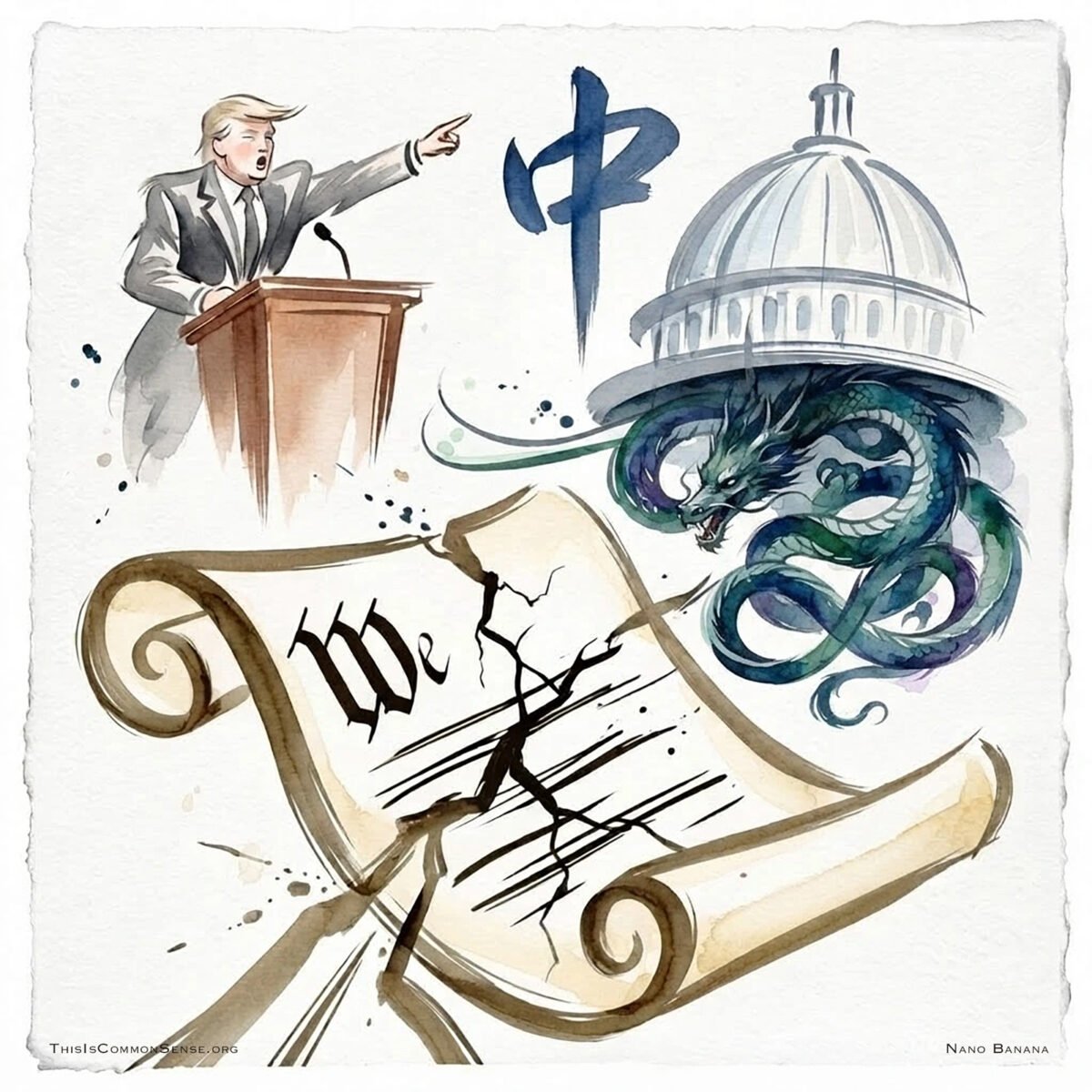
“I would like to congratulate President Xi, and the Great Country of China, on their massive Birthright Citizenship WIN!” President Donald Trump posted on Truth Social last week, after the Supreme Court struck down his executive order, which declared that children born of mothers in the country illegally or on a temporary visa were not covered by the “birthright citizenship” clause of the 14th Amendment.
Mr. Trump was referring to “birthright tourism,” pregnant women traveling to this country with the sole purpose of giving their child automatic U.S. citizenship. In his new book, The Invisible Coup: How American Elites and Foreign Powers Use Immigration as a Weapon, Peter Schweizer charges that the Chinese government has “created a system whereby it’s happening on an industrial scale,” that in the last decade more than a million Chinese mothers have traveled to America to give birth.
How can we be untroubled that more than a million kids growing up in Communist China today have a legal right to come to the United States at any time?
In his concurring opinion, Justice Brett Kavanaugh argued that, “consistent with the Fourteenth Amendment,” Congress could “enact new legislation establishing exceptions to birthright citizenship . . .”
The president cheered the idea: “No long and unwieldy Constitutional Amendment is necessary!”
Yet, none of the other five justices in the majority left that statutory door open; it likely will require a constitutional amendment. And that should not be impossible, but in the last half-century not even one has been both introduced and ratified.
Sen. Rand Paul introduced an amendment back in April on birthright citizenship. Sen. Tom Cotton has one, too.
Constitutions exist to keep government under citizen control. If we can never alter a word in that compact, we lose that control.
This is Common Sense. I’m Paul Jacob.
Note: Even more so, we need amendments to prevent court-packing, establish term limits on Congress, and secure that only U.S. citizens can vote in federal elections.
Illustration created with Nano Banana
See all recent commentary
(simplified and organized)
See recent popular posts
7 replies on “Constitutional Tourism”
The Treaty Said ‘No Military Intervention’, So We Sent 10,000 ‘Tourists’ Instead
https://www.youtube.com/watch?v=vzF-VQJ6r9o
“How can we be untroubled that more than a million kids growing up in Communist China today have a legal right to come to the United States at any time?”
I’m completely untroubled by the idea of other people moving where they want to live without my permission.
I wasn’t born immune to moral panics that cause people to demand that 250+ years of history and freedom be reversed because of their feelz; later incidents, one of them involving Timo Virkalla, helped me build that immunity.
The last section of the 14th Amendment gives Congress the power to pass appropriate legislation. What situations do the words ‘and subject to the jurisdiction thereof’ encompass? The Chinese women who gave birth here didn’t automatically become subject to the jurisdiction thereof. Their children didn’t forfeit their Chinese citizenship. What’s done is done, but isn’t it possible for Congress to pass legislation defining who is covered by those six pesky words? Traditionally, it referred to diplomats and their families but times have changed. People can come here for several years on a student or work visa and have children here. Does the law consider such visas ‘temporary’? Congress can answer these questions without going through the amendment process. But does it want to?
At present, foreign tourists indeed maintain their foreign citizenship, but they are not exempt from the laws of the United States, nor those of whichever constituent jurisdictions they visit. Congress could indeed exempt tourists in the same way that it exempts diplomats, in which case I fear that America would be subjected to murder tourism and rape tourism. Persons with diplomatic immunity have committed homicides and rapes in America; we may be sure that an increased number of tourists would commit such acts if they were not subject to the jurisdiction of the United States and merely faced expulsion for their crimes.
“Subject to the jurisdiction [of the United States]” means two things:
1) You’re here and
2) You don’t have diplomatic immunity.
If your hypothetical Chinese woman isn’t subject to the jurisdiction of the United States, the “problem” is already solved — the United States has no authority to stop her, detain her, arrest her, or deport her. It has no jurisdiction over her.
You’re not quite right here. Any comprehensive immunity, diplomatic or otherwise, would make a person not subject to the jurisdiction; but those with immunity, such as diplomats, can still be deported.
A diplomat isn’t “deported” while he’s a diplomat. In fact, even if he’s de-credentialed as a diplomat (by his home country, or by the US), he’s generally just declared persona non grata and given time to leave on his own before being treated as subject to the jurisdiction of the US for purposes of deportation.
I suppose there could be other forms of “comprehensive immunity” than diplomatic immunity between regimes. I don’t happen to be familiar with any.