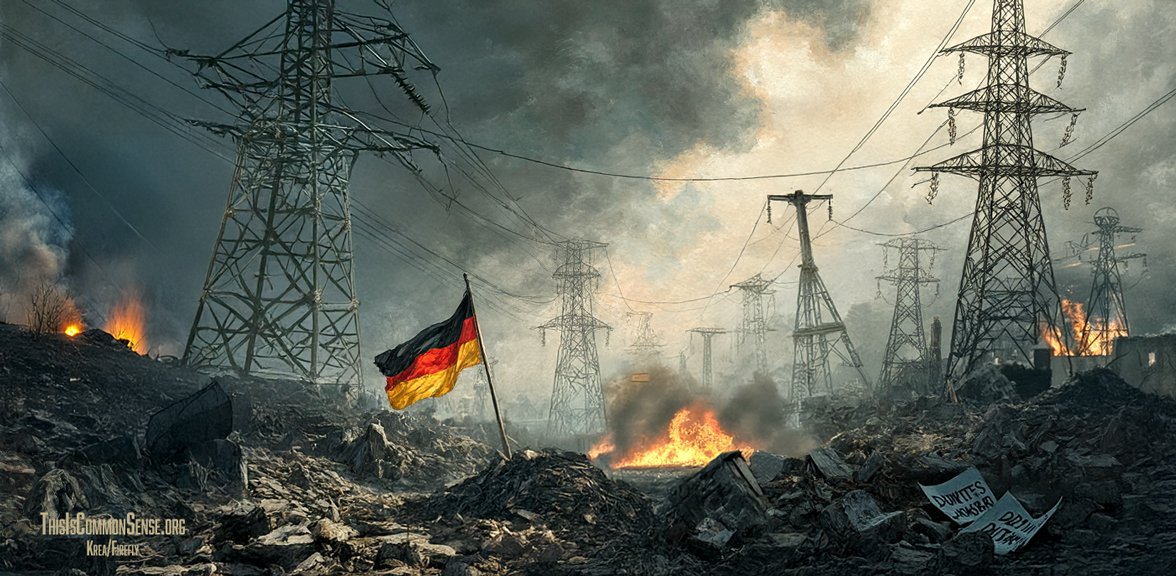
Paige Lambermont reminds us that Germany’s phase-out of nuclear power has its reasons.
Construction, transport, and other processes involved in making and maintaining a nuclear power plant emit carbon dioxide. But nuclear power itself does not emit carbon dioxide, which is supposed to be terrible for climate and planet. So, “What would prompt a country seeking to sharply reduce CO2 emissions to get rid of its largest source of carbon-free energy?”
Lambermont, a policy associate at the Institute for Energy Research, reviews the history of anti-nuclear sentiments, going back to the 1970s, and various news-driven decisions by the German government. A tsunami in Japan didn’t help, though safety measures were strengthened at the affected nuclear power plant.
Now we seem to be nearing the end of the line. German pubs host “demolition viewing parties” as the country self-destructively continues to destroy another nuclear power plant, specifically the part consisting of two giant cooling towers.
A controlled demolition caused 56,000 tons of concrete to collapse in seconds. The speed is misleading, for the job is far from finished. Further work dismantling the Bavaria-based plant is expected to continue until 2040. Of course, the useful life of the plant is already over.
It’s all part of the plan, the German government’s energy-transition plan called Energiewende. The energy has to become “renewable,” a word meaning — in effect — unreliable (wind, solar). Also, Germans must drastically reduce their consumption of energy.
Maybe they should call the plan Götterdämmerung — twilight of the gods or, in this case, of industrial civilization.
This is Common Sense. I’m Paul Jacob.
Illustration created with Krea and Firefly
See all recent commentary
(simplified and organized)
See recent popular posts
4 replies on “Twilight of Electrical Civilization”
A self-inflicted Morgenthau Plan! Germany seems fated to serve as an example to other Western nations of What Not to Do.
The political order in Germany must either become more repressive, or the costs — including lives lost to the cold — of the present arrangement and continued falsifications of the AGCC Narrative will bring-about pressure to build new nuclear plants.
But, even after some significant change of general political will, such plants would take a decade or more to construct and to bring on-line.
I suspect nuclear would compete well in an unsubsidized free market, and would like to see it, and other energy sources, allowed to try.
But nuclear is no more “reliable” or less “intermittent” than wind and solar.
The most common reliability problem with electricity isn’t generation, it’s transmission over sprawling “grids.” When a transformer blows or a line comes down, how the electricity no longer being carried to users was generated is irrelevant.
The solution to that is decentralized and localized generation (to the household level is ideal, but even the neighborhood level would be helpful). At present, solar and wind probably make better sense for that scale, but small neighborhood reactors will eventually be a thing if allowed.
“When a transformer blows or a line comes down, how the electricity no longer being carried to users was generated is irrelevant.” That argument applies to any form of electricity generation be it fossil fuels, nuclear or renewables. Geothermal power is probably more reliable than other forms of renewable energy. That’s great for Iceland, but not for many other countries. The most reliable forms, though not perfect, are those that can withstand less than ideal weather conditions.
We keep hearing how much electricity will be required to power AI. Giving up any source of electricity is asking for trouble. Have the Germans learned nothing from California’s renewable energy initiatives?