Categories
ideological culture meme national politics & policies Popular too much government

More of the More

Alexandria Ocasio-Cortez’s triumphant entry into Washington, DC, as a United States Representative-Elect, is quickly proving a cautionary tale for Democrats. She’s an enthusiastic socialist. Or “progressive,” to use the preferred euphemism. And thus Democrats see her as a fresh breeze to air out the stodgy, musty chambers of . . .

Nancy Pelosi’s office. 

Ocasio-Cortez showed up in the House office building last week, along with other protestors “flooding,” as Politico put it, the Minority Leader’s work area. 

But what she is proving to be is not a breath of fresh air. And she is not merely “more of the same” in leftist agitation. 

She may be “more of the more.”

Progressives cannot seem to formulate an upper limit to their ideology. Dr. Jordan Peterson, trying to be “precise,” warns that this is the main problem of the left today: a lack of any sense of “going too far.” 

If government growth is always good, then . . . all the way to the socialism of Stalin, Mao and the Castros? The result of “always more” is “most.”

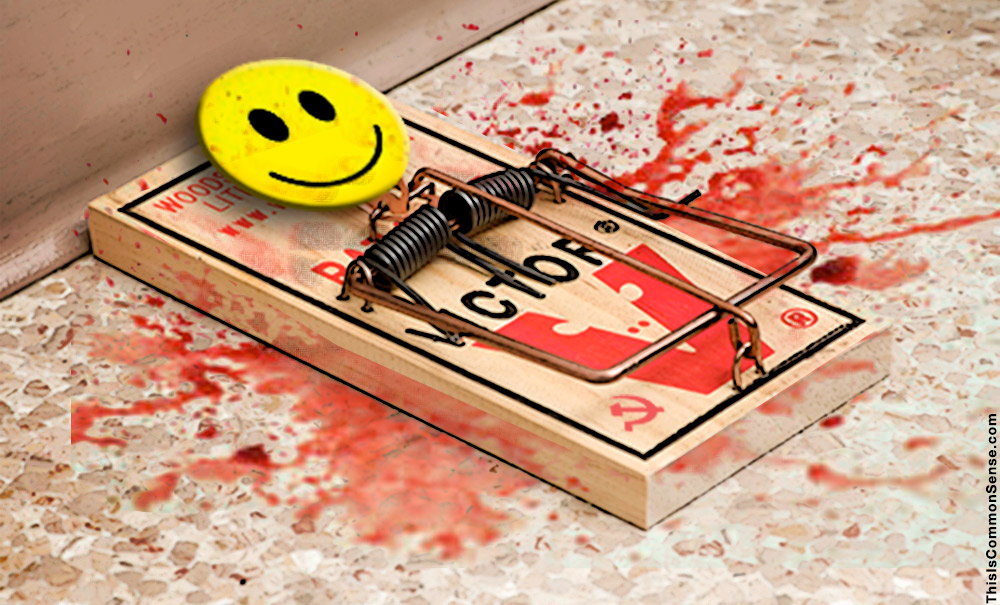
Real socialism is the  trap. “Democratic socialism” is the bait.

Their usual rebuttal? “We just want to be more like Scandinavian countries.” But these countries have less regulation on markets than America does currently. We should believe the “Scandinavian Limit” precisely when progressives earnestly push to repeal some regulations. 

Ideology aside, this may be mainly . . . politics. Ocasio-Cortez proclaimed herself “looking forward” to “working together” with former and likely new Speaker Pelosi, and left the protest before the police began making arrests.

A statesperson in the making.

This is Common Sense. I’m Paul Jacob.


PDF for printing


» See popular posts from Common Sense with Paul Jacob HERE.

Categories
general freedom ideological culture Popular too much government

Socialism Is Anti-Democracy

Common sense politics must peer beneath the superficial attractions of “democratic socialism.”

In “Civil Liberties and Socialism Don’t Mix,” Matthew Harwood explains why those who call themselves democratic socialists may “say they believe in civil liberties” nevertheless “will always be hostile to individual freedom.”

In this short Reason piece, Mr. Harwood starts out by showing that socialism cannot merely be “a more generous welfare state along Nordic lines.” For “socialism” to remain distinct socialists must offer a Unique Selling Proposition. You cannot plausibly push a “new” philosophy and stick to pushing the old liberal stand-bys of private property and markets.

Their own pretensions force them back to central planning, to economic planning for all by a few.

Which is not democratic, of course. It goes far further, to anti-majoritarian.

Actual economic planning requires micromanagement. Harwood quotes socialist economist and luminary Robert Heilbroner, who expresses this requirement as “the necessity to intervene deeply, and probably ruthlessly, into the economy in order to establish the socialist order in the first place.”  

But it cannot stop there. Once established, a socialist state must feel a “need to continue a policy of painful intervention” to adjust to “the constricting limits of the environment.”

“Democratic socialism is not freedom,” Harwood concludes. “It is authority paternalistically dressed up in the language of liberation and wielded on behalf of that fuzzy abstraction, ‘the people,’ regardless of what flesh and blood individuals want.”

Sure, democratic socialists may hope that majorities will allow their elites to plan for everybody. 

But once that handoff is made, the power obtained, then the tyranny.

Inescapably.

This is Common Sense. I’m Paul Jacob


PDF for printing


Categories
folly free trade & free markets general freedom ideological culture property rights too much government

Big Government Apologetics

Journalists play different roles.

Too few report. Too many engage in elaborate apologetics for favored causes.

Like big government.

Take this headline: “Venezuela’s Crisis Is Rooted In Oil Prices — and Authoritarianism.”

Guess: reporting, or bending over backwards to save socialism?

The article’s summary of the decline and fall of Venezuela is accurate insofar as it indicates assaults on liberty, including nationalizations and monetary inflation. But neither “oil prices” nor dependence on oil spawned Venezuela’s crisis.

Every industry, city and nation will experience unfavorable markets, now and then. But what’s fundamental is their “antifragility.” And, news to journalists: socialist societies are fragile in ways that freer societies are not.

Suppose Venezuela had had a free market when oil prices dropped so precipitously. People would then have shifted, however grumpily, into enterprises now more profitable than drilling for and distributing oil.

It is no blunder to specialize, to exploit comparative advantages in knowledge, skills or resources, and to engage in local, regional or international trade. It’s fine even if an economy’s production and exports ends up being dominated by just one good. What matters is whether people are free or burdened by government controls. If the latter, how hard does government make it to cope with changing circumstances?

Unhampered market prices supply the information and incentives needed to adapt to all kinds of changes. But if an economy is chronically distorted and calcified by government controls, it becomes much harder to adapt . . . and much harder to survive.

Today’s journalists routinely adapt facts to story, rather than adjust stories to reality. Guys, give up the ideological apologetics. Go back to reporting.

This is Common Sense. I’m Paul Jacob.


PDF for printing


Categories
crime and punishment ideological culture insider corruption media and media people

Socialist Saboteurs Infiltrate

Once upon a time, people who worried about communists infiltrating the government were often dismissed as paranoid. 

“Sure, commies under every bed! Right!”

Communists in the State Department or wherever generally weren’t caught on tape boasting that they were Soviet agents and part of the Resist Truman or Resist Eisenhower movement. Allen Funt did not expose Alger Hiss. But now we have this social-media thing happening. And we have members of the Democratic Socialists of America (DSA) caught on tape touting their illicit exploits as federal employees.

Project Veritas is a conservative group* that conducts hidden-camera interviews with lefty activists. In one of Veritas’s recent exposes, several DSA members confess to abusing their government positions in order to impede Trump Administration policies, including any even slightly pro-market policies. The goal is to “f*ck sh*t up,” as one rebel summarizes.

Several of the Resisters boast that “we can’t really get fired.” That’s probably almost true; they’re federal bureaucrats. But DOJ paralegal Allison Hrabar and others may find that their license to chill is about to expire. 

Hrabar was in the news a few months back for helping chase Homeland Security Secretary Kirstjen Nielsen from a restaurant. Now she has admitted using government resources to dredge up the home address of a DC lobbyist she wanted to target. Address in hand, she and several DSA comrades swooped down on the residence to hold a harassing protest. 

Not quite how taxpayer dollars are supposed to be deployed.

This is Common Sense. I’m Paul Jacob.


* Project Veritas founder James O’Keefe, whom I know and like, has done enormous good with his undercover stings of ACORN and others. Last year’s failed effort against the Washington Post is the exception. Had Project Veritas succeeded in slipping this false accusation into the newspaper, the result would have been to publicize a harmful lie, not show the truth (per his group’s name.

PDF for printing


Categories
general freedom ideological culture moral hazard nannyism national politics & policies too much government

An Evil Ism

With “democratic socialism” again on the rise, a refresher course in history seems apt: socialism has demonstrated the strong tendency to end up in totalitarian tyranny, poverty, and genocide.

As I mentioned on Monday, Reason’s Nick Gillespie suspects that this response is not very convincing to people tempted by socialism. But really, why not? What about a history of horror could be appealing?

Which is why the question “Do Socialists Mean Well?” as answered by Grant Babcock, might help. Babcock answers in the negative.* “Socialism is not ultimately an end but a means. And as a means, socialism is evil.”

With an evil means, one’s chosen end is irrelevant, because of other results. “If I told you I wanted to end homelessness, you might say I had good intentions,” Babcock explains. But if he confessed to seek that end “by conscripting the homeless into the army . . . [n]ot only should you say I have bad intentions, you shouldn’t give me any moral credit for saying I want to end homelessness.”

True. But Babcock has to engage in his extended argument about means because, for purposes of his essay, anyway, he began with the premise that while fascists are evil because they seek directly to harm some people, socialists do not.

Uh, really? Most socialists make much of taking from “the rich,” however they define the rich — as “the one percent” or “the privileged,” etc.

Call it expropriation; call it theft: that’s a lot of anger and ill will directed to one group of people.

In that way, the appeal of socialism is too much like the appeal of fascism.

This is Common Sense. I’m Paul Jacob.


* Babcock, by the way, denies the label “socialist” to social democrats who call themselves “democratic socialists” — by definition. On this matter, see “Bernie’s Slippery Definition of Democratic Socialism” and “Is Denmark Socialist?” on this site.

PDF for printing


Categories
folly ideological culture moral hazard

Mass Murderers Are Cool?

If you have a lick of sense, you wouldn’t emblazon images of Ché Guevara on your chest or your wall — and yet Ché t-shirts and posters have been a pop culture hit for decades now.

He is cool, we are told, because he was ¡Viva la Revolución! and all that.

But it could get worse. You could be emblazoning a hammer and sickle.

Walmart’s website is there to help. Under “men’s sleeveless,” for example, we see an artistic rendering of the old Communist symbol, frankly identified as a “Soviet Hammer and Sickle,” white on black for $14.97.* Walmart files it under “Pop culture.”

Aren’t men’s sleeveless shirts called “wife beaters”? Should we now call them Kulak Killers?

It’s hip to murder millions!

No wonder Lithuania and several other Baltic countries — who suffered greatly under Soviet rule — object. Indeed, many of these countries go too far in actually banning the symbols. Now, they have contacted Walmart requesting a cessation in hawking the offensive merchandise. “You wouldn’t buy Nazi-themed clothing, would you?” Lithuania’s foreign minister Linas Linkevicius tweeted. Or sell such items.

But a few people might. Certainly, a lot of people do buy stuff that others regard as “Nazi.” Sometimes to be “cool”; other times to make a controversial political point.

At the Uhuru Store, Gavin McInnes’s “ProudBoys Official” sells a “Pinochet Did Nothing Wrong” t-shirt for twice the price of Walmart’s Hammer and Sickle shirt — and that surely has annoyed leftists who have seen it.

I’m waiting for the death of cool.

This is Common Sense. I’m Paul Jacob.


* The shirts also come in Navy, Royal and Gray. I guess to get a red commie shirt you have to go for the sleeves.

PDF for printing


Categories
Accountability general freedom ideological culture national politics & policies Popular too much government

Pulling It Off

Give democratic socialism a chance? 

So says Dr. Cornel West, the “provocative democratic intellectual” who serves as one of eight honorary co-chairs of the Democratic Socialists of America. 

This accomplished Professor of the Practice of Public Philosophy at Harvard University, and Professor Emeritus at Princeton, explained to Fox News host Tucker Carlson that socialism’s “fundamental commitment is to the dignity of ordinary people and to make sure they can lead lives of decency.”

“What happened in Venezuela?” Carlson asked West. “They called that democratic socialism. But they don’t have toilet paper and it’s less equal than ever.”

“But part of the problem is though, brother,” the professor responded, “that any time there [have] been attempts by ordinary people to engage in self-determination, they can get crushed by external nations. Look at U.S. policies toward Venezuela [which have] been very, very ugly — Nicaragua in the same way.”

West offered nary a specific to his charge, but was handy stating his conclusion. “So, we have never had a chance to really pull it off,” the “it” being socialism. 

“So it’s only been a movement so far.”*

How convenient.

West implicitly acknowledges that those ruling Venezuela and Nicaragua are practicing socialism. But he won’t hold them or the -ism responsible for the economic collapse, the hunger, the exodus of millions of very desperate “ordinary” citizens, the arbitrary arrests, use of torture and murder of innocent citizens. 

Dr. West, a follow-up question: Just what specific U.S. policy triggered these socialists to murder and torture their own people?

This is Common Sense. I’m Paul Jacob.


* Dr. West also announced that socialism “is not an ‘ism,’ brother.” I think the professor needs to take a course in ism-ology.

PDF for printing


Photo by Gage Skidmore

Categories
national politics & policies responsibility too much government

The Problem with Public Accounts

President Trump’s promise not to cut one dime from Social Security and Medicare doesn’t square with the fiscal cliff these programs are headed for. To save the system, benefits must be cut, taxes must be raised, or both.

Or else replace the system.

No wonder, then, that John Stossel insists we “Fix Social Security Before It Goes Broke,” and rescues a decades-old proposal: “private accounts,” which he says “would certainly pay retirees more than Social Security will ever pay.”

In Chile, where they have tried this, private accounts have worked out pretty well, contributing to the once-impoverished country’s rise to “the richest country in Latin America.” 

Had the United States adopted such a system, at Social Security’s inception, the amount of capital flowing into projects big and small would have not merely prevented the stagflation of the Seventies and brought us almost unimaginable wealth, it might have turned political eyes towards accountability, prudence and stability.

But, because Social Security was set up as a Pay As We Go system, we paid . . . and the money went.

It got so messed up that by the 1980s Ronald Reagan charged Alan Greenspan with “fixing” it. That “fix” mainly meant increasing taxation. The decades of revenue surge over outflow was spent by Congress for war and handouts. And now we’re reaching a repeat of the late 1970s’ Social Security insolvency.

Meanwhile, Chilean leftists “hold street protests against private accounts,” Stosssel reminds us. “They’re angry because capitalists get a slice of the pie.”

Back in the USA, Democrats demand that more benefits be wrung from Social Security. Are they dead set on proving why socialism doesn’t work?

This is Common Sense. I’m Paul Jacob.


PDF for printing


Categories
Accountability general freedom ideological culture porkbarrel politics responsibility too much government

Ask the Next Question

Republicans are very reliable. When given our system’s “Mandate of Heaven” — majorities in both houses of Congress and the Presidency — they can be relied upon to do one thing: add debt by piling up huge deficits.

It happened under George W. Bush, and it is happening under Donald J. Trump: “The Trump administration expects annual budget deficits to rise nearly $100 billion more than previously forecast in each of the next three years,” the Wall Street Journal tells us, “pushing the federal deficit above $1 trillion starting next year.”

Republicans should ask themselves why. And while they ask themselves that, everyone else should ask the next question: why do politicians who say they want one thing so often deliver its opposite?

This is not a mere “right-wing” phenomenon. Leftists say they want “democratic socialism,” but, as Irving Kristol noted, at some point not far down their road to Utopia, “democratic socialists” must choose between democracy and socialism.* By promising everybody everything, too quickly everybody gets shanghaied into service to produce that “everything,” finding themselves conscripts in socialism’s army.

The equation of socialism with regimentation and general un-freedom has been clear for over a century, explained carefully by sociologists, economists and even politicians.* And yet, increasingly, today’s Democrats are embracing a philosophy with proven anti-democratic features.

Could some deep principle be at play?

Probably. It is built into the very nature of state governance, of politics itself. It may be why republics metamorphose into empires, conservatives go radical and liberals become serviles.

Which is why effective democracy requires limited government. To minimize that boomerang effect.

We might start by limiting spending.

This is Common Sense. I’m Paul Jacob.


* Herbert Spencer’s writings on socialism include The Man versus the State (1884) and Industrial Institutions (1896, Principles of Sociology, Vol. III, Part VIII); German politician Eugene Richter’s satire Pictures of the Socialist Future (1896) is well worth reading; and economist Yves Guyot preceded Ludwig von Mises’ classic Die Gemeinwirtschaft (1922, translated as Socialism: An Economic and Sociological Analysis, 1950) with several books, including The Tyranny of Socialism (1893) and Socialistic Fallacies (1910).

PDF for printing


Categories
Accountability folly free trade & free markets general freedom moral hazard property rights responsibility too much government

Poison Is Poisonous

Venezuela’s socialist economy has been collapsing.

No big mystery. If, out of hostility to capitalism, a society keeps destroying everything that production, trade, and prosperity depend upon, the economy suffers. The benefits of markets don’t flow no matter what.

One assault has taken the form of hyperinflation — runaway printing of currency, done in part to dissolve government debt. Many Venezuelans are resorting to barter. It’s easy to understand why.

Or is it? A Reuters reporter says that economists say that “the central bank [of Venezuela] has not printed bills fast enough to keep up with inflation, which . . . reached an annual rate of almost 25,000 percent in May.”

So go faster!?

Dude. Dude. The massive expansion of Venezuela’s money supply is what’s causing massive jumps in prices. Just like any other economic good, the medium of exchange is subject to the laws of supply and demand.

Other things being equal, enormously increasing a supply of a good will enormously lower its market value or price. Money, too, has a price — in terms of the non-monetary goods being bought. If the pre-hyperinflation price of a dollar in terms of bread is one loaf and the post-hyperinflation price is one bread crumb, you won’t reverse the decline by printing even more dollars or bolívars even faster.

If you’re ingesting poison, you can’t fight the effects by being poisoned more and harder. The very first thing to do is stop ingesting the poison.

This is Common Sense. I’m Paul Jacob.


PDF for printing