Categories
folly international affairs national politics & policies Popular

Remember . . . the Maine?

“President Trump warned Thursday that America ‘will not stand’ for Iran shooting down a U.S. drone over the Strait of Hormuz,” a Fox News report summarizes, “while at the same time leaving open the possibility that the attack was unintentional.” 

This incident immediately follows the previous week’s apparent provocation, attacks on Japanese oil tankers in the same vicinity — also said by our government to have been caused by the Iranian military. Nearly everyone now regards these events as portending war,* which some see as a long time coming, since American relations with Iran have been antagonistic since the late 1970s, when Shia clerics raised a popular revolt to oust the American-installed thug, er, Shah.

While Mr. Trump was incredulous that the strike on the drone (opposite of a drone strike) could have been intentional, the rest of us can dare doubt even more: Can we really trust the “intelligence” that blames Iran’s military or paramilitary Revolutionary Guard for these puzzlingly dangerous provocations?

Not based on past performance.

The “intelligence” used to justify America’s several wars with Iran’s neighbor, Iraq, seems more disinformation than mere misinformation. And we now know that the Gulf of Tonkin incident enabling U.S. escalation into Vietnam was a lie.

We should even “remember the Maine!” — the questionable rationale for the Spanish-American War.

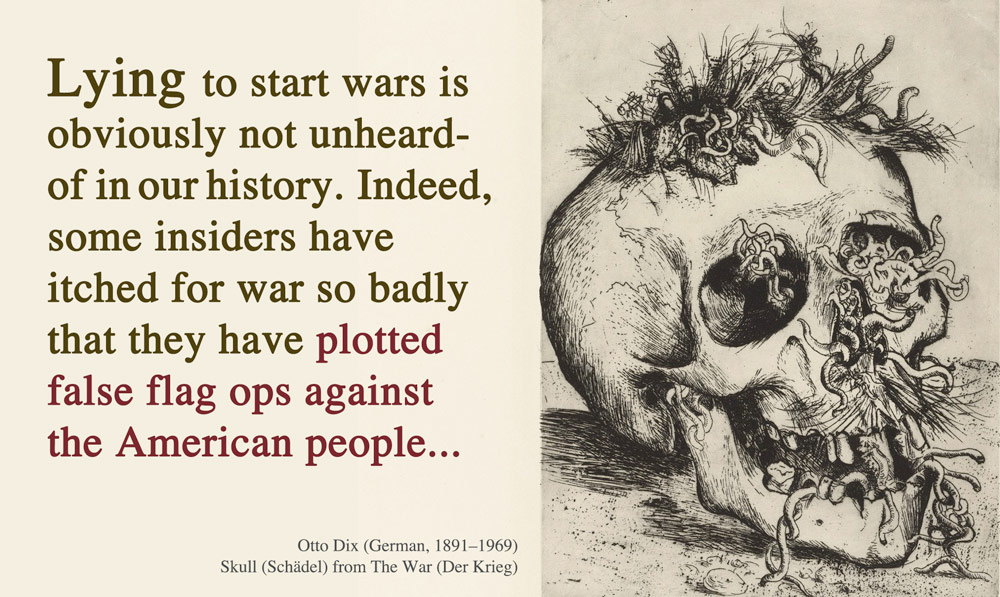
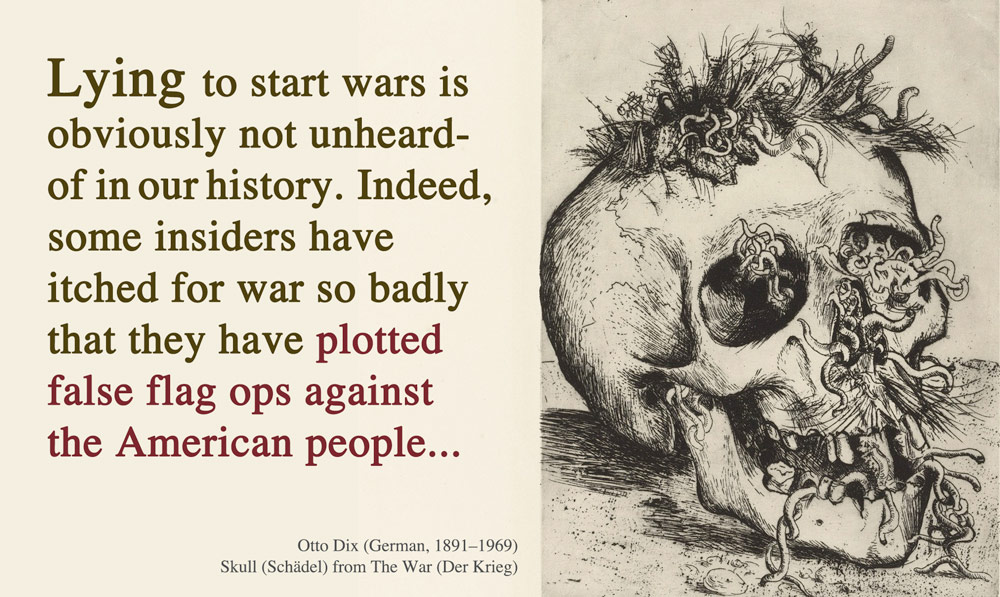
Lying to start wars is obviously not unheard-of in our history. Indeed, some insiders have itched for war so badly that they have plotted false flag ops against the American people.

The truth of what is happening now may not be known for years . . . by us . . . or even by President Trump.

This is Common Sense. I’m Paul Jacob.


* According to the New York Times, late yesterday President Trump authorized and then de-authorized a strike against Iran.
PDF for printing

war, false flag, Iran, Iraq, lies,

See all recent commentary
(simplified and organized)
See recent popular posts

Categories
Accountability government transparency national politics & policies

The National Confessional

Secrecy in diplomacy and intelligence-gathering is supposed to protect the nation. But secrecy also protects bad policy . . . including great crimes that undermine our security.

This week, the National Security Archive released onto the Web the first official admission that agents of the United States government brought down — by assassination and violent coup — Iran’s democratically elected president, Minister Mohammad Mosaddeq, 60 years ago:

The explicit reference to the CIA’s role appears in a copy of an internal history, The Battle for Iran, dating from the mid-1970s. The agency released a heavily excised version of the account in 1981 . . . but it blacked out all references to TPAJAX, the code name for the U.S.-led operation. Those references appear in the latest release.

The sunsetting of the secrecy provisions on the information finally provides sunlight, transparency, to this crucial moment in history.

Crucial, because it involved public American support for Masaddeq’s successor, Mohammad Reza Pahlavi, “the Shah of Iran.” The Shah became quite brutal in his embrace of “modernism” and (this is hard to write with a straight face) “Western values,” including the suppression of religious dissidents. This led to the fundamentalist Muslim backlash, with Mid-East Muslims widely interpreting American intervention and support for the Shah as both imperialistic and anti-Islamic, setting up the current “clash of civilizations” . . . in which neither side ends up looking good.

It’s interesting to note that much of the secrecy about the event not only covered up American crimes, but British ones.

America’s foreign policy seems so un-American. In so many ways.

This is Common Sense. I’m Paul Jacob.

Categories
ideological culture national politics & policies

War and Broccoli

The art of polling is similar to almost any effort where interpretation is required: Context is important.

The Reason-Rupe pollsters seem to get this. Their recent survey covers not only a lot of ground (the president’s job performance, possible candidates in the upcoming elections, health care, morality and war) but goes into some depth on a number of the issues covered. For instance, each of Obama’s major challengers is put in the context of several competitive scenarios — Obama vs. Romney, Obama vs. Santorum (the poll was conducted before Santorum dropping out), Obama vs. Gingrich, Obama vs. Paul, etc.— with even possible third-party runs brought in. All very interesting.

The biggest section of the poll concerned health care. These questions also probed alternatives, eliciting opinions explicitly in the context of possible options and outcomes. But the results regarding Iran’s nuclear capabilities were especially provocative. Nearly half of Americans tend to favor military action against the country were we to discover that the Iranian government was developing nuclear weaponry. But, when the conflict was considered as a long, dragged-out affair — of the same variety as happened in Iraq — support dwindled, and the numbers opposed to intervention went well over half.

Not shocking. Costs matter. Context matters.

The most amusing element of context in the poll emerged in one pair of questions regarding Obamacare. Is the federal requirement to carry medical insurance unconstitutional? Over 60 percent said yes. But switch that mandate to requiring Americans to buy broccoli and other healthy foods, and those crying “unconstitutional” shot up to 87 percent.

Now that’s Common Sense. I’m Paul Jacob.