Categories
general freedom ideological culture Second Amendment rights

Another Disability for Paralympians

The Paralympic Games, being held this year from August 28 to September 8, in Paris, are a “major international sports competition for athletes with disabilities.” 

We should cheer their efforts — not undermine them.

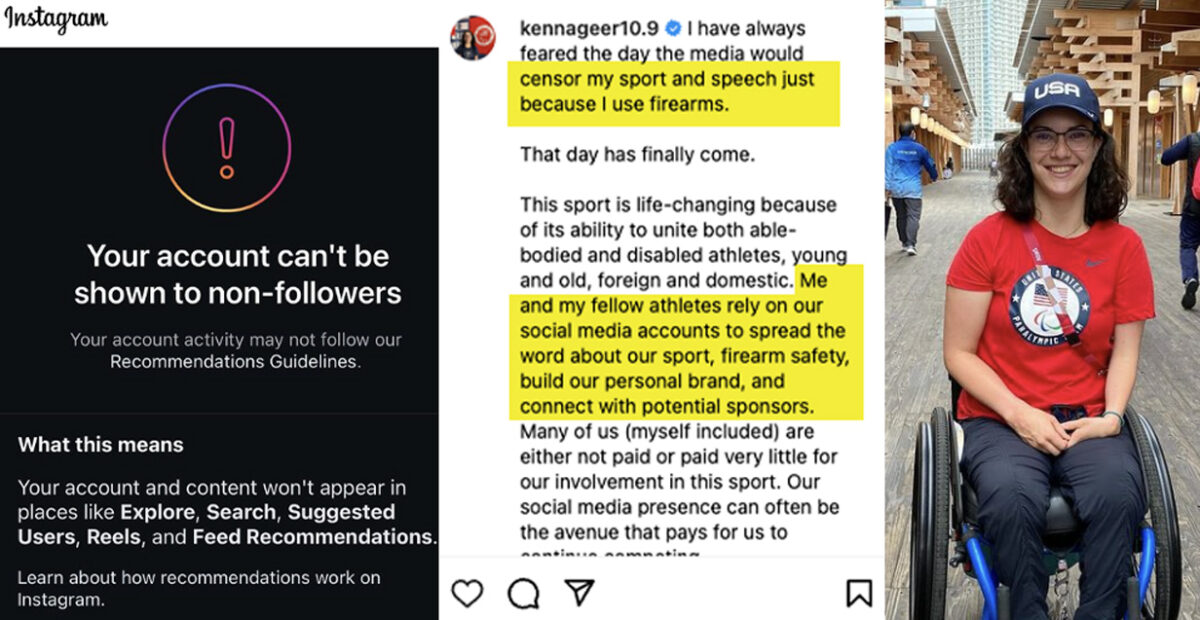
Meta’s Instagram apparently disagrees. In mid-​July, Instagram restricted the account of McKenna Geer, member of the American shooting team, so that it could be viewed only by current followers.

The “problem” seemed to be that she had posted photos of herself in competition. With firearms. For similar reasons, Instagram has also censored the accounts of other athletes. (Skittishness about pics of guns may be why an Olympics​.com photo of an Indian athlete “shooting” shows only head and arm.)

When the restrictions were imposed, Geer observed that she and other athletes use social media to spread the word about their sport and firearm safety, “build our personal brand, and connect with potential sponsors.” Her livelihood and ability to continue shooting competitively were thus at stake.

Geer’s Instagram account is again accessible to non-​followers. But the problem has not been resolved permanently. As aaronalvarado asserted at her account, “a bad AI program with no monitoring” may be to blame. “We appeal and the program shadow-​bans everything.”

If so, at least a human being is not consciously choosing to censor Geer or other athletes because they shoot competitively. But somebody wrote the programming. And Meta must be aware of these problems. 

It’s time to remove the “guns bad, context irrelevant” line of code.

This is Common Sense. I’m Paul Jacob.


PDF for printing

See all recent commentary
(simplified and organized)
See recent popular posts
Categories
crime and punishment defense & war Second Amendment rights

Brace Yourself & Your Gun

Many foes of Second Amendment rights want to outlaw guns for everybody except military, police, Secret Service, sundry federal agencies, and bodyguards for left-​leaning celebrities.

Since this isn’t politically feasible given at least intermittent legislative and judicial support for the right to bear arms, anti-​gunners often pursue various piecemeal bans. The hope is that these will add up to an overall prohibition. Or at least provide an excuse to go after any particular gun owner for neglecting to comply with some subsidiary prohibition.

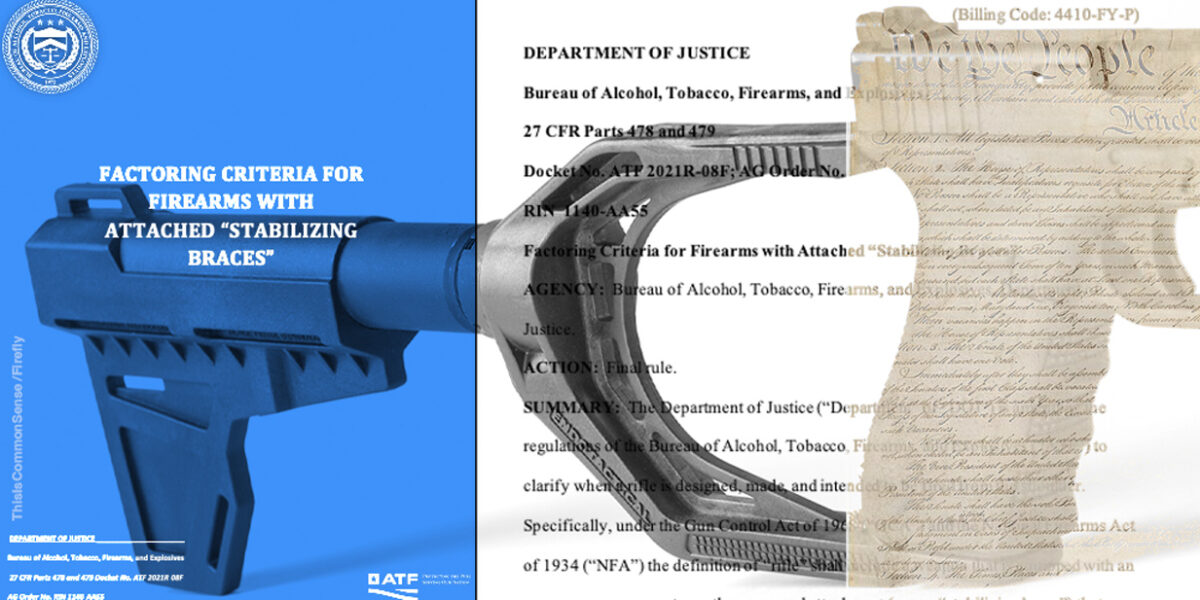
The anti-​gun forces seemed to have been having some success with an outlawing of “stabilizing braces” on short-​barreled rifles. A voluminous ATF rule sought to partially or wholly ban these braces — basically an added pistol grip —  even though the same agency had earlier said such braces were okay. 

And why wouldn’t it be okay to have a pistol brace if it’s okay to have a thing that shoots bullets?

Maybe the idea is that if you’re in a situation where you have to fight for your life using a gun, and a brace would help, trying to survive is okay, sure, but you shouldn’t have too much of a chance to survive. A stabilizing brace might give you an unfair edge? I’m guessing.

In mid-​June, the Northern District of Texas tossed this ATF gun-​brace-​ban rule. Which, according to Judge Reed O’Connor’s decision in the case, Mock v. Garland, is “arbitrary and capricious.” As Shooting News Weekly puts it, “Oof.”

Unlike the similar looking (at least to me) “bump stock,” braces do not change the mechanism of firing. And bump stocks were overturned by the U.S. Supreme Court about the same time. While stabilizing braces seem here to stay, a decision by the Supreme Court may still be required.

This is Common Sense. I’m Paul Jacob.


PDF for printing

Illustration created with Firefly

See all recent commentary
(simplified and organized)
See recent popular posts
Categories
judiciary national politics & policies regulation

Regulatory Pressure?

Should government regulators be able to urge financial institutions to cancel clients that regulators dislike for political reasons? Such as oil companies and groups advocating Second Amendment rights?

Although a court of appeals has said Yes, the Supreme Court has just said Maybe No in a case involving the National Rifle Association (NRA v. Vullo).

The NRA hasn’t won final victory. But the court is unanimously letting it proceed with its lawsuit, which argues that by pressuring banks and insurance companies to cancel their business with the NRA, New York regulator Maria Vullo violated its freedom of speech.

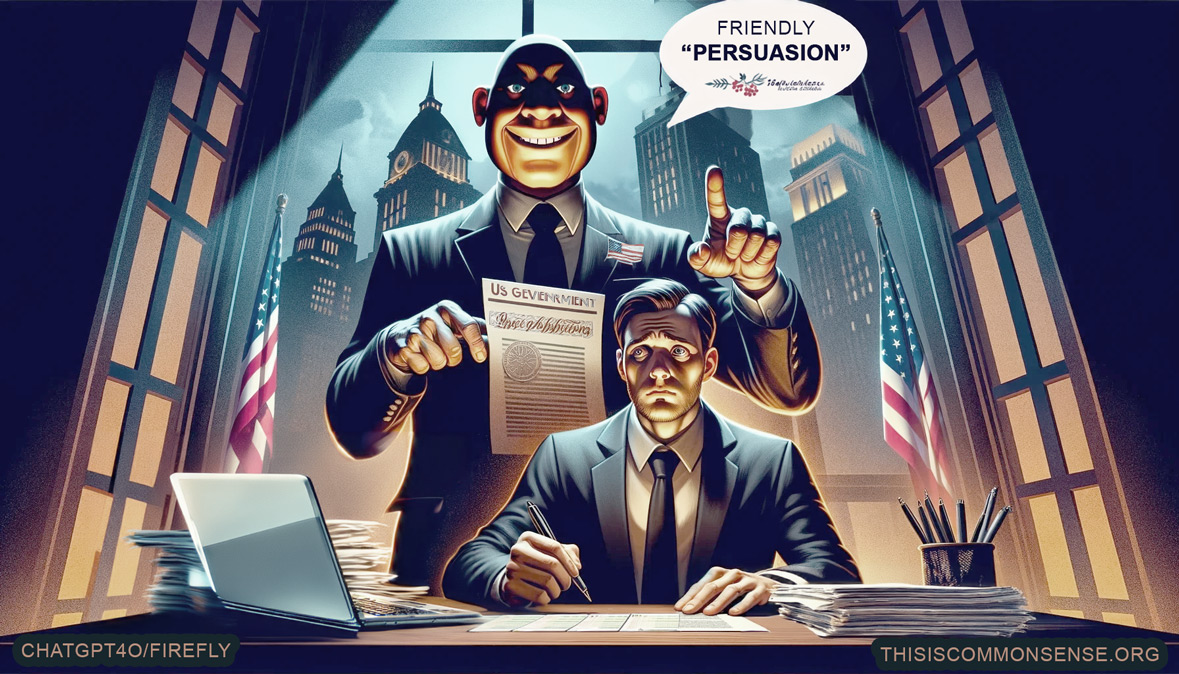
The Supreme Court seems to accept an artificial distinction, though, between a regulator’s “persuading” an organization to hurt a client and “forcing” it to do so.

An official with power over a company who seeks as a government official to “persuade” that company to do something is engaging in coercion. The implicit threat is: “I have the power to hurt you if you don’t do this little favor for me.”

Moreover, in sending the case back to the lower court, the Supreme Court has also said that it may consider whether Ms. Vullo is protected by qualified immunity, the get-​away-​with-​anything card that government officials are too often able to rely on when they commit wrongdoing.

So this decision is hardly a final, definitive victory for the NRA and other victims of thug-​regulators. But at least the NRA can keep fighting — for itself and the rest of us.

This is Common Sense. I’m Paul Jacob.


PDF for printing

Illustration created with ChatGPT 4o and Firefly

See all recent commentary
(simplified and organized)
See recent popular posts
Categories
crime and punishment general freedom

ATF’s 115-​Year Mistake

“Oops. Sorry about almost sending you away for 115 years. Case of mistaken identity and dishonest testimony.”

But Bryan Montiea Wilson did not get even a “sorry” from the Bureau of Alcohol, Tobacco, Firearms and Explosives (ATF) or local law enforcement.

Wilson, who works for a railroad equipment manufacturer, had never been arrested when ATF agents nabbed him in December 2023. Accused of gun and drug sales to local police officers said to be working with the ATF, Wilson could only repeatedly assert his innocence.

His looming punishment included up to 115 years in prison and millions in fines. Then, suddenly, he was released.

How did Wilson wind up being falsely accused? The Truth About Guns site reports that prosecutors realized their blunder after his court-​appointed lawyer investigated. But an uninformative request to dismiss the case is all ATF offered.

“Further review … reveals that the interests of justice would best be served by a dismissal of the pending charges as opposed to further prosecution.… The Government respectfully requests that the Court dismiss the pending charges against defendant Bryan Montiea Wilson.”

I guess we can thank the prosecutors for mentioning “justice.” But there should at least be an accounting in such cases; and this accounting, plus further consequences, should be mandatory.

“Something got messed up and they landed on me,” Wilson says. “I don’t know how this happened, but it can’t happen again. It shouldn’t happen again.”

Wilson has filed a federal civil rights lawsuit.

This is Common Sense. I’m Paul Jacob.


PDF for printing

Illustration created with PicFinder and Firefly

See all recent commentary
(simplified and organized)
See recent popular posts
Categories
general freedom privacy Second Amendment rights

Second Amendment Privacy Act

If you live in Georgia and have recently bought a gun or are about to, good news!

Governor Kemp has signed the Second Amendment Privacy Act to protect the financial privacy of persons buying guns and ammo. Georgia is the fourteenth state to enact such legislation.

According to Lawrence Keane, a lawyer with the National Shooting Sports Foundation, this means no more collusion between financial companies and the government to spy on the private finances of gun owners.

At least not in Georgia.

States must institute these protections because enemies of our right to bear arms have started using financial transactions as way to penalize gun owners. It would be nice if the federal government enacted equivalent protection. But given our present federal regime, the chances of that happening anytime soon are slim.

The main thing the Act does is prohibit financial institutions from requiring that a firearm code be associated with purchases of guns and ammo that you make using a credit card. When banks flag your purchase in this way, it’s easy to target you for sanctions like cancelling your account or maybe adding you, without any good reason, to a government watch list.

The Second Amendment Privacy Act also prohibits using existing firearms codes to discriminate against gun owners. So it protects people whose purchases have already been code-​flagged, not just people who buy a gun now.

It’s progress. Thirty-​six states to go.

This is Common Sense. I’m Paul Jacob.


PDF for printing

Illustration created with Midjourney and Firefly

See all recent commentary
(simplified and organized)
See recent popular posts
Categories
crime and punishment general freedom Second Amendment rights

Balking at the Ban

Key Albuquerque officials won’t enforce the New Mexico governor’s recent order.

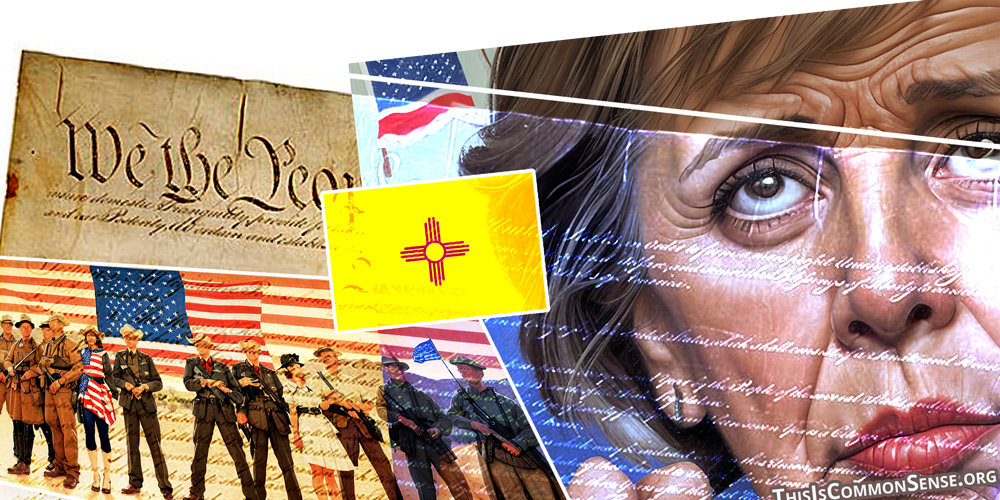
At a press conference last Friday, Governor Michelle Lujan Grisham had vowed to suspend the right to publicly carry firearms “in any public space” in the Albuquerque area. The temporary order, declared in response to recent shootings, was justified by the governor as an “emergency health measure.”

The response has been far from uniformly positive. In addition to officials balking, a gun-​rights group, National Association for Gun Rights, is suing to block the order. And there has been talk of impeaching the governor. There was even an armed protest.

The governor is either unaware or heedless of the possibility that bad people with guns can be stopped by good people with guns — a lesson that would-​be robbers belatedly learned in Maryland a couple weeks ago when they failed to rob a pub full of police officers. (They had missed the cop-​bar scene in Code of Silence.) Violent criminals in the area, for their part, have somehow not agreed to defer their activities for a month in deference to her wishful thinking, however.

Officials who say they won’t cooperate with the governor’s aggressive power grab include Albuquerque Mayor Tim Keller, Police Chief Harold Medina, and Bernalillo County District Attorney Sam Bregman.

Bernalillo County Sheriff John Allen says he is wary of the risks “posed by prohibiting law-​abiding citizens from their constitutional right to self-defense.”

District Attorney Bregman says, “As an officer of the court, I cannot and will not enforce something that is clearly unconstitutional.” 

Thus raising a standard to which people in positions of authority should repair much more often than they do.

This is Common Sense. I’m Paul Jacob.


PDF for printing

Illustration created with PicFinder​.ai

See all recent commentary
(simplified and organized)
See recent popular posts
Categories
partisanship Regulating Protest Second Amendment rights

Partisanship & Pretense

Protest is a tricky business. 

Had those in power their druthers, no protest would be allowed. Had those out of power their way, all their demands would be met.

I’d say the necessary middle ground lies in the rule of law.

Did the recent Tennessee legislature’s reaction to three legislators who broke House rules follow the law?

Not according to The Washington Post, which provided the “Democracy Dies in Darkness” spin in the headline: “Tennessee House expels two Democrats in historic act of partisan retaliation.”

In the wake of the shooting at the Covenant School in late March, with its death toll of six, “activists descended on the Tennessee Capitol and demanded that lawmakers pass gun-​control legislation. Republicans, with supermajorities in both chambers, refused to do so. The three lawmakers — dubbed the Tennessee Three — said they joined the protests inside the legislative chamber to speak out for Tennesseans whose voices have been ignored.”

But what they did is disrupt the proceedings of the legislature. Noisily. Angrily. Not-very-reasonably.

While it’s true that the votes to remove two of the three offending members were along partisan lines, it’s also true that all three offending members were unified by party.

But only two were removed from the legislature. Both are black, and the woman not removed is white. So of course the big issue for many became racism.

She escaped expulsion by one vote.

Was that vote racist?

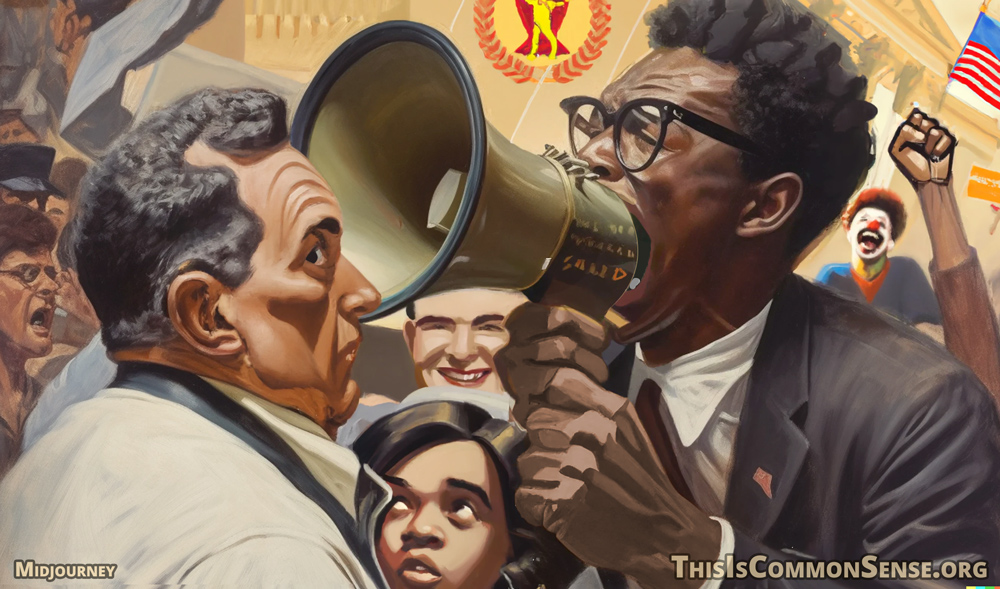
Well, the two who were ousted used bullhorns within the legislative chamber. She did not.

That does seem an extra-​outrageous breach of decorum.

Of course, the whole idea of legislators jumping sides to pretend they are “voiceless” protesters is itself absurd, making the issue here neither partisanship nor racism.

It’s a question of posturing and pretense.

This is Common Sense. I’m Paul Jacob.


Note: After his expulsion last week, the Nashville-​Davidson Metro Council yesterday voted to return Rep. Justin Jones to the state legislature on an interim basis. A special election will be held to fill the seat in the coming months.

PDF for printing

Illustration created with Midjourney /​ DALL-​E2

See all recent commentary
(simplified and organized)
See recent popular posts

Categories
Accountability crime and punishment education and schooling

Problem Student, Problem Admin

“School downplayed warnings about 6‑year-​old before teacher’s shooting, staffers say,” The Washington Post headlined its Saturday report.

Weeks ago, elementary school teacher Abigail Zwerner was shot by a first grader in their Newport News, Virginia, classroom. Authorities are not sure of the precise motive but have called the attack “intentional.”

Zwerner remains hospitalized in stable condition, while her child assailant is in emergency custody undergoing “court-​ordered mental health treatment.”*

School officials received a tip that the boy had brought a gun to school but did not find the weapon in their search.

More disturbing, The Post interviewed “educators claiming that Zwerner raised alarms … and sought assistance” but “that school administrators waved away grave concerns about the 6‑year-old’s conduct.” The lad reportedly “threw furniture and other items in class,” once “barricaded the doors to a classroom, preventing a teacher and students from leaving,” and “was known campuswide for disruptive and violent behavior.”

One educator revealed that “the boy wrote a note telling a teacher he hated her and wanted to light her on fire and watch her die.” When brought “to the attention of Richneck administrators,” however, the teacher “was told to drop the matter.

“Several teachers said they received no support when they faced violence in the classroom or attacks from students,” the article informed. “Some speakers claimed the district is more interested in keeping discipline statistics low than in taking meaningful action to address students’ problems.”

The Post’s story was hampered by numerous school personnel refusing to talk citing their fear of reprisals from school authorities. 

While mental health help must be addressed, there is no solution to problems if administrators act like crooked politicians, simply sweeping aside serious issues.

This is Common Sense. I’m Paul Jacob.


* In Virginia, a person must be seven years of age to be charged with a crime, so the first grader will not be prosecuted.

PDF for printing

Illustrations created with Midjourney

See all recent commentary
(simplified and organized)
See recent popular posts
Categories
general freedom Second Amendment rights too much government

The Gun-​Toting Ruling Class

How to tell if you are part of the favored ruling class? If it is easy for you, but not most others, to obtain a concealed carry permit in your gun-​controlling state.

It’s extremely difficult to carry firearms for protection in states like Illinois, California, New Jersey and New York — except for certain Very Special Persons — rich enough or connected enough for special treatment.

Thankfully, the judicial system — which has the benefit of various guiding principles from a long-​gone time when the rulers wore red coats — is disallowing some of the nonsense.

Still, it’s a struggle to “de-​class-​ify” Second Amendment rights — that is, take gun rights from being a class issue favoring the rich and famous and allowing all peaceful citizens legal access to firearms.

“Two weeks ago, a federal judge issued a temporary restraining order against many of the restrictions on public possession of guns that New York imposed after the Supreme Court upheld the right to bear arms last June,” writes Jacob Sullum in Reason. “Unfazed by that warning, New Jersey legislators this week advanced a strikingly similar bill that includes a subjective standard for issuing carry permits and sweeping, location-​specific restrictions that make it legally perilous even for permit holders to leave home with guns.”

Politicians in these blue states remain resolute: they aim to unconstitutionally restrict access to guns. They strongly resist the current individualistic (as opposed to class-​based) trend in judicial interpretation of the Second Amendment. 

Their idea seems to be: guns for us, but not for them.

And we’re the Them.

This is Common Sense. I’m Paul Jacob.


PDF for printing

See all recent commentary
(simplified and organized)
See recent popular posts

Categories
crime and punishment general freedom national politics & policies Second Amendment rights

The Indicted Have Gun Rights

The idea that those who are indicted for a serious crime may not buy a gun, is, I think, what many in America might think of as “common sense gun control.”

But it isn’t, for it rubs against the grain of the American legal tradition.

The pseudo-​commonsense view appears nonsensical when boldly defended by the U.S. attorney’s office, which, The Texas Tribune informs us, argued that a “law to prohibit those under felony indictment from obtaining guns does not interfere with the Second Amendment ‘because it does not disarm felony indictees who already had guns and does not prohibit possession or public carry.’”

That argument boils down to this: if you retain some relevant gun rights, others may be taken away. 

Compare it to free speech: if the government allows you to talk freely with your family, its regulation of your conversations with neighbors is hunky-dory!

“The Second Amendment has always allowed laws restricting the gun rights of groups viewed by legislatures as posing a public-​safety risk,” the prosecution elucidated, “including those accused but not convicted of wrongdoing.”

But U.S. District Judge David Counts, introduced in every account of this I’ve read so far as “appointed by former President Donald Trump” — so that must be important, eh? — denies this. He found no historical precedent for disallowing the accused and indicted from buying firearms.

Therefore, based on the recent Supreme Court decision,* Judge Countssays the government has no case. It’s still innocent until proven guilty.

That is, governments may not “take away” our rights until convicted of a specific crime, punishment for which is loss of liberty.

This is Common Sense. I’m Paul Jacob.


* That U.S. Supreme Court case is New York State Rifle & Pistol Assoc. v. Bruen.

PDF for printing

Illustration created with DALL‑E

See all recent commentary
(simplified and organized)
See recent popular posts