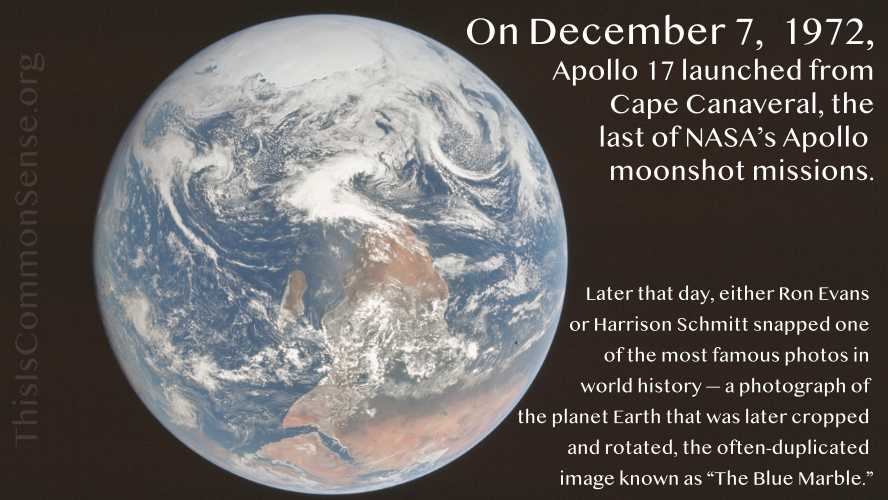
On December 7, 1972, Apollo 17 launched, the last of the Apollo Moon missions. Later that day, one of the astronauts — either Ron Evans or Harrison Schmitt — snapped the photo that would later become famous as “The Blue Marble.”
Blue Marble
On December 7, 1972, Apollo 17 launched, the last of the Apollo Moon missions. Later that day, one of the astronauts — either Ron Evans or Harrison Schmitt — snapped the photo that would later become famous as “The Blue Marble.”
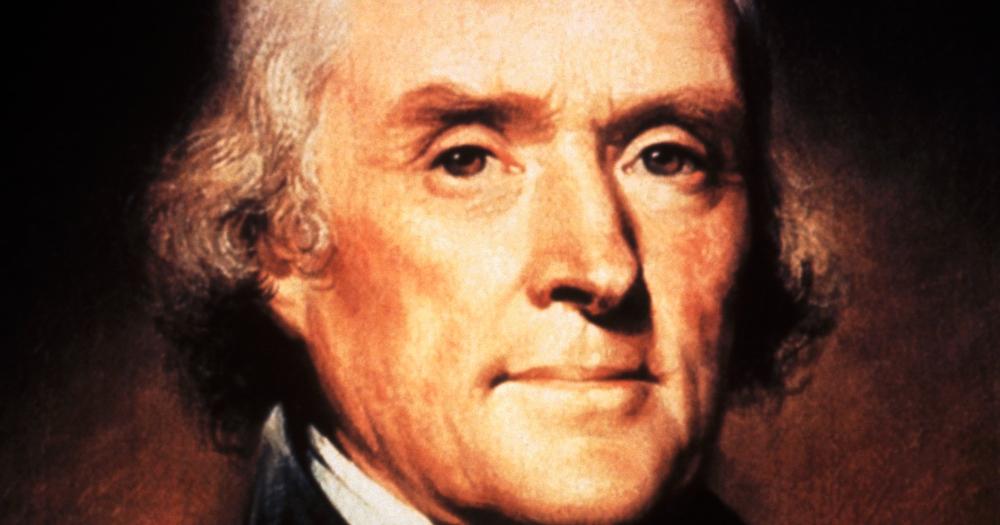
When Thomas Jefferson entered the White House, he promptly began firing civil servants, high-level and -low. It was a big house-cleaning effort, a streamlining after Federalist bloat. The new Democratic-Republican president demanded an efficient and minimal government.
Since then, it’s gotten harder for presidents to do such big house-cleaning jobs, as The Epoch Times explains in a new article:
For months, federal judges have been ordering President Donald Trump to reinstate heads of agencies despite his interest in removing them.
Their decisions have been based on a 90-year-old Supreme Court precedent, known as Humphrey’s Executor v. United States, that says Congress can limit the reasons for which presidents remove officials like members of labor boards.
However, that precedent and various legal blocks on Trump’s firings could be removed depending on how the Supreme Court rules in an upcoming case — potentially giving Trump and his successors more flexibility with personnel.
Sam Dorman, “Supreme Court Set to Consider Trump’s Power to Remove High-Level Bureaucrats,” The Epoch Times (December 6, 2025).
The case, Trump v. Slaughter, goes before the union’s highest court on Monday. It regards Trump’s firing of Rebecca Slaughter as a commissioner of the Federal Trade Commission (FTC).
Something to remember about this “balance of powers” case is that it is not about balancing the constitutional “three branches” of the general government. The permanent bureaucracy, insulated from firing by the “Executive,” has, arguably, become a de facto fourth branch, uncontrolled by an inertial Congress as well as the elected president.
Whatever the Supreme Court decides, the effects of its decision are expected to ripple through many other cases — including ones involving Trump.
For example, two fired labor board officials have filedamicus briefs suggesting the outcome of Slaughter’s case could impact their cases as well.
Trump has not only challenged Humphrey’s Executor but said that even if Congress can insulate certain officers from removal, judges shouldn’t be able to reinstate those officers.
Sauer told the court that while fired officers can seek back pay, their reinstatement intruded on executive power and forces the president to “entrust executive power to someone he has removed.”
Slaughter disagreed, arguing “there is no Article II problem with requiring the President to ‘entrust executive power to someone he has removed’ if he has no Article II authority to remove that person in the first place,” her brief added.
The Supreme Court’s recent decisions on its emergency docket indicated it was sympathetic to Trump’s position.
In at least five separate cases, including Slaughter’s, the justices have allowed Trump to temporarily fire officials as litigation unfolded.
The court has repeatedly said that the executive branch “faces greater risk of harm from an order allowing a removed officer to continue exercising the executive power than a wrongfully removed officer faces from being unable to perform her statutory duty.”
Ibid.
The issue is obviously complicated. The Epoch Times article does a pretty good job explaining that complexity.
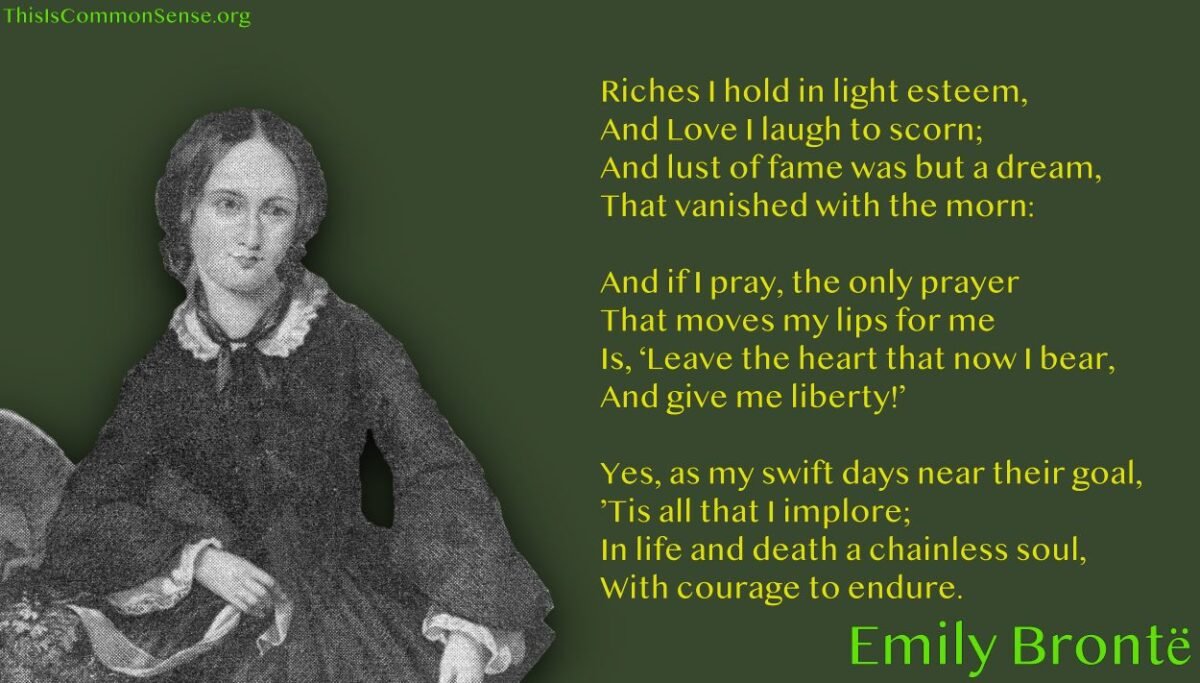
Riches I hold in light esteem,
And Love I laugh to scorn;
And lust of fame was but a dream,
That vanished with the morn:And if I pray, the only prayer
That moves my lips for me
Is, ‘Leave the heart that now I bear,
And give me liberty!’Yes, as my swift days near their goal,
Emily Brontë, “The Old Stoic,” from Clement King Shorter, editor, The Complete Poems of Emily Brontë (1908).
’Tis all that I implore;
In life and death a chainless soul,
With courage to endure.
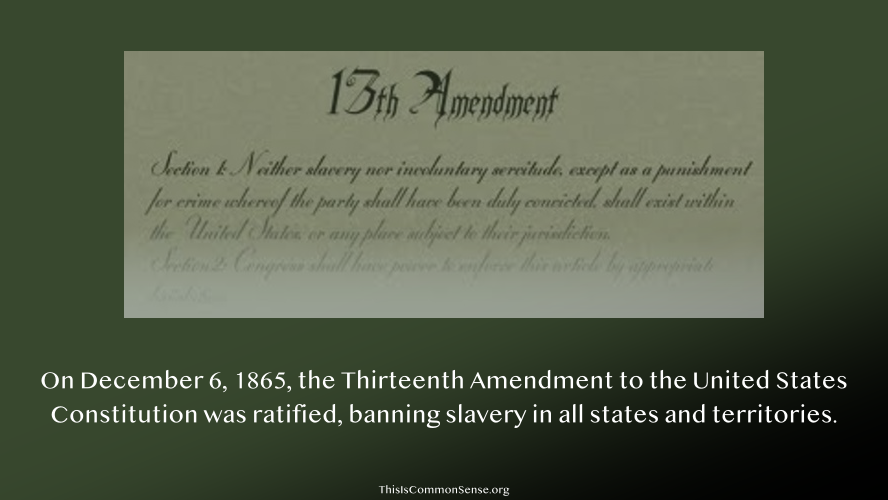
On December 6, 1865, the Thirteenth Amendment to the United States Constitution was ratified, banning slavery in all states and territories.
One-hundred-and-nineteen years later, to the day, in 1984, Paul Jacob (of ThisIsCommonSense.org, LibertyiFund.org, and the Citizens in Charge Foundation) was arrested by the FBI for his refusal to register with Selective Service System (the draft people). The Government was probably not attempting to make a commemorative point about involuntary servitude.
Pacific Legal Foundation observes that according to state law, “the exemption continues as long as family members continue to live in the home. . . . Based on her misreading of the law, the tax assessor retroactively denied the exemption for several previous years.”
The estate’s administrator, Mike Pung, got nowhere trying to explain things to the tax assessor. So he brought his case to the Michigan Tax Tribunal. The tribunal ruled in favor of the Pungs.
Didn’t matter. When Mike paid the property taxes for 2012, the assessor called it an underpayment, since payment for the tax that the Pungs did not owe had not been included.
Mike still refused to pay the school tax. So the county grabbed the home that it had assessed at $200,000 and auctioned it for $76,000 to recover the amount of that tax.
With PLF’s help, the Pungs ultimately received $73,000 of this amount, less than half the home’s assessed value. Now PLF is headed to the Supreme Court to make the case for further compensation.
Chances are good. Two years ago, the Supreme Court affirmed in other PLF litigation that local governments “are not allowed to abuse the tax system to take more from families than is owed.”
Or not owed.
This is Common Sense. I’m Paul Jacob.
See all recent commentary
(simplified and organized)
See recent popular posts
It is not the astronomer’s business to consider whether it would be better if the sun were nearer or farther from the earth, or if he turned round her, instead of turning round him. Nor is it the chemist’s business to consider whether carbonic acid and carbonic oxide are noxious gases that ought not to exist. It has never been thought desirable to make Newton responsible for tiles falling on the people’s heads.
Yves Guyot, The Principles of Social Economy (1892). Caricature by André Gill (1845–1885).
Economists, however, are held answerable for the laws which they discover.
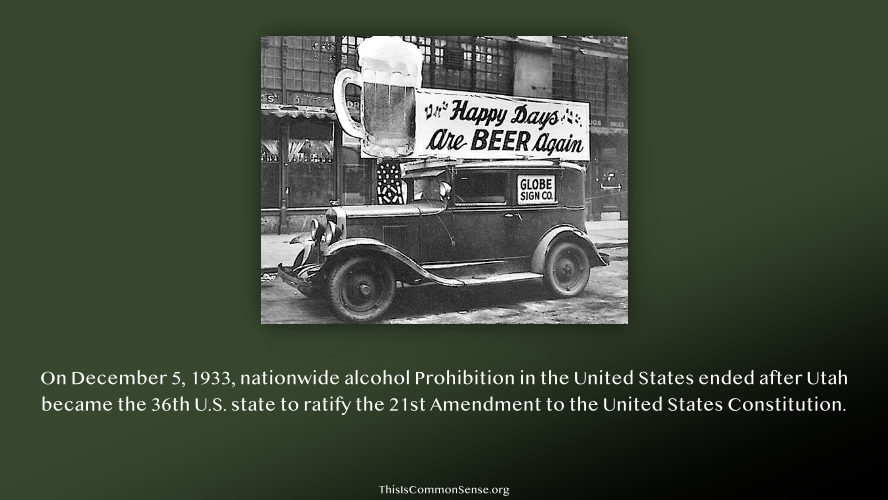
On December 5, 1933, nationwide alcohol Prohibition in the United States ended after Utah became the 36th U.S. state to ratify the 21st Amendment to the United States Constitution, thus establishing the required 75 percent of states needed to enact the amendment that overturned the 18th.
Reading the Mises Institute piece, I got a sense
“Sponsored by Sen. Mike Lee (R-UT), the Gold Reserve Transparency Act would require a full assay, inventory, and audit of all United States gold holdings,” the author, Jp Cortez, explains, “along with an upgrade in the purity of the gold so that it meets global market standards.”
The “haven’t I read this before?” thought hit me hard. Talk of auditing the gold reserves is not new. Earlier this year, in the heady days of Elon Musk and DOGE, a lot of folks dared wonder: does the federal government even have any gold at all?
I asked the question in February, in the context (I kid you not) of UFOs!
A “Gold Reserve Transparency Act” has been introduced four times in the House since 2011, always by Republican sponsors aligned with sound-money advocates. But it has also never passed the House, let alone advanced to the Senate or become law.
The House Committee on Financial Services received these bills but only the 2011 version got so much as a hearing.
No Senate version existed until Sen. Mike Lee’s introduction (S. __, 119th Congress) weeks ago, which mirrors the House bill and remains unnumbered and in committee as of yesterday.
A gold audit would be very interesting. But I get the feeling this will be treated like UFOs: full disclosure forever forthcoming.
This is Common Sense. I’m Paul Jacob.
Illustration created with ChatGPT/NanoBanana/Firefly
See all recent commentary
(simplified and organized)
See recent popular posts
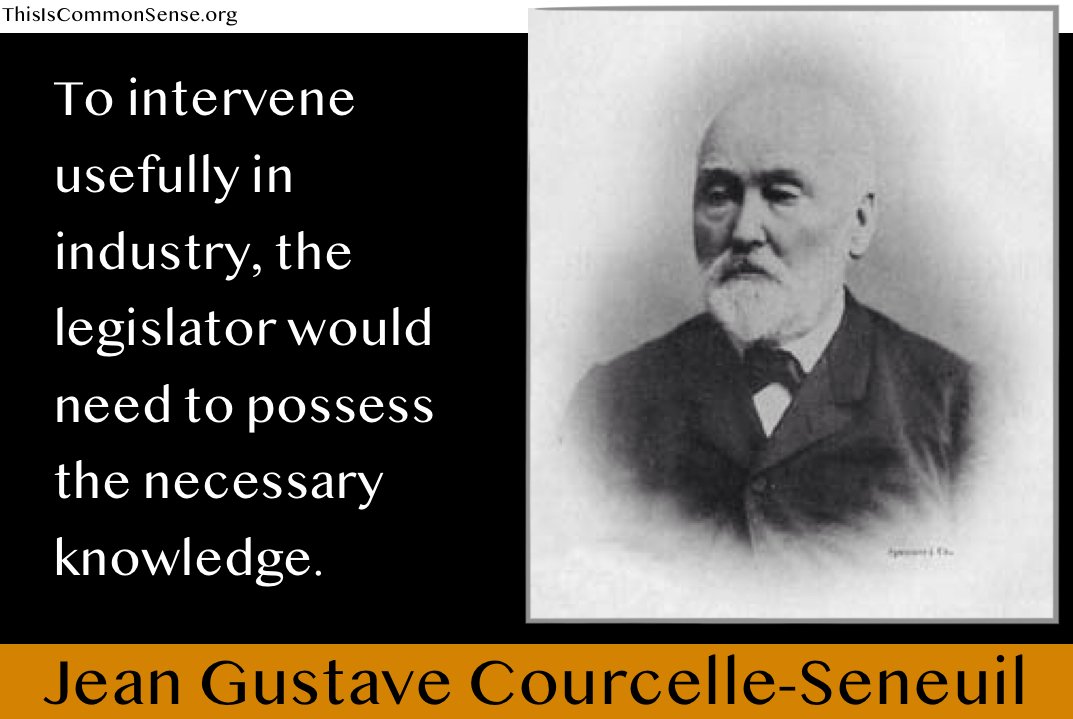
Pour intervenir utilement dans l’industrie, il faudrait
que le législateur possédât les connaissances nécessaires.
To intervene usefully in industry, the legislator would need to possess the necessary knowledge.
Jean Gustave Courcelle-Seneuil (December 22, 1813 – June 29, 1892), Protection et libre-échange (1879).
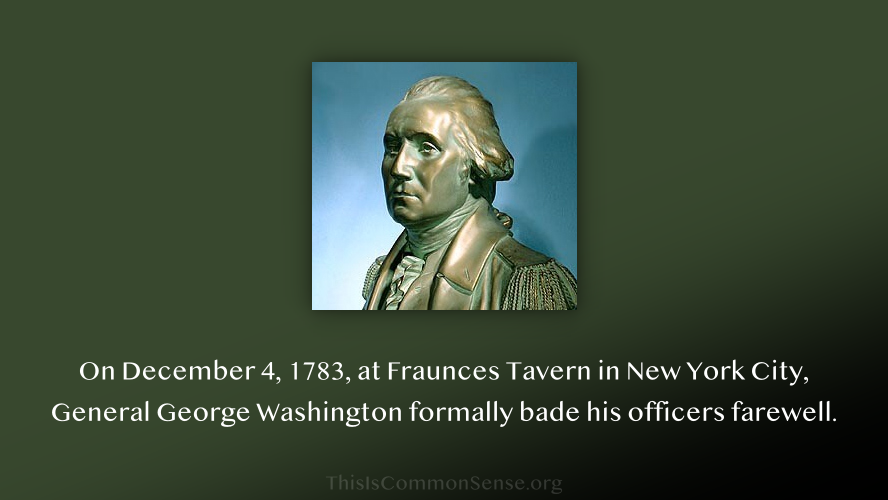
On December 4, 1783, at Fraunces Tavern in New York City, General George Washington formally bade his officers farewell.