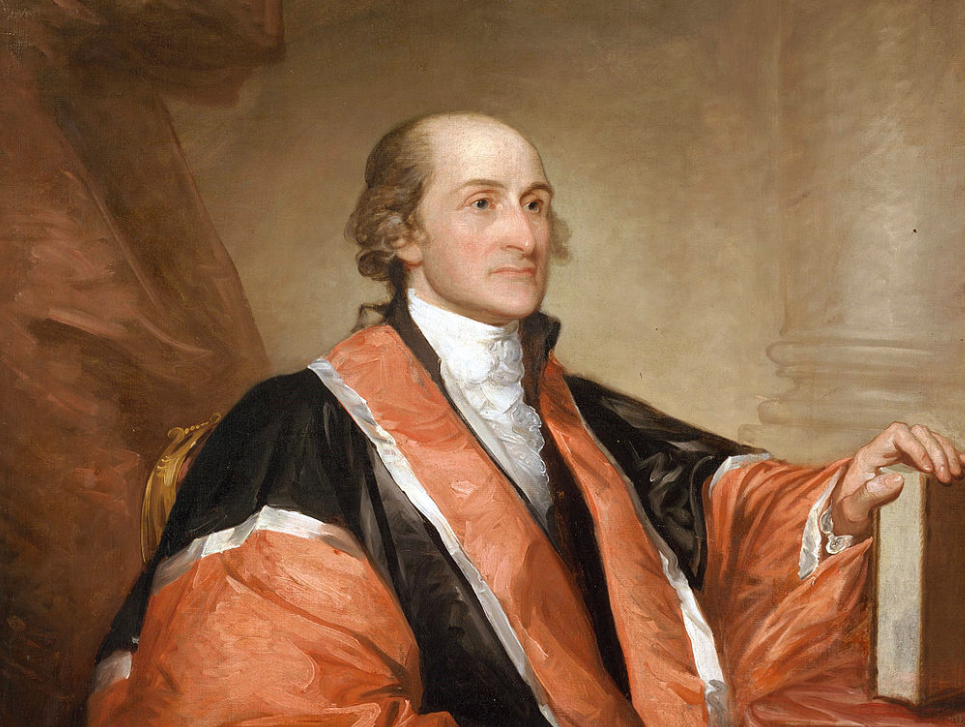
John Jay, First Chief Justice of the United States Supreme Court
On September 24, 1789, the United States Congress passed the Judiciary Act, creating the office of the United States Attorney General and the federal judiciary system, and ordered the composition of the Supreme Court of the United States.
On the same day that President George Washington signed the bill into law, he officially nominated John Jay to the new position of Chief Justice of the Supreme Court. Jay (pictured in his official portrait, above) served in that position until 1795, when he resigned to take up his elected position as second governor of the State of New York. The Supreme Court heard only four cases during Jay’s Chief Justiceship; Jay refused to consult, officially, on legislation written by Alexander Hamilton, establishing the precedent that the Supreme Court has followed to this day: the Court would only rule on cases tried before it.
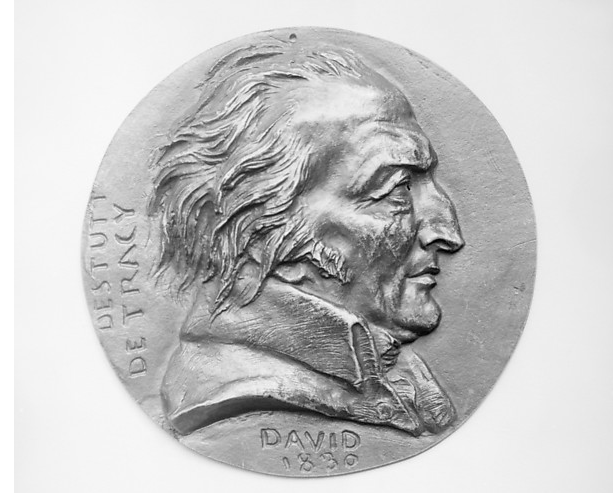
It is scarcely two hundred years since the progress of civilization, of industry, of commerce, that of the social order, and perhaps also the increase of specie, have given to governments the facility of making loans; and in this short space of time these dangerous expedients have led them all either to total or partial bankruptcies, sometimes repeated, or to the equally shameful and more grevious resource of paper money, or to remain overburdened under the weight of a load which daily becomes more insupportable.
But I go farther. I maintain that the evil is not in the abuse; but in the use itself of loans, that is to say that the abuse and the use are one and the same thing; and that every time a government borrows it takes a step towards its ruin. The reason of this is simple: A loan may be a good operation for an industrious man, whose consumption reproduces with profit. By means of the sums which he borrows, he augments this productive consumption; and with it his profits. But a government which is a consumer of the class of those whose consumption is sterile and destructive, dissipates what it borrows, it is so much lost for ever; and it remains burdened with a debt, which is so much taken from its future means.
One of the better arguments for government relies upon sobriety: we want rational, measured responses to threats, not panicky, hot-headed reactions. We have a rule of law to prevent revenge and vendetta, replacing them with justice and civil order.
But when we expand the concept of “threat” far beyond interpersonal violence and to dangers from our own foolish or merely misguided behavior, “sobriety” too often doesn’t even seem an option.
Take drugs.
Specifically, take “vaping.”
That is the innovative technology of “e-cigarettes” that can be used to replace the smoking of tobacco and other drugs with inhaling drug-laced water vapor.
Vaping is far less dangerous than tobacco, at least for emphysema and lung cancer, but it is not harmless. Several hundred people across several of these United States have become very ill and a few have died of a mysterious lung disease.
So of course the Surgeon General calls it an epidemic, and the White House and Congress take up the cause to regulate and even prohibit vaping. And India just “became the latest country to ban electronic cigarettes,” according to Bloomberg.
Whoa, the subject has barely been studied, and what we know so far is that it was not major-brand nicotine e-liquid, but, instead, boutique product that has caused most of the casualties.
The leap to legislation has been too quick for consumers to alter their own behavior with new information.
Besides, prohibition and regulation haven’t worked to prevent the current opiate overdose crisis.
The rush to “do something very, very strong,” as President Trump puts it, is the very opposite of why we say we want government.
In these troubled, uncertain times, we don’t need more command and control; we need better means to engage everyone’s intelligence in solving challenges and crises as they arise.
On September 22, 1862, U.S. President Abraham Lincoln issued a preliminary proclamation that he would order the emancipation of all slaves in any state of the Confederate States of America that did not return to Union control by January 1, 1863. None returned, and the subsequent order, signed and issued January 1, 1863, took effect except in locations where the Union had already mostly regained control.
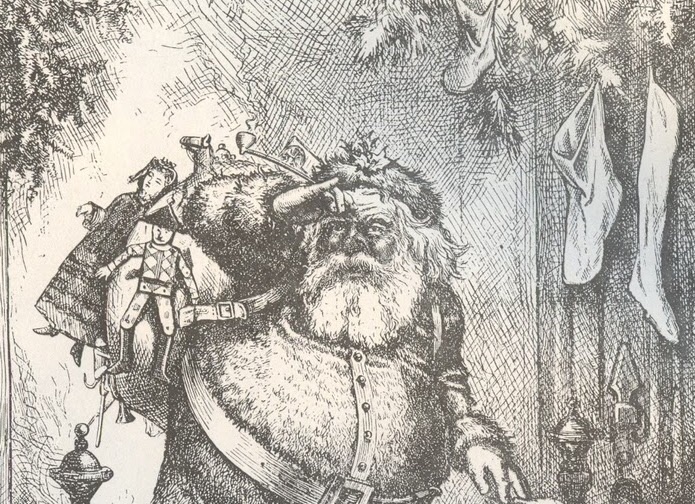
On September 21, 1897, the “Yes, Virginia, there is a Santa Claus” editorial was published in the New York Sun. Note how long before Christmas this is. The Christmas season has long been a long affair.
I like publicity stunts as much as the next activist. But haven’t we had enough of the whole Greta Thunberg bit yet?
On Wednesday, the 16-year-old Swede provided testimony on an apt stage, let us grant her that — the U.S. House of Representatives’ foreign affairs subcommittee joint hearing on the global youth climate change movement.
She didn’t prepare any remarks, though. She merely “attached” the IPCC Special Report on Global Warming “as her testimony.” Her rationale? “I don’t want you to listen to me, I want you to listen to the scientists.” And “to unite behind science.”
You know, for “real action.”
It was what happened right after she demanded “real action,” though, where the stark reality of the situation became clear: a grown man in a suit, elected to Congress, asked, “Could you expand on why it’s so important to listen to the science?”
And then the non-scientist spoke . . . not very expansively.
Forget that science qua science isn’t to be “listened to,” it is to be engaged in, with conjectures, research and refutations. (There was nothing like that at the hearing.) Forget also that the science is increasingly less clear on the severity of what warming we see. Remember only that an elected official used a girl to imbue a text (the IPCC report) with moral legitimacy, dubbing it “best available ‘united science’” — the better to push an unargued-for massive coercive government intervention into the life of our civilization.
Is no adult in the room ashamed of what they are doing . . . exploiting a cute youngster to subvert rationality?