Categories
Today

The French Revolution

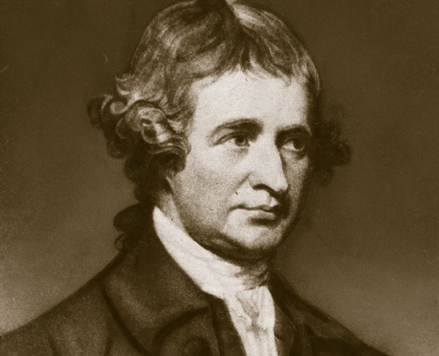
On November 1, 1790, Edmund Burke published his Reflections on the Revolution in France, predicting that the French Revolution would end in disaster. Though many have disputed his premises and reasoning, few dispute his prophecy, which proved spot on.

Categories
audio podcast

Listen: The Menace at the Top of the Stairs

Paul Jacob knows a menace when he sees it. But sometimes one must choose the lesser of two menaces!

This Week in Common Sense, October 31, 2020.
Categories
Thought

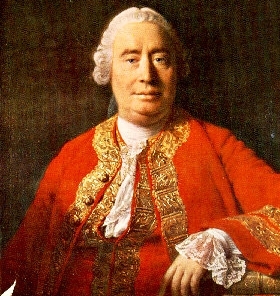
David Hume

Disputes with men, pertinaciously obstinate in their principles, are, of all others, the most irksome; except, perhaps, those with persons, entirely disingenuous, who really do not believe the opinions they defend, but engage in the controversy, from affectation, from a spirit of opposition, or from a desire of showing wit and ingenuity, superior to the rest of mankind. The same blind adherence to their own arguments is to be expected in both; the same contempt of their antagonists; and the same passionate vehemence, in inforcing sophistry and falsehood. And as reasoning is not the source, whence either disputant derives his tenets; it is in vain to expect, that any logic, which speaks not to the affections, will ever engage him to embrace sounder principles.

Categories
Today

Halloween

Ireland, Canada, United Kingdom, United States and other nations celebrate Halloween on October 31.

The word Halloween or Hallowe’en dates to about 1745 and is of Christian origin, meaning “hallowed evening” or “holy evening.” It comes from a Scottish term for All Hallows’ Eve (the evening before All Hallows’ Day). In Scots, the word “eve” is “even,” and this is contracted to “e’en” or “een.” Over time, (All) Hallow(s) E(v)en shortened into Halloween.

It is one of those darker-themed celebrations, often conjuring up images of death and horror. As if in keeping with this theme, Josef Stalin’s body was removed from Lenin’s Tomb on October 31, 1961.

N.B. The carving of pumpkins into mock-horrific faces is an old tradition. This Jack-o’-Lantern photo is taken from Dose of Funny.

Categories
media and media people

The Itch to Edit

There is a place in this world for editors, but not for censors. 

What’s the difference?

Ask Glenn Greenwald: “editors should be there to empower and enable strong, highly factual, aggressive adversarial journalism, not to serve as roadblocks to neuter or suppress the journalism.”

This is from Greenwald’s statement, this week, about his resignation from The Intercept. 

Greenwald co-founded the online journalistic platform in 2013, with the proviso that he could publish what he wanted with minimal interference. But slowly, over time, the editors he and his co-founders put in place have flouted the spirit as well as (Greenwald insists) the letter of those original agreements. So much so that they refused to publish a piece by Greenwald unless he removed “all sections critical of Democratic presidential candidate Joe Biden.”

Greenwald has published that “censored” article on Substack, a platform you may be familiar with for publishing Greenwald’s fellow leftist journo, Matt Taibbi.

This fracas is not a public issue, in one sense. Greenwald lost control of an institution he set up. That’s between him and that institution and all their lawyers.

But it does show the extent to which “the pathologies, illiberalism, and repressive mentality that led to the bizarre spectacle of [Greenwald] being censored by [his] own media outlet are . . . the viruses that have contaminated virtually every mainstream center-left political organization, academic institution, and newsroom.”

We can understand why they might desperately itch to hourly edit the Twitterer in Chief. But it is a bit harder to understand that while they complain Trump has broken with established “norms,” they themselves violate long-established norms of their own profession.

I mean journalism.

Not propaganda.

This is Common Sense. I’m Paul Jacob.


PDF for printing

See all recent commentary
(simplified and organized)
See recent popular posts
Categories
Thought

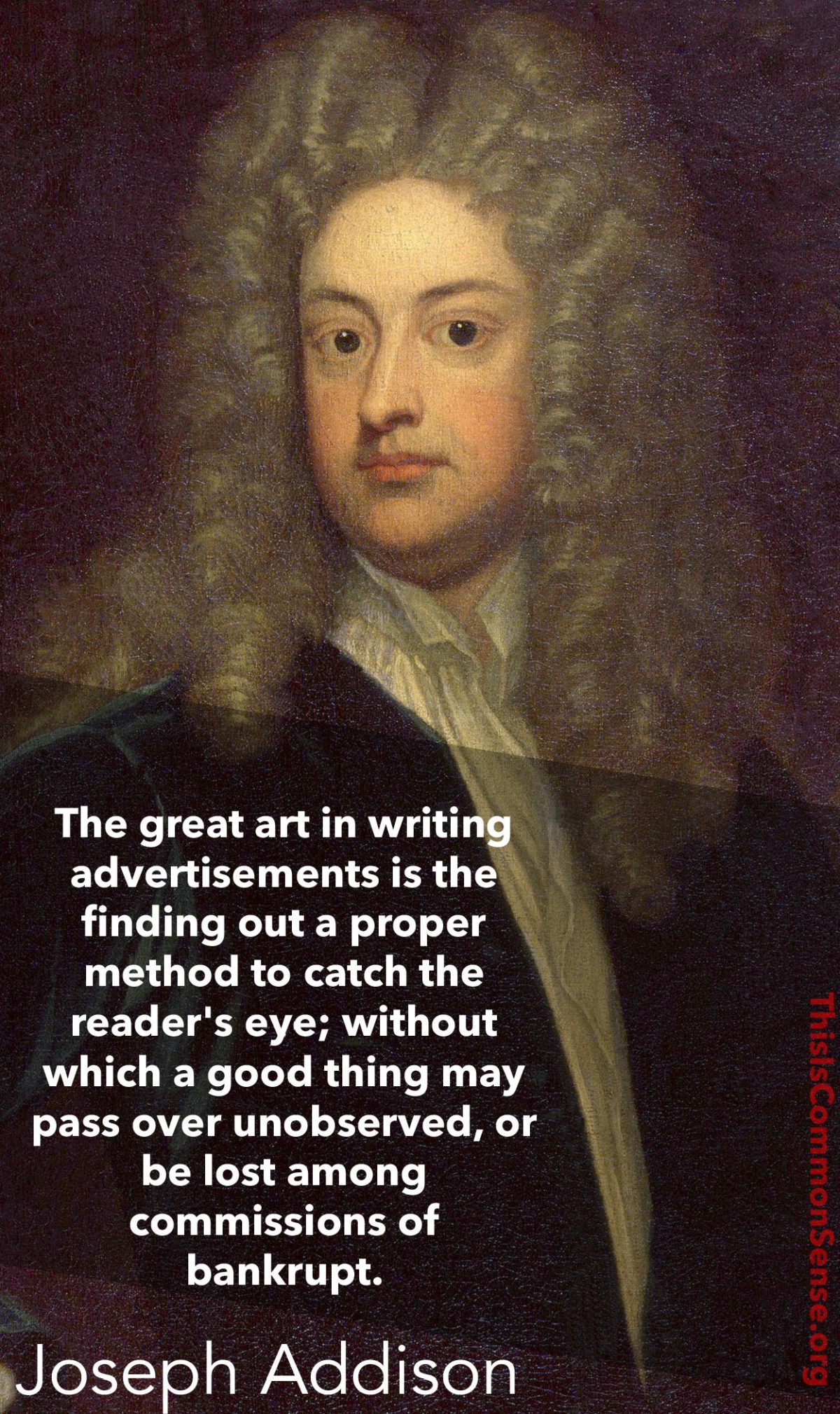
Joseph Addison

The great art in writing advertisements is the finding out a proper method to catch the reader’s eye; without which a good thing may pass over unobserved, or be lost among commissions of bankrupt.

Joseph Addison, The Tatler (1711-1714), No. 224.
Categories
initiative, referendum, and recall

A Referendum to Reinstate Racism

Fighting racism should be at least conceptually easy.

The California Assembly referred to Golden State voters Proposition 16, a constitutional amendment that would repeal a previous constitutional amendment voters had authorized in 1996, with Proposition 209. 

That amendment “stated that discrimination and preferential treatment were prohibited in public employment, public education, and public contracting on account of a person’s or group’s race, sex, color, ethnicity, or national origin,” Ballotpedia explains. “Therefore, Proposition 209 banned the use of affirmative action involving race-based or sex-based preferences in California.”

But important and well-monied interests really want to “use affirmative action programs that grant preferences based on race, sex, color, ethnicity, and national origin. . . .” 

The list of supporters is a veritable Who’s Who of California Democrat pols and corporations and major lobbying organizations. They’ve spent almost $20 million and counting. 

The opposition, organized as Californians for Equal Rights, consists of a smattering of Republican pols and a few non-partisan organizations such as Students for Fair Admissions, and has spent about $1.2 million.

While fighting racism with a prohibition on discrimination in government hiring, and the like, is simple, clear, and across-the-board, fighting racism by preferring individuals of some races over those in others is cumbersome. And nutty.

And wrong.

Usually billed as “compensation” for past ills, it fosters a politics of resentment and inevitably leads to society-wide racial feuding.

Why so popular among “blue” pols? 

There’s money in divisiveness, pitting one group off another.

Over 16 times more money, apparently.

Think of Prop 16 as a litmus test. Will “blue” California buy into the politics of racial division? 

Or will Golden State voters stick with the color-blind principles most Americans favor?

This is Common Sense. I’m Paul Jacob.


PDF for printing

See all recent commentary
(simplified and organized)
See recent popular posts

Categories
Today

Cyrus

On October 29, 539 BC, Cyrus the Great entered the city of Babylon as conqueror. His general policy of religious toleration would be extended to the Jews, who were not long after allowed to return to their homeland.

On the same date in 1923 AD, the Ottomon Empire’s dissolution marked the start of the Turkish Republic.

Categories
Thought

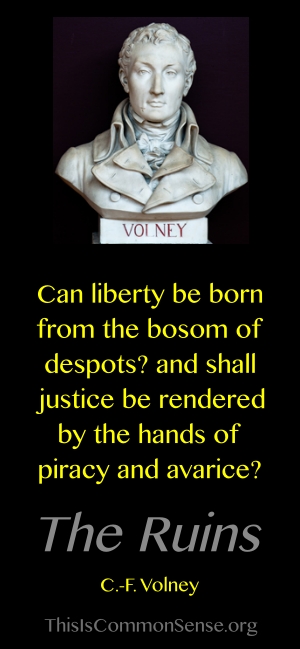
C.-F. Volney

Can liberty be born from the bosom of despots? and shall justice be rendered by the hands of piracy and avarice?

Constantin-François de Chassebœuf (1757–1820), Comte de Volney, The Ruins; Or, Meditation on the Revolutions of Empires: And The Law of Nature, Chapter II (Thomas Jefferson, translator).
Categories
international affairs national politics & policies

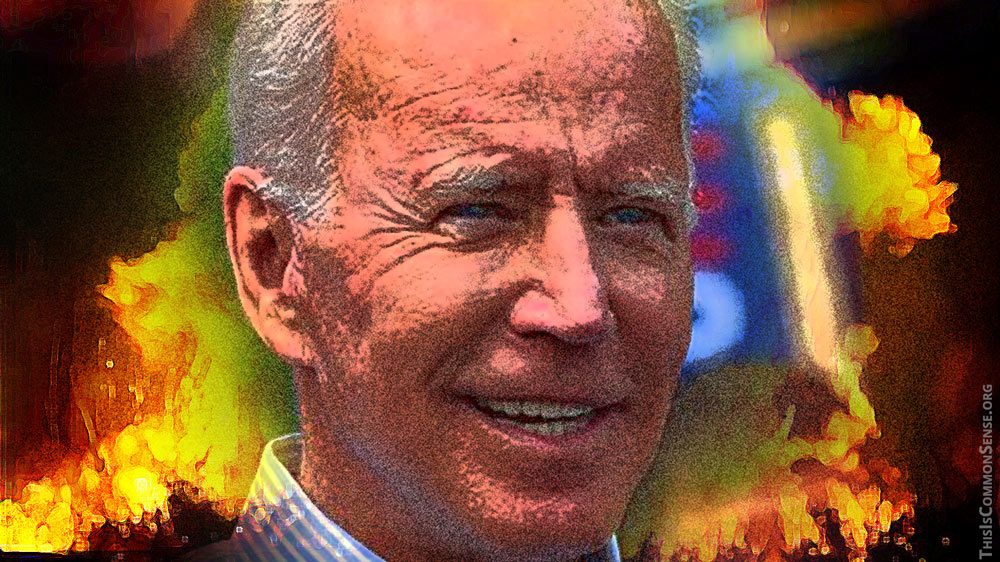
In Deep with Biden

On Election Day, “the Empire hopes to strike back,” writes Daniel McCarthy for The Spectator. “Joe Biden personifies the foreign policy of endless war that Democrats and neoconservatives pursued for 25 years, from the end of the Cold War until the election of Donald Trump in 2016.”

McCarthy argues that “Biden’s overall record is one of foreign policy interventionism,” but Biden’s Senate voting record is iffy-fifty: Biden “voted for the Iraq War, but he also voted against the 2007 surge.” He voted for the 1999 Serbian war, which destabilized relations with Russia, allowing the rise of Putin. But Biden voted against 1991’s Persian Gulf adventure which set the stage for post-Cold War American megalomania.

Nevertheless, McCarthy argues that “Joe Biden is an archetypal liberal interventionist of the post-Cold War variety. He understands war in the same terms as domestic policy: as an occasion to expand the power wielded by experts in Washington, whose moral and rational qualifications are beyond question — no matter how disastrous the consequences of their policies.”

Such a plausible case. War is certainly government “activism.”

McCarthy has spotted a real problem in “progressive liberalism,” and understands the “peer pressure” that so oppressively rules in the corridors of power. But he misses — perhaps merely for reasons of space — the sheer institutional power of the Deep State. It holds the secrets, it controls vast amounts of money, its immensity overpowers rational thought.

It is the government we cannot get to; it is the government that tried to “get” Trump.

Perhaps our “right to petition the government” can skip Congress and go right to the source, the Deep State.

Which really wants Biden to win.

This is Common Sense. I’m Paul Jacob.


PDF for printing

See all recent commentary
(simplified and organized)
See recent popular posts