Categories
international affairs national politics & policies

The Return of the Imperialists

We don’t live in a Star Wars universe. Not yet. But certain themes crop up: republic gives way to empire, and elite corps of . . . magic fighters? . . . seek to run a technocratic state. 

Donald Trump was cast by Democrats as an evil emperor sort of figure, but he didn’t quite fit that script — being the only president in two decades not to engage in a regime-change war.

So, with President-not-quite-Elect Joe Biden publicly announcing his new cabinet heads, we can see the old script followed closely, with the imperial guard piling up outside the fence at 1600 Pennsylvania, panting for power.

Though there are reams of news stories about this to pore over — the picks are big news — I’ll focus on Reason’s round-up. Of course, Biden is offering up Big Spenders (for whom deficits and debts just don’t matter*) as well as gung-ho interventionists. Take the Secretary of State candidate, Antony Blinken, profiled by Bonnie Kristian. While the proposed Secretary pro forma admitted that America cannot “solve all the world’s problems alone,” he then suggested that “our government can solve all the world’s problems if only it partners with other governments,” Ms. Kristian relates. She notes that Blinken has supported “U.S. military action in Libya, Yemen, and Syria. 

“And though he has since regretted the Yemen call, he believes the mistake in Syria was a failure to escalate.”

President Donald John Trump has followed the bomber love of his advisors, but has never quite bought into the need to escalate every conflict. And for that audacity, the foreign policy establishment has loathed him.

When Biden does hobble into the White House, we can unfortunately expect fewer ‘failures to escalate.’

This is Common Sense. I’m Paul Jacob.


* While Republicans do almost nothing to hold back deficit spending, and consequent debt accumulation, Democrats increasingly demonstrate a special zealotry in confessing their lack of concern.

PDF for printing

See all recent commentary
(simplified and organized)
See recent popular posts
Categories
Thought

Mark Twain

Always do right. This will gratify some people, and astonish the rest.

Categories
Today

Monroe Doctrine

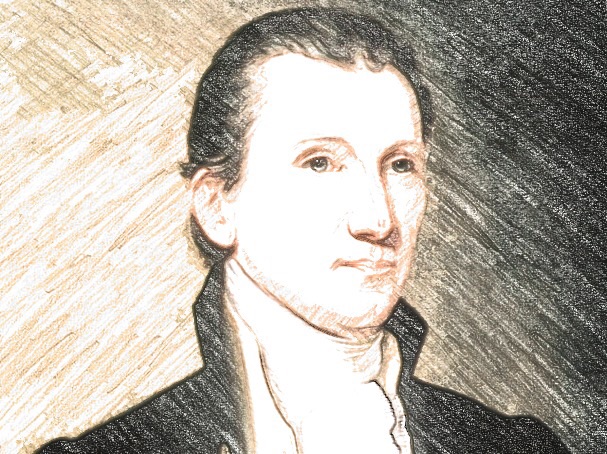
On December 2, 1823, U.S. President James Monroe delivered a speech establishing American neutrality in future European conflicts. The policy became known as the Monroe Doctrine.

Though a much-discussed principle of American foreign policy, it was undermined by the Spanish-American War and proved a dead letter as the U. S. entered World War I.

Categories
Internet controversy media and media people

Google Gag Reflex

Maybe it’s an honor when big-tech companies gag you. Maybe you’re doing something right.

Google-owned YouTube has yanked a Mises Institute talk by Tom Woods (“The COVID Cult”) from the Institute’s YouTube channel for challenging orthodox views of the pandemic. Google is also threatening the Mises Institute with further sanctions if the Institute’s YouTube channel sponsors further prohibited discourse.

In response, Mises Institute President Jeff Deist observes that Google and other big-tech firms have become de facto extensions of the state, “governmentalities . . . committed to ideological service. . . .”

To fight back, he says, we must “build our own platforms.” YouTube alternatives include Bitchute and Odysee, which still host the forbidden talk.

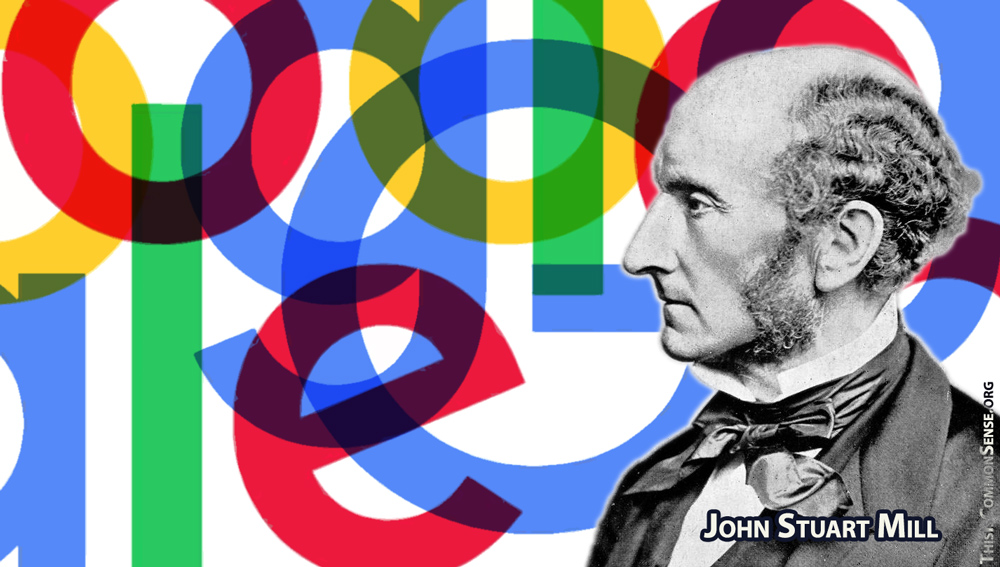
In On Liberty, John Stuart Mill argued that there’s a big difference “between presuming an opinion to be true, because, with every opportunity for contesting it, it has not been refuted, and assuming its truth for the purpose of not permitting its refutation. Complete liberty of contradicting and disproving our opinion, is the very condition which justifies us in assuming its truth for purposes of action; and on no other terms can a being with human faculties have any rational assurance of being right.”

Not every word of this passage is incontestable, but Mill had a point. If Google is so sure it is so right about COVID-19 policy and Woods so wrong, why try to kill an “opportunity for contesting” Google’s view?

Maybe Google’s “assurance of being right” is not so rational.

This is Common Sense. I’m Paul Jacob.


PDF for printing

See all recent commentary
(simplified and organized)
See recent popular posts
Categories
Today

The “Stolen Election”

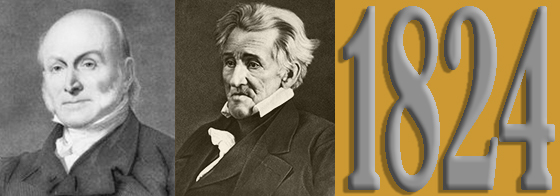
On December 1, 1824, with neither John Quincy Adams nor Andrew Jackson receiving a majority of votes in the Electoral College, the United States House of Representatives was given the task of deciding the winner in accordance with the Twelfth Amendment to the United States Constitution.

The House selected Adams. Jackson and his supporters felt deeply aggrieved, and immediately set about preparing for the next election, which Jackson won handily. Jacksonian supporters referred to the election of 1824 as “the Stolen Election,” in no small part because Jackson had received more popular votes.

Categories
Thought

Ernest Bramah

However deep you dig a well it affords no refuge in the time of flood.

Ernest Bramah, Kai Lung Unrolls His Mat, “The Story of Tong So, the Averter of Calamities” (1928).
Categories
initiative, referendum, and recall

Seeing What’s There

“One can squint and see ballot measures as a kind of super-survey of the electorate, with much larger samples and actual stakes,” wrote Sasha Issenberg over the weekend in The Washington Post. “The results then can be interpreted as a pure representation of voter preferences on discrete issues, without the vexing overlay of partisan polarization, incumbency, candidate personalities, scandal or gaffes.”*

Which “can be seductive,” he warns in an essay entitled, “Ballot measures don’t tell us anything about what voters really want.”

Nothing? 

Mr. Issenberg is willing to toss out these results because “ballot measure contests operate within a framework so different from elections for public office — with few financial limits”** and “lopsided spending.”

He cites Florida’s Amendment 2, pushing the state’s minimum-wage up to $15, where the yes-side spent nearly 10 times as much as the no-side. And California’s victorious Proposition 22, which he argues “declined to protect gig workers” even though that is exactly what it does, and where supporters also outspent opponents roughly ten to one. 

Issenberg also points to marijuana-related issues passing while widely outspending opponents. “In New Jersey, where more than two-thirds of voters said yes to legalization,” he explains, “supporters spent 65 times more than the leading opposition committee . . .” 

But that only amounts to proponents spending half-a-million, which doesn’t go very far in Jersey. 

While Issenberg, the author, journalist, and UCLA political science teacher, acknowledges that “a higher minimum wage and marijuana legalization are broadly popular” and don’t require greater spending, he argues that lopsided “multiples” of spending, like in New Jersey, “are unimaginable in the world of people running for office.” 

Really?

Just try. Numerous candidates for office run without any opposition at all or completely token competition. Take Illinois’s 4th congressional district, where incumbent Democrat Jesús Garcia outspent his Republican challenger by a margin of 704 to one — $593,219 to $843.

Look at the ballot measures decided weeks ago. Don’t squint; put your glasses on, if you need them. And unlike Issenberg, believe your eyes.

This is Common Sense. I’m Paul Jacob.


* Initiatives can suffer from the “personalities, scandal or gaffes” of their proponents. Still, there is clearly far less partisanship and no incumbent, per se.

** Actually, ballot measures have no limits at all. The federal courts have ruled that campaign contributions can corrupt candidates receiving them, but since ballot initiatives are written down in black-and-white and cannot be changed after the election, financial contributions cannot corrupt a ballot measure. 

PDF for printing

See all recent commentary
(simplified and organized)
See recent popular posts
Categories
Today

Chase and Clemens

On November 30, 1804, the United States House of Representatives began impeachment hearings against Supreme Court Justice Samuel Chase. The House thought he was too partisan, too “Federalist.”

The Senate later acquitted Chase.

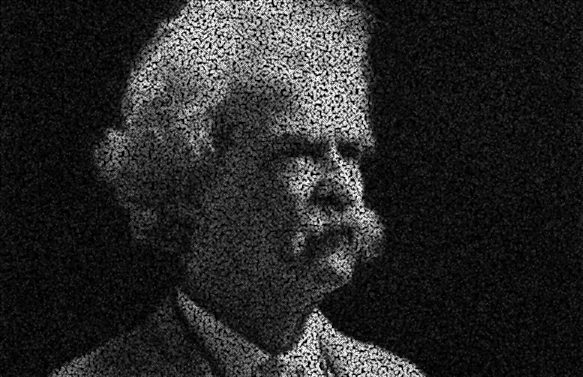
On 1835 on this date, Samuel Clemens was born, later to achieve world fame as author and humorist Mark Twain (pictured above). His most beloved books include The Adventures of Tom Sawyer (1876) and his masterpiece, Adventures of Huckleberry Finn (1885). He died in 1910.

Categories
Thought

John Holbrook ‘Jack’ Vance

Freedom, privileges, options must constantly be exercised, even at the risk of inconvenience. Otherwise they fall into desuetude and become unfashionable, unorthodox — finally irregulationary. Sometimes the person who insists upon his prerogatives seems shrill and contentious — but actually he performs a service for all. Freedom naturally should never become license; but regulation should never become restriction.

The character Amiante, in Jack Vance, Emphyrio (1969).

Categories
by Paul Jacob video

Watch: Go. Take. Leap?

Paul Jacob’s weekend wrap-up in color: