Categories
Today

Slavery, etc.

On December 6, 1865, the Thirteenth Amendment to the United States Constitution was ratified, banning slavery in all states and territories.

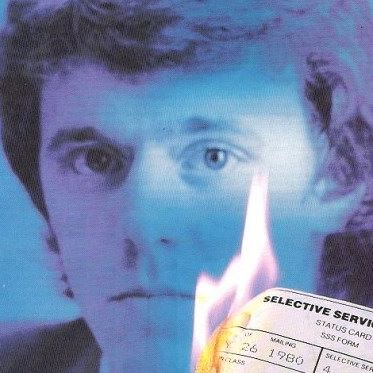
One-hundred-and-nineteen years later, to the day, in 1984, Paul Jacob (of ThisIsCommonSense.org, LibertyiFund.org, and the Citizens in Charge Foundation) was arrested by the FBI for his refusal to register with Selective Service System (the draft people). The Government was probably not attempting to make a commemorative point about involuntary servitude.


In 1917 on this date, Finland declared independence from Russia.

Vladimir Nabokov completed his controversial novel Lolita on the Sixth of December in 1953, and would soon find himself embroiled in censorship and related publishing difficulties, though with no trouble in the United States when it was eventually published by G. P. Putnam’s Sons in 1958.

Categories
audio podcast

Listen: How We Know What Voters Want

Paul Jacob expands upon the biggest stories of the week, beginning with the all-important question of the meaning of initiative and referendum returns.

Categories
Today

Prohibition Ends

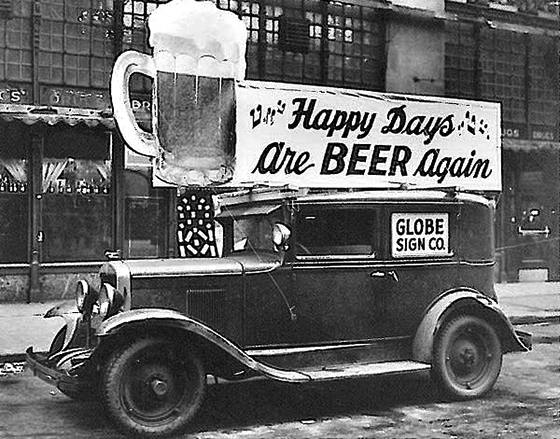
On December 5, 1933, nationwide alcohol Prohibition in the United States ended after Utah became the 36th U.S. state to ratify the 21st Amendment to the United States Constitution, thus establishing the required 75 percent of states needed to enact the amendment that overturned the 18th.

Categories
Thought

Ernest Bramah

One may ride upon a tiger’s back but it is fatal to dismount.

Categories
general freedom too much government

A Tyrant’s License

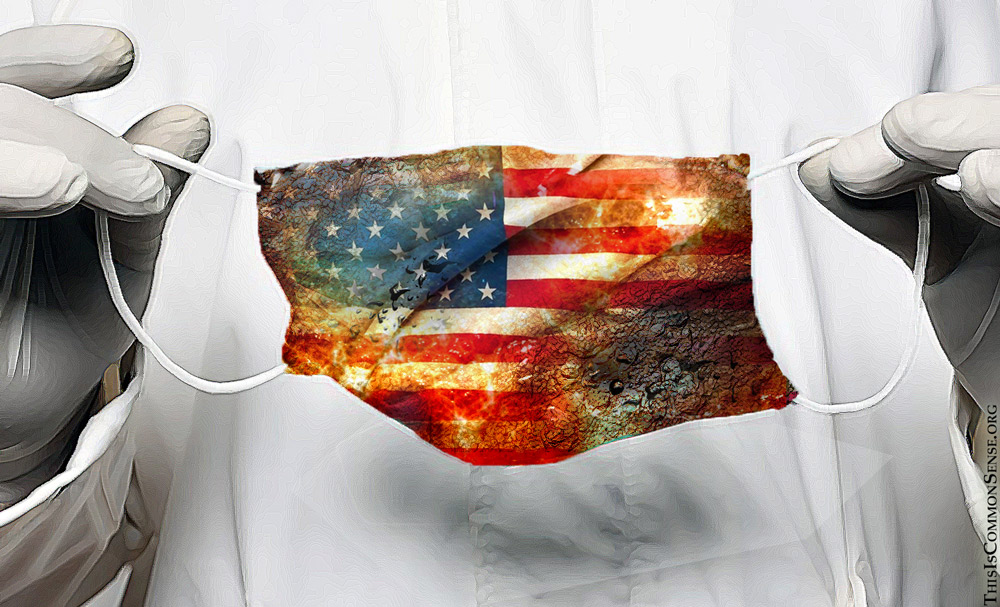
The “lockdowns” are not how a free society would handle a contagion.

Free people might advisedly wear masks and physically distance themselves from others when they are especially vulnerable to an airborne disease, or they themselves show some symptoms.*

But free people take risks, too, and accept responsibility for risks taken. And they go about trying to improve their lives generally, in society.

In society, via commerce. 

Furthermore, free people would also change their behavior based on good information freely discussed.

What they would not do is engage in bullying to suppress information, cheer on institutional debate suppression, or mandate abridgments to other’s liberties on the basis of personal or sectarian opinion.

That is, they would not do what we do now.

And, perhaps most importantly, free people would utterly condemn leaders who lied to them, or who took special privileges by flouting their own mandates, enforced on the rest of us.

We’ve sure seen a lot of this latter.

The latest case is that of Austin, Texas, Mayor Steve Adler, who has been caught in one of those grand hypocrisies that show the panic to be mostly political opportunism: he had recorded his early November message to “stay home if you can” after attending his daughter’s wedding with 20 guests and then taking a getaway trip with a party of eight.

“This is not the time to relax,” he warned, however. “We may have to close things down if we’re not careful.”

Recorded in Mexico, I guess that “social distance” allowed him the gumption to deliver a threat: if you don’t self-quarantine, I will quarantine everybody!

Except, of course, himself.

Freedom is not just something for our rulers. Liberty with an exception clause is spelled “L-I-C-E-N-S-E.”

This is Common Sense. I’m Paul Jacob.


*
By wearing masks and gloves these two groups would signal to others to give them some distance. Not virtue-signaling, but well-mannered responsibility signals. The healthy people, though, would take the risks of the disease because, after all, we face a million risks every day, from automobile injury to cancer.

PDF for printing

See all recent commentary
(simplified and organized)
See recent popular posts
Categories
Thought

Walter E. Williams

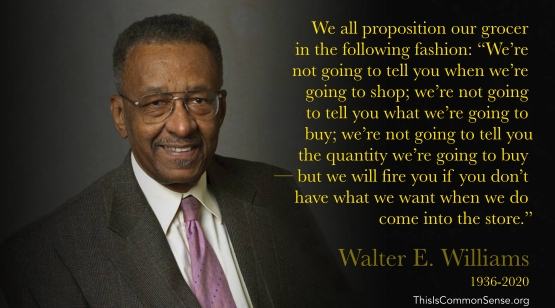
We all proposition our grocer in the following fashion: “We’re not going to tell you when we’re going to shop; we’re not going to tell you what we’re going to buy; we’re not going to tell you the quantity we’re going to buy — but we will fire you if you don’t have what we want when we do come into the store.”

Walter E. Williams (March 31, 1936 – December 2, 2020), Bradley Prize Winner 2017, was John M. Olin Professor of Economics at George Mason University.
Categories
Today

A Farewell to Arms

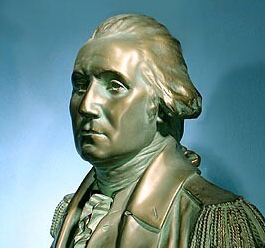
On December 4, 1783, at Fraunces Tavern in New York City, General George Washington formally bade his officers farewell.

Categories
ideological culture individual achievement

The Individualist Economist

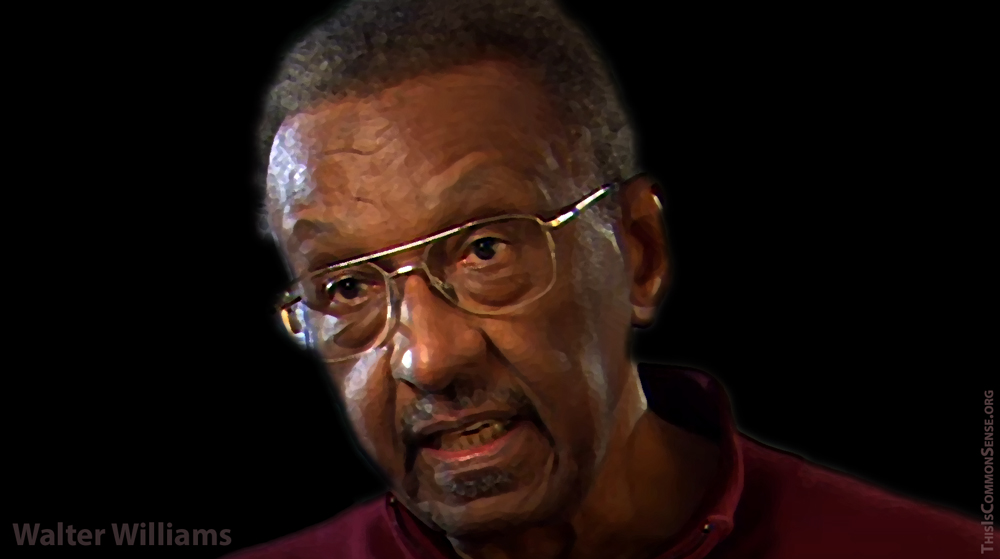
Walter Williams died today. Or, by the time you read this, yesterday. 

Williams was a major figure in economics education, instrumental in building an economics program at George Mason University. Plus, he popularized economics for a wider audience with books, columns, and regular guest radio appearances on Rush Limbaugh’s show.

Dinesh D’Souza, in his video tribute, called Williams “an economist, an individualist, and an African-American conservative” when such people were rare. Especially the African-American variety.

Now, Williams’ main themes were not so much conservative as libertarian, citing Frédéric Bastiat a whole lot more than Edmund Burke. But D’Souza no doubt indicates that when he calls Williams an individualist. Consider it a euphemism for libertarian. 

And Williams certainly was an Individual — an individualist in more than just the political sense — though, we saw his resistance to mob pressure and groupthink most clearly in the realm of ideology. 

He could certainly have gotten wider praise had he stuck closer to the culturally dominant notion of what an African-American intellectual’s role was supposed to be. But instead of pushing “discrimination” as the major factor in differences of wealth and health outcomes in ethnic and racial groups in America, he insisted that actions have consequences, constantly reiterating the major themes of the classical liberal economists Adam Smith and Milton Friedman: people provide greater benefit to the general welfare when they marshal their own resources in a private property/free trade framework than when they pretentiously talk about the “public good” through special government programs. 

When two people trade, both gain. 

In politics, it’s too often about taking from some to give to others.

By being himself, going his own way, Walter Williams himself provided a great example of how to serve the common good. 

This is Common Sense. I’m Paul Jacob.


PDF for printing

See all recent commentary
(simplified and organized)
See recent popular posts

Categories
Thought

Walter E. Williams

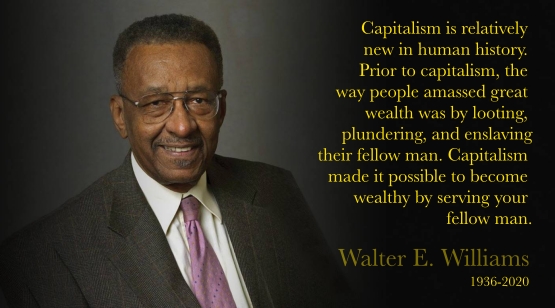
Capitalism is relatively new in human history. Prior to capitalism, the way people amassed great wealth was by looting, plundering, and enslaving their fellow man. Capitalism made it possible to become wealthy by serving your fellow man.

Walter E. Williams (born March 31, 1936), Bradley Prize Winner 2017, was Professor of Economics at George Mason University. He died on December 2, 2020.
Categories
Today

Cold War Ends

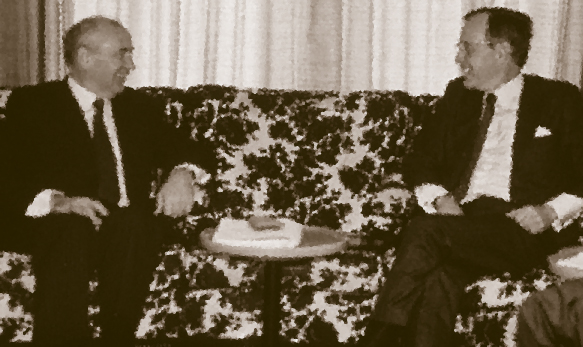
On December 3, 1989, the leaders of the two world superpowers, the United States of America and the Union of Soviet Socialist Republics, declared an end to the Cold War, at a summit in Malta. A little over two years later not only had the Cold War ended, the Soviet Union was itself dissolved.