Paul Jacob is on a roll:

Paul Jacob is on a roll:

On May 8, 1899, Austrian-English economist and philosopher Friedrich August von Hayek was born. He signed the bulk of his books written in the English language as “F.A. Hayek,” and is best known for The Road to Serfdom, The Constitution of Liberty, The Fatal Conceit, and many essays, several of them widely cited, including “Individualism, True and False” and “The Use of Knowledge in Society.”
Years earlier, on the same date in 1873, English philosopher and economist John Stuart Mill died. Now best known for On Liberty (1859) and Utilitarianism (1861), he was and is considered one of the most important economists and philosophers of the Victorian age, with other classics including A System of Logic (1843) and Principles of Political Economy (1848). Mill’s letters to his wife were edited into book form by Hayek.
On May 8, 1946, two Estonian school girls (Aili Jõgi and Ageeda Paavel) blew up the Soviet memorial which stood in front of the Bronze Soldier in Tallinn.

Last week, I asked whether the social media companies that mine our data — which they obtain from our posts — might not expend a little more attention to allowing us to mine our own data with more ease and sophistication.
Today, let’s look at the biggest problem.
Politics.
Facebook and Twitter initially gloried in enabling users to easily communicate political ideas and activism.
Then they realized that people don’t all agree, and that platform headmen Zuckerberg’s and Dorsey’s friends got upset when they lost, blaming Facebook and Twitter for allowing “democracy” to be compromised.
Now, that was overblown. Democracy wins when people use communication technology to convince others — just so long as they do not opt out of democracy’s integral respect for minority rights.
Which is what Democrats accused Republicans — Trump was “obviously” authoritarian.
Which is what Republicans also accused Democrats — and throwing people off a supposedly non-partisan platform for partisan reasons sure looks anti-democratic.
Robby Soave, arguing to the contrary at Reason, says that “Both the Left and the Right Are Exaggerating the Threat Posed by Facebook.” His article’s blurb boasts his thesis: “Facebook can’t kill, jail, or tax you. It can only stop you from posting on Facebook.”
True — but is it true enough? The political ramifications of Facebook’s de-platforming strike me as a great breach of contract — not just a matter of no physical threat. Plus, as mentioned Monday and previously, big tech is not immune to Washington’s political pressure and massive financial clout.
Meanwhile, Mr. Soave quotes Candace Owens, whose advice seems apt to me: “Twitter and Facebook are Fascist companies” that we should be “slowly migrating away from. . . .”
Soave is spot-on to highlight the limits to Facebook’s clout, reminding that we can stop feeding their data mining operations.
This is Common Sense. I’m Paul Jacob.
See all recent commentary
(simplified and organized)
See recent popular posts
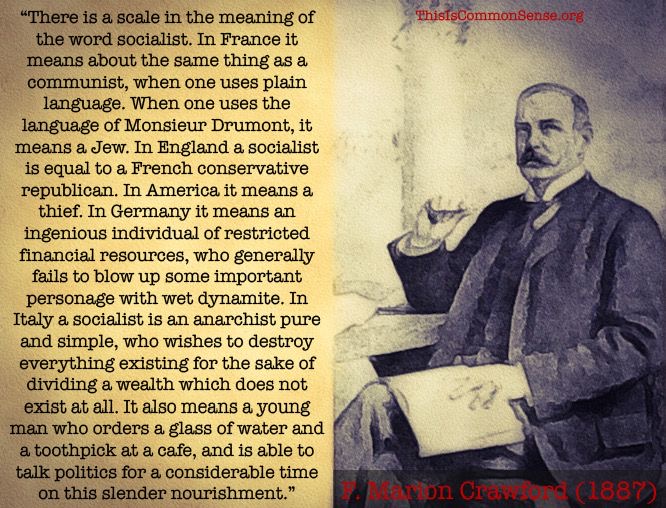
There is a scale in the meaning of the word socialist. In France it means about the same thing as a communist, when one uses plain language. When one uses the language of Monsieur Drumont, it means a Jew. In England a socialist is equal to a French conservative republican. In America it means a thief. In Germany it means an ingenious individual of restricted financial resources, who generally fails to blow up some important personage with wet dynamite. In Italy a socialist is an anarchist pure and simple, who wishes to destroy everything existing for the sake of dividing a wealth which does not exist at all. It also means a young man who orders a glass of water and a toothpick at a cafe, and is able to talk politics for a considerable time on this slender nourishment.
Francis Marion Crawford, Marzio’s Crucifix (1887).
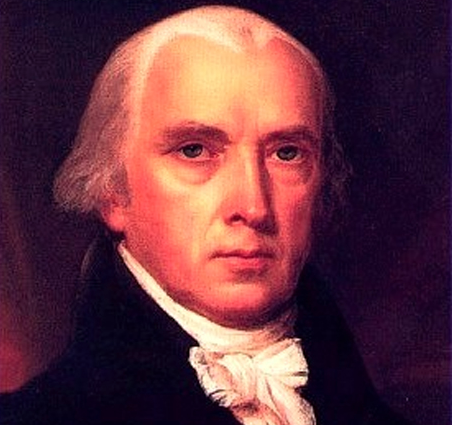
On May 7, 1992, the State of Michigan ratified a 203-year-old proposed amendment to the United States Constitution, thereby fulfilling the terms of amending the document, adding it as 27th Amendment. The amendment had been written by James Madison. He had presented it as part of the original twelve amendments that became the ten making up the Bill of Rights. It bars the U.S. Congress from giving itself a pay raise until after the next election, so that voters have a chance to decide whether those voting for the raise would remain in Congress to receive it.

When an LA County Sheriff’s deputy pulled over a woman driving a Mercedes, she went on a tear that quickly become infamous. “You’re always gonna be a Mexican,” she scolded the cop, “you’ll never be white, you know that, right?”
Undoubtedly, this racist taunt from a black female motorist, confirmed by Fox News to be an area teacher, was in the name of anti-racism. Wokely, assuming that to be Latino and a cop must mean he “wants to be white.”
She claims that she became afraid of the deputy, who she kept calling a “murderer,” so she started recording him. Indeed, he pulled her over because she had been using her cell phone to record . . . while driving! After the stop, she continued to record him, which she (correctly) said she had every right to do. He persevered and gave her a ticket for having used her phone while driving.
He had a bodycam on, which his department does not require. The video he sent Fox journalist Bill Melugin no doubt got in front of The Narrative.
The woman, a serial complainer about police, did indeed file a complaint about his behavior.
Folks who earnestly worry about police abuse — and not, like this woman, who did so in a paranoiac and ideological and racist manner — might consider getting something for road altercations themselves: one for the dash, but also one on their very own person. And something that is not a phone! At least when driving.
Has the utility of the “cop cam” ever been better demonstrated?
This is Common Sense. I’m Paul Jacob.
See all recent commentary
(simplified and organized)
See recent popular posts
The presence of irony does not necessarily mean that the earnestness is excluded. Only assistant professors assume that.
Søren Kierkegaard, Concluding Unscientific Postscript to Philosophical Fragments (1846), Appendix: A Glance at Contemporary Effort in Danish Literature.

On May 6, 1862, American author, philosopher and abolitionist Henry David Thoreau died, after many years of tuberculosis.
Aware he was dying, Thoreau’s last words were “Now comes good sailing,” followed by two lone words, “moose” and “Indian.” Bronson Alcott planned the service and read selections from Thoreau’s works, and Ralph Waldo Emerson wrote the eulogy spoken at his funeral.
His remains, as well as those of members of his immediate family, were eventually moved to Sleepy Hollow Cemetery in Concord, Massachusetts.
His most famous works are An Essay on Civil Disobedience (1849) and Walden (1854).

Izzy Israel lost his job. He had been working in Nashville’s music industry, but the coronavirus pandemic upset those plans. In the induced depression of the pandemic lockdowns, he decided to try to make a wider impact. He went walkabout.
Or, more properly, trek.
He set out to walk from the Florida Keys across country to Cape Flattery in Washington State . . . for a cause.
The cause?
Term limits. “We have people in Congress that are making policies and laws for their entire lifetimes,” he argues. “I think that’s highly corruptible. Big money is guiding our policies. You can see it. I think it’s time for term limits and I wanted to be a part of that change.”
According to the account in Alabama’s Pike County newspaper, The Messenger (troymessenger.com), “He began his cross-nation odyssey on Dec. 22, 2020, and hiked up the Florida panhandle solo until he reached Tallahassee. While generating some publicity for his cause, he attracted the attention of the national organization, U.S. Term Limits.”
Specifically, my old colleague Jeff Tillman.
“Once I met this guy,” Jeff says of Izzy, “I was amazed at how dedicated he was.”
The Messenger goes on to relate how Tillman’s support has made Izzy’s long march for limits on politicians easier and more effective.
Izzy points out that Congress is “having a hard time” term-limiting “itself.” Thankfully, explains Jeff, the Constitution provides a path for 34 states (two thirds) to call a convention to propose an amendment, bypassing Congress.
Four states — Alabama, Florida, Missouri, West Virginia — have passed an application for the single-subject convention advocated by U.S. Term Limits. Another 15 states have passed calls for a multi-subject convention, which includes term limits.
Let’s . . . enact some Common Sense. I’m Paul Jacob.
See all recent commentary
(simplified and organized)
See recent popular posts
The lessons of paternalism ought to be unlearned and the better lesson taught that while the people should patriotically and cheerfully support their Government, its functions do not include the support of the people.
Stephen Grover Cleveland, Second Inaugural Address, March 4, 1893.