Categories
Today

A Fourth & a First

On January 2, 1788, Georgia became the fourth state to ratify the United States Constitution.

On the second day of 1819, the Panic of 1819, the first major peacetime financial crisis in the United States, began. The classic historical treatment of this crisis remains Murray Rothbard’s dissertation.

Categories
audio podcast

Listen: Paul Defends His Favorite Christmas Movie

It is time for the weekend podcast, and Paul has a lot to say. And not just about a great movie:

Categories
Thought

Jo Ann Skousen

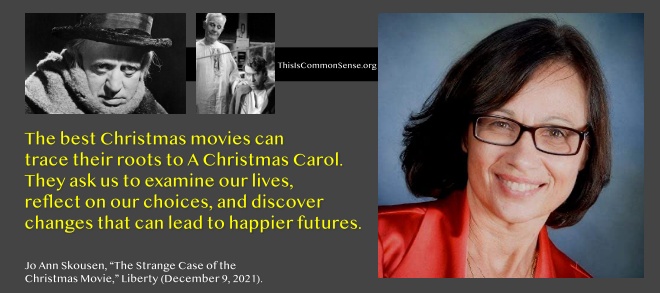
The best Christmas movies can trace their roots to A Christmas Carol. They ask us to examine our lives, reflect on our choices, and discover changes that can lead to happier futures.

Jo Ann Skousen, “The Strange Case of the Christmas Movie” (December 9, 2021), Liberty.
Categories
Today

International Slave Trade

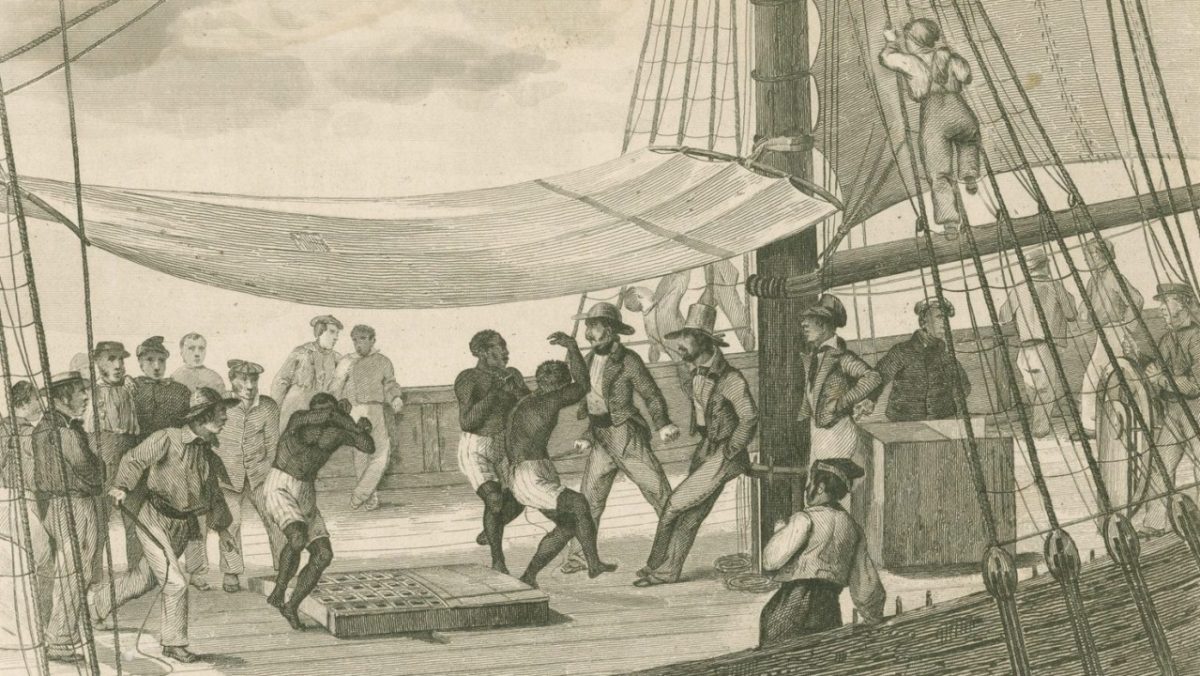
On January 1, 1808, the importation of slaves into the United States was banned.

Categories
First Amendment rights general freedom media and media people moral hazard nannyism social media

Tom Paine Sues Facebook

The ghost of Thomas Paine is suing Instagram and Facebook.

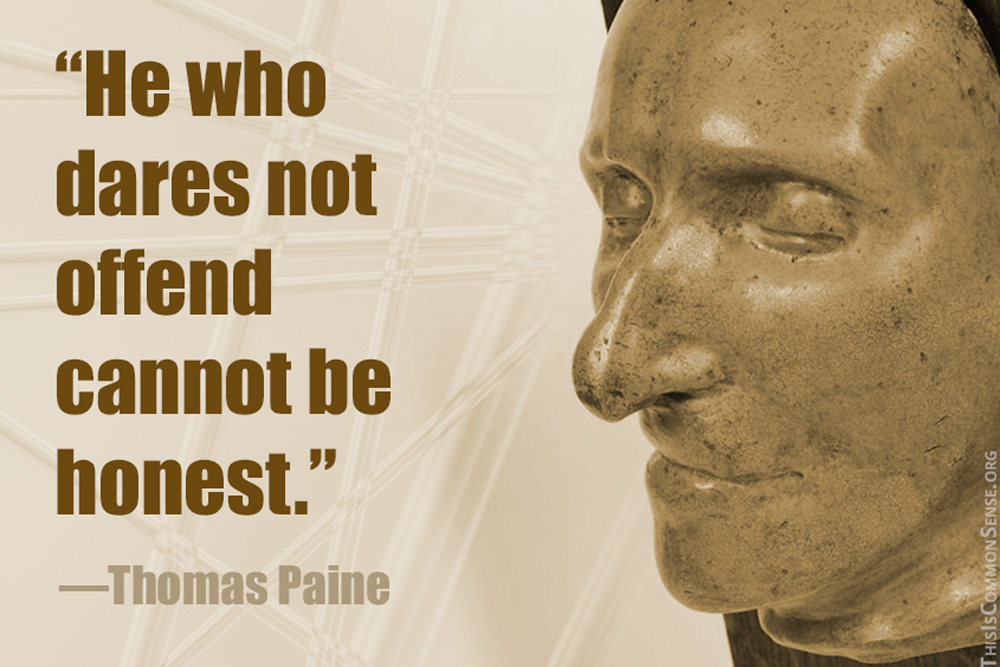
Mr. Paine, the eloquent champion of the American Revolution who penned such zeitgeist-capturing volumes as Common Sense, The American Crisis, and The Rights of Man, is going to court to protest the indignity that these social-media forums recently inflicted upon his spirit by censoring his statement that “He who dares not offend cannot be honest.”

The statement comes from an op-ed Paine published in the April 24, 1776 issue of the Pennsylvania Journal: “Cato’s partizans may call me furious; I regard it not. There are men too, who, have not virtue enough to be angry, and that crime perhaps is Cato’s. He who dares not offend cannot be honest.”

Mr. Paine seems to be saying that persons of craven mettle often eschew the challenge of being standard-bearers of truth, especially when controversial matters are involved. Articulating such views forthrightly tends to offend — somebody.

The particular mentalities of censorious Facebook flunkies and algorithms are new to Mr. Paine, of course. But he is ready to fight.

“Tyranny, like hell, is not easily conquered,” he declares when asked to assess his prospects, “yet we have this consolation with us, that the harder the conflict, the more glorious the triumph. What we obtain too cheap, we esteem too lightly. . . . [I]t would be strange indeed if so celestial an article as FREEDOM should not be highly rated.”

If that be hate speech, Mr. Paine seems to suggest, make the most of it.

This is Common Sense. Happy New Year! I’m Paul Jacob.


PDF for printing

See all recent commentary
(simplified and organized)
See recent popular posts
Categories
Thought

Patrick Henry

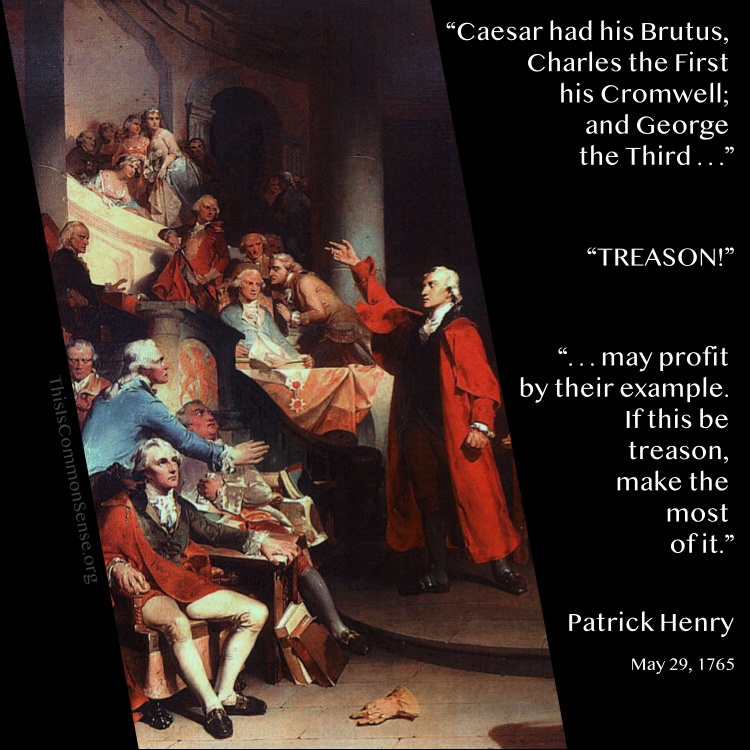
Caesar had his Brutus, Charles the First his Cromwell; and George the Third — [“Treason!” cried the Speaker] — may profit by their example. If this be treason, make the most of it.

Patrick Henry, speech on the Stamp Act, Virginia House of Burgesses (May 29, 1765), according to John Burk in The History of Virginia: From Its First Settlement to the Present Day (Dickson & Pescud, 1805), Volume 3, p. 309. Contemporary accounts vary.
Categories
Today

Bricked Windows

On December 31, 1695, Englanders received a new tax, a window tax. One of the main responses to this was the bricking up of many British windows.

This last day of the year in 1991 marked the complete cessation of all institutions of the Soviet Union.

New Year’s Eve 1992 saw the peaceful dissolution of Czechoslovakia into the Czech Republic and Slovakia. This has been dubbed the “Velvet Divorce.”

Categories
Common Sense crime and punishment general freedom

Against the Regime

Recently, a tyke and his mommy were booted from a Big Apple Applebee’s because the little boy lacked a vaccine passport.

That is, the mother possessed no proof that her son had been vaccinated against the disease of the day.

Now, parents have every right to refrain from getting their kids injected — especially given the low risk that kids will become seriously ill from COVID-19 and the non-negligible risk of harm from vaccine side effects.

But such considerations didn’t prevent a gang of police — no students of Mayberry’s Sheriff Andy Taylor — from ordering the expulsion. (There’s video.)

Residents of New York City’s vaccination regime can at least move to another town. People elsewhere, in larger jurisdictions — Austria, Australia, England — face greater difficulties escaping pandemic tyranny. But, like us, they can protest and they can sue.

In England, a group called Big Brother Watch is challenging the COVID Pass Scheme imposed by the government of Boris Johnson. Their lengthy “pre-action letter” argues that no evidence exists that the passes will reduce the spread of the virus and that the scheme is “unnecessary and disproportionate.”

Amidst so much “information” under dispute, we know three things.

One, for all the suffering and death it has inflicted on the most vulnerable, the current pandemic is hardly the Black Death. It isn’t even the Spanish flu.

Two, being “vaccinated” against COVID-19 does not prevent one from becoming infected or from infecting others.

Three, shutting down society also inflicts suffering. Great suffering. As must shutting down whichever segments of society decline Draconian mandates.

Maybe the scourge of tyranny isn’t the best balm for the scourge of COVID-19.

This is Common Sense. I’m Paul Jacob.


PDF for printing

See all recent commentary
(simplified and organized)
See recent popular posts

Categories
Thought

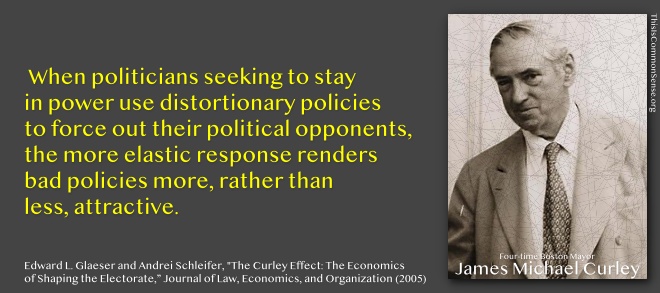
Curley Effect

When politicians seeking to stay in power use distortionary policies to force out their political opponents, the more elastic response renders bad policies more, rather than less, attractive.

Edward L. Glaeser and Andrei Schleifer, “The Curley Effect: The Economics of Shaping the Electorate,” Journal of Law, Economics, and Organization 21 (1): 1-19, (2005). The article’s abstract identifies the principle’s namesake: “James Michael Curley, a four-time mayor of Boston, used wasteful redistribution to his poor Irish constituents and incendiary rhetoric to encourage richer citizens to emigrate from Boston, thereby shaping the electorate in his favor. As a consequence, Boston stagnated, but Curley kept winning elections.” See David Henderson, “Curley Effect in California” (May 4, 2012).
Categories
Today

Student of Law

On December 30, 1919, Lincoln’s Inn in London, England, admitted its first female bar student.