Categories
national politics & policies too much government

No Federal Solution

In a virtual meeting, online, the National Governors Association talked with President Joseph R. Biden, Jr., last week. The biggest issue? COVID.

About COVID tests, “I wish I had thought about ordering a half a billion two months ago,” Mr. Biden confessed. 

While serious people are taking this seriously, blah blah, the truth may be that tests do more harm than good. There have always been problems with the tests: too many false positives; they induce panics at mere “case” levels, thus feeding propaganda and unworkable government “solutions” to the “crisis.”

About which Biden now admits he’s got . . . nothing. 

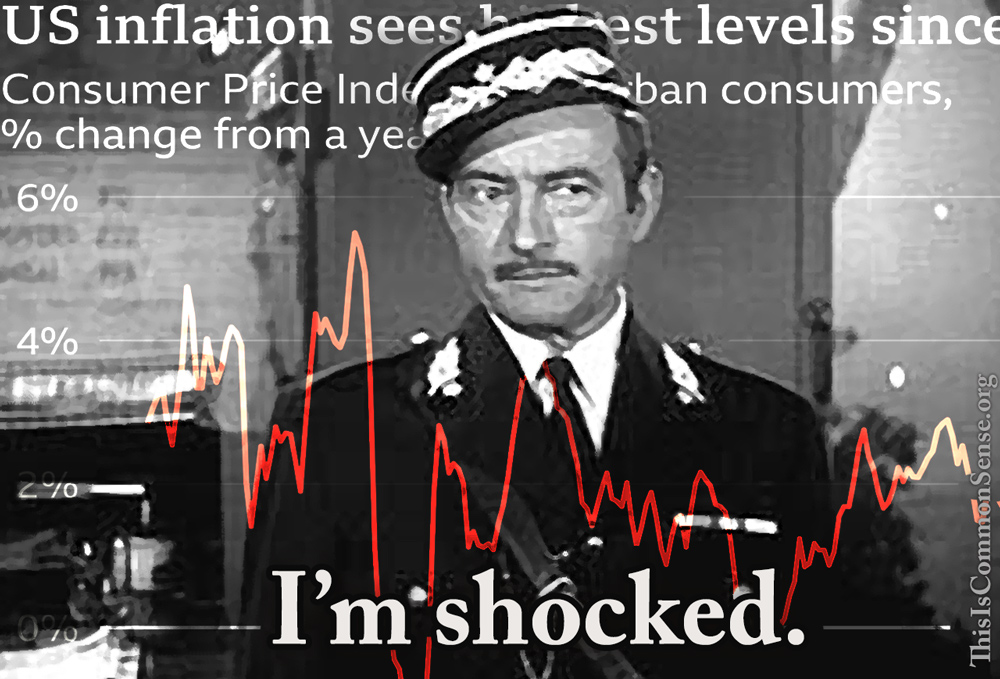
Having run against Donald Trump and his alleged lack of a plan, boasting how the Democrats would conquer COVID, Biden now declares defeat: “Look, there is no federal solution.

“This gets solved at a state level,” acknowledged the president, “. . . and it ultimately gets down to where the rubber meets the road and that’s where the patient is in need of help, or preventing the need for help.”

That last phrase is odd. 

“Preventing the need for help” sounds like he might mean patients taking control of their health care and their own immune systems. Could Mr. Biden be alluding to Vitamin D, Vitamin K, zinc, HCQ, Ivermectin, and many other immune system boosters and virus blockers?

Or Biden could merely be fumbling. He’s made much of the Omicron Variant, including at the governors’ meeting. But instead of addressing the actual trend of the latest iteration, politicians and propagandists push the idea that Omicron is deadly, when the evidence is clear: it is much less deadly than previous variants. 

The great danger of COVID remains the governmental response.

Including, alas, Biden’s.

This is Common Sense. I’m Paul Jacob.


PDF for printing

See all recent commentary
(simplified and organized)
See recent popular posts

Categories
Thought

Palki Sharma

Look at what’s happening in the U.S. It is now one of the biggest omicron hotspots. The U.S. is running out of everything: testing kits, hospital beds, health workers and now nursing home staff. There’s a shortage of everything in America. And these shortages are getting worse by the day. . . . The Biden Administration was clearly not prepared for this.

Palki Sharma, reporting for WION (The World Is One News), an Indian-based media company (Dec. 28, 2021).
Categories
Today

Mongolia

On December 29, 1911, Mongolia gained independence from the Qing Dynasty.

Categories
Accountability folly national politics & policies political economy

Whip Producers Now

The Biden administration is siccing agencies like the Federal Trade Commission, Department of Agriculture, and the Federal Maritime Commission onto the producers of stuff who have recently dared to raise prices.

Stuff like gas. Higher prices at the pump must be an oil-company conspiracy.

It has nothing to do with (and don’t even think it!) governmental actions that impede production, including shutting down the Keystone oil pipeline on Biden’s first day in office or calling a halt to new oil leases on public lands. Etcetera.

Nothing to do with mammoth expansion of the supply of money and credit to facilitate trillion-dollar government spending sprees.

In case you hadn’t noticed, meat costs more, too. So obviously that must be the fault of malicious meatpackers. Rest assured that beef price inflation is utterly unrelated to pandemic-policy-induced labor shortages and delays.

Or to any recent increase in efficiency-impairing trucking regulations.

Same with sundry supply-chain problems, like the ships and crates piling up at ports. Greater consumer demand, new pandemic-induced screening protocols, union rules that prevent ports from operating 24/7 or improving automation — all irrelevant.

Must be. That’s the script from 1600 Pennsylvania Avenue, anyway.

But if companies can hike prices at will, ignoring whether regulations ease or obstruct production, why doesn’t the meat industry, for example, charge a thousand dollars per pound of flesh?

Well, we know why. 

Demand for a pound of ground beef would slide to zero, or close to it.

If only the government people knew! 

Or would stop pretending they don’t know. 

A consistent recognition of the laws of economics would sure make a great gift — in any season. Instead of bullying and making things worse, government could get out of the way.

This is Common Sense. I’m Paul Jacob.


PDF for printing

See all recent commentary
(simplified and organized)
See recent popular posts
Categories
Thought

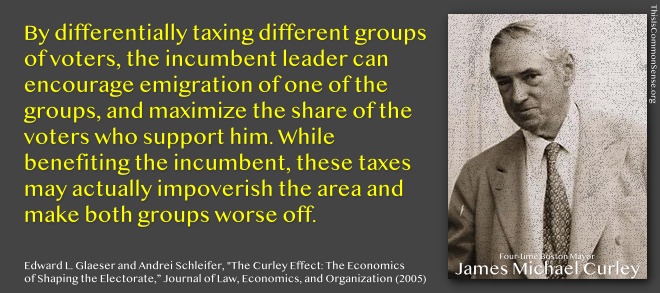
The Curley Effect

By differentially taxing different groups of voters, the incumbent leader can encourage emigration of one of the groups, and maximize the share of the voters who support him. While benefiting the incumbent, these taxes may actually impoverish the area and make both groups worse off.

Edward L. Glaeser and Andrei Schleifer, “The Curley Effect: The Economics of Shaping the Electorate,” Journal of Law, Economics, and Organization 21 (1): 1-19, (2005). The article’s abstract identifies the principle’s namesake: “James Michael Curley, a four-time mayor of Boston, used wasteful redistribution to his poor Irish constituents and incendiary rhetoric to encourage richer citizens to emigrate from Boston, thereby shaping the electorate in his favor. As a consequence, Boston stagnated, but Curley kept winning elections.” See David Henderson, “Curley Effect in California” (May 4, 2012).
Categories
Today

Arrest; Resignation

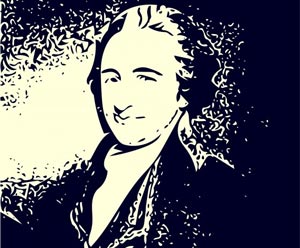
On December 28, 1797, Thomas Paine was arrested in France for treason, after being tried (and convicted) in absentia on December 26. Prior to moving to France, Paine had been an instrumental figure in the American Revolution as the author of Common Sense. Paine then moved to Paris to help along the French Revolution, but the chaotic political climate turned against him. Paine had not earned friends in the Revolution with his vocal opposition to capital punishment.

“During the whole of my imprisonment,” Paine later wrote, “prior to the fall of Robespierre, there was no time when I could think my life worth twenty-four hours, and my mind was made up to meet its fate. The Americans in Paris went in a body to the convention to reclaim me, but without success.”

Paine’s imprisonment in France caused a general uproar in America. Future President James Monroe used all of his diplomatic connections to get Paine released in November 1794.

With the publication of Paine’s secular tract, The Age of Reason — a great part of which he wrote in French prison — the American population turned against him, and he died penniless in New York in 1809.


On this date in 1832, John C. Calhoun resigned as Vice President of the United States, the first to do so.

Categories
ideological culture

Heroism & Love Abounding

“I cannot express how much I love this movie,” Monica Hesse writes in her Christmas eve Washington Post column about It’s a Wonderful Life (Frank Capra, dir.; 1946).* Yet she mocks protagonist George Bailey as “the tortured Boy Scout-type” and contends that “Mary Bailey is the true hero.” Meaning that her husband George — beloved by many in fictional Bedford Falls — is not the “true hero.”

Puh-lease. 

Even Mr. Potter, the movie’s villain, acknowledges that Bailey is “no ordinary yokel.” George is bright, ambitious, hardworking and, most importantly, a good man — someone who cares about people.

He makes sacrifices: taking over his deceased father’s business instead of going to college with money he has saved; loaning that money to his brother to go in his stead; and once turning down ten times the salary so that folks in the town have “someplace to go without crawling to Potter.”

Hesse ignores all this to mark George as a deadbeat regularly bailed out by his wife, Mary. When in one scene “a market crash threatens to sink the Bailey Building & Loan,” Hesse smugly asks, “whose idea is it to donate George and Mary’s honeymoon funds to keep things afloat?”

Indeed. But George earned that money and, having just shared it with his new bride, would never take it back. Still, many spouses would lack Mary’s quick thinking. 

Hesse belittles George’s existential panic at impending bankruptcy and scandal as “his foul work-mood,” and highlights Mary as “the one who’s been home all day with a sick toddler.” 

As if a competition. 

Most perplexing for Hesse? “[T]he movie suggests that the saddest thing of all is that Mary Bailey became a librarian.” Well, not exactly. In the world the angel shows, in which George had never been born, it is that Mary “never married,” not the librarian gig, that rocks George.

But had Mary wed a wonderful fellow enjoying a relentlessly happy family, that would hardly demonstrate to George Bailey what the angel Clarence insists, that George’s life mattered.

“The entire movie celebrates the personal sacrifices of a nice man,” claims Hesse, “while ignoring the identical sacrifices of a nice woman.”

It’s a Wonderful Life is told from George’s perspective but doesn’t ignore Mary’s sacrifices at all. If it did, how on earth could Hesse recount them?

Moreover, George and Mary are more than merely “nice.” They have the courage and commitment to do for each other and the world around them . . . even under enormous stress. 

Both are heroes. Don’t let Monica Hesse or anyone tear them asunder. 

This is Common Sense. I’m Paul Jacob.


* If you are part of the less than 1 percent who have somehow dodged viewing the ubiquitous film, George’s uncle misplaces (into Potter’s evil hands) $8,000 of the company’s money, which would force the Bailey Building & Loan into bankruptcy likely followed by George’s criminal prosecution. Desperate and unable to come up with the money on Christmas eve, George considers suicide to save the business and his family with his life insurance money. But an angel intervenes and shows George what the world would be like without him. George decides he wants to live and get back to his wife and kids and, when the angel returns him to real life, Mary has rallied all his friends who contribute many times the amount of money needed. Lots of heroes found in this flick.

PDF for printing

See all recent commentary
(simplified and organized)
See recent popular posts
Categories
Thought

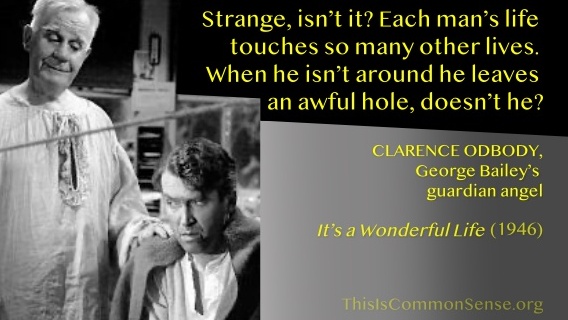
Clarence

Strange, isn’t it? Each man’s life touches so many other lives. When he isn’t around he leaves an awful hole, doesn’t he?

Clarence Odbody, George Bailey’s guardian angel in It’s a Wonderful Life (1946), directed by Frank Capra, written by Capra, Frances Goodrich and Albert Hackett to a story by Philip Van Doren Stern, and as portrayed by Henry Travers.
Categories
Today

Remonstrance

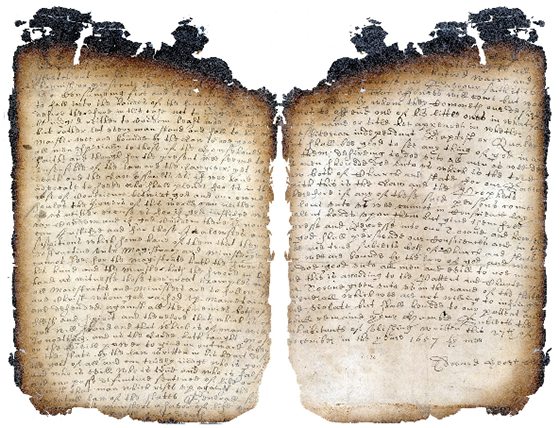
On December 27, 1657, a group of English citizens in Flushing, New York, who were not themselves Quakers, signed a petition protesting the persecution of Quakers. This “Flushing Remonstrance” is an eloquent statement of the principle of religious liberty, and is widely regarded as a forerunner to the U.S. Constitution’s First Amendment.

The petition was delivered to Director-General of New Netherlands, Peter Stuyvesant.

Categories
audio podcast

Listen: Hope After All?

It is the Day After Christmas — Boxing Day, in Britain! — and did you open this weekend’s podcast? If not, here is your chance!

See all recent commentary
(simplified and organized)
See recent popular posts