On April 8, 1913, the 17th amendment to the Constitution, providing for the popular election of U.S. senators, was ratified.
Categories
17th Amendment

On April 8, 1913, the 17th amendment to the Constitution, providing for the popular election of U.S. senators, was ratified.
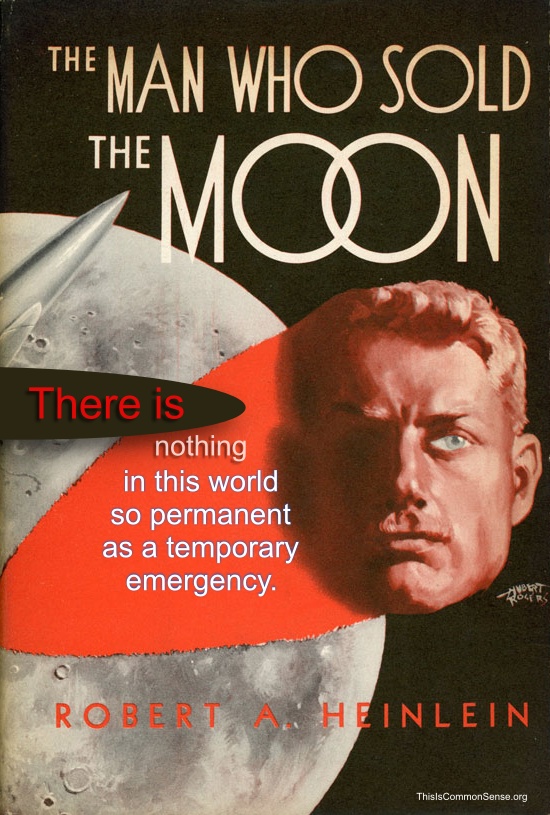
There is nothing in this world so permanent as a temporary emergency.
Robert A. Heinlein, The Man Who Sold the Moon (1951), p. 100.

If you disagree about what’s better for breakfast, eggs or oatmeal, no problem.
But despite their putative pretense of providing open forums, the dominant social-media companies routinely ban discussion of touchy subjects like Hunter Biden laptops, pandemics, and and the politics of race and gender. As the satire site Babylon Bee discovered, even calling a man a man, apparently quite a controversial observation, can get you in hot water with Twitter censors.
We have ways of combatting the censorship. One is using alternative platforms that do regard open discussion as a value. Another is becoming a major stockholder and disrupting the anti-speech agenda from within.
Is this what Elon Musk is up to? Bee CEO Seth Dillon says that after Twitter suspended Babylon Bee for calling a man a man, Musk called him about the suspension and said that “he might need to buy Twitter.”
Presumably in order to put a stop to such censorious shenanigans.
Now Elon Musk, who has 80.6 million followers on Twitter, has bought the company. Or rather, he has acquired a big stake in it, a 9.2 percent stake. This apparently makes him Twitter’s largest stockholder. Maybe we can dare to hope that he will eventually become the majority stockholder.
Good first step, Mr. Musk.
Next? Get Twitter to remove the gags.
This is Common Sense. I’m Paul Jacob.
See all recent commentary
(simplified and organized)
See recent popular posts
Mass psychology is not simply a summation of individual psychologies; that is a prime theorem of social psychodynamics—not just my opinion; no exception has ever been found to this theorem. It is the social mass-action rule, the mob-hysteria law, known and used by military, political, and religious leaders, by advertising men and prophets and propagandists, by rabble rousers and actors and gang leaders, for generations before it was formulated in mathematical symbols. It works.
Robert A. Heinlein, Methuselah’s Children (1941; 1958).

On April 7, 1933, Prohibition in the United States was repealed for beer of no more than 3.2 percent alcohol by weight — eight months before the ratification of the XXI amendment, which repealed the 18th (or Prohibition) Amendment.
The enabling legislation was the Cullen-Harrison Act, which figured the low alcohol content as the excuse to get around the 18th Amendment’s prohibition of intoxicating beverages. The act passed Congress on March 21, 1933, and was signed into law by Franklin Delano Roosevelt the next day.

But as the pandemic progressed, we learned some things.
Over time, I became more skeptical of much good coming from mask-wearing.
Now that the panic portion of the pandemic is mostly over — and what a long panic it was! — we should be able to more calmly review.
Two months ago, Vinay Prasad, an actual epidemiologist, looked carefully at the CDC’s study allegedly showing a high medical efficacy in universal mask-wearing during a major contagion. The study, he argued, was plagued with “very poor quality data, insufficient to support community masking, particularly for years on end. Cloth masks had especially bad data. Data to support masking kids was absolutely absent.” And the CDC’s own reporting of what its study actually found was unreliable and . . . well, dishonest.
Take the case of Dr. Anthony Fauci. “Pre-pandemic, community masking was discouraged because the pre-existing evidence was negative,” explained Prasad. “This is why Fauci was critical of it in early March 2020 on 60 minutes.”
But many of us were perhaps unduly pro-mask because Fauci appeared to be protecting the supply of masks used by medical professionals, thus, lying for a strategic reason. It was hard not to learn a . . . dubious . . . lesson: Fauci lied to protect professional mask use, so masks for the masses likely worked well.
Then he changed tune. And went off the deep end, ignoring his previous statements and advocating double- and triple-masking!
Still, the most ominous issue about mask mandates is how it became “a marker of politics. Good liberals wear them and bad conservatives don’t.”
Prasad does not go where Matthias Desmet and others have: showing how mask mandates became a means to induce panic and the politicization of medicine.
Voluntary masking without mandates — as has been commonly the case in Japan, for example — provides important signals about infection rates, and allows people to negotiate their own physical distancing. Universal mask mandates spoil the informative aspect and instead serve tyrants and mass hysteria.
This is Common Sense. I’m Paul Jacob.
See all recent commentary
(simplified and organized)
See recent popular posts

Vices are those acts by which a man harms himself or his property. Crimes are those acts by which one man harms the person or property of another. Vices are simply the errors which a man makes in his search after his own happiness. Unlike crimes, they imply no malice toward others, and no interference with their persons or property. In vices, the very essence of crime — that is, the design to injure the person or property of another — is wanting. It is a maxim of the law that there can be no crime without criminal intent; that is, without the intent to invade the person or property of another. But no one ever practices a vice with any such criminal intent. He practices his vice for his own happiness solely, and not from any malice toward others. Unless this clear distinction between vices and crimes be made and recognized by the laws, there can be on earth no such thing as individual right, liberty, or property, and the corresponding coequal rights of another man to the control of his own person and property.

On April 6, 1930, Mohandas K. Gandhi raised a lump of mud and salt, declaring, “With this, I am shaking the foundations of the British Empire.”
Thus began the Salt Satyagraha.
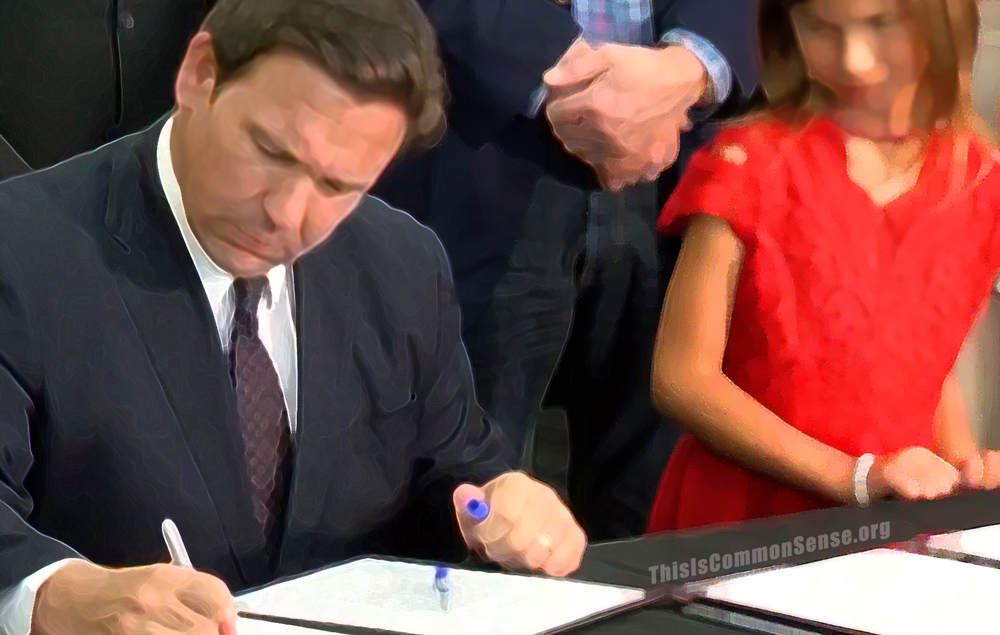
The limits passed by Florida’s legislature and signed into law by Governor Ron DeSantis are not the best one could hope for. State senators pushed for and got a 12-year limit rather than the eight-year limit preferred by house members.
Regardless, parents and children are better off with at least some legal limit on the tenure of board members and on their opportunity to abuse power — some curb in addition to the possibility of surmounting the overwhelming electoral advantages that incumbents typically enjoy.
Governor DeSantis agrees that the legislation reaching his desk should have been an eight-year limit.
“They did three terms . . . and I wouldn’t veto the bill just over that. But if it were a standalone measure, I would have insisted on just two terms for school board members because I think that’s enough time to go, serve, get stuff done.”
In 2018, the Florida Constitutional Revision Commission sent eight-year limits on school-board tenure to the voters as Amendment 8. But the Florida Supreme Court knocked the question off the ballot because the limits were combined with other measures to reform education, like more freedom for charter schools.
It is a near-certainty that voters would have passed the measure — a prospect that terrified those who benefit from rampant school-board corruption.
Sure, what has now been enacted is only a partial remedy. But it’s something.
I’m a firm believer in the philosophy that something good is better than nothing good.
This is Common Sense. I’m Paul Jacob.
See all recent commentary
(simplified and organized)
See recent popular posts

. . . bloße Erfahrung ist keine Wissenschaft.
Experience by itself is not science.
Edmund Husserl, Pure Phenomenology: Its Method and Its Field of Investigation; Inaugural Lecture at Freiburg im Breisgau (May 3, 1917); Die reine Phänomenologie, ihr Forschungsgebiet und ihre Methode.