The man
Percy Bysshe Shelley, Queen Mab (1813), Canto III.
Of virtuous soul commands not, nor obeys.
Categories
Percy Bysshe Shelley
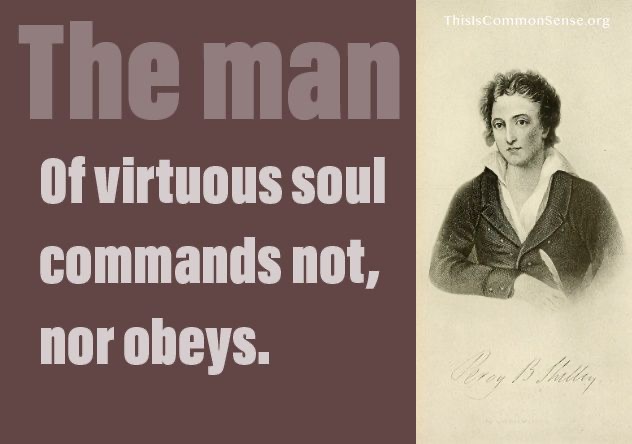
The man
Percy Bysshe Shelley, Queen Mab (1813), Canto III.
Of virtuous soul commands not, nor obeys.
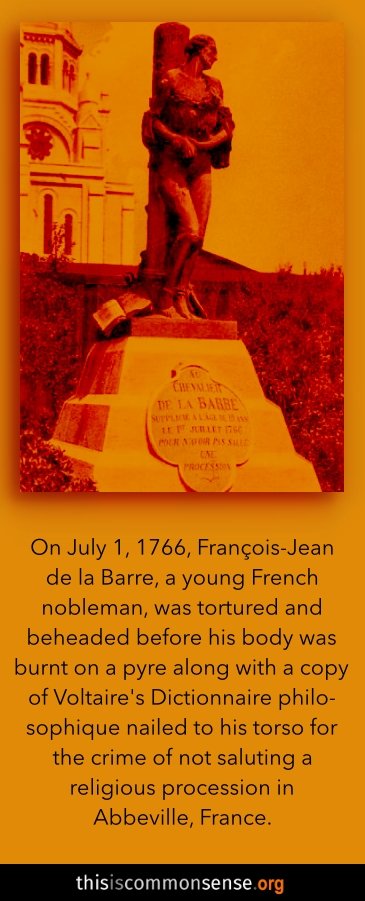
On July 1, 1766, François-Jean de la Barre, a young French nobleman, was tortured and beheaded before his body was burnt on a pyre along with a copy of Voltaire’s Dictionnaire philosophique nailed to his torso for the crime of not saluting a Roman Catholic religious procession in Abbeville, France.

Thus tweeted Gene Wu, District 137’s representative to the Texas legislature.
That was his reaction to yesterday’sSupreme Court decision striking down racial discrimination in picking students for colleges and universities.
He’s a Democrat and in a tricky situation. The case was brought to the High Court by Asian Americans, who have been most discriminated against in college placement. Rep. Wu, himself Asian American, talks up the compensatory racial preference cause.
“Asian Americans have consistently been used as a foil to eliminate Affirmative Action programs which serve to repair centuries of intentional discrimination against Black and Latino AND Asian communities,” he argues. “Having Asian Americans as parties doesn’t make it any less racist.”
Actually, of course, discriminating in favor of “Black and Latino” applicants has hurt Asian Americans’ college placements the most, and provably so. Racial discrimination was the criterion. Not academic achievement, IQ, or ability to pay. Asian Americans were the big losers.
More than whites.
But all Rep. Wu can think about is WHITE SUPREMACY. In all-caps, no less.
He worries not one whit about racial discrimination against Asians!
As absurd as what we used to call “reverse” discrimination is, we can be sure that, after this current ruling, DEI-obsessed administrators will still seek ways to continue their discrimination on the basis of race.
Also being raised? The issue of legacy admissions, rewarding with preferential treatment applicants whose parents and grandparents previously attended the institution. Senator and GOP presidential candidate Tim Scott called for public universities to nix those policies as well. Scott was joined by President Biden and AOC.
Sounds like justice and fairness based on merit is on a roll.
This is Common Sense. I’m Paul Jacob.
Illustration created with PicFinder.ai
See all recent commentary
(simplified and organized)
See recent popular posts
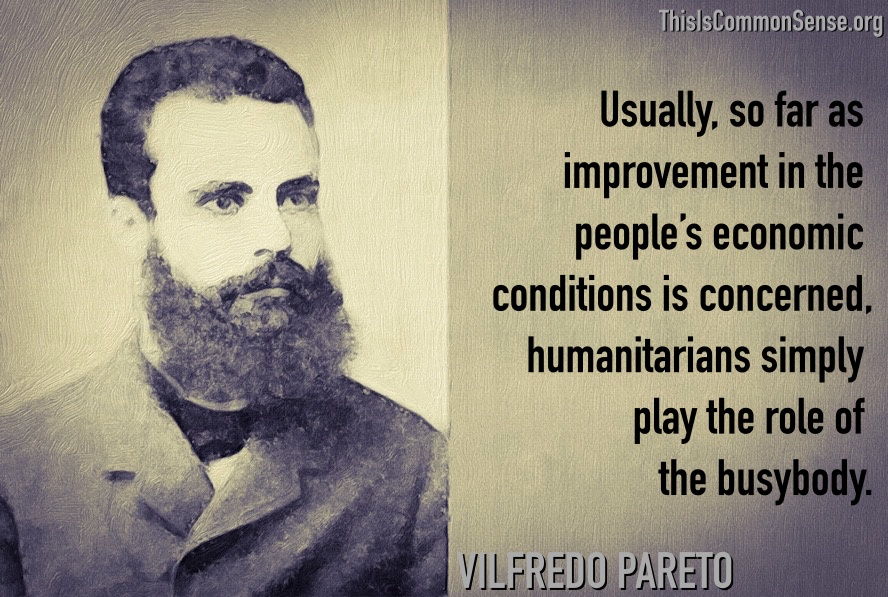
Usually, so far as improvement in the people’s economic conditions is concerned, humanitarians simply play the role of the busybody.
Vilfredo Pareto, Manual of Political Economy (1927, Ann S. Schwier, trans., 1971), p. 301.
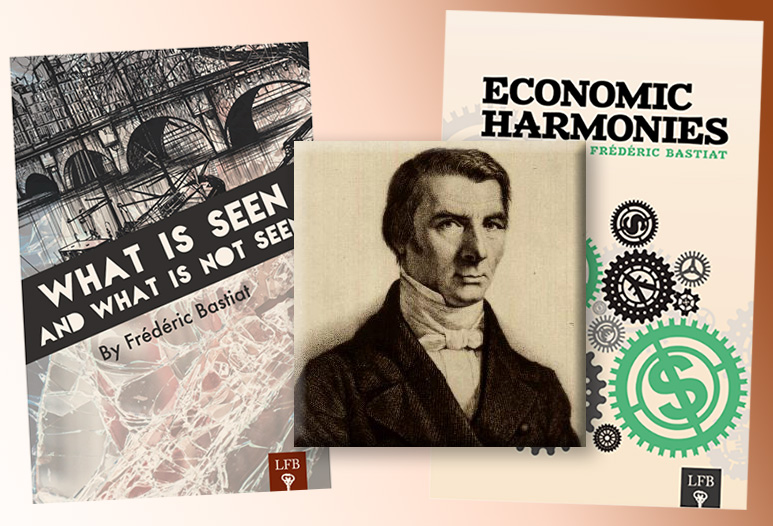
On June 30, 1801, Frédéric Bastiat was born. Bastiat became one of the most important French Liberal School economists, following Condilliac and Jean-Baptiste Say, best known for his books Economic Harmonies and Economic Sophisms and two monographs, “The Seen and the Unseen,” and “The Law.” He was a brilliant stylist and perceptive critic of state-managed trade. His influence on conservative, libertarian and “limited-government thought” has been vast. He died on Christmas Eve, 1850.
The emergency number of “999” was introduced in London, June 30, 1937, the first of its kind — arguably the best innovation in government service in modern times.

“Over the course of the Coronavirus Disease 2019 (COVID-19) pandemic, SBA disbursed approximately $1.2 trillion of COVID-19 Economic Injury Disaster Loan (EIDL) and Paycheck Protection Program (PPP) funds,” explains a report from the SBA’s Office of Inspector General. “The economic assistance was intended to help eligible small business owners and entrepreneurs adversely affected by the crisis.”
You might think that $1.2 trillion would do the job, if anything could.
But of course there was “a hitch” — it’s the thing in government we are never “without.”
The hitch was fraud.
“So far,” writes Eric Boehm at Reason, “investigations into COVID-related fraud have netted 1,011 indictments, 803 arrests, and 529 convictions. The joint efforts of the SBA, U.S. Secret Service, and other federal agencies have resulted in nearly $30 billion in COVID funds being seized or returned to SBA. . . .”
But that’s not even a quarter of it. The Inspector General’s report indicates that the SBA made 4.5 million loans to fraudulent recipients, and the full estimate of their loot is $200 billion — more than 15 percent of the total.
No mystery, though. “It is noteworthy that SBA executed over 14 years’ worth of lending within 14 days, and this was just the beginning.”
Politicians’ make-believe would have us thinking they can just command things to happen and they do. “Everything is possible.” Because, well, “government.” Or “willpower.” Or what-have-you.
Well, losing hundreds of billions is always on the table.
This is Common Sense. I’m Paul Jacob.
Illustration created with PicFinder.ai
See all recent commentary
(simplified and organized)
See recent popular posts
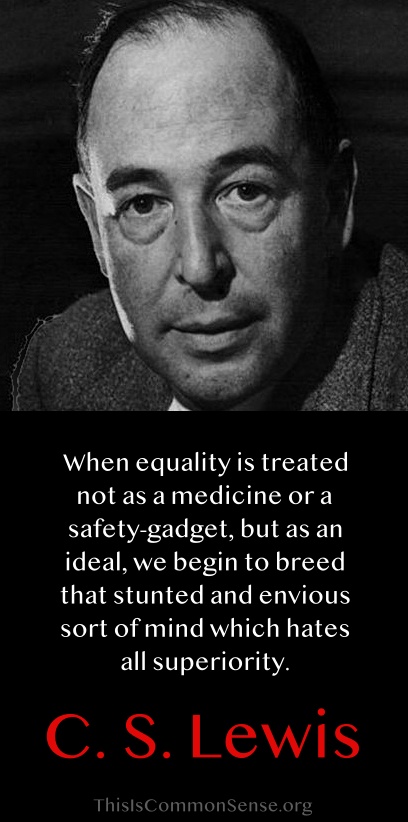
When equality is treated not as a medicine or a safety-gadget, but as an ideal, we begin to breed that stunted and envious sort of mind which hates all superiority.
Clive Staples Lewis, “Equality,” The Spectator, Vol. CLXXI (August 27, 1943).

On June 29, 1914, the day after the shooting of the Archduke Ferdinand and his wife, Austrian interrogations confirmed that the Serbian government was behind the assassination. Serbia denied involvement.
Thus continued the series of events that led to “The Great War,” now known as “World War I.”
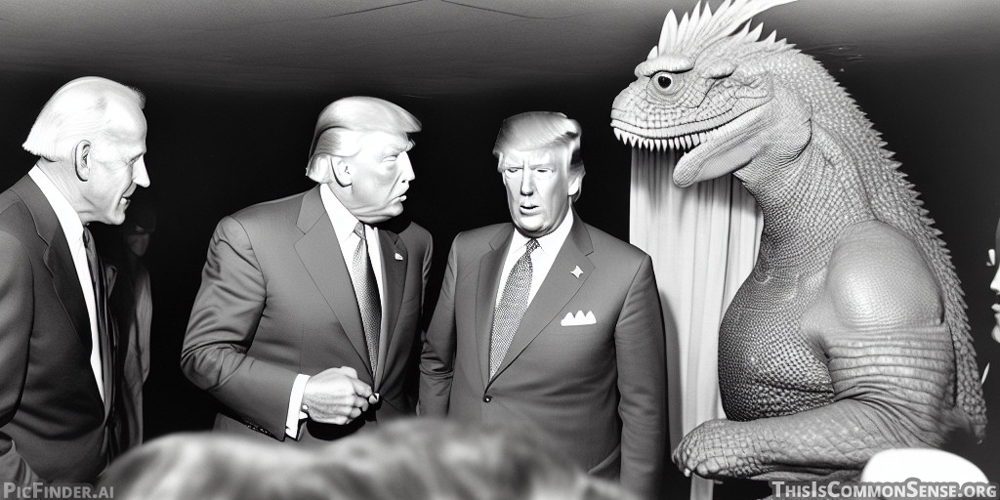
Regular readers of this column are familiar with one use of AI: images constructed to arrest your attention and ease you into an old-fashioned presentation of news and opinion, written without benefit of AI.
But our images are obviously fictional, fanciful — caricatures.
One advantage of AI-made images is that they are not copyrighted. Using them reduces expenses, and they look pretty good — though sometimes they are a bit “off,” as in the case of a Toronto mayoral candidate’s use of “a synthetic portrait of a seated woman with two arms crossed and a third arm touching her chin.”
But don’t dismiss it because it’s Canada. Examples in the article include New Zealand and Chicago and . . . the Republican National Committee, the DeSantis campaign, and the Democratic Party.
Indeed, the Democrats produced fund-raising efforts “drafted by artificial intelligence in the spring — and found that they were often more effective at encouraging engagement and donations than copy written entirely by humans.”
Yet, here we are not dealing with fakery except maybe in some philosophical sense. Think of it as the true miracle of artificial intelligence, where heuristics grab the “wisdom of crowds” and apply it almost instantaneously to specific rhetorical requirements. Astounding.
There’s a lot of talk about regulating and even prohibiting AI — in as well as out of politics. After all, science fictional scenarios featuring AI becoming sentient and attacking the human race precede The Terminator franchise by decades.
I see no way of putting the genie back in the bottle.
The AI will only get better, and if outlawed will go underground. It would be a lot like gun control, only outlaws would have AI.
We cannot leave deep fakery to the Deep State.
This is Common Sense. I’m Paul Jacob.
Illustration created with PicFinder.ai
See all recent commentary
(simplified and organized)
See recent popular posts
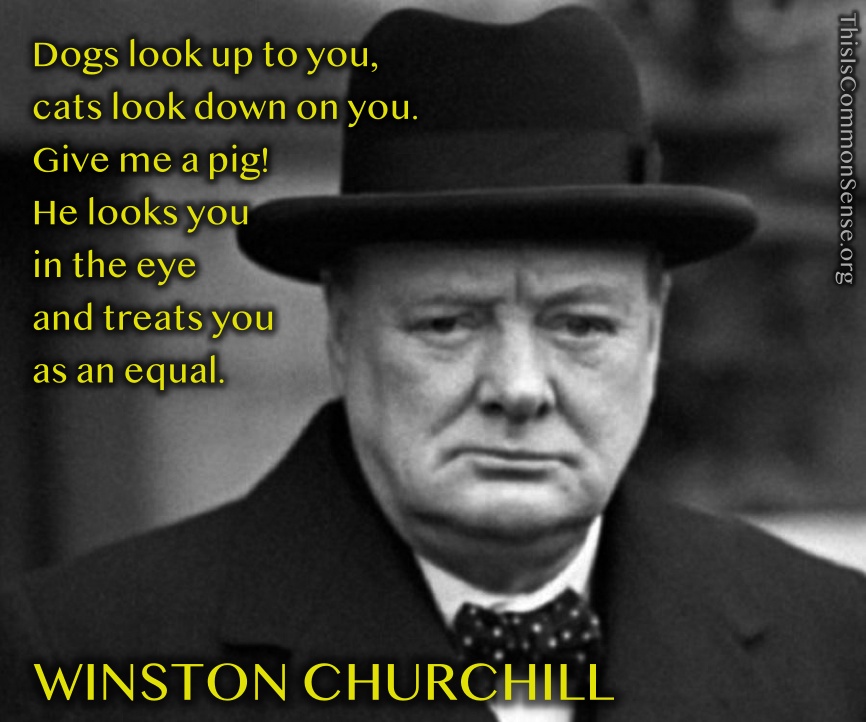
Dogs look up to you, cats look down on you. Give me a pig! He looks you in the eye and treats you as an equal.
Winston Churchill, as cited in Churchill by Himself (2008), p. 535.