On April 15, 1945, the Bergen-Belsen concentration camp was liberated.
Bergen-Belsen Liberated
On April 15, 1945, the Bergen-Belsen concentration camp was liberated.
On March 29, House Joint Resolution 7 passed with a 68–23 margin in the Senate: 47 Republicans and 21 Democrats voting Yea. Earlier this week, Joe Biden signed it into law.
But, as The Epoch Times explains, that resolution “states that the pandemic national emergency ‘is hereby terminated,’” but “does not impact the public health emergency, which is still scheduled to terminate on May 11.”
But that lag — why terminate one (“national”) emergency footing and leave the other (“public health”) to linger for another month?
It’s worse than that, though. Back in September, President Biden told 60 Minutes that the pandemic was over, noting then that “no one’s wearing masks; everybody seems to be in pretty good shape.”
The administration offers bureaucratic rationales for the lagtime. But its impact on you and me is said to be zero: “To be clear, [the] continuation of these emergency declarations until May 11 does not impose any restriction at all on individual conduct with regard to COVID-19,” explains a January letter from the Biden administration to Congress.
Repeat that: the continuation of the emergency declarations does not impose any restriction at all on individual conduct. Which should have been true from the beginning, for the Constitution does not provide any powers to the general government over individuals on these matters.
Does public health really need another month of
At least, there is a May 11th at the end of the tunnel.
This is Common Sense. I’m Paul Jacob.
Illustration created with Midjourney
See all recent commentary
(simplified and organized)
See recent popular posts
The real sin of idolatry is always committed on behalf of something similar to the State.
Simone Weil, Prelude to Politics (1943).
On April 14, 1775, the Society for the Relief of Free Negroes Unlawfully Held in Bondage, the first American organization committed to the abolition of slavery, was formed in Philadelphia.
On April 14, 1818, Noah Webster published his American Dictionary of the English Language, one of the first lexicons to include distinctly American words. The dictionary, which took him more than two decades to compile, introduced more than 10,000 “Americanisms.”
On April 14, 1988, representatives of the Soviet Union, Afghanistan, the United States, and Pakistan signed an agreement calling for the withdrawal of Soviet forces from Afghanistan. In exchange for an end to the disputed Soviet occupation, the United States agreed to end its arms support for the Afghan anti-Soviet factions, and Afghanistan and Pakistan agreed not to interfere in each other’s affairs.
Around the country, so-called representatives have repealed state legislative term limits enacted as statutes rather than constitutional amendments; gone to court to get term limits outlawed; and even, in one or two instances, ignored term limits on themselves until forced to step aside by judicial action.
I bet that even if voters enact a term limits law with a provision specifically prohibiting legislators from sending a question to the ballot to weaken or repeal voter-enacted term limits, such a prohibition would not stop lawmakers from proposing just such measures.
Well, it’s time for me to collect on the bet.
In the current legislative session, North Dakota State Representative Jim Kasper submitted a resolution, HCR 3019, to ask North Dakotans to weaken legislative term limits they’d passed just five months ago, last November. Kasper wants a limit of 12 consecutive years in a chamber instead of a lifetime limit of eight years.
What a shocker! He’d like to stay in power longer.
The law voters passed months ago states that the legislature “shall not have authority to propose an amendment to this constitution to alter or repeal” the term limits. This ability is instead “reserved to initiative petition of the people.”
It seems so clear.
Nevertheless, Kasper’s unconstitutional constitutional amendment barreled ahead in the North Dakota legislature until finally expiring in the senate just days ago.
Perhaps the new law should have included something about tarring and feathering lawmakers who try to ignore the ban on acting to undermine their term limits?
This is Common Sense. I’m Paul Jacob.
Illustration created with PicFinder.ai
See all recent commentary
(simplified and organized)
See recent popular posts
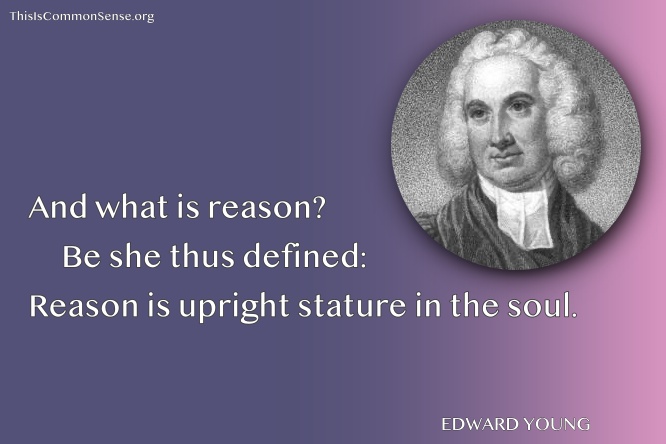
No man who ever held the office of president would congratulate a friend on obtaining it.
John Adams, as quoted in Fred R. Shapiro, The Yale Book of Quotations (2006).
On April 13, 1743, Thomas Jefferson was born. Author of Notes on the State of Virginia and the first draft of the United States’ Declaration of Independence, Jefferson was also a scientist, philosopher, inventor, diplomat, and American politician. He also composed music, designed buildings, and translated works from his favorite French writers, whom he had met in his diplomatic missions to Paris: Volney and de Tracy.
The “difficult moment” she refers to? A talk on campus by All-American swimmer Riley Gaines, sponsored by Turning Point USA. Gaines was speaking out against “transgender women” (biological men) competing in women’s sports.
President Mahoney did finally acknowledge that the event was followed by “a disturbance,” which “unfortunately” “delayed the speaker’s departure.”
In fact, Gaines wasn’t able to leave for hours, until nearly midnight . . . when, as CNN reported, “the San Francisco Police Department sent officers to disperse the crowd.” Gaines says she was “physically assaulted,” “struck twice,” with video confirming a very threatening situation.
“We are reviewing the incident,” Mahoney assured, “and, as always, will learn from the experience.”
No arrests have been made. They should be. That’s the teachable moment we need.
SFSU’s president did acknowledge that what occurred last week was “deeply traumatic.” But she meant the event itself, which she claimed “advocated for the exclusion of trans people in athletics.”
That isn’t true. Gaines and many (if not most) folks involved in the controversy simply want collegiate sports separated by biological sex and not by gender identity.
Let’s realize that these Antifa-esque “trans activists,” the ones who threaten to beat up women, do not speak for all transgendered people — certainly not those I know and love. Their goal is clearly not harmony but the very opposite.
The solution is simple: Love for trans folks, common sense public policies, and jail for the thug attackers of free speech.
I’m Paul Jacob.
Illustration created with PicFinder.ai
See all recent commentary
(simplified and organized)
See recent popular posts
La lutte elle-même vers les sommets suffit à remplir
un cœur d’homme; il faut imaginer Sisyphe heureux.
The struggle itself toward the heights is enough to fill a man’s heart. One must imagine Sisyphus happy.
Albert Camus, The Myth of Sisyphus (1942).
On April 12, 1914, American economist Armen Alchian was born. His contributions to economic theory and teaching were many and varied — his textbook, co-authored with William R. Allen, University Economics (also titled Exchange and Production), was widely considered one of the finest intermediate texts in microeconomics — but he remains perhaps best known for his work on property rights.
Alchian died in 2014, in late February, at the age of 99.