Categories
Thought

Courcelle-Seneuil

Le sacrifice que l’on fait en employant une chose à un usage plutôt qu’à un autre, c’est le sacrifice de l’utilité qu’on aurait pu retirer de cet autre usage.  

Ainsi, quand on emploie un capital à construire une maison d’habitation, on renonce à l’intérêt qu’il aurait rapporté s’il avait été placé en valeurs publiques ou prêté à intérêt; quand on emploie un terrain à la rente qu’on aurait pu en tirer en le louant ou en le cultivant autrement.  

Le vrai coût d’une chose, par conséquent, ce n’est pas seulement le travail qu’elle a exigé, c’est encore tout ce à quoi on a renoncé pour l’obtenir.

Jean Gustave Courcelle-Seneuil (December 22, 1813 – June 29, 1892), Traité théorique et pratique d’économie politique (1858, volume I, chapter VIII, § 144–145). Here the eminent diplomat and economist presented the powerful concept known over a decade later in Austrian literature as “opportunitätskosten” and more than half a century before it became common in English as “opportunity cost.”
Categories
Today

John Brown’s Last

John Brown was executed in Charles Town, Virginia (now West Virginia) for his role in the raid on the federal arsenal at Harpers Ferry, on December 2, 1859. Brown was tried and hanged alone, though others involved in the raid faced execution later.

Categories
Accountability ideological culture subsidy

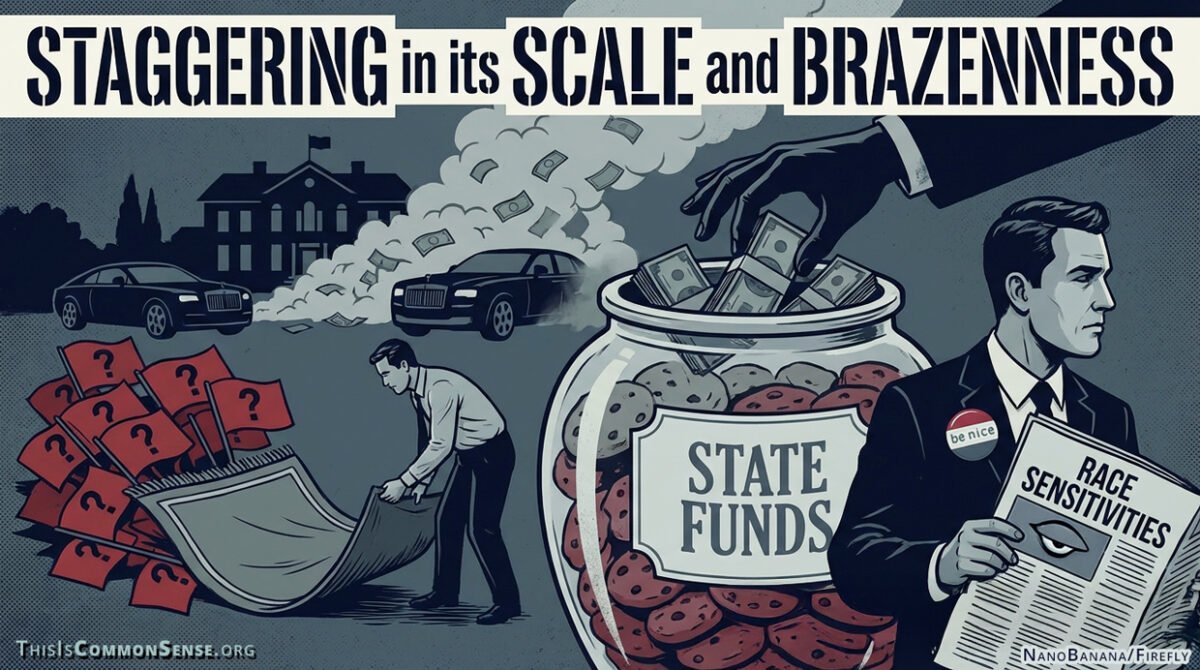
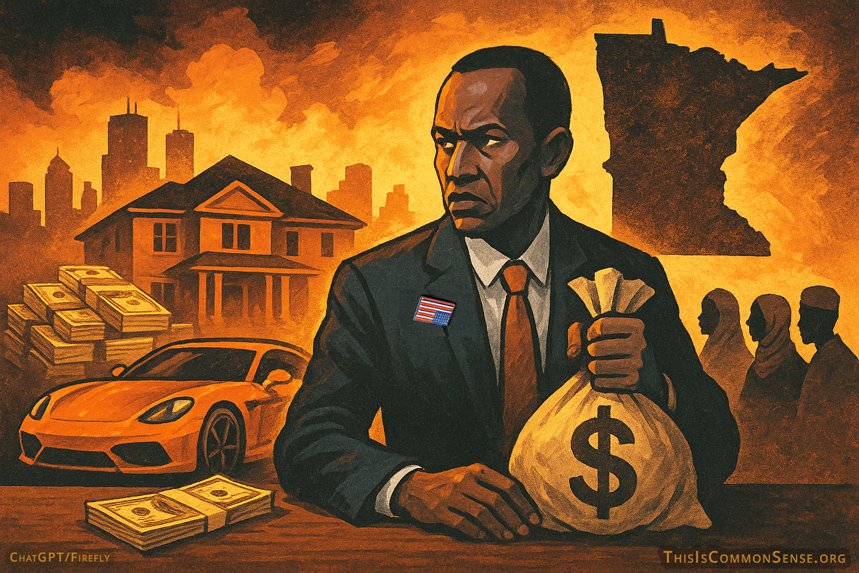
Red-Flagged Welfare Fraud

“Staggering in its scale and brazenness.” 

That’s how The New York Times describes the more than $1 billion in fraud that “took root in pockets of Minnesota’s Somali diaspora as scores of individuals made small fortunes by setting up companies that billed state agencies for millions of dollars’ worth of social services that were never provided.”

Quite a lucrative business model: Stealing from programs to prevent homelessness and keep children fed during the pandemic, the crooks instead “spent the funds on luxury cars, houses and even real estate projects abroad.” 

So far, prosecutors have convicted 59 people, with “all but eight of the 86 people charged” of “Somali ancestry.”

According to Ryan Pacyga, an attorney representing several defendants, The Times reports that “some involved became convinced that state agencies were tolerating, if not tacitly allowing, the fraud.”

What?

“No one was doing anything about the red flags,” argues Pacyga. “It was like someone was stealing money from the cookie jar and they kept refilling it.”

Why was nothing done?

Well . . . the federal prosecutor contends that what The Times calls “race sensitivities” (read: fear of being called racist) were “a huge part of the problem.” 

One former fraud investigator, a Somali American named Kayseh Magan, blames “the state’s Democratic-led administration” which was “reluctant to take more assertive action in response to allegations in the Somali community.”

“There is a perception that forcefully tackling this issue might cause political backlash among the Somali community,” Magan explains, “which is a core voting bloc.” 

For Democrats.

Very expensive votes.

This is Common Sense. I’m Paul Jacob.


PDF for printing

Illustrations created with ChatGPT, NanoBanana and Firefly

See all recent commentary
(simplified and organized)
See recent popular posts

Categories
Thought

Yves Guyot

Progress is in inverse ratio to the coercive action of man on man, in direct ratio to his command over things. The Protectionist, by trying to prevent his countrymen from consuming what they choose, wishes to remove them from the effects of all external progress, and when he gains his ends he may indeed find the most extravagant conceptions of Swift pale before the irony of his creation.

Yves Guyot, The Comedy of Protection, 1906, viii.

Categories
Today

A Corrupt Bargain?

The “Stolen Election” of 1824: Since no candidate had received a majority of the total electoral college votes in the election, the United States House of Representatives was given the task, on December 1, 1824, of deciding the winner of that year’s presidential race in accordance with the Twelfth Amendment to the United States Constitution. The congressional vote took place on February 9, 1825 — the only time in U.S. election history that Congress decided an election in accordance with the Twelfth Amendment.

Democratic candidate Andrew Jackson was none too pleased about Congress’s selection of John Quincy Adams over himself, despite his winning the greatest number of estimated popular and official Electoral College votes. He charged Henry Clay and Adams with having struck a “Corrupt Bargain,” and campaigned for four years on the grievance of a “stolen election.”

Categories
Update

The Venezuela War

President Donald John Trump’s blowing up of Venezuelan boats on the high seas have not been just here and there, one or two . . . as an Epoch Times article’s title and blurb ably elaborates: “Trump Declares Venezuelan Airspace Closed as US Intensifies Pressure on Maduro” (November 29, 2025), and

The United States has carried out at least 21 lethal strikes on suspected drug-smuggling vessels since September, killing more than 80 alleged traffickers.

The USS Gerald R. Ford arrived in the Caribbean mid-month, and “Operation Southern Spear” is well underway with 12,000 troops and a dozen or so ships in play.

Trump signaled the possibility of expanded operations earlier this week, telling U.S. troops on Nov. 27 that American forces may soon conduct ground actions targeting drug-trafficking routes inside Venezuela. He praised the work of the Air Force’s 7th Bomb Wing in deterring maritime smuggling, saying traffickers have increasingly shifted away from sea routes.

“You probably noticed that people aren’t wanting to be delivering by sea, and we’ll be starting to stop them by land also,” the president said.

“Venezuela’s foreign ministry has accused the U.S. of trying to manufacture a pretext for military escalation,” The Epoch Times story goes on to explain. Since this war has been a ramping up of the War on Drugs, of which Donald Trump has long been a fan, the accusation looks plausible.

Senator Rand Paul (R.-Ky.) has offered his warning:

There are undoubtably war-hungry voices in Washington.

If the administration enters into an invasion of Venezuela or sends more Ukraine aid, it would be detrimental to the party, and would reopen the same divisions we are still trying to mend.

Categories
Thought

Wilson Sy

Macro-data during the COVID-19 pandemic in the United Kingdom (UK) are shown to have significant data anomalies and inconsistencies with existing explanations. This paper shows that the UK spike in deaths, wrongly attributed to COVID-19 in April 2020, was not due to SARS-CoV-2 virus, which was largely absent, but was due to the widespread use of Midazolam injections which were statistically very highly correlated (coefficient over 90 percent) with excess deaths in all regions of England during 2020. Importantly, excess deaths remained elevated following mass vaccination in 2021, but were statistically uncorrelated to COVID injections, while remaining significantly correlated to Midazolam injections. The widespread and persistent use of Midazolam in UK suggests a possible policy of systemic euthanasia. Unlike Australia, where assessing the statistical impact of COVID injections on excess deaths is relatively straightforward, UK excess deaths were closely associated with the use of Midazolam and other medical intervention. The iatrogenic pandemic in the UK was caused by euthanasia deaths from Midazolam and also, likely caused by COVID injections, but their relative impacts are difficult to measure from the data, due to causal proximity of euthanasia.

Wilson Sy, Director, Investment Analytics Research, Australia, “Excess Deaths in the United Kingdom: Midazolam and Euthanasia in the COVID-19 Pandemic” (February 15, 2024).
Categories
Today

Ending the American Revolution

On November 30, 1782, representatives from the United States and Great Britain signed preliminary peace articles, drafted in Paris, France. These were later formalized as the 1783 Treaty of Paris.

Categories
Update

A Third 2025 Milestone?

Senator Rand Paul stated an obvious possibility, the other day: soon the U.S. federal government’s official debt will roll over another trillion dollar mark, to $39 trillion.

His Thanksgiving message was not unrelated to the debt:

And there was a follow-up poll:

Speaking of time, the $36 trillion mark was hit a year ago, in late November.

The $37 and $38 trillion marks both hit this year. Will we squeeze a third trillion dollar mark in for 2025? No, if the Congressional Budget Office’s predictions are correct. The CBO expects the debt will rise above $39 trillion in mid-2026, with $40 trillion achieved later in the year.

Categories
Thought

Denis Diderot

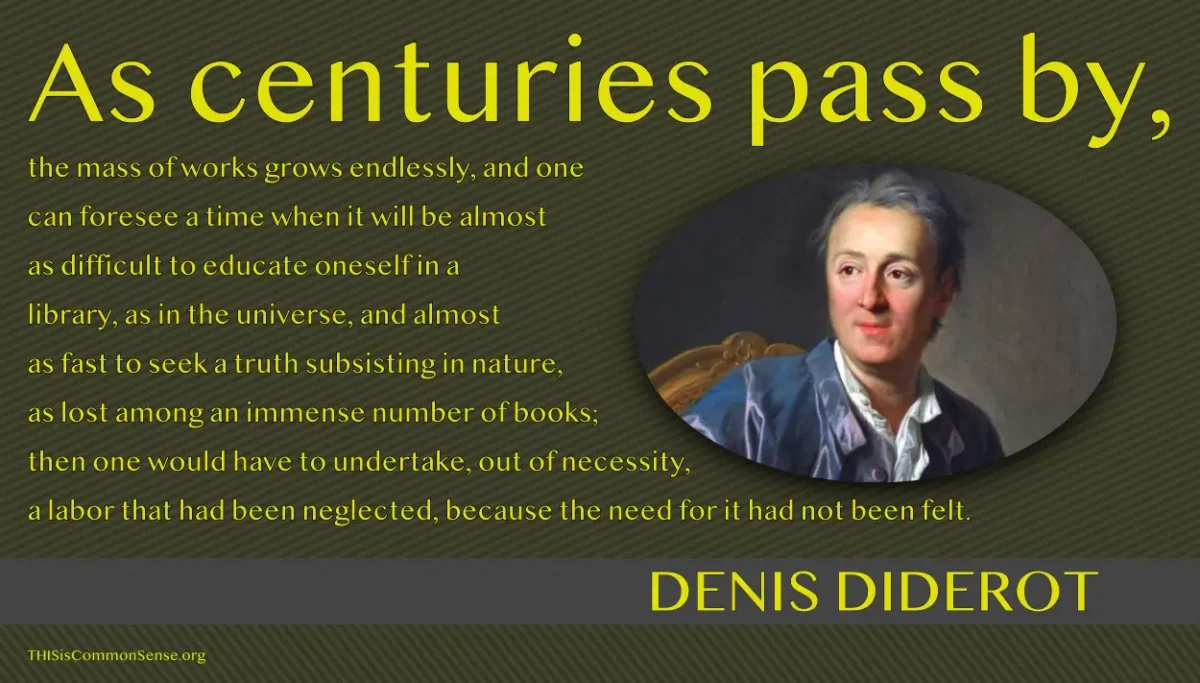
As centuries pass by, the mass of works grows endlessly, and one can foresee a time when it will be almost as difficult to educate oneself in a library, as in the universe, and almost as fast to seek a truth subsisting in nature, as lost among an immense number of books; then one would have to undertake, out of necessity, a labor that had been neglected, because the need for it had not been felt.
If we think of the image of literature in times before the invention of printing, we see a small number of men of genius busy creating, and a countless throng of workers busy transcribing. If we anticipate centuries to come, and think of the image of literature once printing, which never rests, has filled huge buildings with books, we will find it once more split into two classes of men. There will be those who read little and immerse themselves in new research or what they take to be new (for if we already are ignorant of part of what is contained in so many books published in all sorts of languages, we will know still far less about what is in those books increased a hundred-, a thousand-fold); the others, workmen incapable of producing anything, will be busy leafing through those books night and day, and separating out what they deem worthy of being anthologized and preserved. Is this prediction not already being fulfilled?

Denis Diderot, “Encyclopédie,” in Encyclopédie, ou dictionnaire raisonné des sciences, des arts et des métiers, Vol. 5 (1755), pp. 635–648A.