It is the spirit of the age to believe that any fact, however suspect, is superior to any imaginative exercise, no matter how true.
Gore Vidal, “French Letters: Theories of the New Novel,” Reflections Upon a Sinking Ship (1969).
Gore Vidal
It is the spirit of the age to believe that any fact, however suspect, is superior to any imaginative exercise, no matter how true.
Gore Vidal, “French Letters: Theories of the New Novel,” Reflections Upon a Sinking Ship (1969).
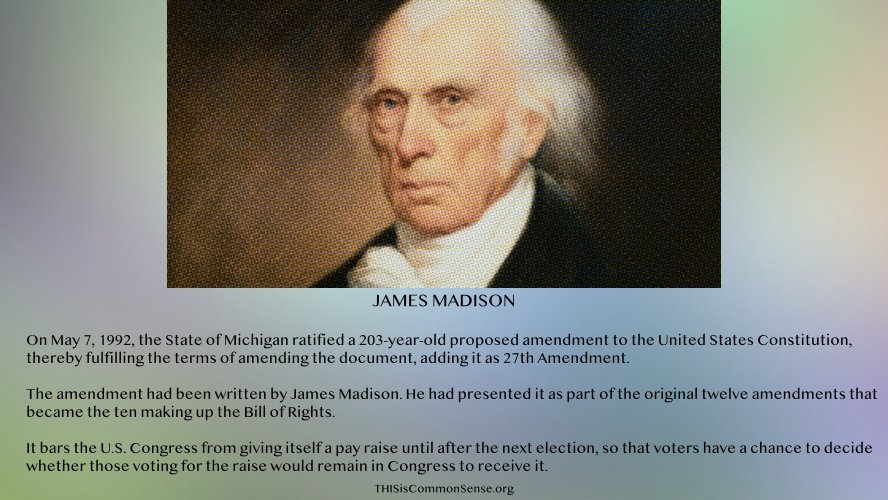
On May 7, 1992, the State of Michigan ratified a 203-year-old proposed amendment to the United States Constitution, thereby fulfilling the terms of amending the document, adding it as the 27th Amendment.
The amendment had been written by James Madison. He had presented it as part of the original twelve amendments that became the ten making up the Bill of Rights.
It bars the U.S. Congress from giving itself a pay raise until after the next election, so that voters have a chance to decide whether those voting for the raise would remain in Congress to receive it.
The alleged reason for the censure? Her post mentioned the winner of a girls’ track championship who is publicly known to be the winner and publicly known to be male.
Censuring Libby for stating her views would be bad enough. But the legislature went beyond putting its disapproval (or the Democratic majority’s disapproval) on record.
Representative Libby isn’t being allowed to speak as a representative during session. And she’s not being allowed to vote until she apologizes.
For stating her views on a public question.
Nor was she even allowed to defend herself when the House voted along party lines 75-70 to censure her.
This qualifies as tyranny, another mile down the slippery slope of eroding — or dynamiting — democratic norms and practices. The tyranny is not that of an autocrat but of the majority. In this case, the tyranny of a majority of partisans in a legislature.
It is also an attack on free speech. As the Foundation for Individual Rights and Expression observes, people elect representatives to “vote according to their conscience and express themselves freely on controversial topics.”
Rightly, Laurel Libby has refused to remove the Facebook post criticizing the policy of the Maine Principals’ Association. Wrongly, her constituents continue to be deprived of her voice and vote in the legislature.
She is asking the U.S. Supreme Court to redress this injustice. Let it act, and fast.
This is Common Sense. I’m Paul Jacob.
Illustration created with Midjourney and Firefly
See all recent commentary
(simplified and organized)
See recent popular posts
Generally the fraud starts out small, and they try to hide it. But then, year after year, if nobody stops the fraud, it gets more and more brazen, and every year it gets bigger, until they’re literally renting out stadiums.
Elon Musk, in conversation with Fox News host Jesse Watters, clarifying why DOGE altered Treasury’s payout system, requiring a receipt before payment is made. This discussion referred to a four billion dollar Department of Education fund. “Fraud at Scale,” May 1, 2025.
On May 6, 1862, American author, philosopher and abolitionist Henry David Thoreau died, after many years of tuberculosis.
Aware he was dying, Thoreau spoke his last words: “Now comes good sailing,” followed by two lone words, “moose” and “Indian.” Bronson Alcott planned the service and read selections from Thoreau’s works, and Ralph Waldo Emerson wrote the eulogy spoken at his funeral.
His remains, as well as those of members of his immediate family, were eventually moved to Sleepy Hollow Cemetery in Concord, Massachusetts.
His most famous works are An Essay on Civil Disobedience (1849) and Walden (1854).
“We are doing all that we can and more to ensure — as the facts show in all of our states — that only U.S. citizens are voting.”
Problem is, Secretary Benson did not ensure that only U.S. citizens voted in Michigan. Under her stewardship, we now know that noncitizens did indeed vote.
Last November, a Chinese student at the University of Michigan registered and voted. The reason we know this is that the foreign student apparently thought better of it and asked officials for his ballot back.
Too late, though, for Haoxiang Gao’s vote had already been counted. Last week, Gao missed a court hearing and a bench warrant was issued for his arrest. (Will Beijing send him back to stand trial?)
Since that one, lone, incredibly rare, don’t-worry-your-pretty-little-head-about-it incident, officials have discovered another 15 votes cast by noncitizens.
Also last week in Michigan, House Joint Resolution B was defeated. This measure would have clarified only citizens as eligible voters, requiring proof of citizenship to register to vote and photo ID to vote. Democrats, including Secretary Benson (now a candidate for governor), opposed it fiercely.
Yet, you guessed it, something else happened last week: Americans for Citizen Voting-Michigan filed an initiative petition to place the Citizen Only Voting Amendment, passed overwhelmingly so far in 14 states, on the ballot in the Great Lakes State. Polling back in January showed 82 percent of likely voters favor the measure.
“Leaving holes in the process that easily allow noncitizens to vote disenfranchises citizens,” said Kurt O’Keefe, the committee’s treasurer. “We need to make sure that only U.S. citizens can vote in our elections. This initiative does the job.”
This is Common Sense. I’m Paul Jacob.
Note: I’m the national chairman of Americans for Citizen Voting.
Illustration created with Krea and Firefly
See all recent commentary
(simplified and organized)
See recent popular posts

There is something about a bureaucrat that does not like a poem.
Gore Vidal, Reflections Upon a Sinking Ship (1969).
On May 5, 1821, Napoleon Bonaparte, former emperor of France, died in exile on the island of Saint Helena in the South Atlantic Ocean.
On the Fifth of May, 1945, a Fu-Go balloon bomb launched by the Japanese Army killed six people near Bly, Oregon.
On May 5, 2023, the World Health Organization declared the end of the global health emergency that was the COVID-19 pandemic.
“Federal red ink now costs businesses more than $2.1 trillion per year, report says,” an article in The Washington Times tells us.
The cost of federal regulations has grown to more than $2.1 trillion per year, almost as much as the government’s annual haul from income taxes, according to a report released Thursday.
The report, released by the Competitive Enterprise Institute and titled “Ten Thousand Commandments,” outlined how the annual cost of red ink has steadily risen due to decisions made by presidents and Congress that impose new requirements and paperwork on businesses.
Mallory Wilson, “Federal red ink now costs businesses more than $2.1 trillion per year, report says,” The Washington Times (April 24, 2025).
“American households were found to pay on average more than $16,000 annually in these hidden regulatory taxes, which eat up 16% of income and 21% of household expenses,” Mallory Wilson reports. “That total exceeds household spending on health care, food, transportation, entertainment, apparel, services and savings, and is higher only than the cost of housing.”
The report is by Clyde Wayne Crews, Jr., and is the 2025 update of CEI’s ongoing coverage of the federal regulatory burden.
One of the most interesting sections of the report is near the very end:
Article I of the Constitution notwithstanding, administrative agencies, not Congress, do most of America’s lawmaking. Congress enacts weighty legislation but delegates the details to agencies. Agencies welcome this delegation and can use it to add to their powers in ways that often go beyond congressional intent.
This imbalance gives rise to the Unconstitutionality Index. The index is the ratio of rules issued by agencies to laws Congress passes.
The index is the featured image (see above) for this Update. Not a lot has changed in Washington — according to this measure, anyway — with the biggest increase in the number of regulations occurring in the first year of President Joe Biden’s term in office.
The only wisdom I think I’ve attained is the wisdom to be skeptical of other people’s ideology and other people’s arguments. I tend to be a skeptic, I don’t like dogmatic approaches by anybody. I don’t like intolerance and a dogmatic person is intolerant of other people.
Joseph Heller, in an interview for the Australian Broadcasting Corporation: “Joseph Heller — Closing Time” (1998) by Ramona Koval.