On April 3, 1968, Martin Luther King, Jr., delivered his “I’ve Been to the Mountaintop” speech.
Categories
To the Mountaintop

On April 3, 1968, Martin Luther King, Jr., delivered his “I’ve Been to the Mountaintop” speech.
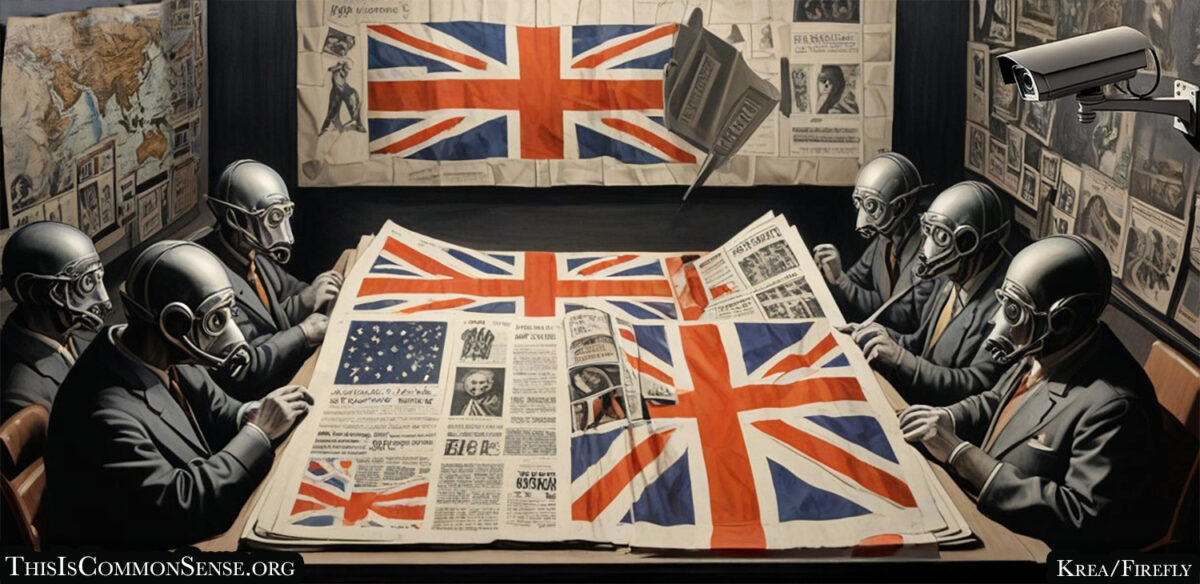
Starmer’s Labour government wants the whole world to obey its censorship demands. The latest is that its Office of Communications, called Ofcom, is threatening the American social media platforms Gab and Kiwi Farms with mega-steep fines for unwaveringly safeguarding the freedom of speech of users.
Which of course Gab and Kiwi Farms have every right to do.
Ofcom says it’ll sock Gab with fines of up $23 million USD for refusing to censor its users per UK orders.
“We will not pay one cent,” says Gab CEO Andrew Torba.
Gab is not only not cooperating with Ofconjob’s insanity, it has also reported the Starmer government to the U.S. Trade Representative and the U.S. Department of Justice in hopes that the U.S. government will retaliate against the United Kingdom for trying to gag social media in the United States.
Kiwi Farms, threatened with the same fine of up to 10 percent of worldwide revenue, is telling UK users who want to use the site to access it through a VPN or Tor in order to protect their online traffic and disguise which country they’re from. Otherwise, they’re out of luck.
Kiwi has also reported success in obtaining pro bono counsel for dealing with “the UK’s attempts to enforce its censorship regime in the United States.”
As the U.S. president famously said in Butler, Pennsylvania: “Fight! Fight! Fight!”
This is Common Sense. I’m Paul Jacob.
Illustration created with Krea and Fireflly
See all recent commentary
(simplified and organized)
See recent popular posts
Trouble comes looking for you if you’re a fool.
Gregory Benford, “To the Storming Gulf”(Fantasy & Science Fiction, April 1985).
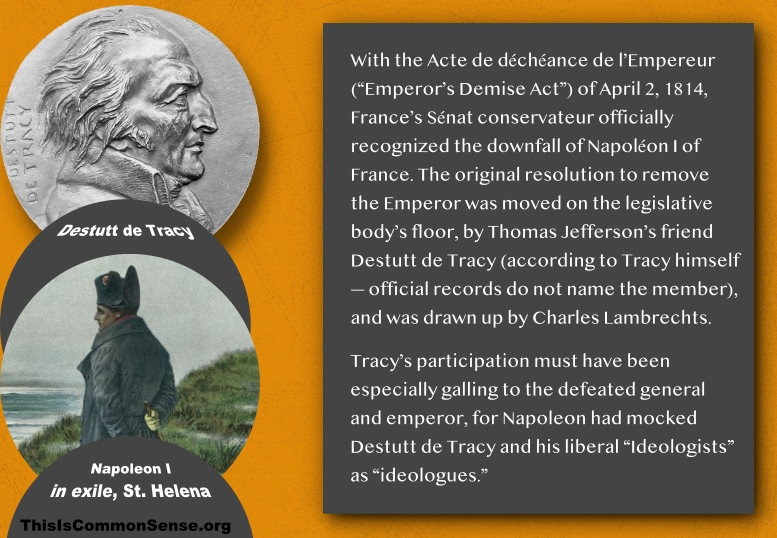
With the Acte de déchéance de l’Empereur (“Emperor’s Demise Act”) of April 2, 1814, France’s Sénat conservateur officially recognized the downfall of Napoléon I of France. The original resolution to remove the Emperor was moved on the legislative body’s floor, by Thomas Jefferson’s friend Destutt de Tracy (according to Tracy himself — official records do not name the member), and was drawn up by Charles Lambrechts. The final paragraph summarized the new reality concisely:
The Senate declares and decrees as follows: 1. Napoleon Buonaparte is cast down from the throne, and the right of succession in his family is abolished. 2. The French people and army are absolved from their oath of fidelity to him. 3. The present decree shall be transmitted to the departments and armies, and proclaimed immediately in all the quarters of the capital.
Nine days later, after attempting to put his son on the throne, Napoléon abdicated unconditionally. The Allies exiled him to Elba, which was to be the whole extent of this reign as “Emperor.”
This arrangement proved unstable, with Napoléon staging a comeback, eventually leading to more war, his defeat at Waterloo, and his exile to an island in the South Atlantic.
American author, art critic, and commentator Camille Paglia was born April 2, 1947.
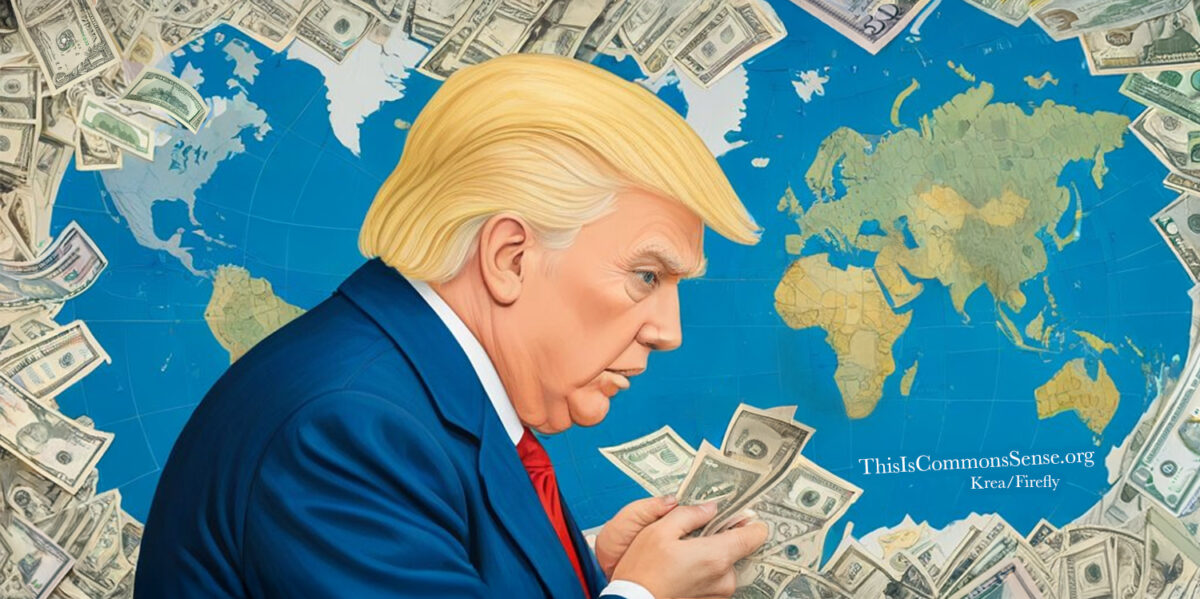
In “Tariffs Are Awful, But The Income Tax May Be Worse,” economist Walter Block seems less confused. “Donald Trump supports them on the ground that the McKinley administration was prosperous, and relied upon tariffs,” Walter’s Eurasia Review op-ed posits. Our free-market economist notes that this rests on a fallacy: “since A precedes B, A must be the cause of B.”
Professor Block offers a better “historical episode to shed light on this matter, the Smoot-Hawley Tariff of 1930.” You know, the tariff hike that worsened the Great Depression.
The best part of Walter Block’s refutation, however, follows his explanation of the Law of Comparative Advantage. He discusses the gains to our economy if the expert workers Trump fires from the IRS were to find work in the private sector.
And, contemplating the idea of switching from income taxes to tariffs, our widely-published octogenarian notes that “it takes relatively little labor to run a tariff system. Hey, we already have tariffs in place. An increase in their level would hardly call for much more manpower, likely hardly any more at all.” The gains of nixing income taxes would be vast; the harms of higher tariffs would be comparatively minuscule.
An interesting argument? Sure. But I don’t see politicians giving up the income tax any time soon.
This is Common Sense. I’m Paul Jacob.
Illustration created with Krea and Firefly
See all recent commentary
(simplified and organized)
See recent popular posts
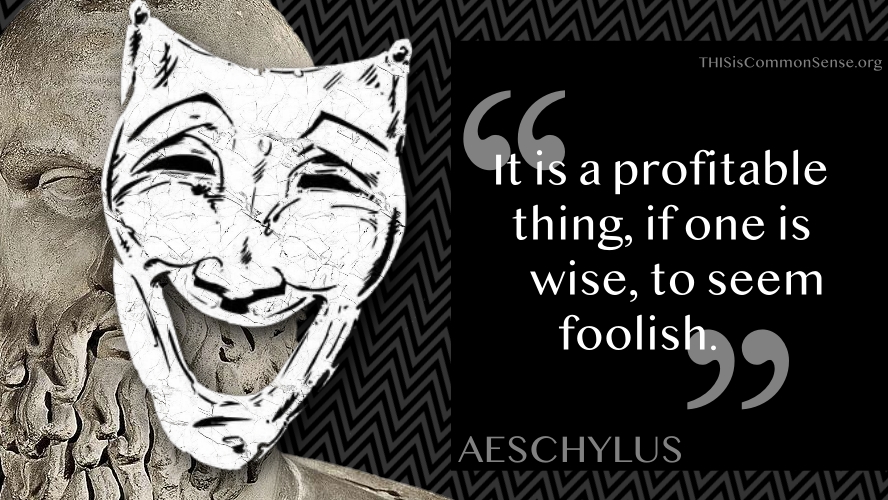
It is a profitable thing, if one is wise, to seem foolish.
Aeschylus, Prometheus Bound (c. 478 BC), David Grene translation.
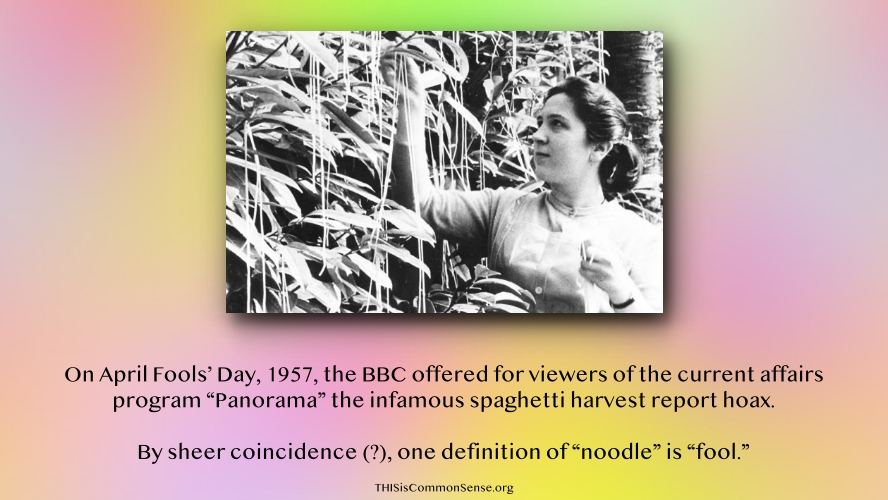
On April Fools’ Day, 1957, the BBC offered for viewers of the current affairs program “Panorama” the infamous spaghetti harvest report hoax.
By sheer coincidence (?), one definition of “noodle” is “fool.”

“Her only known activism,” the Associated Press relates her friends saying, “was co-authoring an op-ed in a student newspaper that called on Tufts University to engage with student demands to cut ties with Israel.”
A federal judge is now preventing her deportation.
Citing those who “want to participate in movements that are involved in doing things like vandalizing universities, harassing students, taking over buildings, creating a ruckus,” is how Rubio explained the rationale for the ousting. “We gave you a visa to come and study and get a degree, not to become a social activist, to tear up our university campuses.”
But there’s the rub, isn’t it?
Obviously, those who “tear up” by committing acts of violence and intimidation, breaking our laws, should be deported.
Yet, what about those merely speaking or writing words — whether you like them or loathe them, or their speaker — that tear up the university’s status quo in the minds of listeners? Or might, if allowed voice?
Any “alien” in our country legally has a First Amendment right to speak. Even our Highest Court has so ruled.
The Trump administration appears to have vast legal authority to remove aliens from U.S. soil . . . except perhaps the way they’re doing it. Deportation cannot be a selective punishment for speech, which is protected.
“America was built on free speech, so if we don’t have that, then what?” said Carina Kurban, a Lebanese American, at a recent rally in defense of Ozturk. “Then where do we go?”
This is Common Sense. I’m Paul Jacob.
Illustration created with Krea and Firefly
See all recent commentary
(simplified and organized)
See recent popular posts
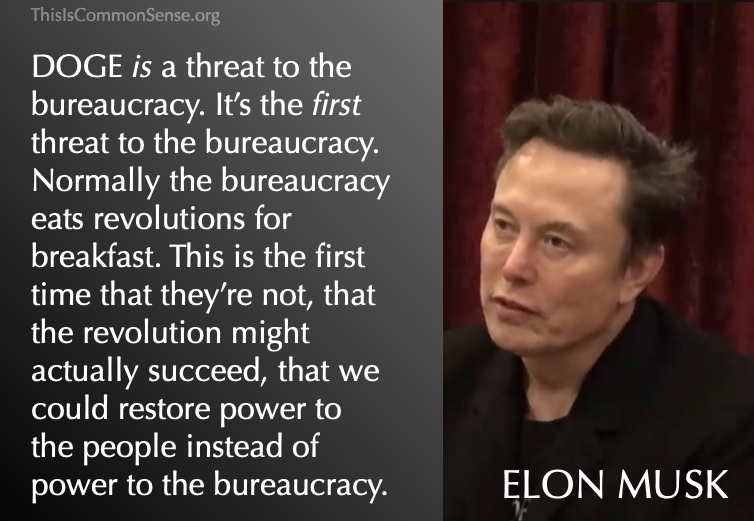
DOGE is a threat to the bureaucracy. It’s the first threat to the bureaucracy. Normally the bureaucracy eats revolutions for breakfast. This is the first time that they’re not, that the revolution might might actually succeed, that we could restore power to the people instead of power to the bureaucracy.
Elon Musk, Joe Rogan Experience (#2281, 2025).

On March 31, 1717, a sermon on “The Nature of the Kingdom of Christ,” by Benjamin Hoadly, the Bishop of Bangor, provoked the Bangorian Controversy.
The sermon’s text was John 18:36, “My kingdom is not of this world,” and from that Hoadly deduced — supposedly at the request of King George I himself, who was present in the assembly — that there was no Biblical justification for any church government. Hoadly identified the church with the kingdom of Heaven, noting that Christ had not delegated His authority to any representative.
King George’s preference for the Whig Party, and for latitudinarianism in ecclesiastical policy, is widely thought to have been a strategic maneuver to degrade church power in political government.