 [E]very individual spontaneously tries to find the place and the trade in which he can best increase National gain, if laws do not prevent him from doing so.
Every man seeks his own gain. This inclination is so natural and necessary that all Communities in the world are founded upon it. Otherwise Laws, punishments and rewards would not exist and mankind would soon perish altogether. The work that has the greatest value is always best paid, and what is best paid is most sought after.
As long as I can produce 6 Daler worth of goods a day in one trade, I do not willingly change to another that brings in 4. In the former case the Nation’s gain and mine was one-third more than in the latter.
It is thus undoubtedly a loss to the Nation when somebody is forced or is encouraged by public rewards to work in a trade other than the one in which he earns the highest profit; for this does not happen without such inducements, just as a merchant does not sell his Wares for less than what is offered him.
If he whose work someone has been forced to do gains as much as the worker has lost, it is not National gain; but if he gains more, only the difference is the gain of the Nation, but obtained through the oppression of its citizens.

 The problem with socialism is that you eventually run out of other people’s money.
 Harriett Beecher Stowe’s “Uncle Tom’s Cabin” begins its ten-month serialization in the National Era, an abolitionist publication, on this date in 1851.
 [T]he most important change which extensive government control produces is a psychological change, an alteration of the character of the people. This is necessarily a slow affair, a process which extends not over a few years but perhaps one or two generations. The important point is that the political ideals of a people and its attitude toward authority are as much the effect as the cause of the political institutions under which it lives. This means that . . . even a strong tradition of political liberty is no safeguard if the danger is precisely that new institutions and policies will gradually undermine and destroy that spirit.
  Henry Ford puts his first “quadricycle” through a test run on June 4, 1896. Ford would go on to transform transportation by applying the principles of the assembly line to automobile production, which would transform American life . . . and the world.
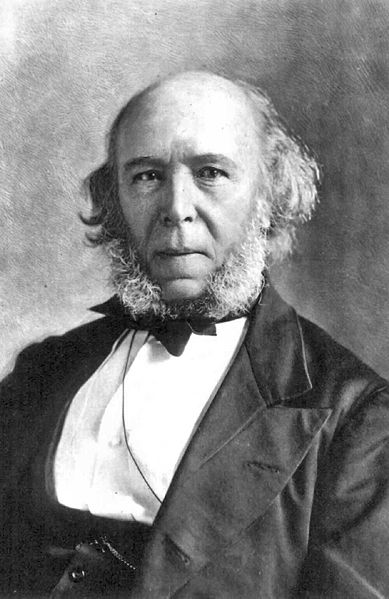 The essential trait in the moral consciousness, is the control of some feeling or feelings by some other feeling or feelings.
 Born on this date in 1821, Edward Livingston Youmans, American science writer and editor. In 1871 he started publication of the International Scientific Series of then-modern classics of scientific literature (published simultaneously first in New York, London, Paris, and Leipzig, later also in St. Petersburg and Milan), and the next year started the magazine Popular Science Monthly. In these and other venues he promoted the work of British philosopher Herbert Spencer, instigating Spencer to write the popular “The Study of Sociology,” and arranging publication of all of Spencer’s books with D. Appleton & Co., as well as many other international authors – with royalties on the sales (which in Spencer’s case reached 132,000 copies by 1890) going to the authors, despite the lack of an international copyright.