The discovery that one cannot convince an opponent and that it is hopeless to go on trying involves a confession of subjectivity that deprives the world of meaning.
Mary McCarthy, The Oasis (1949).
Mary McCarthy
The discovery that one cannot convince an opponent and that it is hopeless to go on trying involves a confession of subjectivity that deprives the world of meaning.
Mary McCarthy, The Oasis (1949).
The Twenty-second Amendment (Amendment XXII) of the United States Constitution, which sets a term limit for election and overall time of service to the office of President of the United States, was ratified by the requisite 36 of the then-48 states of the union on February 27, 1951.
Congress had passed the amendment on March 21, 1947.
The suit is brought by a group of white male professors that does not include Eugene Volokh, one of its examples of applicants summarily ignored under the alleged hiring practices.
“Northwestern University School of Law refuses,” the plaintiff’s complaint reads, “to even consider hiring white male faculty candidates with stellar credentials, while it eagerly hires candidates with mediocre and undistinguished records. . . .
“Professor Volokh’s candidacy was never even presented to the Northwestern faculty for a vote, while candidates with mediocre and undistinguished records were interviewed and received offers because of their preferred demographic characteristics.”
One of those with the requisite demographic characteristics is Destiny Peery, a black woman who graduated near the bottom of her class at Northwestern Law School.
The suit alleges that Dan Rodriguez, the dean in 2014, the year she was hired, threatened to penalize faculty members who voted against her. She would “never even have been considered” for the appointment but for her sex and race.
Rodriguez also ordered the faculty to abstain from discussing candidates on the faculty listserv and mentioned the risk of litigation as his reason for the ban. In other words, this administrator knew that his policy was illegal and sought to cover it up.
Now the feared lawsuit has arrived, brought against Northwestern by Faculty, Alumni, and Students Opposed to Racial Preferences (FASORP).
Wobbly acronym, sure, but Federal law is clear in outlawing hiring discrimination based on race or sex.
This is Common Sense. I’m Paul Jacob.
Illustration created with Krea and Firefly
See all recent commentary
(simplified and organized)
See recent popular posts
The untold story mothers the lie.
Ursula K. Le Guin, Another Story or a Fisherman of the Inland Sea (1994).
February 26 marks the Dominican Republic’s Independence Day.
Dudek almost got fired for helping the DOGE team understand how SSA’s systems work so that DOGE could zero in on wasteful or fraudulent payments.
On social media, Dudek wrote: “At 4:30pm EST, my boss called me to tell me I had been placed on administrative leave pending an Investigation. They want to fire me for cooperating with DOGE . . .
“I confess. I helped DOGE understand SSA. I mailed myself publicly accessible documents and explained them to DOGE. . . . I moved contractor money around to add data science resources to my anti-fraud team. . . . I asked where the fat was and is in our contracts so we can make the right tough choices.”
An investigation? Administrative leave? For helping, as an executive-branch employee, the head of the executive branch to find and extirpate waste and fraud? SSA managers may have been confused about whether Donald Trump really is the president.
The suspense didn’t last long.
Dudek was not fired. Instead, the SSA commissioner was fired and Dudek became acting commissioner.
“There are many good civil servants,” says Senator Mike Lee, “who have been quietly frustrated for years with politically motivated mismanagement [and] who possess an encyclopedic knowledge of the problems with their agencies. Put them in charge, hand them scalpels and flamethrowers.”
Could we have at long last found the cure for dimwitted obstructionism? A certain reality TV star had words for it: “You’re fired!”
This is Common Sense. I’m Paul Jacob.
Illustration created with Krea and Firefly
See all recent commentary
(simplified and organized)
See recent popular posts
The trouble with men is that they have limited minds. That’s the trouble with women, too.
Joanna Russ, Existence (1975).
On February 25, 1870, the first African-American entered Congress to serve in the U. S. Senate.
Hiram Rhodes Revels (Sep 27, 1827 – Jan 16, 1901) was a minister in the African Methodist Episcopal Church, a Republican politician, and college administrator. Born free in North Carolina, he later lived and worked in Ohio, where he voted before the Civil War. Revels (pictured above) was elected as the first African American to serve in the United States Senate, and was the first African American to serve in the U.S. Congress. He represented Mississippi in the Senate in 1870 and 1871 during the Reconstruction era.
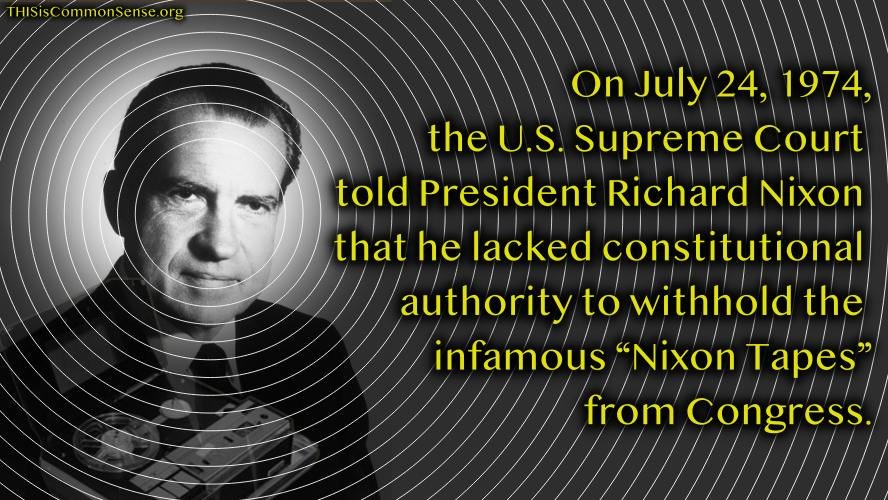
Behind this fracas looms the legacy of . . . Richard M. Nixon.
First, the fracas: “In a tense exchange with Maine Democratic Gov. Janet Mills, President Donald Trump threatened to strip Maine of its federal funding,” explains CNN, “if the state refuses to comply with his executive order banning transgender women from competing in women’s sports.”
The brief volley of promises (threats) between the governor and the president made other governors “uncomfortable.” Yes, that’s a news story.
“Is Maine here?” he wondered aloud. “The governor of Maine?”
“Yeah,” Gov. Janet Mills answered from across the room. “I’m here.”
And then came a testy political exchange, the kind you don’t often see, culminating in this from Trump: “You better comply, you better comply, because, otherwise, you’re not getting any federal funding.”
“See you in court,” she promised.
“Good; I’ll see you in court. I look forward to that. That should be a real easy one. And enjoy your life after governor, because I don’t think you’ll be in elected politics.”
Trump may not be wrong. He may have the better
But doesn’t it seem weird that the president of the United States can extort compliance from the states on matters that are not enumerated in the Constitution?
Well, back in his first term Trump signed an executive order to direct a new devolution process of turning back education to the states. But the transgender issue is a big deal, and most Americans (around 80 percent) are against “biological” “men” competing with girls and women in sports, and since much of sports in America takes place in state-directed/taxpayer-funded contexts, Trump is leveraging federal bloc grants against states that balk at his agenda.
Thank Nixon and his “New Federalism.” While an attempt to give power back to the states, it also tied federal money to the devolution, which has effectively turned states into welfare queens begging big bucks off Washington, severely compromising the states’ . . . basic competence.
It’s this policy that Trump should be fighting.
But that would make governors even more uncomfortable.
This is Common Sense. I’m Paul Jacob.
Illustration created with Krea and Firefly
See all recent commentary
(simplified and organized)
See recent popular posts
Only connect! That was the whole of her sermon. Only connect the prose and the passion, and both will be exalted, and human love will be seen at its height. Live in fragments no longer. Only connect, and the beast and the monk, robbed of the isolation that is life to either, will die.
E. M. Forster, Howards End (1910), chapter 22.