 A political country is like an American forest; you have only to cut down the old trees, and immediately new trees come up to replace them.
Categories
A political country is like an American forest; you have only to cut down the old trees, and immediately new trees come up to replace them.
 On February 6, 1756, Aaron Burr was born. Burr was an American politician who served as third Vice President of the United States, a man with a deeply ambiguous record. His popularity in his home state of New York, combined with the Slave Power vote, allowed for Thomas Jefferson’s victory in 1800 — and yet, another constitutional quirk, in addition to his apparent calculating ambition, precipitated a constitutional crisis in that election. He found a strong opponent in Federalist politician Alexander Hamilton, whom he later killed (in a duel, during his vice presidency). Out of office, Burr gathered an army west of the Appalachians, ostensibly to conquer Mexico. The army was captured, and Burr was put on trial for treason, with Thomas Jefferson moving heaven and earth to see a conviction. Burr was found not guilty, traveled to Europe, and then returned to America for a long life in the private sector.
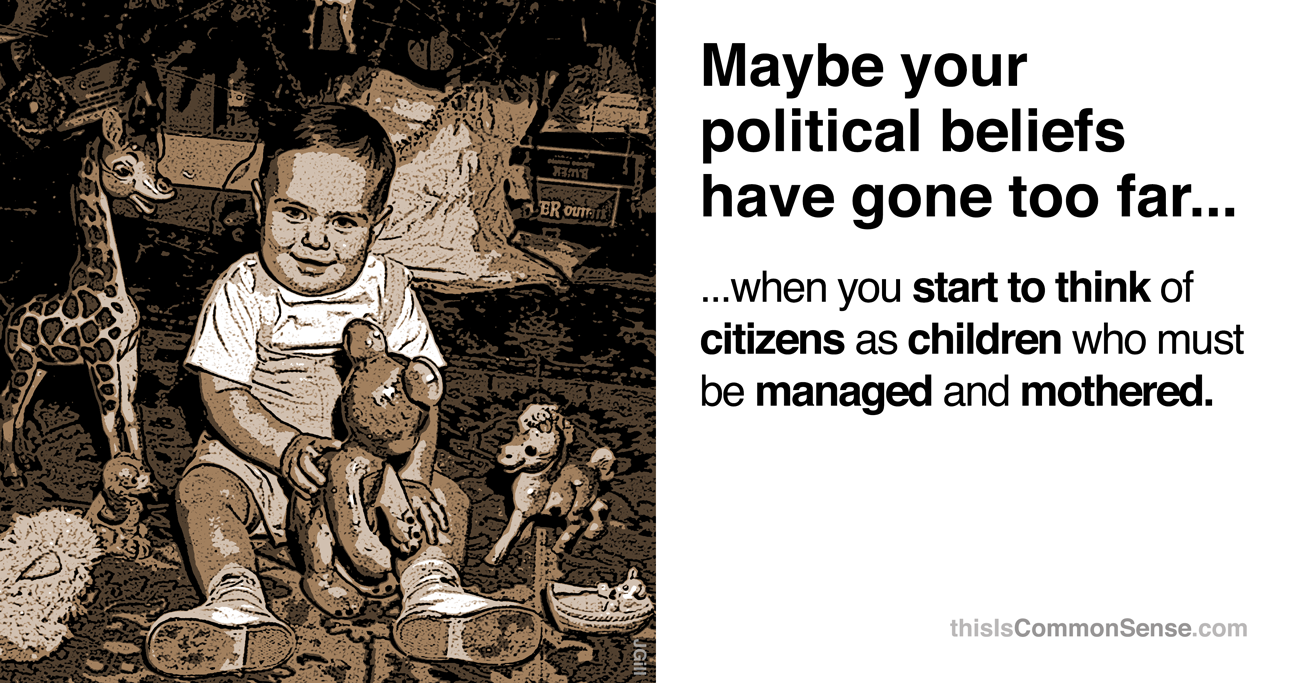
Maybe your political beliefs have gone too far… when you start to think of citizens as children who must be mothered and managed.

To download the full-size version of this image, click it!
Hillary Clinton and Barack Obama gave cautious support for the anti-vaxxer cause a few years ago. No scandal.
But only now that Republican politicians Chris Christie and Rand Paul have talked about the risks of (as well as of parental rights and responsibility regarding) childhood vaccination has the issue of mandatory vaccination finally hit big.
Ronald Bailey offers a more modest proposal. “Vaccination is arguably the greatest public health triumph of the past century,” he begins. But he argues not for mandating vaccines, but for social pressure: “person-to-person shaming and shunning.”
That is one traditional (and less politically extreme) way to solve such problems.
 But what is that problem, at base? Those who fear a negative personal effect from vaccination (and there are some, though the “autism” charge appears to be bogus) become “free riders,” as economists like to put it. They gain a de facto immunity without having to pay — either in money or in the small risk that vaccination does demonstrate.
This particular free rider benefit depends on the concept of “herd immunity.” That’s the conjectured level of protection for individuals who lack biological immunity by the overwhelming presence of vaccinated people in a population who are immune. (The disease can’t spread because it hits too many dead ends in healthy hosts.)
As has been often noted the last few days, though the anti-vaxxer trend has mainly tended to “infect” (as a “meme”) urban populations of left-leaning folks — epitomized by Hollywooders Jenny McCarthy and Jim Carrey — the new backlash against anti-vaxxer rights has come strongest from the left-leaning media.
The Republican “offenders” provide cover?
Apparently, those of the Democratic herd think they have immunity . . . to criticism.
This is Common Sense. I’m Paul Jacob.
A constitutional statesman is in general a man of common opinions and uncommon abilities.
 On February 5, 1788, Robert Peel was born. He would become one of the most important of the United Kingdom’s prime ministers, ushering in some reforms that led to the liberalization of England in the 19th century.
Rosa Parks, born February 4, 1913, became a symbol of the Civil Rights Movement for her actions on December 1, 1955. Ordered to move from the first row of the “colored” section after seats reserved for white passengers had filled up, Parks refused.
“When that white driver stepped back toward us, when he waved his hand and ordered us up and out of our seats, I felt a determination cover my body like a quilt on a winter night.”
Economist Thomas Sowell believes that the conflict might never have even come up as an issue, had the bus been privately run.
 “Why was there racially segregated seating on public transportation in the first place?” he asked on the occasion of her death in 2005. “[T]here was certainly plenty of racism in the South, going back for centuries. But racially segregated seating” did not have the same unbroken history. Sowell pointed out that no matter what their own views, owners of the private transit lines of the 19th and early 20th century lacked motive to enforce segregation and thereby alienate many of their passengers.
When markets aren’t overrun by politics, both buyers and sellers must focus on the value they want from trade — a good product or competent service. Participants are penalized if they routinely set aside those benefits in order to indulge an animus.
In the 20th century, the trend towards taxpayer-funded mass transit displaced economic incentives with political ones.
Only governments can force entire industries to routinely act on an irrational prejudice.
This is Common Sense. I’m Paul Jacob.
On February 4, 1789, George Washington was unanimously elected as the first President of the United States, under the new Constitution, by the U.S. Electoral College. On the same date five years later, the French legislature abolished slavery throughout all territories of the French Republic.
It is good to be without vices, but it is not good to be without temptations.
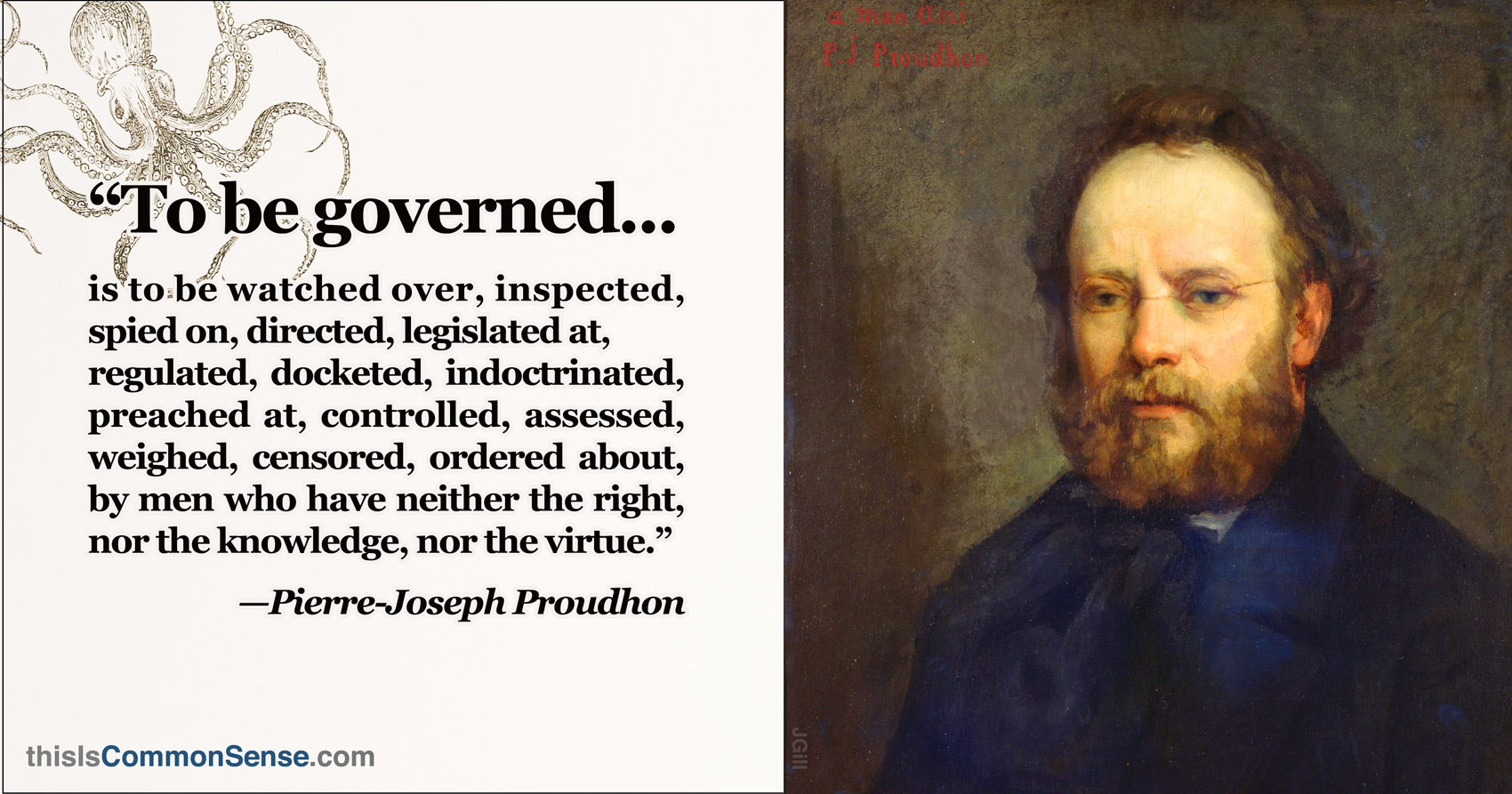
“To be GOVERNED is to be watched, inspected, spied upon, directed, law-driven, numbered, regulated, enrolled, indoctrinated, preached at, controlled, checked, estimated, valued, censured, commanded, by creatures who have neither the right nor the wisdom nor the virtue to do so. To be GOVERNED is to be at every operation, at every transaction noted, registered, counted, taxed, stamped, measured, numbered, assessed, licensed, authorized, admonished, prevented, forbidden, reformed, corrected, punished. It is, under pretext of public utility, and in the name of the general interest, to be place under contribution, drilled, fleeced, exploited, monopolized, extorted from, squeezed, hoaxed, robbed; then, at the slightest resistance, the first word of complaint, to be repressed, fined, vilified, harassed, hunted down, abused, clubbed, disarmed, bound, choked, imprisoned, judged, condemned, shot, deported, sacrificed, sold, betrayed; and to crown all, mocked, ridiculed, derided, outraged, dishonored. That is government; that is its justice; that is its morality.”
—Pierre-Joseph Proudhon

To download the full-size version of this image, click above.