Categories
Today

Good Friday Agreement

On April 10, 1998, the Northern Ireland peace talks ended with an historic agreement, dubbed the Belfast, or Good Friday Agreement. The accord was reached after nearly two years of talks and 30 years of conflict.

The agreement was approved by voters across the island of Ireland in two referendums held on May 22, 1998. The agreement came into force on December 2, 1999. 

Categories
media and media people national politics & policies

Praying to the Deep State

The Deep State does not exist.

How do we know?

If it did exist, it would have stopped Trump’s tariffs!

Welcome to modern political theology and ideological theodicy — by way of late-night “comedic entertainment.”

Because of Trump’s tariffs, “we’ve had the worst day for our economy since Covid,” quipped Stephen Colbert on Thursday’s Late Show. “Just a reminder: this time he’s the disease.”

I found his setup somewhat funny, goofy looks and all, and I don’t usually find Colbert funny. But as the bit progressed . . .

“It’s all pretty solid proof that there is no Deep State.”

I’ve already given away his punchline, because it was not so much funny as eye-roll-worthy.

“Because if there was, they would have stopped this s**t.”

The assumption here is that, by definition, the Deep State must be omnipotent. While we can point to existing institutions working under the new rubric of “Deep State,” it’s never been all-powerful. It’s just very powerful, working in mysterious (secret) ways.

“But if they do exist,” Colbert continued, “I just want to say to the cabal of financial and governmental elites who pull all the strings behind the scenes, ‘maybe put a pause on your 5G chip/JFKjr/adrenochrome/chemtrail orgy and jump in here cuz we’re f**king dying!’”

Here’s the deal: Trump was hounded with unprecedented state surveillance, impeachments, lawfare, and speech suppression . . . and dodged bullets from assassins. While we know nothing, if we catch a whiff of anything it’s that “non-existent” Deep State.

So begging it to take out Trump is . . . late-in-the-game.

The cabal has already tried. Many times. And failed. Proving itself perhaps more desperate than competent.

This is Common Sense. I’m Paul Jacob.


PDF for printing

Illustration created with Krea and Firefly

See all recent commentary
(simplified and organized)
See recent popular posts
Categories
Thought

Samuel Adams

The natural liberty of man is to be free from any superior power on Earth, and not to be under the will or legislative authority of man, but only to have the law of nature for his rule.

Samuel Adams, The Rights of the Colonists: The Report of the Committee of Correspondence to the Boston Town Meeting, Nov. 20, 1772.
Categories
Today

Näfels

Despite being outnumbered 16 to one, forces of the Old Swiss Confederacy proved victorious over the Archduchy of Austria in the Battle of Näfels, April 9, 1388.


On this date in 1991, Georgia declared its independence from the Soviet Union.

Categories
First Amendment rights international affairs Internet controversy social media

X Marks the Censor

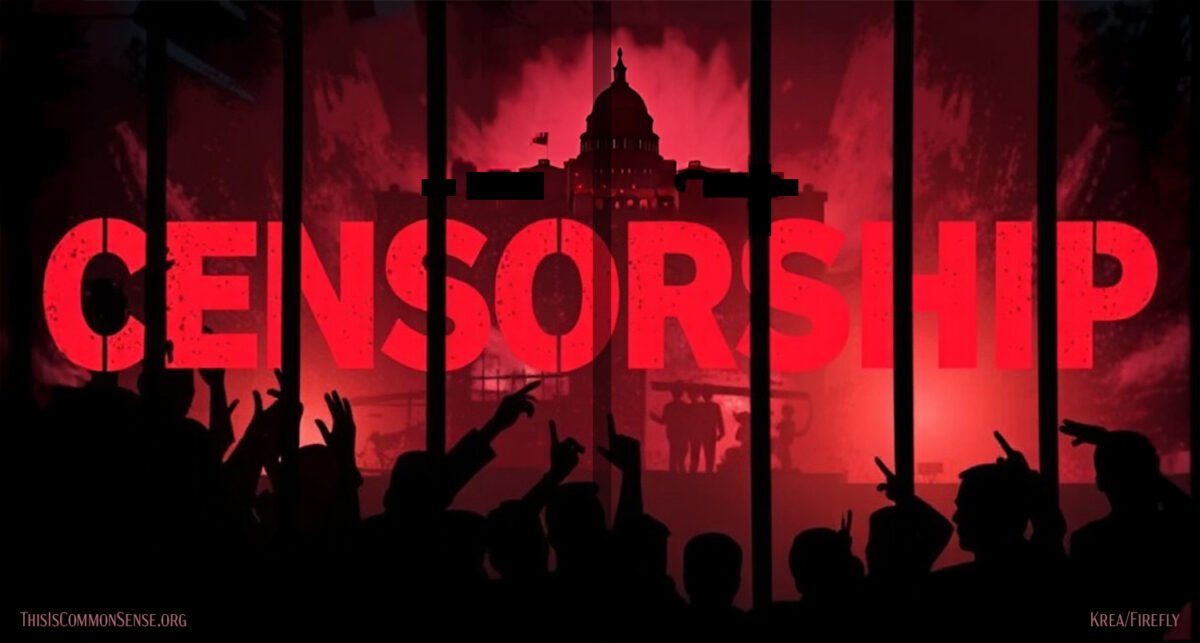
The European Union’s censors are outraged that Elon Musk’s social media platform, Twitter-X, flouts their demands to gag users.

So they’re gearing up to fine X more than a billion dollars. The EU will also be demanding “product changes.”

Another EU investigation reported by The New York Times “is broader and . . . could lead to further penalties,” but amounts to the same thing: punishing Musk’s free-speech company for disobeying orders to prevent and punish speech.

All this is rationalized by a new EU law to compel social media platforms to police users. One would be hard put to find a clearer case of governmental censorship-by-delegation. It’s not even taking place behind closed doors, as was the case regarding the U.S. Government and Twitter before Mr. Musk bought the platform. 

These European censors brag about it.

X says it will do its best to “protect freedom of speech in Europe.”

If push comes to shove and EU goons do not back down, what X should do has been indicated by the smaller platforms social media platforms Gab and Kiwi Farms.

First, refuse to pay a penny of any imposed fine. 

Second, block access to X within the European Union, advising all account holders who try to log on why having an EU IP address is now a bad idea and why using a good virtual private network (VPN) to access X is now a good idea.

By disguising point of origin and encrypting traffic, a good VPN can help people living under tyrannical regimes like the European Union to evade censorship.

This is Common Sense. I’m Paul Jacob.


PDF for printing

Illustration created with Krea and Firefly

See all recent commentary
(simplified and organized)
See recent popular posts

Categories
Thought

Fernando Pessoa

A metafísica é uma consequência de estar mal disposto.

Metaphysics is a consequence of not feeling very well.

Fernando Pessoa, Tabacaria (1928), trans. Richard Zenith.
Categories
Today

The 17th Amendment

On April 8, 1913, the 17th amendment to the Constitution, providing for the popular election of U.S. senators, was ratified.

Prior to this, senators had been appointed by state legislatures. It was John Dickinson of Delaware who suggested that the Senate be selected by state legislatures. “The combination of the state governments with the national government was as politic as it was unavoidable,” he argued. But as early as 1826, resolutions calling for direct popular election of senators appeared in the House of Representatives, but none succeeded. Following the Civil War, disputes among state legislators over Senate elections resulted in deadlocks, leaving some Senate seats vacant for long periods — Delaware remained without representation in the U.S. Senate for two years. In light of such problems, reformers in many states began calling for a change to the system of electing senators. In 1906, publisher William Randolph Hearst, a proponent of direct election, hired novelist David Graham Phillips to write a number of articles on the subject. Phillips’ series, “The Treason of the Senate,” portrayed senators as pawns of industrialists and financiers — with no small amount of hyperbole (to put it politely). The articles further galvanized public support for reform. 

Senator Joseph Bristow of Kansas offered, in 1911, a Senate resolution to amend the Constitution. In two years the Constitution was amended.

Categories
national politics & policies tax policy

DOGE Does the IRS

A note of caution going into today’s subject: let us try to bite our tongues; no expressions of schadenfreude; no sarcastic “Boo-hoos” or the like.

The IRS has been grossly inefficient for a very long time, as now uncovered in a Department of Government Efficiency [DOGE] investigation.

Courtesy of Laura Ingraham, we learn that the Internal Revenue Service is “35 years behind” in its scheduled upgrades, and “already $15 billion over budget.”

“You’ve heard the sob stories,” says Ms. Ingraham. “And they are quite entertaining at times. But the [presumably non-Fox legacy news] media — they continue to spread this story: ‘DOGE is some dark and mysterious organization; you know, embedding itself into departments like some jack-booted thugs, just intimidating staff, threatening those that don’t comply.’ OK. We’re asking, what is the truth?” 

So she interviewed Treasury Secretary Scott Bessant and Treasury’s DOGE adviser, Sam Corcos.

“We,” Corcos said, including himself in the IRS’s very “they” themness, “process about the same amount of data as a midsize bank. A midsize bank has 100 to 200 people in IT and a $20 million budget. The IRS? It has 8,000 IT employees and a $3.5 billion operations and maintenance budget. I don’t really know why yet.” But he does notice that 80 percent of that budget goes to “contractors and software licenses.”

“DOGE advisers have found billions in waste just by asking questions,” explains Ingraham’s report. Secretary Bessant blames the power of special “entrenched interests” that “keep constricting themselves around the power, the money, and the systems. Nobody cares.”

“Inertia” is also a word often heard on this subject.

Democrats have been complaining about the president’s cutting of the IRS budget, and number of employees. But if most of the force is just spinning gears, the cuts could hardly be said to hurt the “service.”

And you’d think that the most pro-government party in our political system would want this key function of government — everything rests on taxes, they admit — to be efficient, do the assigned jobs well.

But for some reason that does not seem to be the case.

Shocking, I know.

This is Common Sense. I’m Paul Jacob.


PDF for printing

Illustration created with Krea and Firefly and ChatGPT

See all recent commentary
(simplified and organized)
See recent popular posts
Categories
Thought

George Mason

There is a Passion natural to the Mind of man, especially a free Man, which renders him impatient of Restraint.

George Mason, Letter to the Committee of Merchants in London (June 6, 1766).

Categories
Today

Prohibition Begins to End

On April 7, 1933, Prohibition in the United States was repealed for beer of no more than 3.2 percent alcohol by weight — eight months before the ratification of the 21st amendment, which repealed the 18th (or Prohibition) Amendment.

The enabling legislation was the Cullen-Harrison Act, which figured the low alcohol content as the excuse to get around the 18th Amendment’s prohibition of intoxicating beverages. The act passed Congress on March 21, 1933, and was signed into law by Franklin Delano Roosevelt the next day.