On March 25, 1965, civil rights activists led by Martin Luther King, Jr., successfully completed their four-day, 50-mile march from Selma to the capitol in Montgomery, Alabama.
Categories
From Selma to Montgomery
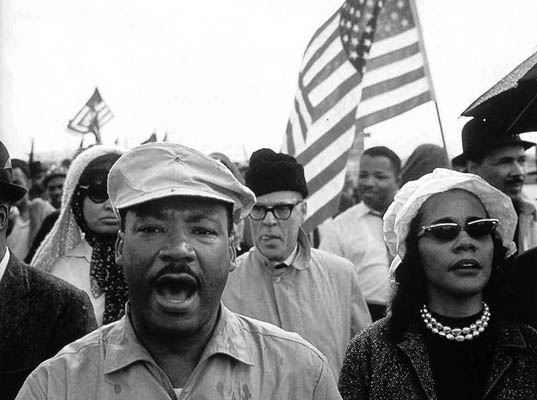
On March 25, 1965, civil rights activists led by Martin Luther King, Jr., successfully completed their four-day, 50-mile march from Selma to the capitol in Montgomery, Alabama.
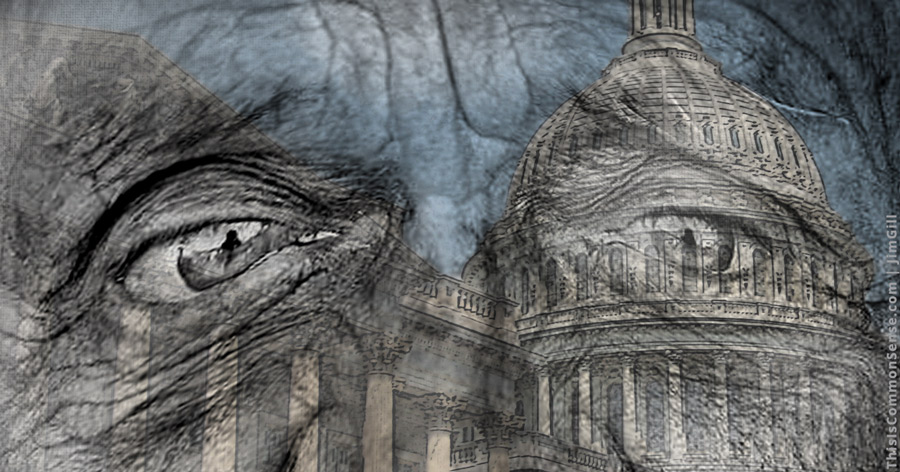
This week, the Senate Judiciary Committee grilled Judge Neil Gorsuch, President Trump’s nominee for the U.S. Supreme Court. Talk about a silly rite. Senators repeatedly fired questions about specific legal views that no High Court nominee ever answers.
Why not? Because to answer would be to pre-judge possible future cases.
That didn’t prevent displays of faux-outrage from committee Democrats, though. “You have been very much able to avoid any specificity,” Sen. Dianne Feinstein (D-Calif.) criticized, “like no one I have ever seen before.”
In Washington, isn’t that a compliment?
Into this kabuki theater, Republicans added their own inanity. Sen. Jeff Flake (R-Ariz.) inquired of Gorsuch, “What’s the largest trout you’ve ever caught?”
So that is how to determine whether to confirm someone for a lifetime position.
But even a lifetime doesn’t beat Congress. Elected every two years in the House or six years in the Senate, congresspersons often rack up longer tenure than do justices appointed for life.
The longest serving justice in our history was William O. Douglas, who spent nearly 37 years on the High Court. But if Douglas had spent that epoch in Congress, he wouldn’t place first, but 80th.
In fact, three Judiciary Committee members — Senators Patrick Leahy, Chuck Grassley and Orrin Hatch — have already served longer than any High Court justice in American history.
Interestingly, of the 20 longest serving justices, half served before 1900. Conversely, all of the 20 longest continuously serving members of Congress served after 1900.
Careerism in Congress beats lifetime tenure.
It’s time for term limits.
This is Common Sense. I’m Paul Jacob.
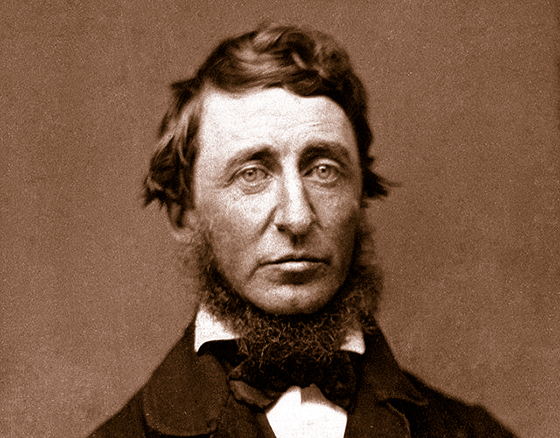
Some circumstantial evidence is very strong, as when you find a trout in the milk.
Henry David Thoreau, journal, Nov. 11, 1850, presumably playing off of rumors of dairymen diluting their product with water during a milk shortage.
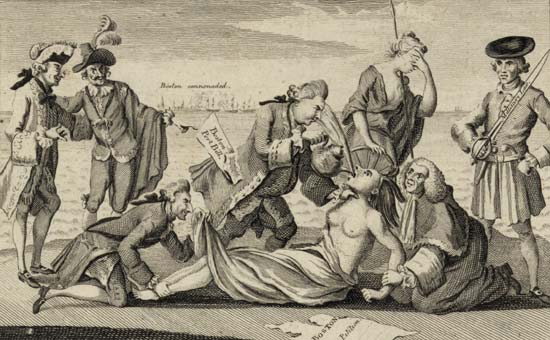
On March 24, 1765, the Kingdom of Great Britain passed the Quartering Act, which required the Thirteen Colonies to house British troops.
On the same date in 1855, slavery was abolished in Venezuela.
The Intolerable Acts (among which was the Quartering Act) was the American Patriots’ name for a series of punitive laws passed by the British Parliament in 1774 after the Boston Tea party. They were meant to punish the Massachusetts colonists for their defiance in throwing a large tea shipment into Boston harbor. In Great Britain, these laws were referred to as the Coercive Acts.

Police departments nationwide have begun to outfit their on-duty officers with body cameras. These small recording devices make great sense, so we can better judge police encounters.
And it turns out that not only do police behave better when wearing body cameras, so do the citizens with whom they interact.*
Yet, cameras aren’t magic. They do not work when turned off. And video recorded by police offers little value when tampered with or deleted.
On Monday, the Washington Post ran an in-depth feature about the 2014 fatal shooting of 19-year-old Mary Hawkes by Albuquerque, New Mexico, police, who pursued her for allegedly stealing a truck.
The Post explained that her case “has become a cautionary tale about the potential of new technology to obscure rather than illuminate, especially in situations when police control what is recorded and shown to the public,” raising concern “about whether a nationwide rollout of body cameras is fulfilling promises of greater accountability.”
Six police officers huddled in close proximity to the deadly incident — all wearing body cameras. The officer who shot Ms. Hawkes, however, had his turned off. Footage from three others “showed signs of alterations and a deletion.”
A federal investigation is underway.**
It is now obvious that cameras alone won’t suffice. Rules must require that the cameras be turned on — with consequences for non-compliance. The public needs access to the footage, too.
The Police Cameras for Ferguson initiative*** on the ballot April 4th does exactly that. We need similar legislation in Albuquerque and everywhere else.
This is Common Sense. I’m Paul Jacob.
* See Barak Ariel, William A. Farrar, Alex Sutherland, “The Effect of Police Body-Worn Cameras on Use of Force and Citizens’ Complaints Against the Police: A Randomized Controlled Trial,” Journal of Quantitative Criminology (September 2015, Volume 31, Issue 3), pp 509–535; reportage on this study can be found here.
** The probe has already revealed that a former Albuquerque police employee has declared, in an affidavit, “it was routine for officials to delete, alter or refuse to release footage because of ‘political calculations.’”
*** Your support is still desperately needed to educate voters in Ferguson, Missouri, about the Police Camera ballot measure. Please help today.

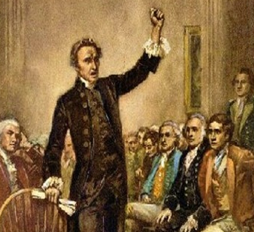
Suspicion is a virtue as long as its object is the public good, and as long as it stays within proper bounds. . . . Guard with jealous attention the public liberty. Suspect every one who approaches that jewel.
Patrick Henry, Virginia Ratifying Convention (June 5, 1788), speech regarding the Federal Constitution.
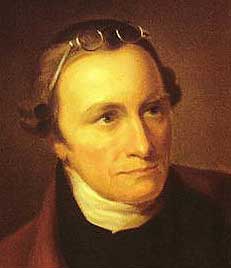
On March 23, 1775, Patrick Henry delivered his “Give me Liberty, or give me Death!” speech at St. John’s Church in Richmond, Virginia.
On this date in 1992, economist and social philosopher Friedrich August von Hayek died.

Will Donald Trump, infamously successful businessman, actually do something about the federal government’s out-of-control deficits and mounting debt?
Economist Pierre Lemieux, writing in the Financial Post, finds some reason for hope in President Trump’s “America First: A Budget Blueprint to Make America Great Again”:
The proposal to eliminate funding for agencies like the Corporation for Public Broadcasting, the National Endowment for the Arts, and the National Endowment for the Humanities is welcome. Artists should be able to stand on their own two feet with the support of private sponsors and organizations, of which there are many in America. Lovers of concerts should finance their own passion.
Though Lemieux gives good reason to want to cut “official arts and humanities” subsidies even sans their budgetary implications, imagine the backlash from Democrats, the media and the whole collegiate sector!
Actually, the backlash has already begun.
Can united government under the GOP cut even these most obviously least necessary aspects of government subsidy?
I’m not holding any pockets of air in my two lungs.
“Many monstrous bureaucracies would be reined in,” Lemieux goes on, listing proposed cuts to the Environmental Protection Agency (-31 percent), Department of Labor (-21 percent), and other departments of the so-called “discretionary” budget. But this is all small potatoes. “Really cutting federal expenditures would require reducing the welfare state — which Trump has no intention of doing.”
And the fortunes Trump wishes to throw at the military? No knack for parsimony there.
Though we can expect a little exceptional hack-and-slashery from Trump, Lemieux remains skeptical of any overall major effect.
Get used to ballooning debt.
Like you haven’t already.
This is Common Sense. I’m Paul Jacob.


On March 22, 1630, the Massachusetts Bay Colony outlawed the possession of cards, dice, and gaming tables. Exactly eight years later, the colony expelled Anne Hutchinson for religious dissent.
In 1812 on this date, Stephen Pearl Andrews was born. Andrews would go on to become an important American abolitionist, free love advocate, and theorist of “individual sovereignty,” promulgating the reforms of Josiah Warren.
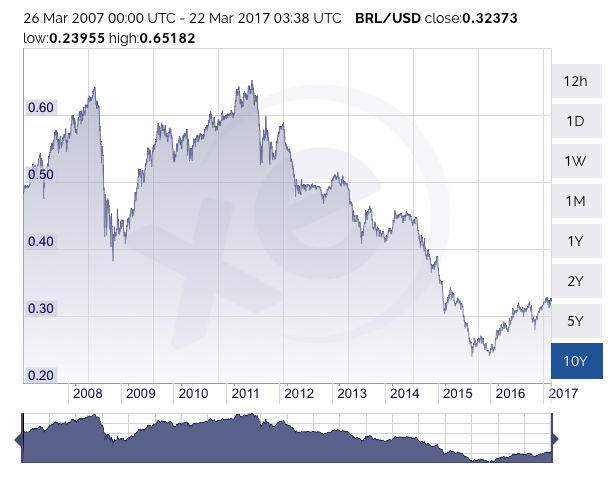
Today we are practically living a trade war, a currency war because the exchange rate today is one of the important factors to determine the competitiveness or not of products. Generalized currency depreciation in my view is an explicit strategy used by countries and that threatens us.
Guido Mantega, “The Role of Industry in the Growth of Brazil” organized by the Getulio Vargas Foundation, September 27, 2010. This statement from Brazil’s Finance Minister is eerily similar to statements made by folks around the world — about other countries’ monetary policies. Donald Trump bases his complaints against China on precisely these grounds. Pictured: the Brazilian Real against the U.S. Dollar from 2007 to 2017, courtesy xe.com.