As Cæsar was at supper the discourse was of death — which sort was the best. “That,” said he, “which is unexpected.”
Lucius Mestrius Plutarchus (c. 46 – 120) quoting Gaius Julius Caesar, Roman Apophthegms.
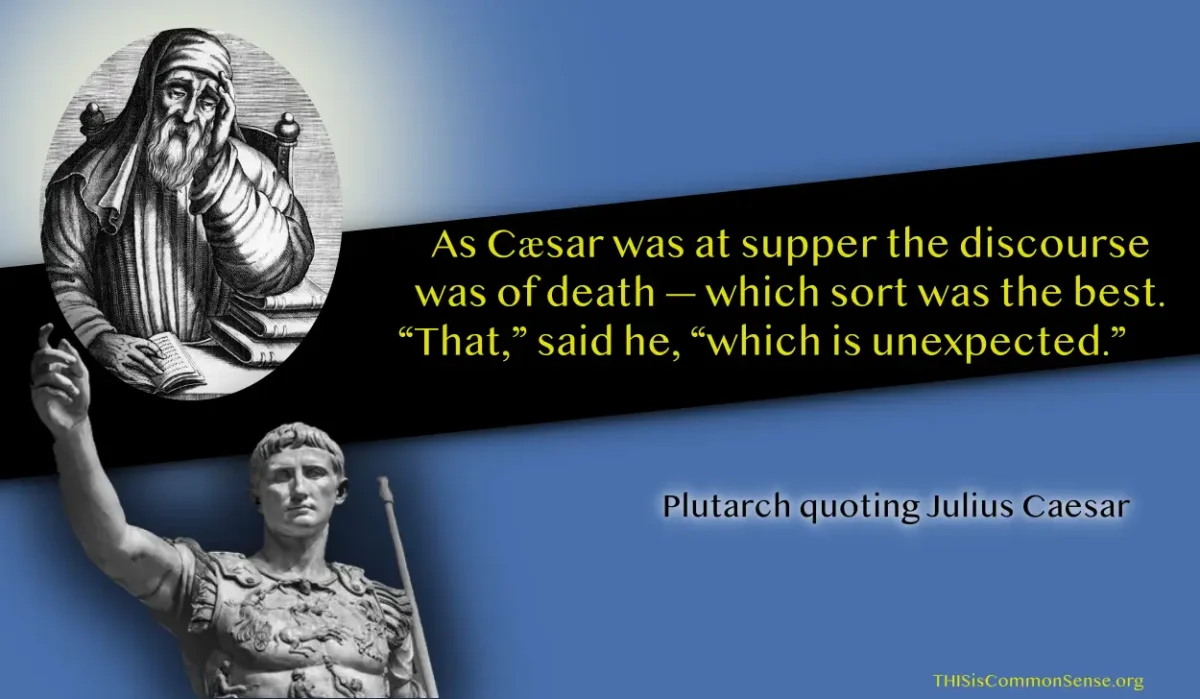
As Cæsar was at supper the discourse was of death — which sort was the best. “That,” said he, “which is unexpected.”
Lucius Mestrius Plutarchus (c. 46 – 120) quoting Gaius Julius Caesar, Roman Apophthegms.
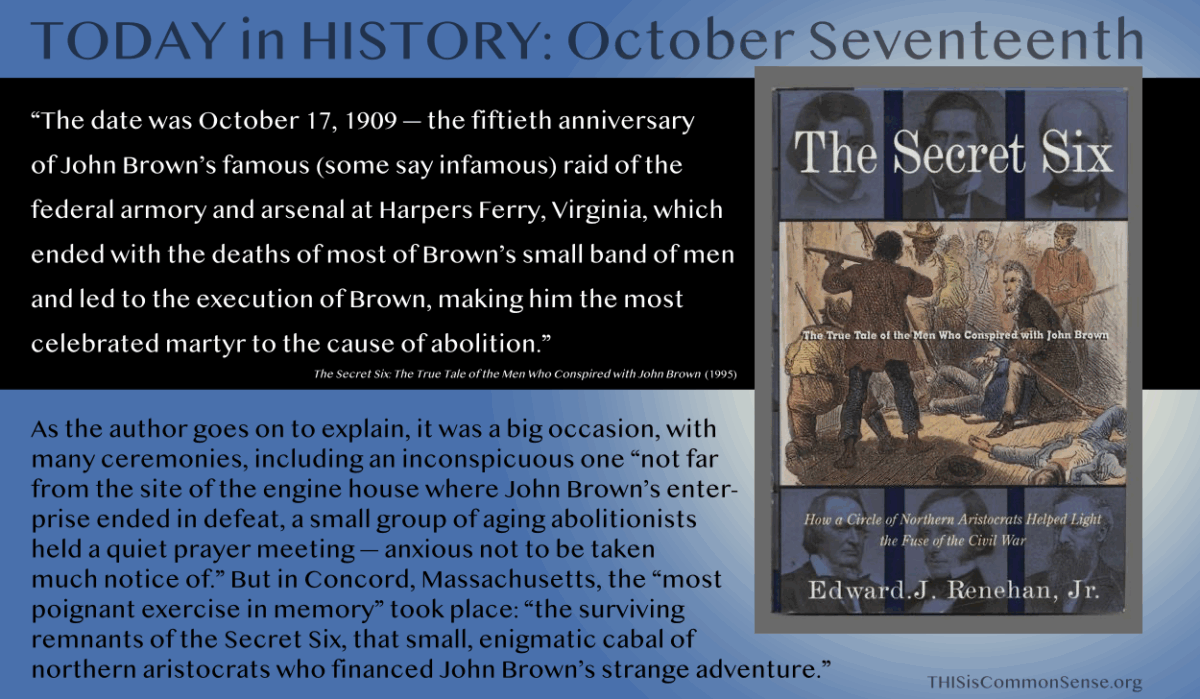
“The date was October 17, 1909 — the fiftieth anniversary of John Brown’ famous (some say infamous) raid of the federal armory and arsenal at Harpers Ferry, Virginia, which ended with the deaths of most of Brown’s small band of men and led to the execution of Brown, making him the most celebrated martyr to the cause of abolition.” So begins The Secret Six: The True Tale of the Men Who Conspired with John Brown (1995), by Edward J. Renehan, Jr.
As the author goes on to explain, it was a big occasion, with many ceremonies, including an inconspicuous one “not far from the site of the engine house where John Brown’s enterprise ended in defeat, a small group of aging abolitionists held a quiet prayer meeting — anxious not to be taken much notice of.” But in Concord, Massachusetts, the “most poignant exercise in memory” took place: “the surviving remnants of the Secret Six, that small, enigmatic cabal of northern aristocrats who financed John Brown’s strange adventure.”
Those attending this meeting were two conspirators, Thomas Wentworth Higginson (December 22, 1823 – May 9, 1911) and Franklin Sanborn (December 15, 1831 – February 24, 1917), as well as Julia Ward Howe (May 27, 1819 – October 17, 1910), widow of a third conspirator, Dr. Samuel Gridley Howe (November 10, 1801 – January 9, 1876). Not present, because long dead, were Reverend Theodore Parker (August 24, 1810 – May 10, 1860), Gerrit Smith (March 6, 1797 – December 28, 1874), and George Luther Stearns (January 8, 1809 – April 9, 1867).
Print out a commemorative poster:

Preston Byrne, a lawyer representing 4Chan, has responded to UK regulator Ofcom’s attempt to impose the fines — more than $26,000 to start — with instructions to get lost.
Ofcom Enforcement Czar Suzanne Cater says that this fine “sends a clear message that any service which flagrantly fails to engage with Ofcom and their duties under the Online Safety Act can expect to face robust enforcement action.”
How robust, though?
Byrne: “4chan’s constitutional rights remain completely unaffected by this foreign e-mail. 4chan will obey UK censorship laws when pigs fly. In the meantime, there’s litigation pending in DC. Ofcom hasn’t yet answered. . . .
“That fine will never be enforced in the USA. The UK is welcome to try to enforce it in an American court if they disagree.”
The Trump administration has stressed its opposition to the UK’s global-censorship agenda. So what is going on here?
It appears that when some people over-zealously seek to dominate others, the weaker they are the more desperate — and in their desperation they become more belligerent. Since the United Kingdom is in no position to launch an invasion of the United States in order to force us . . . well, they might just shut up already.
Britain’s leadership is in disarray. The country is very weak — a least, unless it teams up with a more powerful country, like China. Which is what the UK indeed seems to be doing.
This is Common Sense. I’m Paul Jacob.
Illustration created with Krea and Firefly
See all recent commentary
(simplified and organized)
See recent popular posts
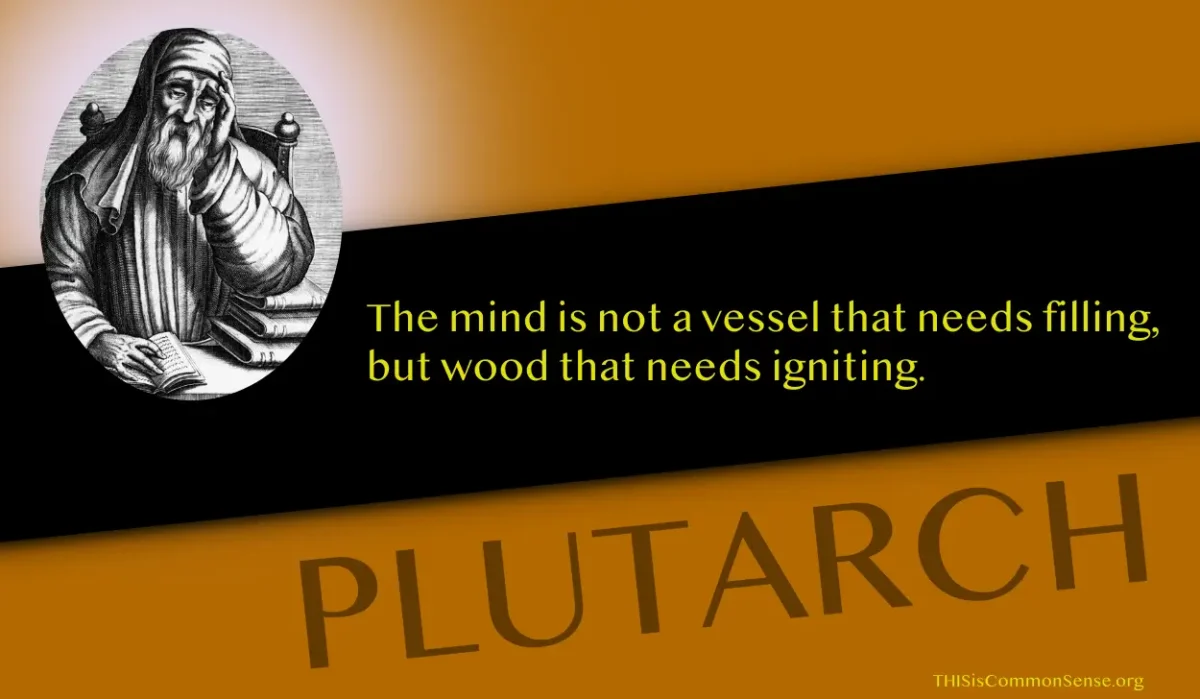
The mind is not a vessel that needs filling, but wood that needs igniting.
Lucius Mestrius Plutarchus (c. 46 – 120), “On Listening to Lectures,” Moralia.
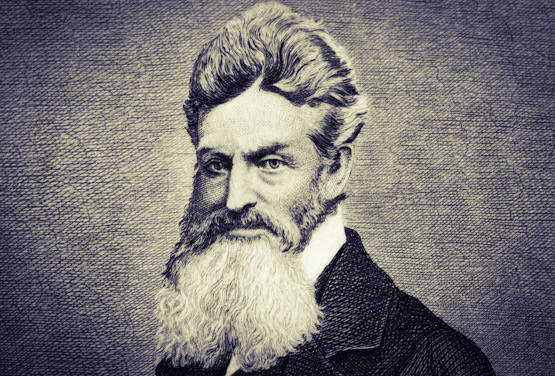
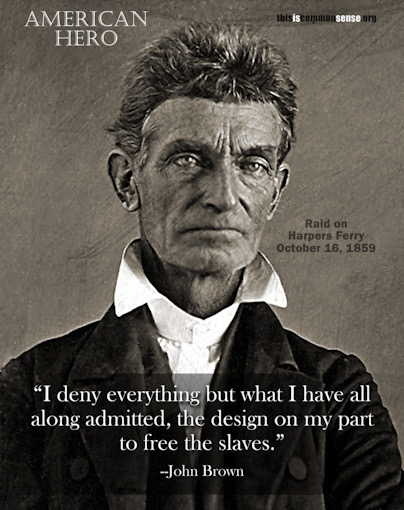
On this day in 1859, abolitionist John Brown led a group of 21 men — 14 white, seven black — on a raid of the federal armory at Harpers Ferry, Virginia (then; since 1863, West Virginia), to capture weapons and initiate a slave revolt in southern states.
Brown’s forces initially captured the armory, which had only one guard on duty that night, but the expected uprising did not occur. Soon the raiders were blocked from any escape by townspeople and local militiamen and then overwhelmed by federal troops sent into the town (commanded by Colonel Robert E. Lee, who would later lead the Confederate armies). The siege ended on the 18th of October.
Ten of Brown’s men were killed during the incident; seven were captured, tried, convicted and executed, including John Brown; and five escaped. Two enslaved African-Americans joined Brown’s cause and also died in the fighting. Battling against Brown’s raiders, a Marine and four townspeople lost their lives, including the town’s mayor and a free African-American.
Though the raid on Harpers Ferry was a failure, it set the states on the road to disunion, war, and the eventual end of slavery.
“John Brown began the war that ended American slavery and made this a free Republic,” Frederick Douglass would write in remembrance of this event. “Until this blow was struck, the prospect for freedom was dim, shadowy and uncertain. The irrepressible conflict was one of words, votes and compromises. When John Brown stretched forth his arm the sky was cleared. The time for compromises was gone — the armed hosts of freedom stood face to face over the chasm of a broken Union — and the clash of arms was at hand.”
Print out a commemorative poster:

A kink for women’s dresswear?
Nope. Both denied the existence of major criminal organizations.
Hoover, Director of the Federal Bureau of Investigation from 1924 to 1972, refused to affirm that the Mafia crime syndicate existed. Repeatedly, over the years.
Rumors that he was being blackmailed by the Mafia itself, over his own cross-dressing kinks (the mob allegedly had photos), is not affirmed by major historians, who say his denial-of-the-facts was just politics.
So when we encounter those rejecting the reality of Antifa, take them with a grain of salt. Truth is, Antifa has a long history. It had a beginning; it spread; it fell into disarray; it was revived (or mimicked) by young radicals wanting an excuse to commit violence against “fascists” — which proved, of course, to be anyone they disagree with. We see them today on the streets of major cities at night, black masks and their proclivity to beat up heretics to their variant of communism/anarchism/nihilism.
But comedian and ABC talk-show host Jimmy Kimmel derides such observations.
“There is no Antifa. This is an entirely imaginary organization,” he cackled, likening any claim for Antifa’s existence to announcing the capture of fictional creatures such as the Decepticons or the Chupacabra.
But Chupacabra didn’t beat Andy Ngo within an inch of his life; Decepticons have not been caught on camera throwing bricks.
Many other talking heads have made similar denials — despite the demonstrated fact that Antifa is well funded and that funding is directed by somebody.
Even a “grassroots” organization informally managed counts as an existing entity; just because a group looks more like a network than a corporate entity with an HR department doesn’t mean it doesn’t exist.
Philosophers might call these denials “ontic negative claims” — “ontic” as in ontology as in the Philosophy of Being. While I’m uncertain of many things, I am certain of this: Antifa exists and Jimmy Kimmel is no ontologist.
This is Common Sense. I’m Paul Jacob.
Illustration created with Krea and Firefly
See all recent commentary
(simplified and organized)
See recent popular posts

He said that those who were serious in ridiculous matters would be ridiculous in serious affairs.
Lucius Mestrius Plutarchus (c. 46 – 120) quoting Cato the Elder, Roman Apophthegms.
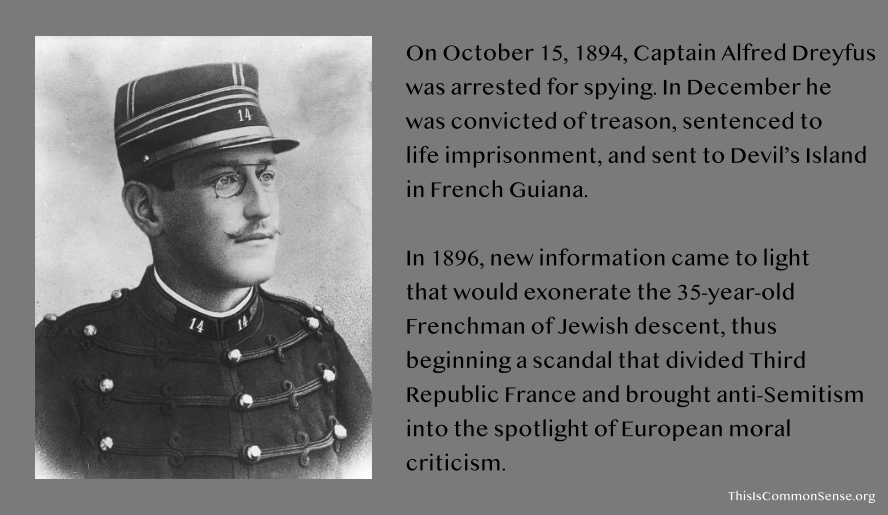
On October 15, 1894, Captain Alfred Dreyfus was arrested for spying. In December he was convicted of treason, sentenced to life imprisonment, and sent to Devil’s Island in French Guiana.
In 1896, new information came to light that would exonerate the 35-year-old Frenchman of Jewish descent, thus beginning a scandal that divided Third Republic France and brought anti-Semitism into the spotlight of European moral criticism.
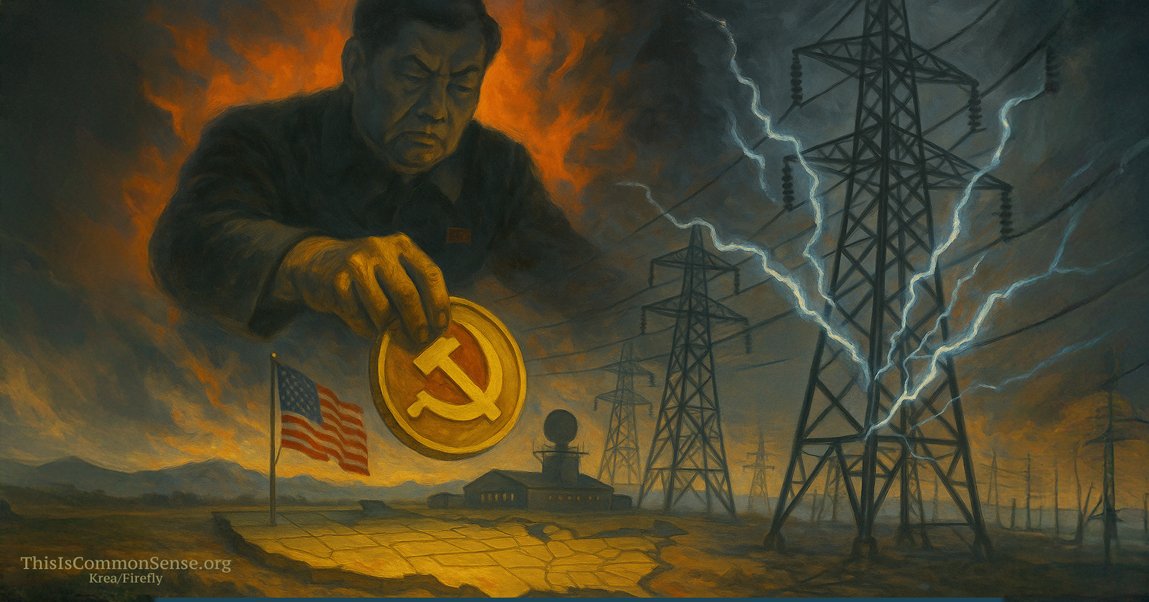
“There was no other reason to target those systems. There’s no advantage to be gained economically. There was no foreign intelligence-collection value,” replied the general. “The only value would be for use in a crisis or a conflict.”
Systems? The segment featured Chinese infiltration into the computer system controlling electricity and the water supply for Littleton, a town of 10,000 residents in Massachusetts.
Littleton’s manager, Nick Lawler, pointed to how disastrous losing control of the computer system could become, noting that with that control an evil force — in this case, the Chinese Communist Party (CCP) — “can poison the water.”
Literally as well as figuratively.
Once head of the National Security Agency and the U.S. Cyber Command, Haugh explained that the CCP is “certainly attempting every single day to be able to target telecommunications, to be able to target critical infrastructure.”
Even in little bitty Littleton. Talk about “unrestricted warfare”!
We have known for years that China’s Communists were tyrants; responsible for arguably a hundred million deaths due to murder, torture and starvation; subjugating Tibet; harvesting organs from political prisoners; placing more than a million Uyghurs in concentration camps; canceling all political rights in Hong Kong. These totalitarians also threaten to invade Taiwan and lay claim, ridiculously, to 90 percent of the South China Sea . . . which they are policing.
Then we discovered the Chinese had opened police stations in the United States and other countries to harass and silence Chinese dissidents who had managed to escape to our shores.
Now, it is hardly a surprise that the CCP has intruded into our electrical grids and water systems, while buying up farmland near American military bases.
Xi Jinping and the Chicoms are far worse than our rivals. While a far starker problem for those living in Asia, we are not safe from the Chinese State.
This is Common Sense. I’m Paul Jacob.
Illustration created with Krea and Firefly
See all recent commentary
(simplified and organized)
See recent popular posts
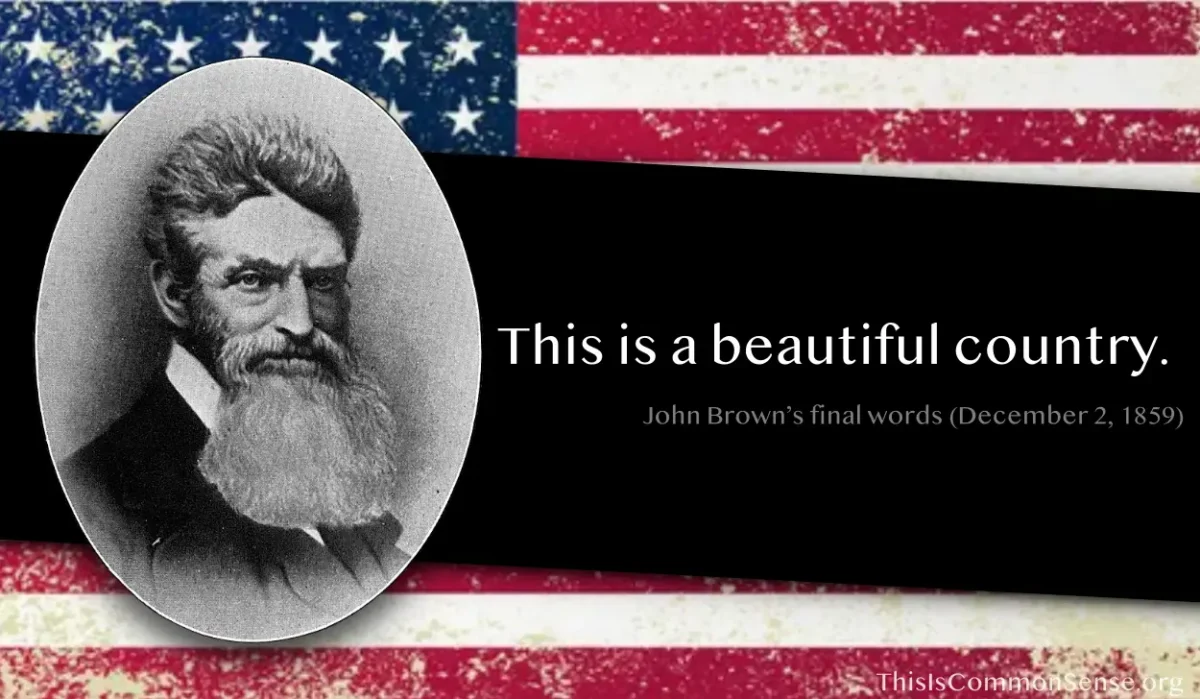
This is a beautiful country.
John Brown, last words (December 2, 1859), as quoted in John Brown and his Men (1894) by Richard Josiah Hinton, p. 397.