Categories
Update

Trump Unbound

Everyone should fear a lawless president. But complaining about President Trump’s allegedly illegal actions while not having complained about Biden’s and Obama’s smacks of partisanship.

But the one magazine in America that should not be open to this criticism has to be Reason, right? This magazine of “free minds and free markets” has been critical of every president. Hasn’t it?

So when it reports on Trumpian oversteps, missteps, and outright tyrannical acts of “the imperial presidency,” we should certainly not dismiss the cases out of hand.

“President Donald Trump overstepped the limits of executive authority when he used emergency powers to levy tariffs,” wrote Eric Boehm, “a federal appeals court ruled on Friday.

Trump administration used IEEPA in February to slap tariffs on imports from Canada, China, and Mexico. The Trump administration again invoked IEEPA to impose its so-called “Liberation Day” tariffs in early April, which included a universal 10 percent tariff on all imports and higher, country-specific tariffs, some of which went into effect in August after being delayed several times.

As seemed evident during oral arguments, the court’s majority was deeply skeptical of the government’s claim to broad powers that are not spelled out in the IEEPA law, which notably does not contain the word “tariff.”

If the government’s interpretation of the IEEPA statute is correct, the court ruled, that would create “a functionally limitless delegation of Congressional taxation authority.” Elsewhere in the ruling, the court said that such a delegation of taxation power would be unconstitutional, even if that were what Congress intended to do.

In short, the Trump administration’s argument for using emergency powers to impose tariffs fails on multiple fronts.

Eric Boehm, “Why Is Trump’s Border Patrol Arresting Firefighters During a Wildfire?” Reason (August 29, 2025).

But the court lifted all injunctions on the tariffs, throwing the whole issue into chaos. Boehm not unreasonably calls upon Congress to settle the matter. Setting tax rates is the constitutional duty of Congress, after all.

On the same day, however, Joe Lancaster tells us of another ICE arrest, in “Why Is Trump’s Border Patrol Arresting Firefighters During a Wildfire?” Fighting summer fires in the Olympic National Forest were two illegal aliens, it seems. So they were nabbed. We are supposed to be incensed by this. “The arrest was a reversal of federal policy under two presidents. ‘Absent exigent circumstances, immigration enforcement will not be conducted at locations where disaster and emergency response and relief is being provided,’ the Department of Homeland Security announced in 2021, during Joe Biden’s presidency.”

This is mildly interesting. But resting a case against Truman border enforcement on Biden era border control policy seems too tendentious by half, for the Biden let open the borders. And going against past protocols is hardly a case of an Imperial President Threatening All. While we know that Reason folks lean heavily to the radical open borders position, anyone who is at all alarmed at the millions of illegal aliens wandering out in America will hardly be impressed with this particular coverage.

“Arresting firefighters during a wildfire simply over their immigration status undercuts the president’s rhetoric on both immigration and public safety,” Mr. Lancaster argues — not very convincingly. It would be very easy to argue, on the contrary, that the one place that one should not expect to find illegal alien workers is in government employment. And that finding them there uncovers something of an emergency in and of itself.

Categories
Update

Only One Thing Worse Than Global Warming

The current stretch of history dominated by Trump, war, a reverse in fortunes in the culture war, and AI, have the Greta Thunberg brigades champing at the bit to bring back “climate change” as the main driver of conversation and policy.

So gird up your loins and remember the real big picture in climate change: the regularity of the cycle of glaciation/deglaciation in our current era, the current interglacial of the Ice Age.

And of course there is always John Stossel to throw some cold water on global warming:

Categories
Update

Socialism Voted Out

South America’s 21st century boom in socialist politics is going bust all over the continent. The latest case? Bolivia. See the terrific article in Reason:

Argentina’s libertarian president, Javier Milei, has turned fiscal shock therapy into a political calling card, and the payoff is visible as inflation cools, poverty falls, and growth returns. In Ecuador, Daniel Noboa secured a second term by blending tough security policies at home with pragmatic economic partnerships abroad, striking new deals with China while maintaining close ties to the U.S. Colombia is poised to move sharply to the right in next year’s election, with one leading contender, the conservative journalist Vicky Dávila, sounding a lot like Milei.

The most recent reversal is happening in Bolivia, where voters just rejected democratic socialism by a lopsided margin. The results mark a sharp turn away from the policies of former President Evo Morales, which have brought immense suffering to the country. In last week’s election, the once-dominant Movement Towards Socialism (MAS) barely cleared 3 percent of the vote.

César Báez, “Socialism Just Imploded in Bolivia,” Reason (August 21, 2025).

Socialism is inherently unstable, contra all the leftists in first world countries who apologize for it. Why is it unstable? Well, the key argument was developed by Ludwig von Mises and F.A. Hayek: complex systems like large societies gain much by distributing responsibility widely, so that diverse knowledge from all sources can be leveraged with minimum of coercion and maximum of efficiency; the industrial society that tries to provide a wide array of consumer goods must fail, because the central planners cannot calculate value without markets in production goods.

Socialism as a universal mode of production is impracticable because it is impossible to make economic calculations within a socialist system. The choice for mankind is not between two economic systems. It is between capitalism and chaos.

Ludwig von Mises, Omnipotent Government: The Rise of the Total State and the Total War (1944).

There are many other arguments as well. Ayn Rand famously said that though one can vote oneself into socialism, one must shoot one’s way out. That appears to be the case in Venezuela, but not, thankfully, Bolivia. “The socialist project ‘imploded by itself,’ Bolivian policy analyst Rolando Schrupp” explained, according to the Reason article, “citing public exhaustion after nearly two decades of rule.”

This is the problem with democratic socialism, as Irving Kristol noted: “Every social-democratic party, once in power, soon finds itself choosing, at one point after another, between the socialist society it aspires to and the liberal society that lathered it.”

Thankfully, Bolivians are choosing democracy by voting out the socialists.

Categories
Update

How Much of Everything Is Fake?

The tale is repeated every day. A skeptic of the federal government questions a purported fact and is told he is an awful person for believing “alternative facts” or “denying reality.” But how much of our social reality is curated for us? How much is fake? How much of official, government-stamped and -indexed reality is false?

Take crime. President Trump has federal forces taking over the Dysfunction of Columbia — that is, placed the National Guard on the streets, to cut down on crime. Crime in the imperial city is an embarrassment, Trump says — and many agree: visitor and resident and neighbor alike. But the newspapers and news readers on TV say that “Akshually, crime has been down for two years!”

But has it? Really? And if it is down, isn’t it too high? Can we trust the stats?

For example, one way to get lower crime stats is to disengage the police from actual crime, or even effectively de-criminalize crimes against property, as in many cities around the country.

The question of reliability of statistics came up in a recent Trump firing:

Donald Trump fired the head of the Bureau of Labor Statistics, Erika McEntarfer, after she reported weaker-than-expected job growth figures, which he claimed were “rigged” for political purposes. This action raised concerns about the integrity and credibility of U.S. economic data.

Duck.ai ”Search Assist,” August 16, 2025.

We saw a similar response from newspaper headline writers, saying that it is Trump himself who is engendering bad statistics: “Trump firing of statistics chief puts US data credibility at risk, experts warn,” as an early August article in The Guardian put it.

When two sides call each other the same bad thing, it makes it hard to judge. But sometimes we can make good guesses.

There is no small amount of evidence, after all, that much of our social reality has been faked to some degree. Tim Pool suggests that the hit USAID took from DOGE did in progressive media; reputations fell as bots were liquidated and dark money sources evaporated:

As has been discussed by Paul Jacob in these pages, USAID played a vast shell game, distributing fortunes to NGOs and other “non-government” institutions without requiring any accounting. And all that money could indeed have been used to support a dying cause — and radicalizing a minority of moonbats in the process.

Categories
Update

Redistricting (he says) “For the People”

Note to comedians: there’s a rich vein here.

As Paul Jacob discussed on August 5th, Texas’s bold redistricting plan is causing a furor among Democrats. The latest is especially funny, but we’ll let you supply the jokes:

On Aug. 14, California Gov. Gavin Newsom called for his state to hold a referendum to redraw the state’s congressional maps, marking an escalation in the ongoing, nationwide districting battles between Republicans and Democrats.

“We’re putting the maps on the ballot, and we’re giving the power to the people,” Newsom announced at an event in Los Angeles, saying that the vote would be held on Nov. 4.

The referendum would be a vote to approve a map to more heavily favor Democrats in California. Given Democrats’ political dominance in the Golden State, it’s likely to pass.

Joseph Lord, “Newsom Calls Special Election to Redistrict California Congress Seats—What to Know,” The Epoch Times (August 15, 2025).

For a historical perspective, consult Brion McClanahan:

This historian understands the comic element here.

Categories
Update

Col. John Mills on Russiagate

As Donald Trump tries to negotiate a peace in Ukraine — with the beleaguered country’s president balking at the current favored option of Putin and Trump (ceding thr Donbas to Russia) — an older Russia story is receiving updates. Russia Collusion!

Paul Jacob last covered the story late last month, in “One Dares Call It Collusion,” with Tulsi Gabbard releasing the intel data on “Russiagate” to the public. Now we are seeing a lot more of the evidence, with testimony of key figures.

Not Clapper or Brennan or Comey, mind you — they confess to nothing.

But the evidence against these past directors of the NSA, CIA, and FBI (respectively) appears to be mounting, and one bit of testimony, at least, is worth considering: “Two days after the election in 2016, I was called up on the NSA phone. The person said I had to be on the intelligence community assessment that was assembling to finalize the Russia narrative, because we were going to prove that Trump was a Russian asset, and we were going to delay or block the inauguration of Donald J. Trump for the first term.”

Also worth considering? This very same Col. John Mills’ perspective on Chinese (well, CCP) influence: “How the CCP and Its Proxies Created a ‘World on Fire’.”

Categories
Update

Vax Whistleblower Treated Badly by NZ?

Fallout from the pandemic response of 2020-2023 continues to . . . fall out.

New Zealand’s “Royal Commission has been tasked with investigating the nation’s COVID-19 response,” wrote Frank Bergman a few weeks ago. “However, the body is facing intense criticism for ignoring key scientific data and creating a narrative that unquestioningly supports government policies and the ‘safety’ of mRNA ‘vaccines.’”

The southern hemisphere nation-state, when headed by quasi-repudiated former Prime Minister Jacinda Adern (pictured above), proved to be an enthusiastic enforcer of lockdowns and vaccination-by-novel-therapeutics. And has experienced an ominous post-pandemic rise in excess deaths (higher rates of mortality than is statistically expected). Still, the government does not seem eager to question public health practices.

The Commission received extensive briefings from groups like Voices for Freedom and New Zealand Doctors Speaking Out on Science (NZDSOS).

The briefings included peer-reviewed studies and official data.

Yet, the Commission has been accused of selectively referencing discredited claims to further its agenda.

In addition, the Commission was found to have ignored studies and data that highlighted the dangers associated with the mRNA shots.

Frank Bergman, “New Zealand Government Caught Covering Up Data Exposing Covid ‘Vaccine’ Deaths,” Slay News (July 28, 2025).

Officials stubbornly refuse to entertain alternative views or even data from other countries:

One of the most alarming aspects of the Commission’s handling of evidence is its refusal to consider the significant findings of international studies.

Most notably, the panel ignored a bombshell Japanese analysis of 21 million health records.

This study showed a disturbing rise in unexpected all-cause deaths following Covid mRNA injections.

The data shows that deaths spiked significantly after mRNA “booster” doses, with many occurring 90 to 120 days post-vaccination.

This timeline directly challenges the Commission’s stance that deaths need to occur shortly after vaccination to be linked causally.

Yet, this critical data was brushed aside during public hearings, further fueling the perception that the Commission is more interested in defending the status quo than genuinely investigating public health concerns.

Ibid.

The article goes on to mention the New Zealand government’s hostility to whistleblowers, Barry Young in particular. His story has been circulating again on social media this past week, so if you aren’t familiar with this controversy, brace yourself. He claims that his work as the sole healthcare database manager in New Zealand allowed him to notice (and expose) “a staggering 10 million deaths around the world” because of “vaccines”:

New Zealand’s case against Mr. Young — a database designer for a corporation under government contract, Te Whatu Ora — is dubious. He says he saw a pattern of results contrary to what the government was telling citizens and patients, and thus disclosed that information. The case against him is this: he is alleged also to have disclosed private information, too. That is what Sean Plunket, above, is so much exercised about.

While Te Whatu Ora claims that 12,000 individuals’ data was exposed, their statements are cautious, noting that the data “appears anonymised” but that there is a “small chance” some individuals could be identified.

The story is well-covered, if a tad one-sided in the media . . . in New Zealand. Happy Googling. (We recommend DuckDuckGo or Freespoke.)

Categories
Update

Dire Debt Fallout Hits Close to Home

Did you know that “the federal debt is expected to grow from 124 percent of gross domestic product (GDP) in 2025 to 135 percent in 2035”?  Yes or no, from this fact you probably can guess what the consequence of this sad fact of rising government debt is: “the federal government will absorb an increasingly larger share of the economy and capital markets.”

The quotations are from an article in Reason magazine by Mariana Trujillo, “The National Debt Is Becoming Your Local Problem.” It is well worth reading, for this discussion of an ever-growing problem is distinct from most others, in that it focuses on the effects of said problem on the governments closest to you. 

The $29 trillion federal debt held by the public is becoming an increasingly local problem. Washington’s fiscal challenges have led to increased borrowing costs as well as reduced federal aid to states, cities, and other local governments — who may soon have to reconsider their budgets as they face a difficult choice: cut services, raise taxes, dip into reserves, or incur further debt.

Curiously for a “libertarian” magazine, the general tenor of the challenge local governments now face — increasingly — is not depicted as an opportunity. Less government, libertarians are wont to say, is better. Being forced to economize should be a welcomed thing. Look on the bright side.

Well, OK — Ms. Trujillo does conclude with a hint of that perspective:

As federal support dries up from many ends, and its return becomes not only politically but economically less feasible, state and local governments should resist the temptation to push costs to an indefinite future and drive down precious savings to fund permanent programs — precisely the approach that has led to the status quo — and opt instead for a serious, responsible reorganization of their finances.

It just doesn’t seem very upbeat. None of that old-fashioned, Robert Poole-style “Cutting Back City Hall” enthusiasm.

Still, the article is well worth reading. Though not long, it contains some interesting facts.

Categories
Update

DEI Not Required

The National Science Foundation (NSF) changed priorities with the new Trump administration. It terminated some previously awarded research programs to develop “diversity-related projects,” since they do not align with the goal of creating “opportunities for all Americans everwhere.”

While the reader may be wondering why the National Science Foundation concerns anything but the advancement of science, the more immediate questions are Is the NSF allowed to just stop funding some projects on the basis of altered executive branch priorities? and What is required of the NSF by statute?

Sixteen states sued, asking for a court injunction to stop the halt of spending on DEI by the NSF. On August 1, a federal judge declined the request. “In a 78-page opinion, U.S. District Judge John Cronan declined to issue the injunction,” explains an Epoch Times article, “noting that the case involves monetary claims and therefore falls within the jurisdiction of the Court of Federal Claims.

Cronan determined that the plaintiffs failed to demonstrate that NSF’s directive runs counter to its mandatory statutory obligations, according to the court ruling.

The judge also stated that NSF’s directive, by its terms, does not require the agency to stop supporting projects aimed at increasing participation of women, minorities, and people with disabilities in STEM fields, citing evidence presented by the plaintiffs.

For example, the University of Northern Colorado stated that NSF funding supported nine of its programs that specifically aim to promote minority participation in STEM fields. Of those, only one had its funding terminated following the change in the agency’s policies, according to the court order.

“To the contrary, the record makes clear that, under the Priority Directive, NSF continues to fund many projects that advance the congressional objectives reflected in the NSF Act,” Cronan stated.

Aldgra Fredly, Judge Declines to Block National Science Foundation From Ending DEI-Related Grants,” The Epoch Times (August 2, 2025).

Paul Jacob has been following the DEI issue for years, most recently in January with “DEI, Dying?” He remembers when its “diversity/equity/inclusion” policies were called “reverse discrimination.”

Categories
Update

Interstellar Probe?

The Hubble telescope’s photo looks like an iPhone snap of a faux-granite countertop, complete with the intrusive glare of an overhead kitchen light.

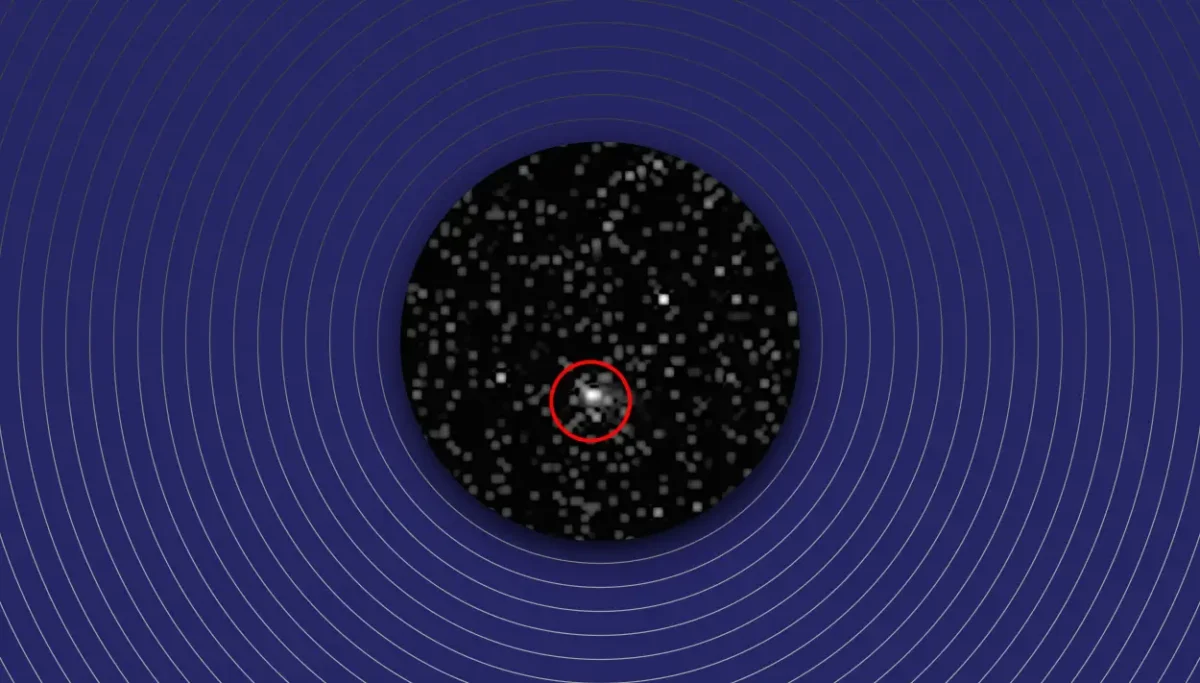
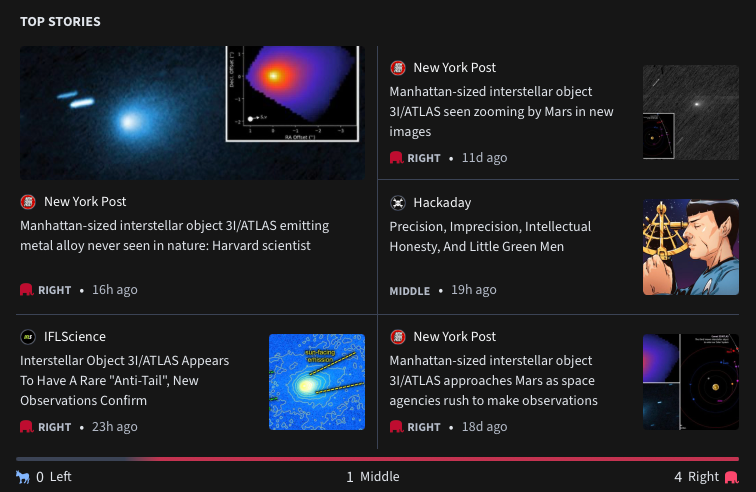
But scientists swear it is indeed a real photo of a real object in outer space — and one that stirs up substantive controversy. Discovered on July 1, it sports a hyperbolic trajectory and was designated 3I/ATLAS, with the “3” and the “I” indicating the third interstellar object discovered in our solar system.

So it’s not the first. In October of 2017, astronomers espied an object apparently coming from the direction of the star Vega. Its brightest was the opposite of constant, with a light curve (of dark-light-dark-light . . .) that most scientists extrapolated evidence of an oblong object tumbling, not spinning, through space. Most intriguingly, it picked up speed after perihelion (when it was closest to the sun), which could not be attributed to a gravitational effect. The object goes by a number of related names, 1I; 1I/2017 U1; 1I/ʻOumuamua; or 1I/2017 U1 (ʻOumuamua), with the “I” standing for “interstellar” and the proper name deriving from Hawaiian, meaning “scout.”

‘Oumuamua’s path through the solar system.

A second interstellar visitor passed through our system two years later. Unlike ‘Oumuamua, it showed a “coma” (cloud of surrounding gas, or out-gassing from the object) that lit up as it approached the Sun, so it is generally designated a comet. (Comets got comas.)

2I/Borisov’s path through the solar system.

3I/ATLAS, however, has some more striking oddities. It is bigger than the others. Much bigger: perhaps 20 kilometers wide.

It will come close to three planets: Mars, Venus, and Jupiter. When closest to Mars, it may reach an apparent magnitude of 11 from the planet, perhaps allowing Mars orbiters to observe it. On the other hand, it will not be observable from Earth when at perihelion because Earth and the comet will be on opposite sides of our yellow star. In early December, if all goes according to normal, predictable comet behavior, 3I/ATLAS will be observable again.

3I/ATLAS at perihelion, and its predicted course.

This odd transit, coming so close to three planets but “avoiding” the most interesting (ours), has suggested to statisticians that something funny is going on. And some scientists are taking note:

A new study authored by Adam Hibberd, Adam Crowl, and Abraham Loeb proposes a possibility that 3I/ATLAS may be technological in origin. While the authors openly describe their hypothesis as a speculative and pedagogical exercise, the investigation itself is grounded in detailed trajectory analysis, dynamic modeling, and mission planning frameworks used in interplanetary navigation.
The underlying premise of the paper is a simple one: if 3I/ATLAS exhibits features or behaviors inconsistent with known natural interstellar bodies, then it is worth investigating whether those features point to artificiality. . . .
The object’s passage through the Solar System is unusually efficient in its interactions with planetary orbits. Its trajectory brings it into close proximity with Venus, Mars, and Jupiter. Each of these encounters happens within a tight orbital window. The likelihood of all three alignments occurring simultaneously, if 3I/ATLAS had entered the system at a random time and trajectory, is calculated to be less than 0.005 percent. These odds, according to the authors, are small enough to merit attention. The close approach distances are not trivial. In the case of Mars, the approach is as close as 0.19 astronomical units, with a longitude difference of just over 7 degrees. Jupiter and Venus show similarly close alignments. The low inclination of 3I/ATLAS’s orbit allows for such interactions to occur without substantial maneuvering.

David Freeman, “Is 3I/ATLAS Acting Like a Probe? New Models Say Yes” (July 19, 2025).

The authors make a rather obvious point: the object passes close enough to Jupiter that, with minor modifications of trajectory, the gas giant could be used to be used to decelerate and swing into an orbit in the solar system.

If artificial.

The timing of any interaction with Earth is another feature analyzed in the study. The authors project that an optimal intercept trajectory would lead to an arrival in Earth’s vicinity sometime between November 21 and December 5, 2025. While this does not confirm intent, it sets a testable timeframe. If no perturbations or anomalies are observed during that window, the hypothesis can be weakened. If, however, a significant change in course, acceleration, or luminosity occurs, the discussion would need to be revisited.

Ibid.

This moves us to something out of a science fiction story. And the authors of the paper have indeed made public comments on this eerie element. See Avi Loeb, “Is the Interstellar Object 3I/ATLAS Alien Technology?” (Medium, July 16, 2025):

One of the solutions to Enrico Fermi’s question about extraterrestrials: “where is everybody?” is offered by the dark forest hypothesis, popularized by Cixin Liu’s science fiction novel “The Dark Forest.” This hypothesis proposes that our cosmic neighborhood is dangerous, filled with intelligent civilizations that are hostile and silent to avoid detection by potential predators. In this context, the silence in searches for radio signals by the SETI community is not caused by the lack of extraterrestrial intelligent civilizations, but is instead a consequence of them fearing mutual destruction.
Our paper explores the possibility that the recently discovered interstellar object, 3I/ATLAS, may provide evidence in support of the dark forest hypothesis.

Yikes?

Yes, yikes: “The velocity thrusts needed for launches of gadgets out of 3I/ATLAS to intercept Venus, Mars, or Jupiter are smaller than 5 kilometers per second, achievable by intercontinental ballistic missiles.” In other words: possible probe. Or probe carrier.

3I/ATLAS comes from the direction of the galactic center. But what matters is where it is going. And, if it changes course, why.