Categories
Update

It’s the Sun, Stupid

Every now and then Paul Jacob covers “the climate.” This would fall outside of the scope of his commentary if politicians and activists would not step outside the scope of their expertise. In the real world, alas, “climate change” and “anthropogenic global warming” are huge political issues, driving trillions of dollars in “research” and, increasingly, in mitigation policies. Costly, sometimes horrendously destructive and dangerous policies.

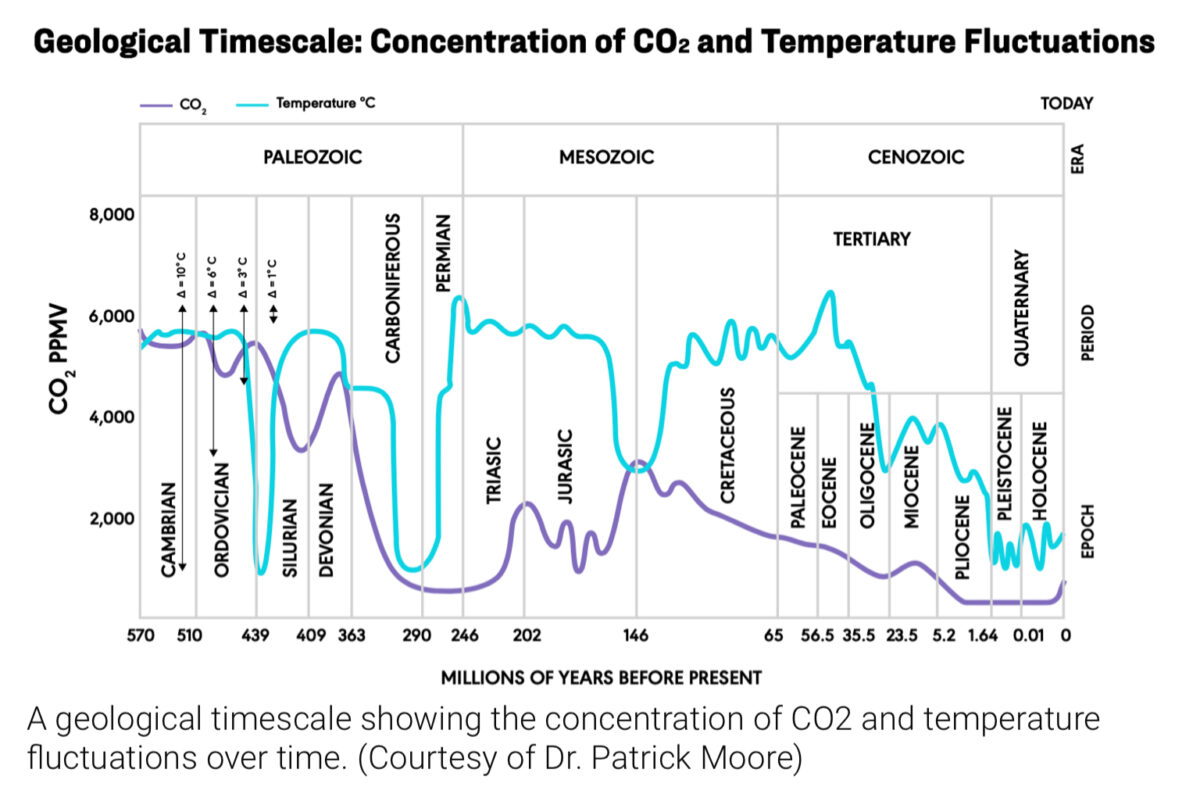
So “Fixation on CO2 Ignores Real Driver of Temperature, Experts Say,” a recent article by Katie Spence in The Epoch Times is worth consulting for a contrarian take.

The current pseudo-consensus driven by massive coordinated propaganda holds that increases in atmospheric carbon is the main destabilizer to past low temperatures, which are almost unaccountably regarded as ideal. Ms. Spence notes that the cold temperatures of pre-industrial Europe were not pleasant. But then gets to a major point:

“If emissions of CO2 stopped altogether, it would take many thousands of years for atmospheric CO2 to return to ‘pre-industrial’ levels,” the Royal Society states in a report on its website. The organization describes itself as a “fellowship of many of the world’s most eminent scientists.”

“Surface temperatures would stay elevated for at least a thousand years, implying a long-term commitment to a warmer planet due to past and current emissions,” the report states. “The current CO2-induced warming of Earth is therefore essentially irreversible on human timescales.”

If this be true, then a lot follows. But would politics actually follow the consequences of this and other arguments? There is a social addiction, at present, to the AGW claims about CO2.

The article relies heavily on the work of Ian Clark, emeritus professor at the Department of Earth and Environmental Sciences at the University of Ottawa, who argues that CO2’s driving of climate is only apparent; in actuality is follows temperature changes “It lags by about 800 years.”

“If we completely cut out emissions, CO2 would stop rising at its current rate,” Mr. Clark said. “But it would probably continue to rise to a certain point, and then it could come down. But that would be driven by temperature.”

Mr. Clark said that in different parts of the world and at different times of the year, CO2 fluctuates “between 15 and 20 percent,” and that’s driven by the temperature of the seasons.

“If we start having cooler summers and colder winters, those fluctuations would start driving CO2 further down. But overall, climate is going to do whatever the sun dictates,” he said.

Categories
Update video

The Deep State’s Long History FOR & AGAINST Free Speech

On this website we have covered government involvement in tech company censorship for a long time. Readers should not miss Tucker Carlson’s recent interview with Mike Benz, who goes into significant detail, and with some new information and a perhaps-startlingly wide perspective:

Categories
Update

Special Use of COVID Fund for Illegal Immigrant Subsidy

In Thursday’s Common Sense, “Paid Invaders,” Paul Jacob discussed the U.S. taxpayers’ subsidies going to the ongoing illegal immigrants crossing the southern border. But the sheer size of the subsidies and handouts is hard to grasp. So consider just one state of the union, on the border with Canada, not Mexico, but which found a way to find the funds to help migrants who came up from the South.

“Washington State diverted over $400 million of federal relief funds to illegal aliens in 2023,” reports Anthony Brian Logan. “The money was taken from a COVID-19 fund and was not meant to shore up migrants’ inability to make ends meet. Under this program, migrants who were not entitled to stimulus money due to their illegal status were given checks of up to $3,000 each. An estimated 300,000 illegal aliens may have been given cash through this method in Washington State alone.”

An article in The New York Post, linked to by Mr. Logan, places the 2023 total of hijacked funds at $60 million less:

A new report is highlighting how federal COVID funds were used in Washington state to give $1,000 checks to illegal immigrants who were ineligible to receive federal economic impact payments during the pandemic due to their immigration status.

The report, by the Economic Policy Innovation Center (EPIC), points to money administered by the Coronavirus State and Local Fiscal Recovery Fund (SLFRF), which was created by the American Rescue Plan Act and was intended to help state and local governments with their response and recovery from the COVID-19 pandemic. 

Washington state received $4.4 billion in funding overall from that program.

The report from the group, which calls for a smaller federal government, highlighted how $340 million in funding went to a program that sent $1,000 checks to illegal immigrants in the state.

Adam Shaw, “Washington state diverted $340M in federal COVID funds to migrants,” New York Post, February 3, 2024.

The program was announced in 2022, by the state’s Department of Health and Human Services, expressing the usual press-release pride:

“The DSHS Office of Refugee and Immigrant Assistance has been honored and humbled to work with our community partners over the past two years to support the WA COVID-19 Immigrant Relief Fund,” said Sarah Peterson, who heads the Office of Refugee and Immigrant Assistance. “This is a tremendous opportunity for DSHS to help people who may have been left out of other federal and state resources to address the economic impact of the pandemic.”

The agency’s goal is to get these resources into the hands of community members in a timely and thoughtful manner and has partnered with many different immigrant-led organizations to implement this fund effectively and safely.

“Washington COVID-19 Immigrant Relief Fund launches new application period Sept. 19-Nov. 14,” Medium, September 19, 2022.

In his discussion of the program, Anthony Brian Logan notes that the federal source of the hand-outs to migrants was, by law, disallowed for that purpose.


Categories
privacy property rights Update

Update: The “No Duh” Element in Private Property

In yesterday’s update, we directed your attention to a court decision that showed some progress in preventing the federal government from outright theft via the medieval civil asset forfeiture technique. The Epoch Times reported. But there was a passage we did not quote:

“Plaintiffs do have a significant privacy interest in their safe deposit boxes, given that their conduct indicates they intended their items to be ‘preserved . . . as private,’ and society generally views the privacy expectations of items in safe deposit boxes as reasonable,” Judge Smith wrote.

Yes, Judge Smith, we do have “privacy interests” in our . . . private property.

It is right there in the term, private property.

The conceptual fight to reclaim our rights can be a tough slog through the obvious.

Categories
Fourth Amendment rights Update

Update: The FBI Stole

Government agencies that “fight crime” too often engage in criminal behavior to do so. 

In June of 2021, Common Sense with Paul Jacob reported on an FBI operation that raided safe deposit boxes.

In March, the federal government conducted a raid of a safe deposit box company called U.S. Privacy Vaults. The government accuses the company of abetting drug dealers.

The government accuses the box renters of . . . nothing. But DOJ is trying to use civil forfeiture laws to retain most of what it seized during the raid: some $85 million in cash and valuables.

In August of 2022 Paul returned to the case, wondering whether FBI agents would themselves see justice:

The plot’s been foiled, it appears, but will the culprits within the FBI be prosecuted?

Seems unlikely.

Truth is, the culture at the FBI has never been good. Barring defunding (which would be politically difficult) perhaps FBI agents should be restricted to just investigation, stripped of their weaponry, forced to rely on state and local lawmen — and perhaps the U.S. Marshals — to make any searches and arrests at all. 

In October, the courts failed to back up the Constitution regarding searches and seizures in this case.

Now, according to The Epoch Times, a federal court has indeed found cause to reprimand the FBI and the lawyers that defended the agents who had — without cause — searched all of the safety deposit boxes: 

“We note that it is particularly troubling that the government has failed to provide a limiting principle to how far a hypothetical ‘inventory search’ conducted pursuant to customized instructions can go,” Judge Smith said.

Many of the plaintiffs have already had their belongings returned by the FBI but pressed forward with the case for an opinion in their favor.

The ruling remanded the case back to U.S. District Judge Robert Klausner, who previously dismissed the case, for a ruling that directs the FBI to destroy records the bureau collected on the box renters who are members of the class-action case.

The opinion “draws a line in the sand, to ensure something like this never happens again,” Rob Johnson, a senior attorney with the Institute for Justice, which was representing the plaintiffs, said in a statement. “If this had come out the other way, the government could have exported this raid as a model across the country. Now, the government is on notice its actions violated the Fourth Amendment.”

It took several years, but apparently justice in this case is finally approaching, and the Federal Bureau of Investigations has been reminded that its powers are limited. By our rights.

Categories
Update

Update: California’s Hospitals

Last Thursday, in “The S-Word in California,” the subject was the danger posed to the stability of the Golden State’s medical system by the promise to guarantee service to nearly a million new illegal immigrants.

But one mechanism of this instability was not brought up, for reasons of space: the politicians’ past, as well as present, promises do not recompense hospitals at anything like a market rate. Which leads to insolvency. Which does not help the poor:

Across a state with the highest proportion of millionaires in the nation, 1 in 5 hospitals are now at risk of closing, according to a study released earlier this year by the California Hospital Association. Many serve the state’s rural redoubts, whose populations are often disproportionately poor and underinsured, and inner-city neighborhoods such as south-central Los Angeles.

Scott Wilson, “A hospital’s abrupt closure means, for many, help is distant,” Washington Post (November 16, 2023).

Now, the recent legislation discussed ostensibly solves the problem, as the Washington Post puts it:

As part of the final state budget, state lawmakers also approved one of the largest increases in years in the rates that Medi-Cal will reimburse hospitals for services. The move is particularly important for rural counties: While about 40 percent of California’s population is covered by Medi-Cal, the rate in Madera is nearly twice that.

And, beginning next year, all of California’s more than 2 million undocumented residents will be eligible for coverage under Medi-Cal, adding another 700,000 undocumented residents to the state insurance plan, meaning hospitals will no longer have to absorb their costs.

If it be true that the rates of reimbursement from Medi-Cal will now cover actual costs, then, as stated on Thursday, that will be an extra burden on the California taxpayer. But upping the rates is not a market phenomenon — a monopsonistic practice by definition — and the Post does not analyze whether the rate hikes will be enough to prevent more hospital failures. Like Medicare’s rates of reimbursement, these are historically pennies on the dollar, and vary widely by procedure and service, adding to administrative burden.

So of course politicians talk about adding more subsidies upon existing subsidies.

The spiral of burdens and benefits just goes out of control, as we would expect when governments seek to replace actual, effective markets for government “solutions.”

Categories
Update

Milei’s Chainsaw

Among the big stories we have been following is the Javier Milei epic, the tale of of the colorful new libertarian president of Argentina and his attempt to bring prosperity and freedom to the beleaguered South American country.

Once upon a time Argentina — named for the metal silver — was wealthy, its people gaining in prosperity. It was a common phrase, a century ago, to refer to a prosperous person as being “as rich as an Argentine.” But with the rise of fascism and Peronism and “modernism” in general, the old liberal peace and prosperity course of progress became a metastasizing cancer of statism and growing gap between the rich and poor. So the new president has presented a radical new reform bill to the Argentine congress.

The 351-page bill includes 664 articles aimed at deregulating and modifying laws pertaining to several sectors, including labor, commercial, real estate, aeronautics, and health. According to Milei, the omnibus bill contains two-thirds of all of his reform proposals. 

Katarina Hill, “Milei Brings His Chainsaw to Argentina’s Regulatory State,” Reason (December 29, 2023).

A big part of the reform bill is a de-nationalization effort:

The bill mentions 41 companies it proposes to privatize, including the flagship airline Aerolíneas Argentinas, the oil company YFP, the country’s largest bank, Banco de la Nación, the news agency Télam, the water company AYSA, the Argentine mint, and the country’s rail system. 

Hill, ibid.

While granting the president some huge powers for a two-year period, the bill would prohibit the government from engaging in all sorts of regulatory activity, especially in the energy industry:

Argentine President Javier Milei is seeking to extinguish decades of government intervention in the nation’s oil industry by unshackling crude exports and leaving local fuel prices at the whim of market forces.

Milei included such measures in sweeping legislation he sent to congress on Wednesday, the latest move since the libertarian president took office on Dec. 10 with a mission to deregulate Argentina’s tightly controlled economy. While his bill has far-reaching consequences for a slew of industries, it features a chapter specifically addressing oil.

Jonathan Gilbert, “Argentina’s Javier Milei Seeks Free Oil Markets in New Legislation,” Bloomberg (December 28, 2023).

The bill would increase export taxes, but offer a tax amnesty for Argentinians. It would eliminate the presidential primary. Other political reforms include

Changes to Argentina’s proportional representation electoral system would raise the number of lawmakers in each district to one per 161,000 inhabitants, from one per 180,000 inhabitants. This would give more power to the populous province of Buenos Aires in the lower house of Congress, according to a note to clients by consultancy firm 1816.

Lucinda Elliott, “What is in Javier Milei’s sweeping Argentina reform bill?Reuters (December 28, 2023).

The “chainsaw” is in the hands of legislators now.