On May 13, 1888, the Empire of Brazil abolished slavery with the passage of the Lei Áurea (“Golden Law”).
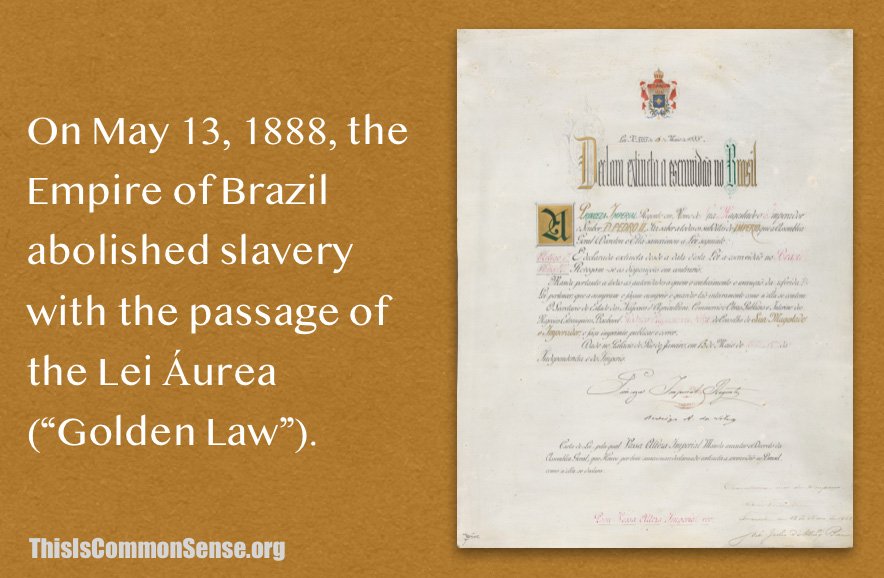
On May 13, 1888, the Empire of Brazil abolished slavery with the passage of the Lei Áurea (“Golden Law”).

On May 12, 1943, Axis forces in North Africa surrendered.

On May 11, 1858, Minnesota was admitted as the 32nd U.S. State.
Nine years later, to the day, the Grand Duchy of Luxembourg’s independence and neutrality were affirmed in the Second Treaty of London.
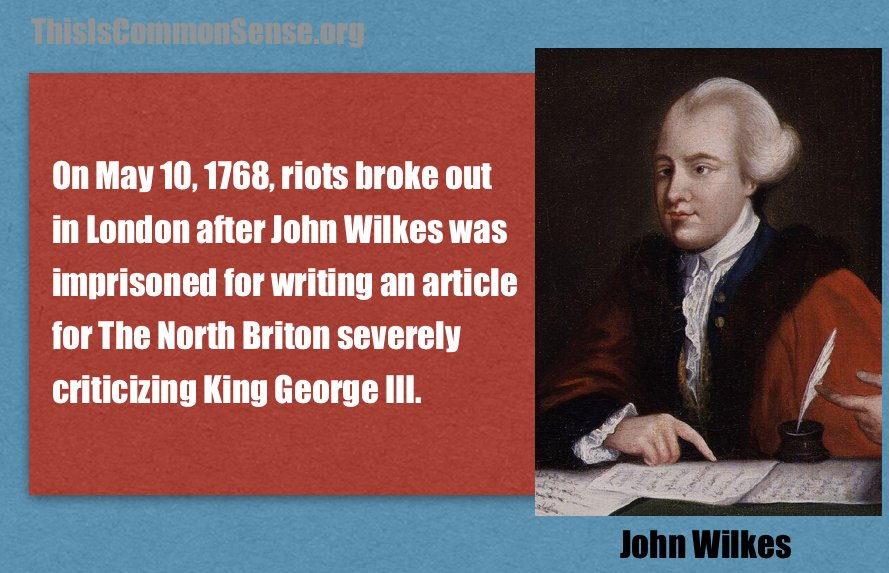
On May 10, 1768, riots broke out in London after John Wilkes was imprisoned for writing an article for The North Briton severely criticizing King George III.

On May 9, 2020, the U.S. unemployment rate hit 14.9 percent, its worst rate since the Great Depression. This was not caused by the boom and bust cycle, credit inflation followed by deflation, or sunspots. It was caused by the “15 days to flatten the curve” pandemic lockdowns that most states had started in March or April of that year and had continued well past the promised end date.
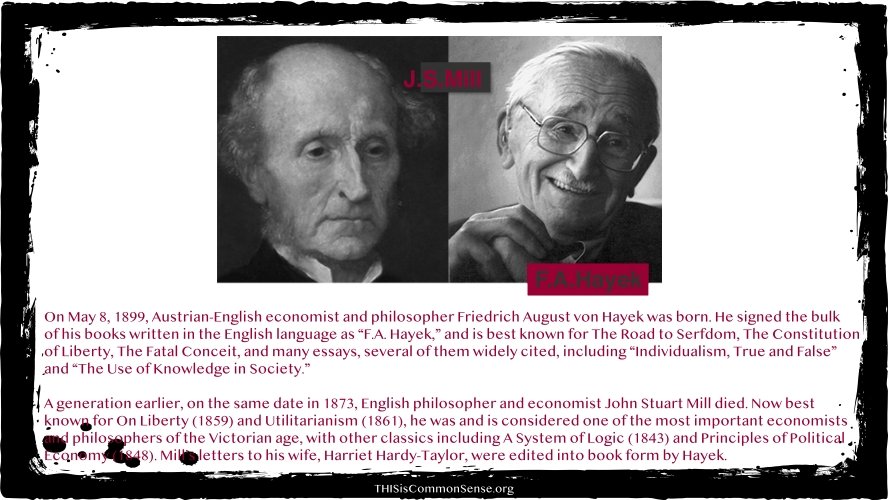
On May 8, 1899, Austrian-English economist and philosopher Friedrich August von Hayek was born. He signed the bulk of his books written in the English language as “F.A. Hayek,” and is best known for The Road to Serfdom, The Constitution of Liberty, The Fatal Conceit, and many essays, several of them widely cited, including “Individualism, True and False” and “The Use of Knowledge in Society.”
A generation earlier, on the same date in 1873, English philosopher and economist John Stuart Mill died. Now best known for On Liberty (1859) and Utilitarianism (1861), he was and is considered one of the most important economists and philosophers of the Victorian age, with other classics including A System of Logic (1843) and Principles of Political Economy (1848). Mill’s letters to his wife, Harriet Hardy-Taylor, were edited into book form by Hayek.
On May 8, 1946, two Estonian school girls (Aili Jõgi and Ageeda Paavel) blew up the Soviet memorial which stood in front of the Bronze Soldier in Tallinn.
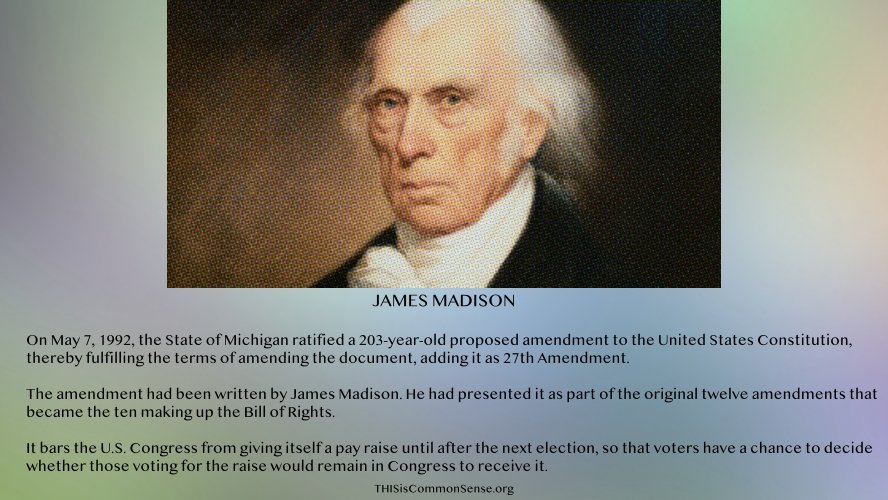
On May 7, 1992, the State of Michigan ratified a 203-year-old proposed amendment to the United States Constitution, thereby fulfilling the terms of amending the document, adding it as the 27th Amendment.
The amendment had been written by James Madison. He had presented it as part of the original twelve amendments that became the ten making up the Bill of Rights.
It bars the U.S. Congress from giving itself a pay raise until after the next election, so that voters have a chance to decide whether those voting for the raise would remain in Congress to receive it.
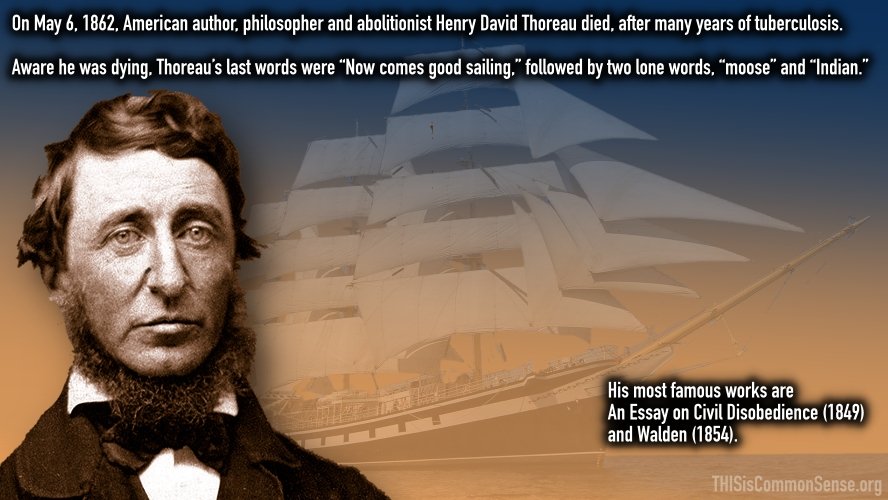
On May 6, 1862, American author, philosopher and abolitionist Henry David Thoreau died, after many years of tuberculosis.
Aware he was dying, Thoreau spoke his last words: “Now comes good sailing,” followed by two lone words, “moose” and “Indian.” Bronson Alcott planned the service and read selections from Thoreau’s works, and Ralph Waldo Emerson wrote the eulogy spoken at his funeral.
His remains, as well as those of members of his immediate family, were eventually moved to Sleepy Hollow Cemetery in Concord, Massachusetts.
His most famous works are An Essay on Civil Disobedience (1849) and Walden (1854).
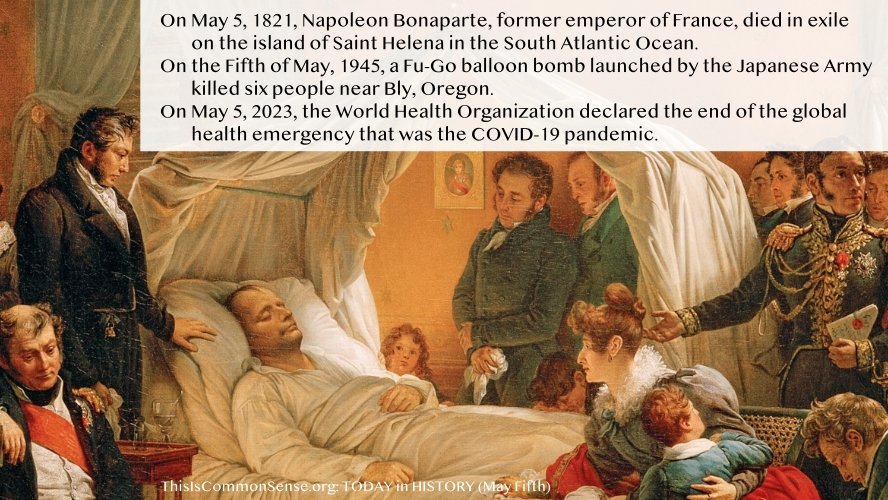
On May 5, 1821, Napoleon Bonaparte, former emperor of France, died in exile on the island of Saint Helena in the South Atlantic Ocean.
On the Fifth of May, 1945, a Fu-Go balloon bomb launched by the Japanese Army killed six people near Bly, Oregon.
On May 5, 2023, the World Health Organization declared the end of the global health emergency that was the COVID-19 pandemic.

In Tiananmen Square in Beijing, China, approximately 3,000 students from 13 Beijing universities gathered on May 4, 1919, to protest the Treaty of Versailles, which transferred Chinese territory to Japan.