A marketing representative for the Digital Equipment Corporation sent the world’s first spam message (unsolicited commercial email) on May 3, 1978, to every ARPANET address on the west coast of the United States.

A marketing representative for the Digital Equipment Corporation sent the world’s first spam message (unsolicited commercial email) on May 3, 1978, to every ARPANET address on the west coast of the United States.

On May 2, 1989, the Hungarian government began dismantling its border fence with Austria, allowing a number of East Germans to defect.

The Manifesto of the Anti-Fascist Intellectuals, written by philosopher Benedetto Croce in response to the Manifesto of the Fascist Intellectuals by Giovanni Gentile, declared the unreconcilable split between the philosopher and the Fascist government of Benito Mussolini, to which he had previously given a vote of confidence on October 31, 1922.
The manifesto was published by Il Mondo on May 1, 1925, which was Workers’ Day, symbolically responding to the publication of the Fascist manifesto on the Natale di Roma, the founding of Rome (traditionally celebrated on April 21). The Fascist press claimed that Croce’s manifesto was “more authoritarian” than its Fascist counterpart — a typical leftist dismissal of what used to be called “liberalism.”
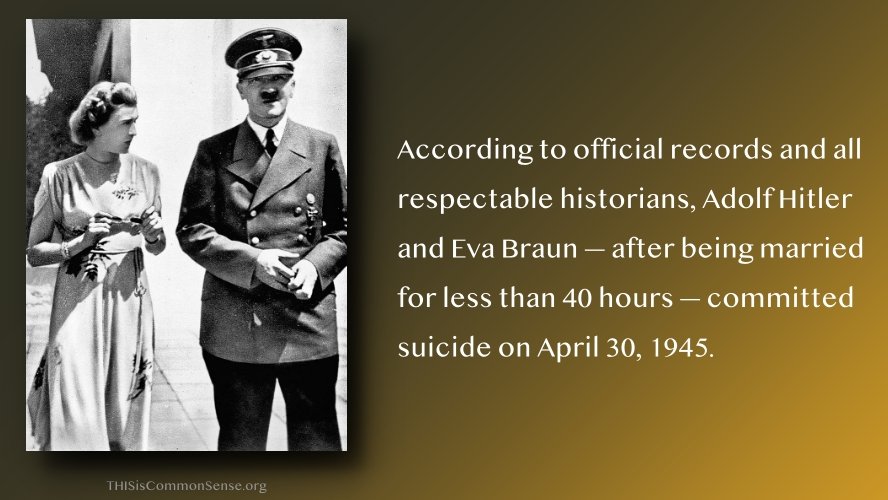
According to official records and all the respectable historians, Adolf Hitler and Eva Braun — after being married for less than 40 hours — committed suicide on April 30, 1945. Nevertheless, rumors about Hitler’s survival in South America, until the 1960s, continue.

On April 29, 1945, U.S. troops of the Seventh Army liberated the Dachau concentration camp.
On April 28, 1788, Maryland became the seventh state to ratify the United States Constitution.
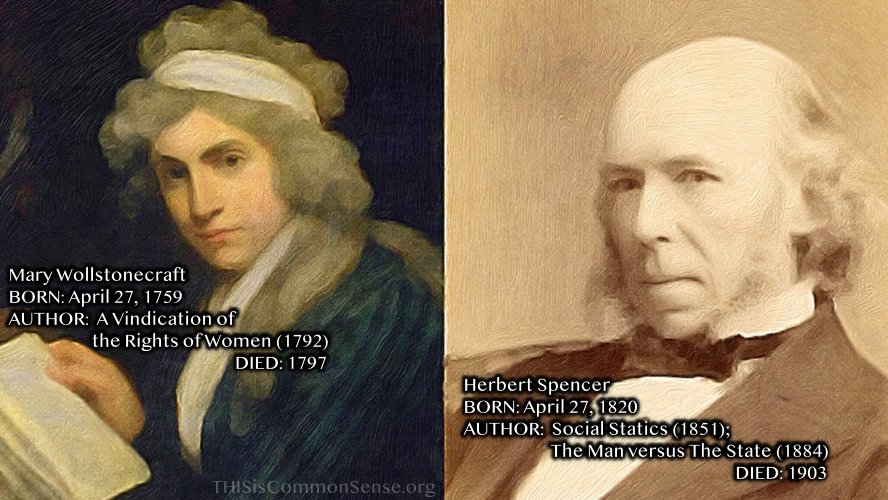
On April 27, 1759, English philosopher and author Mary Wollstonecraft was born. Wollstonecraft wrote several important political treatises, including her response to Edmund Burke’s Reflections on the Revolution in France (1790), A Vindication of the Rights of Men (1790), and her valiant effort in the emancipation of women, A Vindication of the Rights of Women (1792).
English philosopher, psychologist, sociologist, and political theorist Herbert Spencer was born in Derby, England, on April 27, 1820. Among Spencer’s most famous books are First Principles, Principles of Ethics (chiefly its first part, The Data of Ethics), The Study of Sociology, The Man versus the State, and two editions of Social Statics. Spencer was an evolutionary theorist as well as a religious and political philosopher, and coiner of the phrase “survival of the fittest.” He called the basic principle of a free political order “The Law of Equal Freedom.”
Wollstonecraft married anarchist philosopher and bookseller William Godwin; the couple begat one daughter, Mary Shelley, author of Frankenstein: or, The Modern Prometheus. Mary Wollstonecraft died on September 10, 1797.
Spencer never married, dying on December 8, 1903.

On April 26, 1777, Sybil Ludington, aged 16, rode 40 miles to alert American colonial forces to the approach of the British. Her ride was over twice as long as Paul Revere’s more famous effort.
Sybil’s story first appeared in Martha J. Lamb’s History of the City of New York (1880), based on Ludington family oral history, twenty years after Henry Wadsworth Longfellow commemorated Revere in “Paul Revere’s Ride,” a once-popular and quite famous poem. Sybil was commemorated on an 8-cent U.S. Postage Stamp in 1975.
Actual evidence for Miss Ludington’s adventure is slim to none, however.

On April 25, 1792, the French national anthem, “La Marseillaise,” was composed by Capt. Claude Joseph Rouget de Lisle.
The United States Library of Congress was established on April 24, 1800, when President John Adams signed legislation to appropriate $5,000 to purchase “such books as may be necessary for the use of Congress.”