Categories
Today

Statue of Liberty

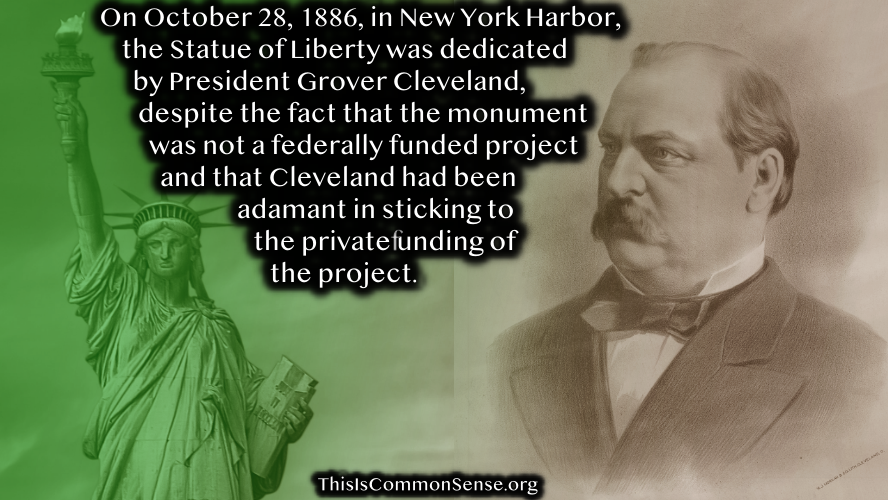
On October 28, 1886, in New York Harbor, the Statue of Liberty was dedicated by President Grover Cleveland, despite the fact that the monument was not a federally funded project and that Cleveland was adamant in sticking to the private funding of the project.

Categories
Today

The Choice

On October 27, 1964, Ronald Reagan delivered a speech on behalf of Republican candidate for the United States Presidency, Barry Goldwater, thereby launching Reagan’s political career. The speech came to be known as “A Time for Choosing.”

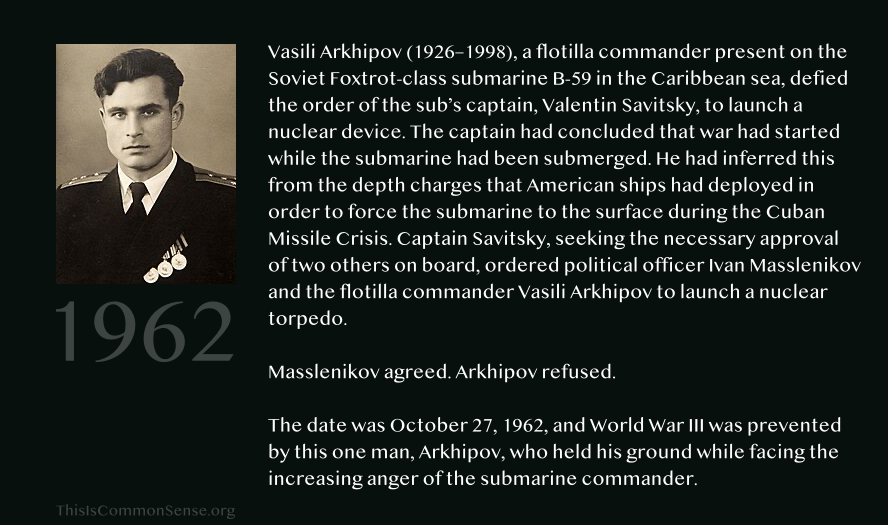
Two years earlier, Vasili Arkhipov, a flotilla commander present on the Soviet Foxtrot-class submarine B-59 in the Caribbean sea, defied the order of the sub’s captain, Valentin Savitsky, to launch a nuclear device. The captain had concluded that war had started while the submarine had been submerged. He had inferred this from the depth charges that American ships had deployed in order to force the submarine to the surface during the Cuban Missile Crisis. Captain Savitsky, seeking the necessary approval of two others on board, ordered political officer Ivan Masslenikov and the flotilla commander Vasili Arkhipov to launch a nuclear torpedo.

Masslenikov agreed. Arkhipov refused.

The date was October 27, 1962, and World War III was prevented by this one man, Arkhipov, who held his ground while facing the increasing anger of the submarine commander, refusing to approve a nuclear torpedo launch that would most almost certainly have triggered a conflict that would have doomed civilization, perhaps most or all of humanity.

That, we can now agree, was a “time for choosing” — and the correct choice was made.
Categories
Today

Continental Congress

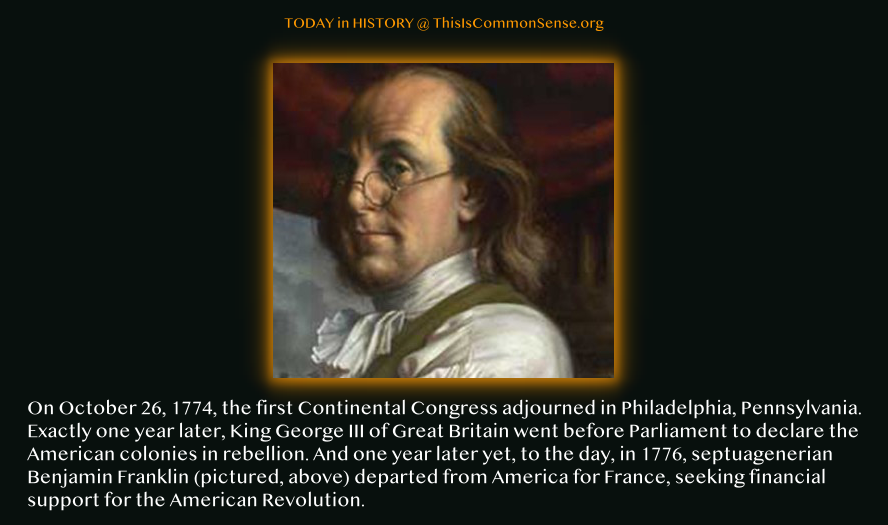
On October 26, 1774, the first Continental Congress adjourned in Philadelphia, Pennsylvania. Exactly one year later, King George III of Great Britain went before Parliament to declare the American colonies in rebellion. And one year later yet, to the day, in 1776, septuagenerian Benjamin Franklin (pictured, above) departed from America for France, seeking financial support for the American Revolution.

Categories
Today

Max Stirner

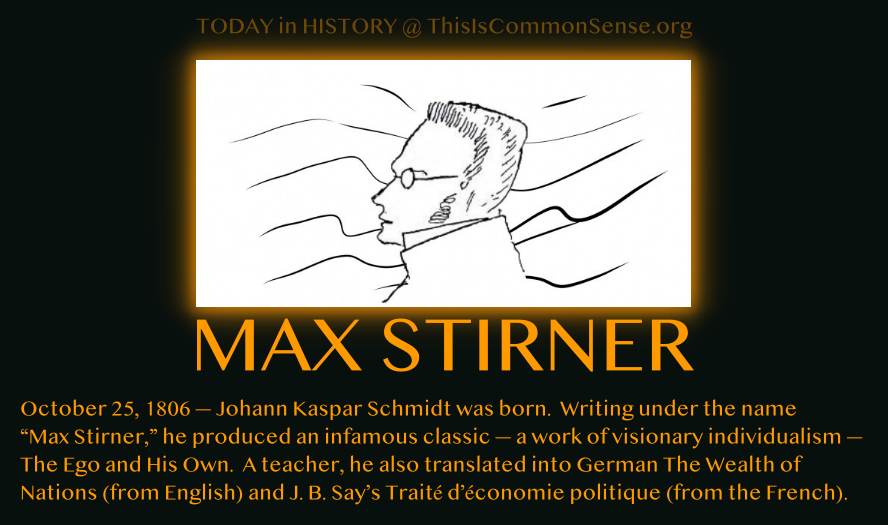
On October 25, 1806, German philosopher Max Stirner was born. Stirner was known for his radical individualism, which under the name of “egoism” became culturally chic in the late 19th and early 20th centuries. In addition to Der Einzige und sein Eigentum, a major work that was famously attacked by Karl Marx, he translated into German Adam Smith’s Wealth of Nations (from its original English) and J.-B. Say’s A Treatise on Political Economy (from its original French).

Der Einzige und sein Eigentum has been translated into English as The Ego and Its Own and The Ego and His Own.

“Max Stirner” is a nom de plume, his birth name being Johann Kaspar Schmidt. He died in 1856, and his biography by John Henry Mackay, Max Stirner — sein Leben und sein Werk, was published in German in 1898 (enlarged 1910, 1914), and finally translated into English in 2005.

The only image we have of him was sketched by Karl Marx’s comrade, benefactor and abuse-buddy, Friedrich Engels. The portrait above has been adapted from that drawing.

Categories
Today

Thirty Years’ End

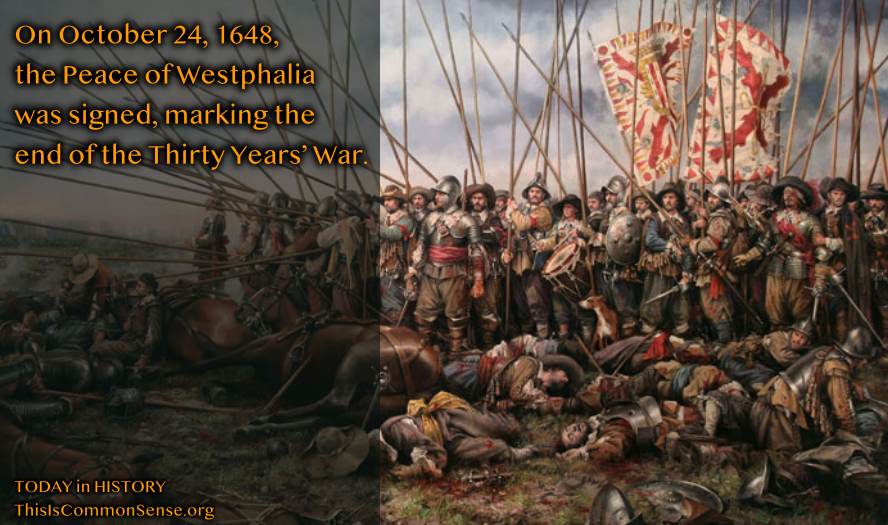
On October 24, 1648, the Peace of Westphalia was signed, marking the end of the Thirty Years’ War.

Categories
Today

An Uprising

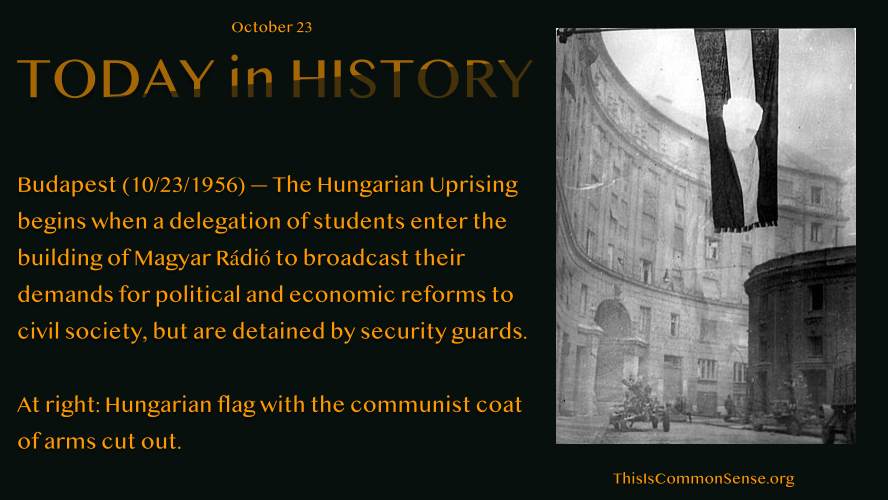
Budapest (10/23/1956) — The Hungarian Uprising begins when a delegation of students enter the building of Magyar Rádió to broadcast their demands for political and economic reforms to civil society, but are detained by security guards.

Categories
Today

Sartre’s Nobel

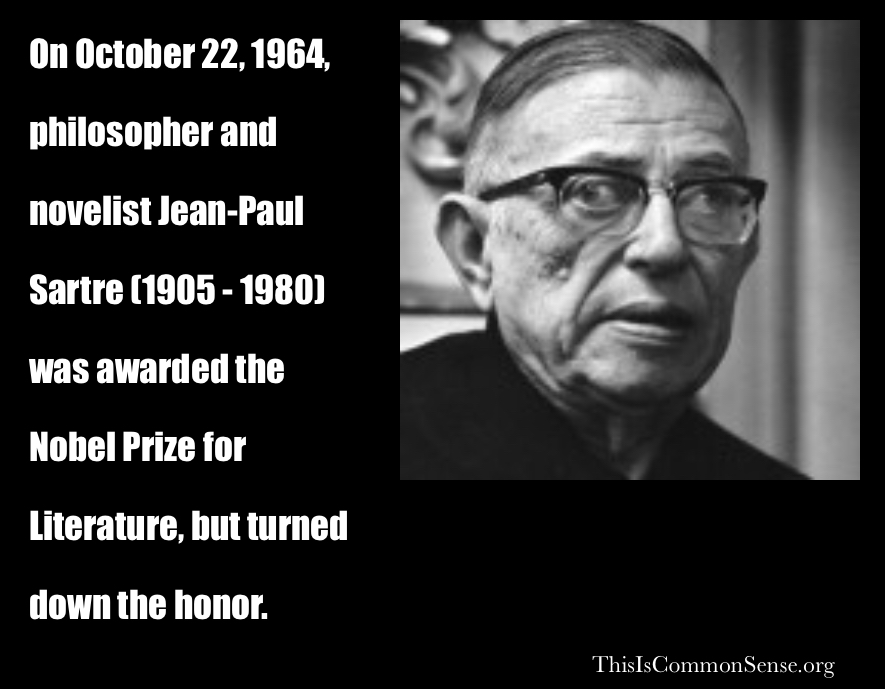
On October 22, 1964, philosopher and novelist Jean-Paul Sartre (1905 – 1980) was awarded the Nobel Prize for Literature, but turned down the honor — establishing a precedent that should have been followed by numerous Peace Prize winners, including Barack Obama and the European Union.

Sartre rejected the award on account of having rejected previous honors. In this he was not dissimilar from philosopher Herbert Spencer (1820-1903) who refused many doctorates late in life, on the grounds that such awards did an old man no good, and perhaps because he was a cantankerous old coot — a judgment that surely applied also to the later French philosopher.

Sartre is best known for his novel Nausea (1938), his play No Exit (1944) and his treatise, Being and Nothingness (1943). One of his main themes was freedom, a concept better explored at the fundamental level of the individual human being than politically, since he become a “Marxist” of sorts . . . the precise nature of which he elaborated in the Critique of Dialectical Reason (1960). He failed to complete his tetralogy of novels, Roads to Freedom, never finishing the final volume.

Categories
Today

Harding Spoke Out

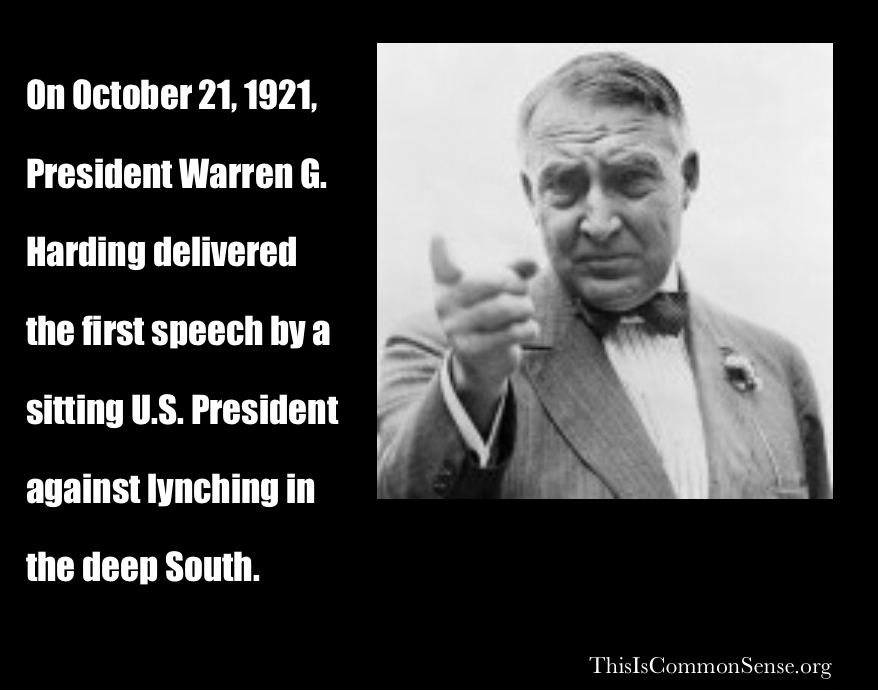
On October 21, 1921, President Warren G. Harding delivered the first speech by a sitting U.S. President against lynching in the deep South.

Categories
Today

Boundaries

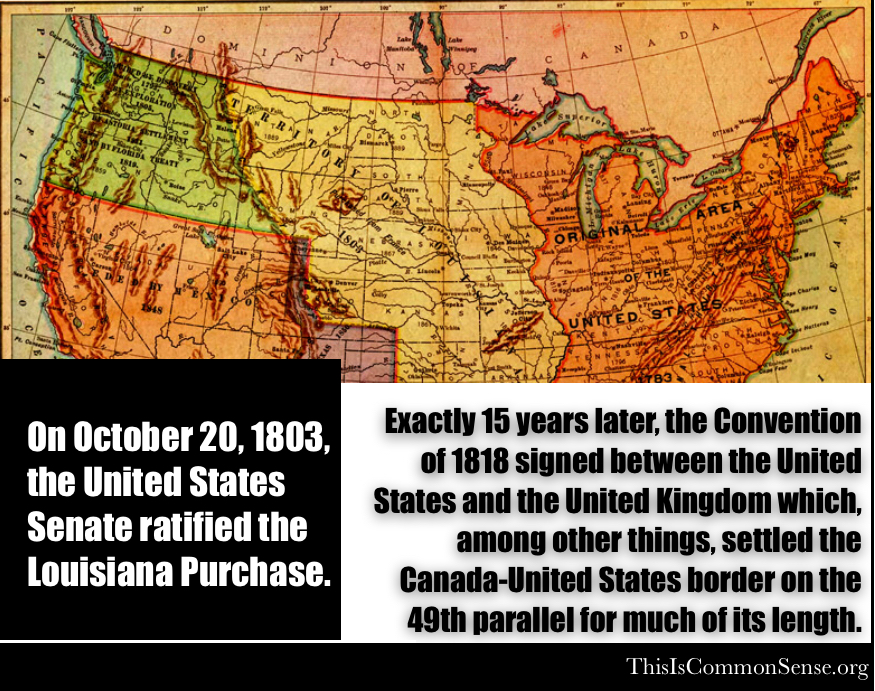
On October 20, 1803, the United States Senate ratified the Louisiana Purchase.

Exactly 15 years later, the Convention of 1818 signed between the United States and the United Kingdom which, among other things, settled the Canada-United States border on the 49th parallel for much of its length.

Categories
Today

The Surrender of Cornwallis

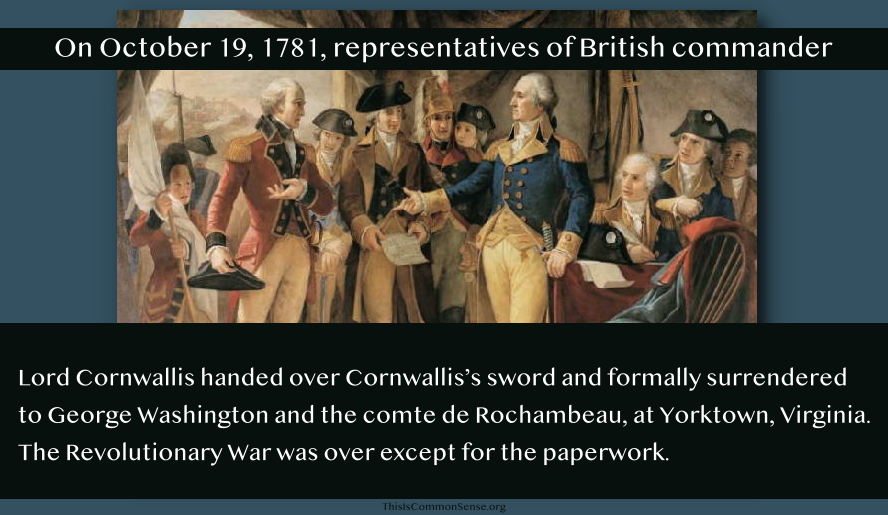
On October 19, 1781, representatives of British commander Lord Cornwallis handed over Cornwallis’s sword and formally surrendered to George Washington and the comte de Rochambeau, at Yorktown, Virginia. The Revolutionary War (or War for Independence, or Colonial Rebellion, or whatever you wish to call it) was over except for the paperwork.