Categories
Today

Nero Recites, Exits

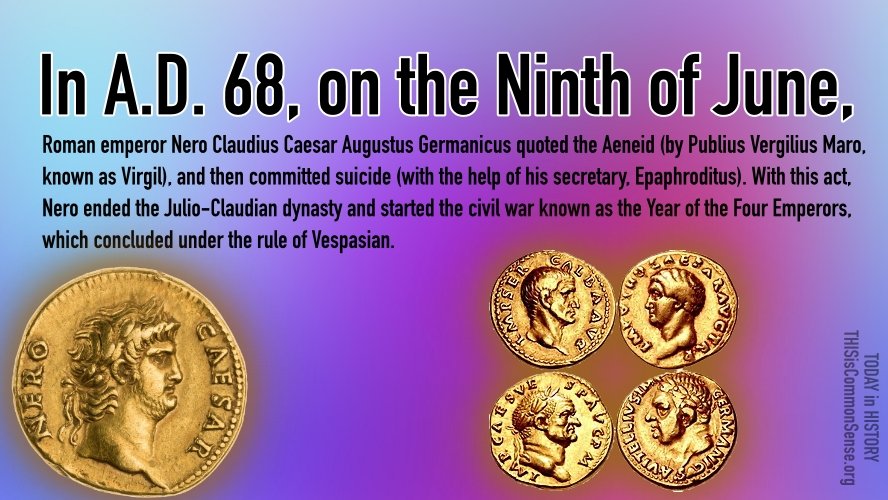
In A.D. 68, on the Ninth of June, Roman emperor Nero Claudius Caesar Augustus Germanicus quoted the Aeneid (by Publius Vergilius Maro, known as Virgil), and then committed suicide (with the help of his secretary, Epaphroditus). With this act, Nero ended the Julio-Claudian dynasty and started the civil war known as the Year of the Four Emperors, which concluded under the rule of Vespasian.

Categories
Today

Nineteen Eighty-Four

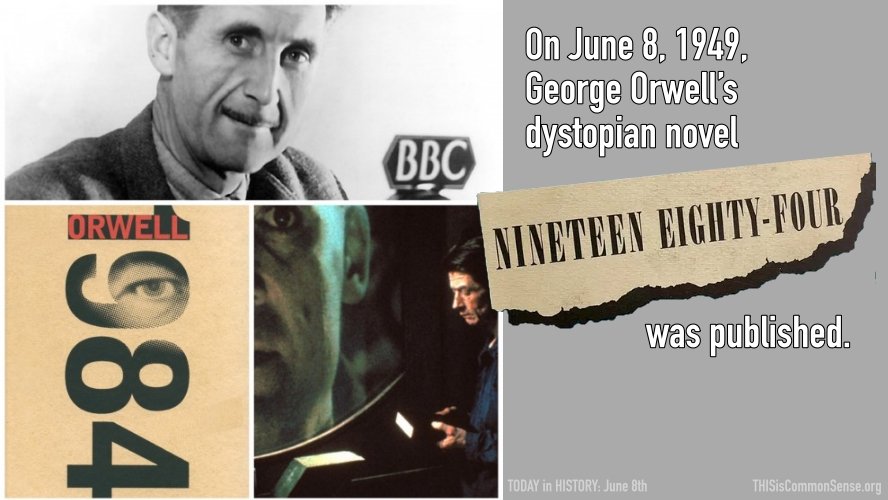
On June 8, 1949, George Orwell’s dystopian novel Nineteen Eighty-Four was published.

Categories
Today

Founders, Fathers

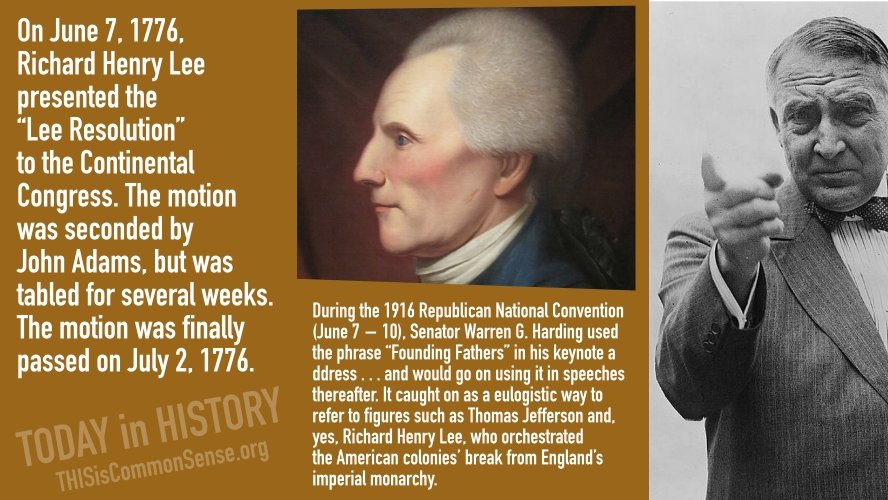
On June 7, 1776, Richard Henry Lee presented the “Lee Resolution” to the Continental Congress. The motion was seconded by John Adams, but was tabled for several weeks. The motion was finally passed on July 2, 1776.

During the 1916 Republican National Convention (June 7 – 10), Senator Warren G. Harding used the phrase “Founding Fathers” in his keynote address . . . and would go on using it in speeches thereafter. It caught on as a eulogistic way to refer to figures such as Thomas Jefferson and, yes, Richard Henry Lee, who orchestrated the American colonies’ break from England’s imperial monarchy.

Categories
Today

A Bolide

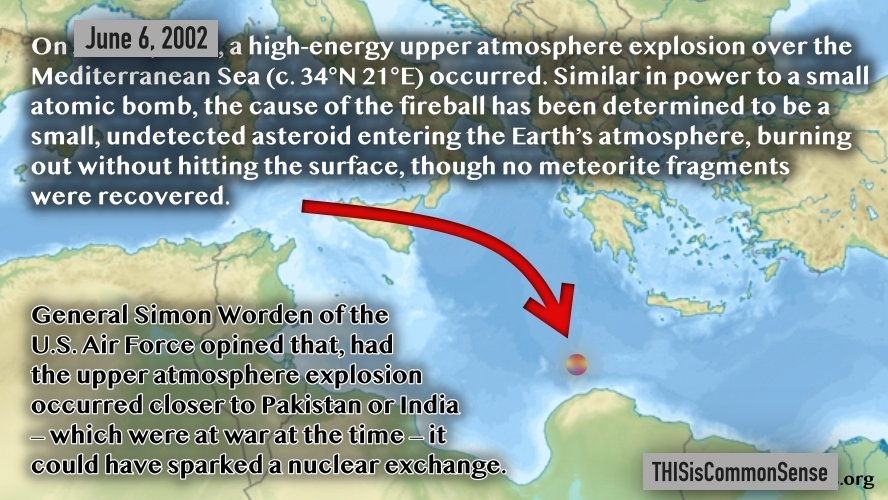
On June 6, 2002, a high-energy upper atmosphere explosion over the Mediterranean Sea (c. 34°N 21°E) occurred. Similar in power to a small atomic bomb, the cause of the fireball has been determined to be a small, undetected asteroid entering the Earth’s atmosphere and burning out without hitting the surface, though no meteorite fragments were recovered. One of the several meanings of the word “bolide” is this, an atmospheric explosion of a meteor.

General Simon Worden of the U.S. Air Force opined that, had the explosion occurred closer to Pakistan or India — which were at war at the time — it could have sparked a nuclear exchange.*


* “Near-Earth Objects Pose Threat, General Says,” Space Daily (2002-09-17).

Categories
Today

Uncle Tom’s Cabin

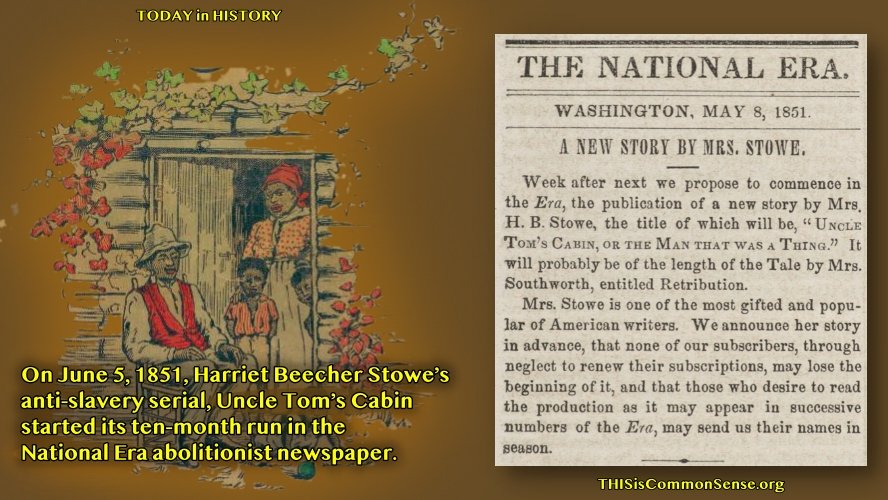
On June 5, 1851, Harriet Beecher Stowe’s anti-slavery serial, Uncle Tom’s Cabin, or Life Among the Lowly, started its ten-month run in the National Era abolitionist newspaper. It had been announced earlier, in the May 8th issue of the paper.

Categories
Today

Remember June 4

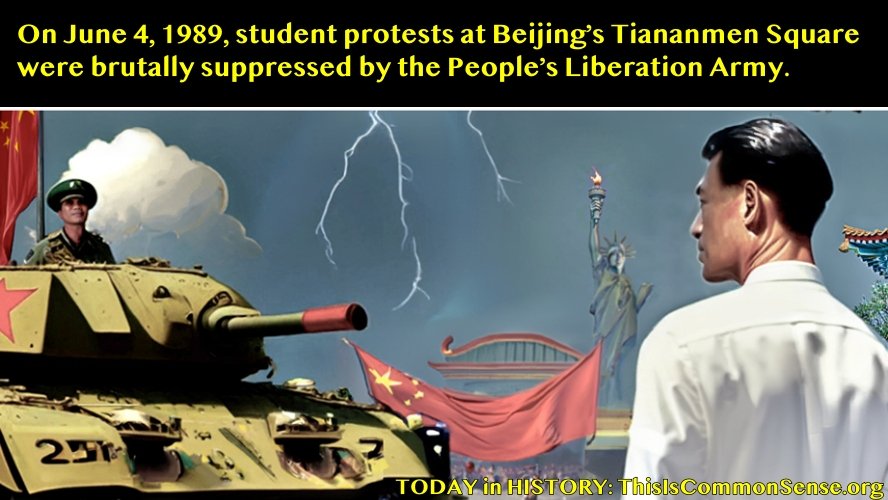
On June 4, 1989, student protests at Beijing’s Tiananmen Square were brutally suppressed by the People’s Liberation Army.

See all recent commentary
(simplified and organized)
See recent popular posts

Categories
Today

Singapore’s Constitution

On June 3, 1959, Singapore adopted a constitution.

Categories
Today

Citizenship

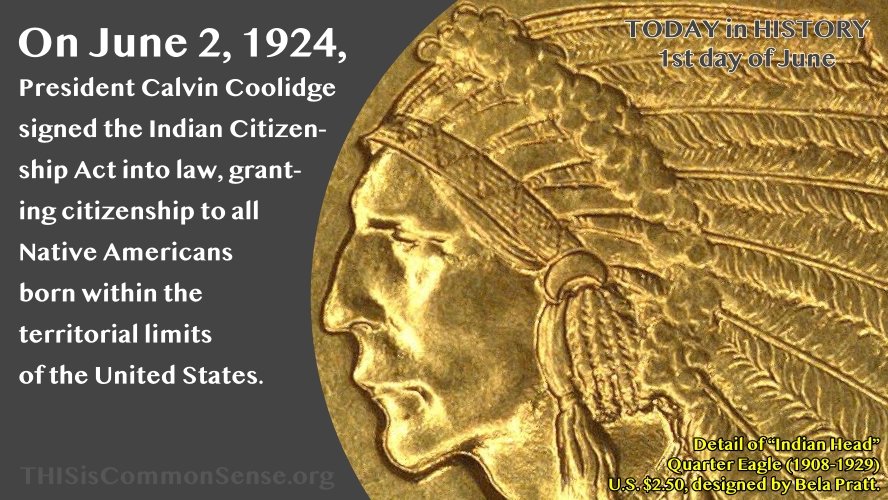
On June 2, 1924, President Calvin Coolidge signed the Indian Citizenship Act into law, granting citizenship to all Native Americans born within the territorial limits of the United States.

Categories
Today

First Day of June

  • The Roundheads defeated the Cavaliers at the Battle of Maidstone in the Second English Civil War on June 1, 1648.
  • The court-martial for malfeasance of Benedict Arnold, a general in the Continental Army during the American Revolutionary War, began on this date in 1779.
  • Kentucky was admitted as the 15th state of the United States in 1792 on the same day of the month.
  • Tennessee was admitted as the 16th state of the United States exactly four years later.
  • Territorial Governor Alexander Ramsey declared the Territory of Minnesota officially established — 1849.
  • The Treaty of Bosque Redondo was signed, allowing the Navajo to return to their lands in Arizona and New Mexico, in 1868.
  • The United States Census Bureau began using, on June 1, 1890, Herman Hollerith’s tabulating machine to count census returns.
  • Adolf Eichmann, a former SS officer in Nazi Germany, was hanged on June 1, 1962, in Israel . . . for having committed crimes against humanity, war crimes, and other offenses.
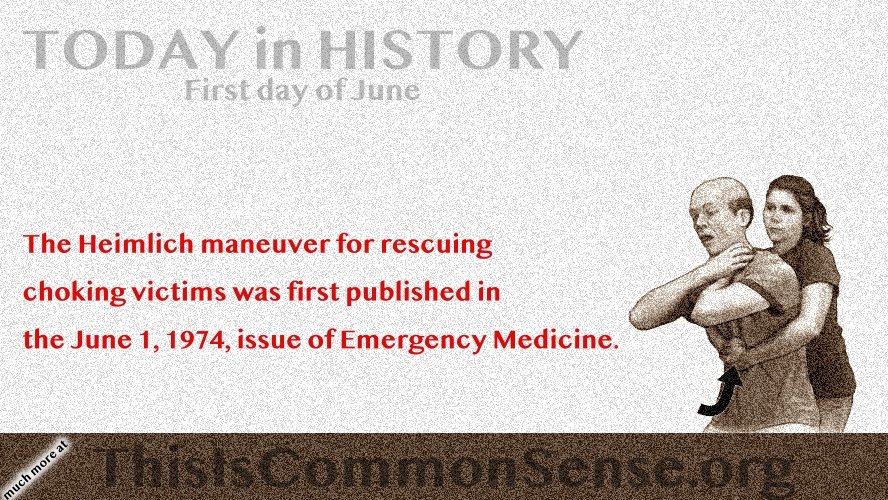
  • The Heimlich maneuver for rescuing choking victims was first published in the June 1, 1974, issue of Emergency Medicine.
  • George H. W. Bush and Mikhail Gorbachev signed a treaty to end chemical weapon production in 1990, on the first day of June.
Categories
Today

Stoned Emperor

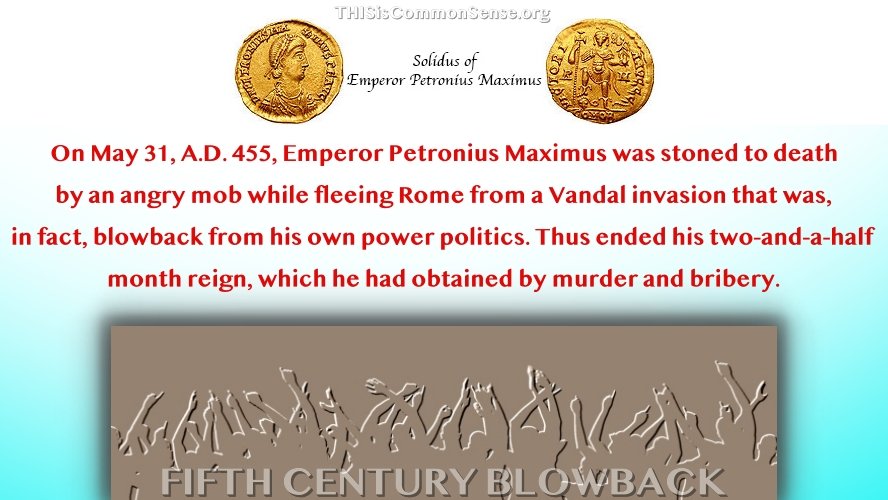
On May 31, A.D. 455, Emperor Petronius Maximus was stoned to death by an angry mob while fleeing Rome from a Vandal invasion that was, in fact, blowback from his own power politics. Thus ended his two-and-a-half month reign, which he had obtained by murder and bribery.

Petronius Maximus made at least one strategic mistake, attempting to strengthen his position by forcing Licinia Eudoxia, the previous emperor’s widow, to marry him — and forcing her daughter Eudocia to marry his son. This latter arrangement canceled Eudocia’s betrothal to the son of the Vandal king Genseric, infuriating both Eudocia and Genseric, who sent a fleet to Rome. Maximus failed to obtain troops from the Visigoths and he fled as the Vandals arrived. In the hubbub, he became detached from his retinue and bodyguard and was killed by fellow Romans.