Categories
Common Sense meme Thought

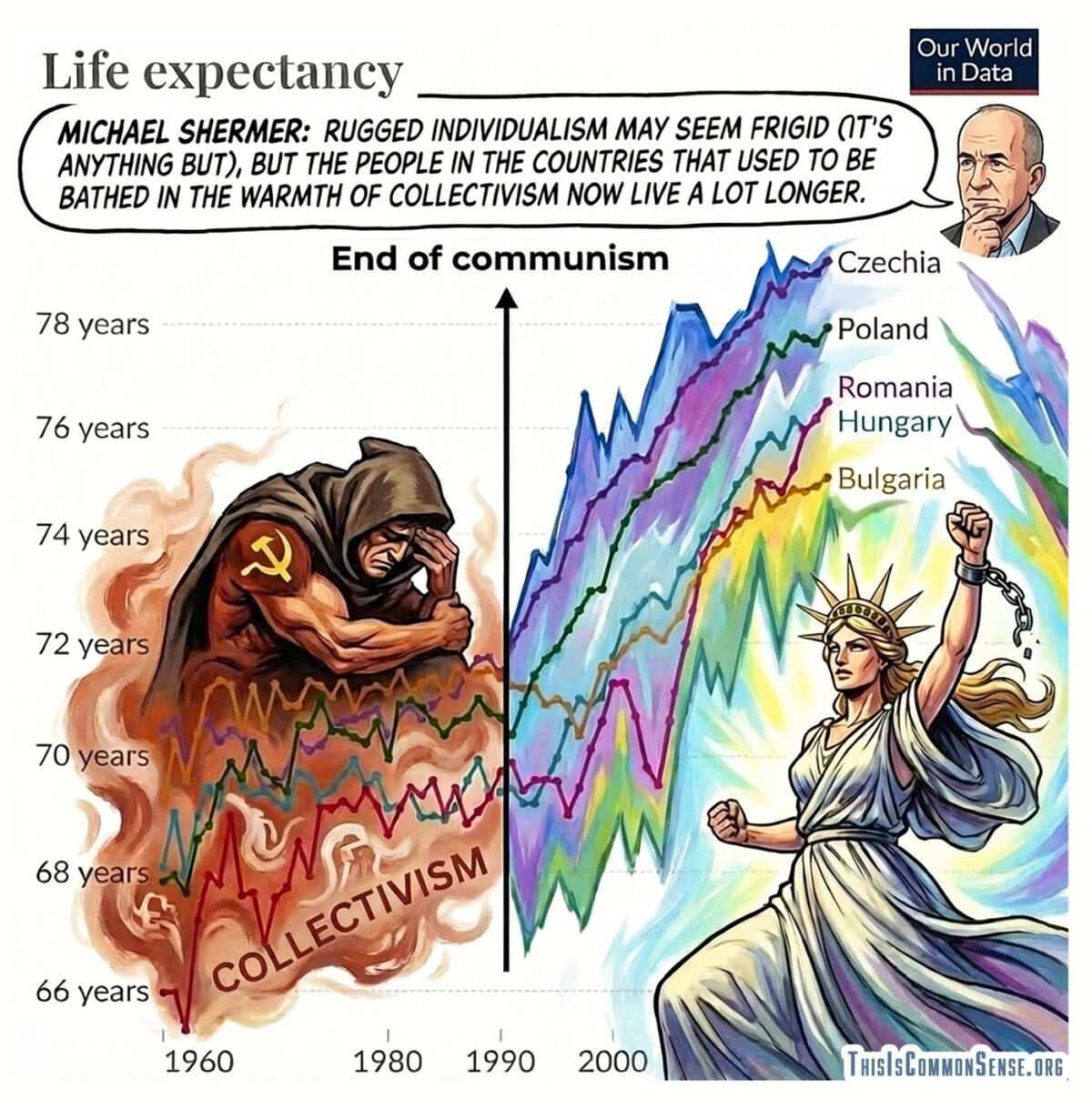
Warmth of Collectivism

“Rugged individualism may seem frigid (it’s anything but), but the people in the countries that used to be bathed in the warmth of collectivism now live a lot longer.”

Michael Shermer (an American science writer, historian of science, executive director of The Skeptics Society, and founding publisher of Skeptic magazine, a publication focused on investigating pseudoscientific and supernatural claims)
Categories
Thought

F. A. Hayek

What a free society offers to the individual is much more than what he would be able to do if only he were free.

F. A. Hayek, The Constitution of Liberty (1960).
Categories
Thought

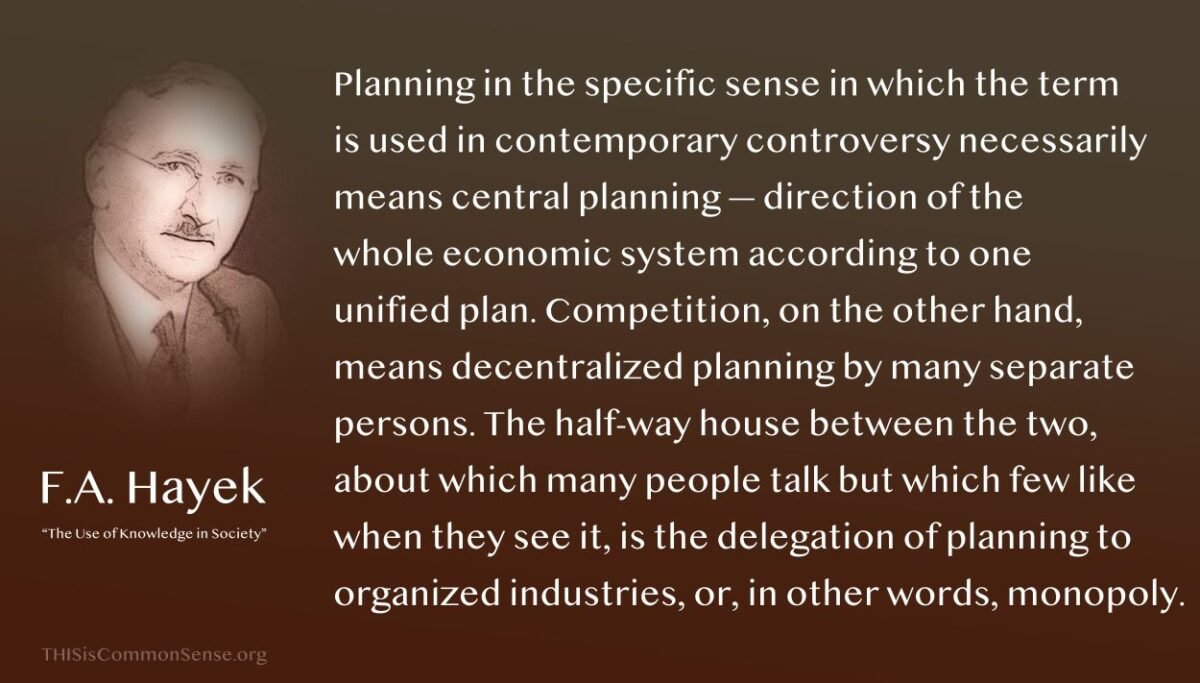
F.A. Hayek

Planning in the specific sense in which the term is used in contemporary controversy necessarily means central planning — direction of the whole economic system according to one unified plan. Competition, on the other hand, means decentralized planning by many separate persons. The half-way house between the two, about which many people talk but which few like when they see it, is the delegation of planning to organized industries, or, in other words, monopoly.

F.A. Hayek, “The Use of Knowledge in Society,” 35 American Economic Review 519 (September 1945), included as Chapter V in Individualism and Economic Order (1948).
Categories
Thought

Dunoyer

Man’s concern is not with government; he should look on government as no more than a very secondary thing — we might almost say a very minor thing. His goal is industry, labour and the production of everything needed for his happiness. In a well-ordered state, the government must only be an adjunct of production, an agency charged by the producers, who pay for it, with protecting their persons and their goods while they work. In a well-ordered state, the largest number of persons must work, and the smallest number must govern. The work of perfection would be reached if all the world worked and no one governed.

Charles Dunoyer, De la liberté du travail (1845), David M. Hart, translator.
Categories
Thought

Pareto

La spoliation ne déplace pas seulement
la richesse, elle en détruit toujours une partie.

Spoliation does not merely displace wealth; it always destroys a part of it.

Vilfredo Pareto, Les systèmes socialistes (1902-1903), Vol. II, p. 54, David M. Hart, translator.
Categories
Thought

Dunoyer

Man’s concern is not with government; he should look on government as no more than a very secondary thing — we might almost say a very minor thing. His goal is industry, labour and the production of everything needed for his happiness. In a well-ordered state, the government must only be an adjunct of production, an agency charged by the producers, who pay for it, with protecting their persons and their goods while they work. In a well-ordered state, the largest number of persons must work, and the smallest number must govern. The work of perfection would be reached if all the world worked and no one governed.

Charles Dunoyer, De la liberté du travail (1845), David M. Hart, translator.
Categories
Thought

Pareto

Let us assume that all production is socialized. If citizens abandon their work on the slightest pretext to go for a walk, they will end up in destitution and die of hunger. One will therefore be forced, sooner or later, to take measures to avoid these evils; and if one does not want to let selection operate and carry out the sorting of good and bad elements, it will be necessary to take away from citizens the freedom to leave their work, condemning them, in a way, to forced labor.

Vilfredo Pareto, Les systèmes socialistes (1902-1903), Vol. II, p. 63.
Categories
Thought

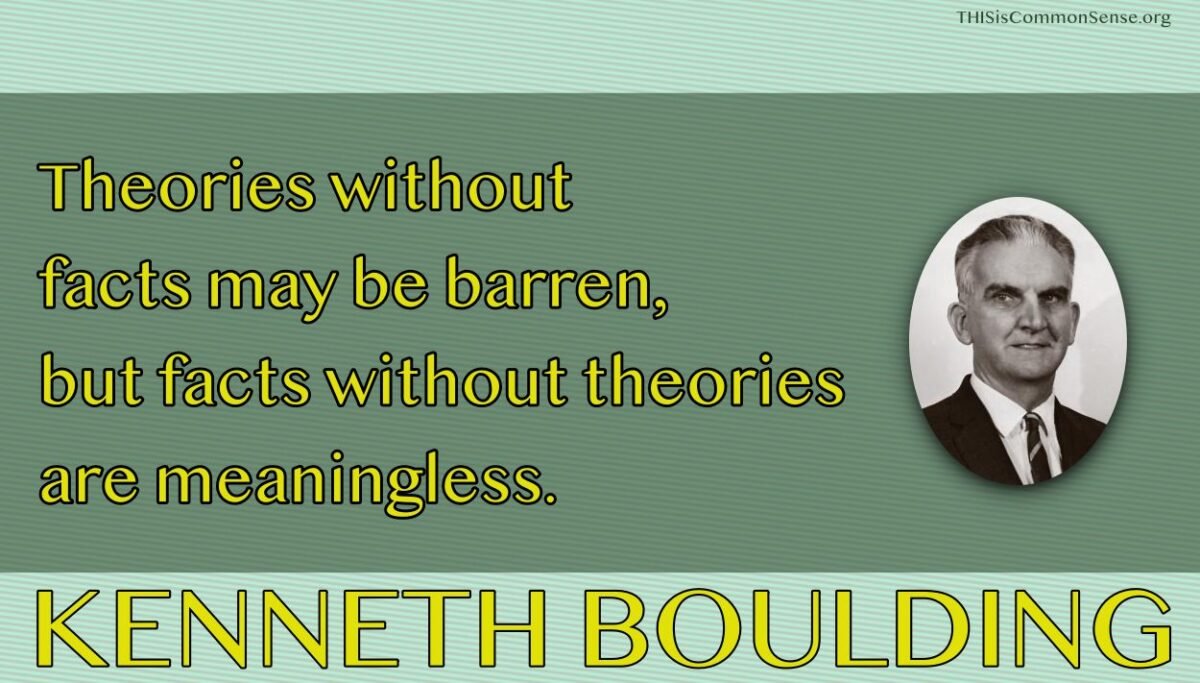
Boulding

Theories without facts may be barren, but facts without theories are meaningless.

Economist Kenneth Boulding, as quoted in Liberal education (1955). Vol. 41, p. 430.
Categories
Thought

Pareto

Signe de décadence: humanitaires, mièvre sensiblerie;
rend incapable défendre positions. Toute élite qui nest
pas prête à livrer bataille pour défendre ses positions
est condamnée à disparaître, et il y a une élite
nouvelle qui monte et qui pousse l’ancienne.

Sign of decadence: humanitarians, mawkish sentimentality; makes one incapable of defending positions. Any elite that is not ready to do battle to defend its positions is condemned to disappear, and there is a new elite that rises and pushes out the old.

Vilfredo Pareto, Les systèmes socialistes (1902-1903), Vol. I, p. 37-38, David M. Hart, translator.
Categories
Thought

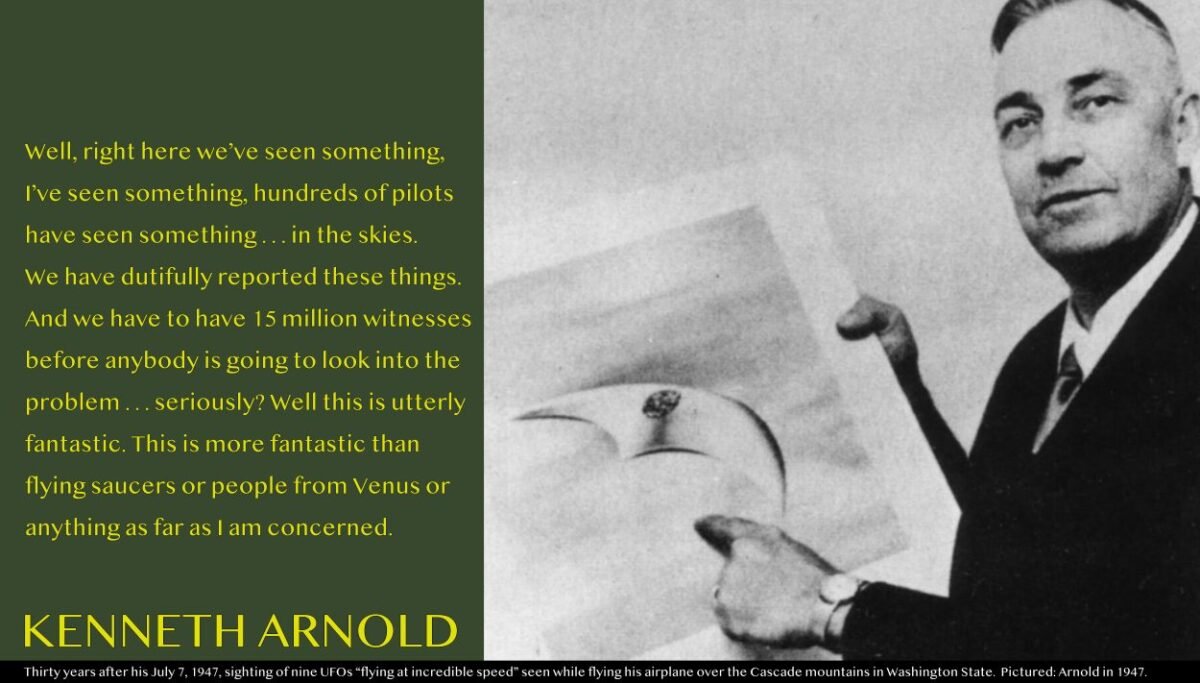
Kenneth Arnold

Well, right here we’ve seen something, I’ve seen something, hundreds of pilots have seen something . . . in the skies. We have dutifully reported these things. And we have to have 15 million witnesses before anybody is going to look into the problem . . . seriously? Well this is utterly fantastic. This is more fantastic than flying saucers or people from Venus or anything as far as I am concerned.

Kenneth Arnold, 30 years after first seeing nine mysterious flying objects over Mount Rainier, while attending the First International UFO Congress in Chicago, curated by Fate to mark the 30th anniversary of the “birth” of the modern UFO age, “Pilot Kenneth Arnold 1977 still angry about disbelief,” on YouTube.