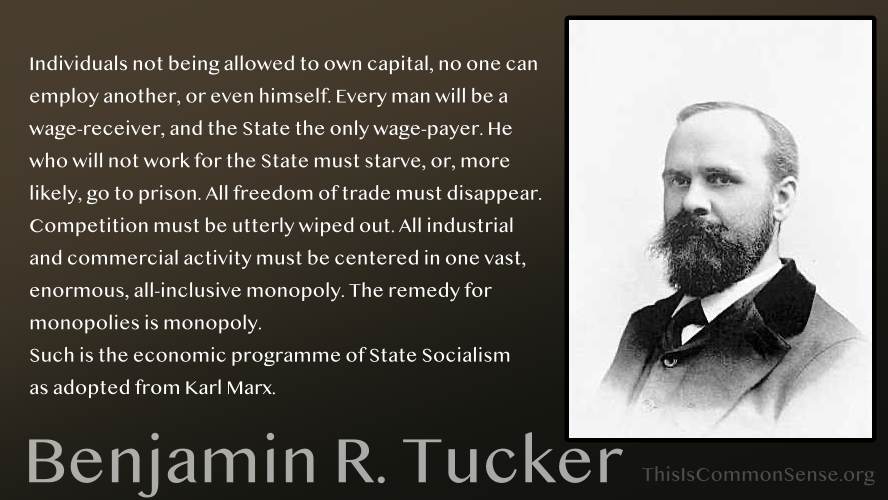
First, then, State Socialism, which may be described as the doctrine that all the affairs of men should be managed by the government, regardless of individual choice. Marx, its founder, concluded that the only way to abolish the class monopolies was to centralize and consolidate all industrial and commercial interests, all productive and distributive agencies, in one vast monopoly in the hands of the State. The government must become banker, manufacturer, farmer, carrier, and merchant, and in these capacities must suffer no competition. Land, tools, and all instruments of production must be wrested from individual hands, and made the property of the collectivity. To the individual can belong only the products to be consumed, not the means of producing them. A man may own his clothes and his food, but not the sewing-machine which makes his shirts or the spade which digs his potatoes. Product and capital are essentially different things; the former belongs to individuals, the latter to society. Society must seize the capital which belongs to it, by the ballot if it can, by revolution if it must. Once in possession of it, it must administer it on the majority principle, though its organ, the State, utilize it in production and distribution, fix all prices by the amount of labor involved, and employ the whole people in its workshops, farms, stores, etc. The nation must be transformed into a vast bureaucracy, and every individual into a State official. Everything must be done on the cost principle, the people having no motive to make a profit out of themselves. Individuals not being allowed to own capital, no one can employ another, or even himself. Every man will be a wage-receiver, and the State the only wage-payer. He who will not work for the State must starve, or, more likely, go to prison. All freedom of trade must disappear. Competition must be utterly wiped out. All industrial and commercial activity must be centered in one vast, enormous, all-inclusive monopoly. The remedy for monopolies is monopoly.
Benjamin R. Tucker, Liberty 5.16, no. 120 (March 10, 1888), pp. 2-3, 6.
Such is the economic programme of State Socialism as adopted from Karl Marx.
Categories
Benjamin R. Tucker