Categories
Thought

John Adams

Old minds are like old horses; you must exercise them if you wish to keep them in working order.

Categories
Thought

Étienne Bonnot de Condillac

We have seen how wealth spreads everywhere when trade enjoys full and permanent freedom. It pours continuously from one province into another. Agriculture is flourishing: people cultivate the arts even in the hamlets: each citizen finds a comfortable existence in work of his choice: all is brought to value; and one does not catch a glimpse of those fortunes out of all proportion which bring luxury and wretchedness.
Everything changes in step with different causes which bring blows to freedom of trade. We have run through these causes, which are wars, tolls, customs, guilds, exclusive privileges, taxes on consumption, variations in coinage, exploitation of mines, every kind of government borrowing, the grain police, the luxury of a great capital, the rivalry of nations, finally the spirit of finance which enters every part of the administration.
Then disorder is at its height. Wretchedness grows with luxury: the towns fill with beggars: the countryside loses population; and the state which has contracted huge debts appears to have no further expedients except those which bring about its ruin.

From the concluding chapter to Commerce and Government considered in their mutual relationship, by the Abbé de Condillac of the Académie Française & Member of the Royal Society of Agriculture of Orléans (1776).
Categories
Thought

David Crockett

Statesmen are gamesters, and the people are the cards they play with.

David Crockett, first sentence of The Life of Martin Van Buren, Heir-apparent to the “Government” and the Appointed Successor to General Andrew Jackson (Tenth edition, 1836).
Categories
Thought

Aristotle

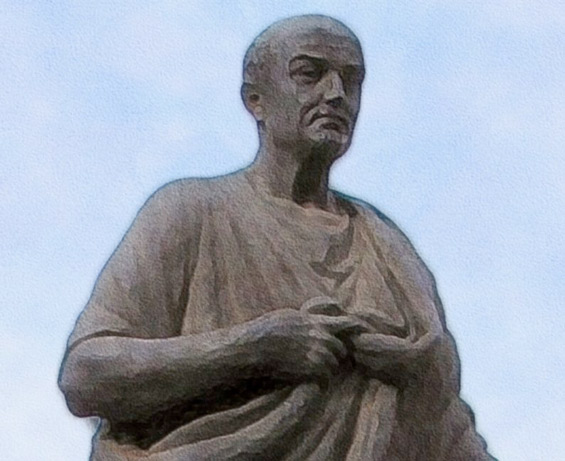
Now we take the human function to be a certain kind of life, and take this life to be the soul’s activity and actions that express reason, and the function of a good man to be the good and noble performance of these. Each function is completed well when its completion expresses the proper virtue. Therefore, the human good turns out to be the soul’s activity that expresses virtue. And if there are more virtues than one, the good will express the best and most complete virtue. Moreover, it will be in a complete life. For one swallow does not make a spring, nor does one day; nor, similarly, does one day or a short time make us blessed and happy.

Aristotle, Nichomachean Ethics
Categories
Thought

Juvenal

Mens sana in corpore sano.

“You should pray for a sound mind in a sound body.”

Categories
Thought

Joseph Hiam Levy

Elevation of purpose, though a condition of the best achievements, is also a condition of the worst. The maximum of evil is never done save by the agency of men and women of disinterested lives and virtuous intentions.

J. H. Levy, biographical introduction to Yves Guyot, The Tyranny of Socialism, (London: Swan Sonnenschein and Co., 1894).
Categories
Thought

Étienne Bonnot de Condillac

Commerce presumes two things: surplus production on the one hand, and on the other consumption to be made.

Commerce and Government considered in their mutual relationship, by the Abbé de Condillac of the Académie Française & Member of the Royal Society of Agriculture of Orléans (1776).
Categories
Thought

Marcus Aurelius

Never let the future disturb you. You will meet it, if you have to, with the same weapons of reason which today arm you against the present.

Imperator and Pontifex Maximus Marcus Aurelius, Meditations, VII, 8 (Penguin Classics edition, translated by Maxwell Staniforth).

Categories
Thought

Herbert Spencer

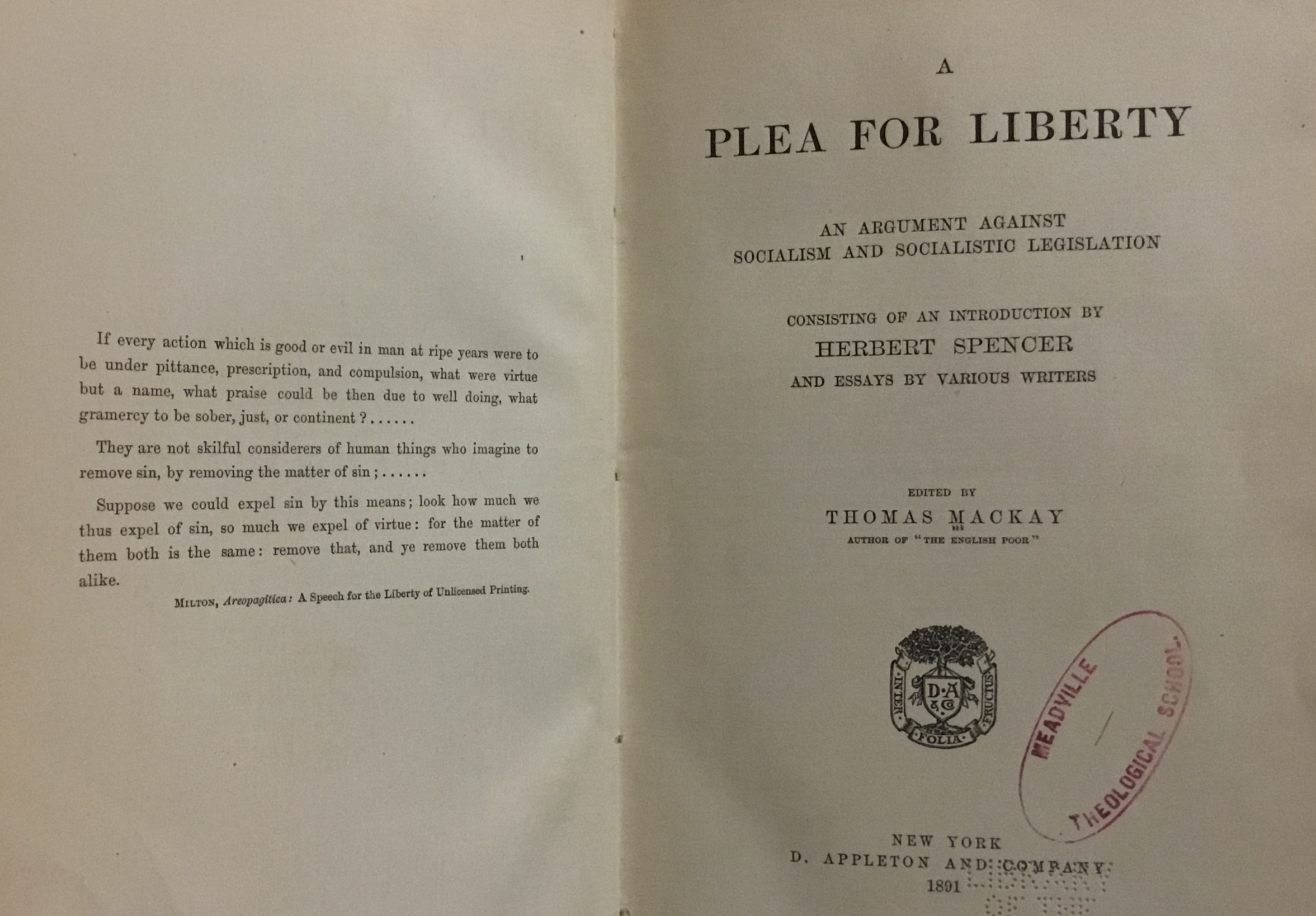
Speaking broadly, every man works that he may avoid suffering. Here, remembrance of the pangs of hunger prompts him; and there, he is prompted by the sight of the slave-driver’s lash. His immediate dread may be the punishment which physical circumstances will inflict, or may be punishment inflicted by human agency. He must have a master; but the master may be Nature or may be a fellow man. When he is under the impersonal coercion of Nature, we say that he is free; and when he is under the personal coercion of some one above him, we call him, according to the degree of his dependence, a slave, a serf, or a vassal. . . .

Men may work together in a society under either of these two forms of control: forms which, though in many cases mingled, are essentially contrasted. Using the word co-operation in its wide sense, and not in that restricted sense now commonly given to it, we may say that social life must be carried on by either voluntary co-operation or compulsory co-operation; or, to use Sir Henry Maine’s words, the system must be that of contract or that of status—that in which the individual is left to do the best he can by his spontaneous efforts and get success or failure according to his efficiency, and that in which he has his appointed place, works under coercive rule, and has his apportioned share of food, clothing, and shelter.

The system of voluntary co-operation is that by which, in civilized societies, industry is now everywhere carried on. . . . This voluntary co-operation, from its simplest to its most complex forms, has the common trait that those concerned work together by consent. There is no one to force terms or to force acceptance. It is perfectly true that in many cases an employer may give, or an employee may accept, with reluctance: circumstances he says compel him. But what are the circumstances? In the one case there are goods ordered, or a contract entered into, which he cannot supply or execute without yielding; and in the other case he submits to a wage less than he likes because otherwise he will have no money wherewith to procure food and warmth. The general formula is not—“Do this, or I will make you”; but it is—“Do this, or leave your place and take the consequences.”

Herbert Spencer, ”From Freedom to Bondage,” in Thomas Mackay, ed., A Plea for Liberty (1891).
Categories
Thought

William J. Locke

The only remedy against the malady of life is life itself. The bane is its own antidote.

William J. Locke, The Glory of Clementina (1911).