A weak man has doubts before a decision, a strong man has them afterwards.
Categories
Karl Kraus
A weak man has doubts before a decision, a strong man has them afterwards.
Reading furnishes the mind only with materials of knowledge; it is thinking that makes what we read ours.

The books that help you the most are those which make you think the most.
Theodore Parker, as quoted in The Gigantic Book of Teachers’ Wisdom (2007) by Erin Gruwell and Frank McCourt, p. 496.

Europe was a heap of swords piled as delicately as jackstraws; one could not be pulled out without moving the others.
Barbara W. Tuchman, The Guns of August, Chapter 2, “Let the Last Man on the Right Brush the Channel with His Sleeve” (p. 22).
There is what I call the American idea. I so name it, because it seems to me to lie at the basis of all our truly original, distinctive, and American institutions. It is itself a complex idea, composed of three subordinate and more simple ideas, namely: The idea that all men have unalienable rights; that in respect thereof, all men are created equal; and that government is to be established and sustained for the purpose of giving every man an opportunity for the enjoyment and development of all these unalienable rights. This idea demands, as the proximate organization thereof, a democracy, that is, a government of all the people, by all the people, for all the people; of course, a government after the principles of eternal justice, the unchanging law of God; for shortness’ sake, I will call it the idea of Freedom.
Theodore Parker, “The American Idea,” a speech at New England Anti-Slavery Convention, Boston (May 29, 1850).
We all want progress, but if you’re on the wrong road, progress means doing an about-turn and walking back to the right road; in that case, the man who turns back soonest is the most progressive.

Of all liars, the smoothest and most convincing is memory.
Harlan Ellison, The City on the Edge of Forever: The Original Teleplay.
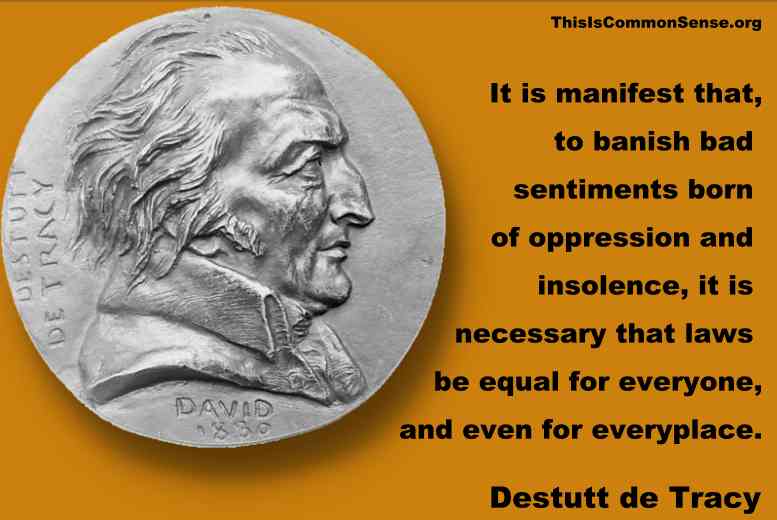
Destutt de Tracy, as quoted by Mme. Victor de Tracy, Death Notice on Destutt de Tracy (translated by Iris Hartman, 1852).
It is manifest that, to banish bad sentiments born of oppression and insolence, it is necessary that laws be equal for everyone, and even for everyplace.
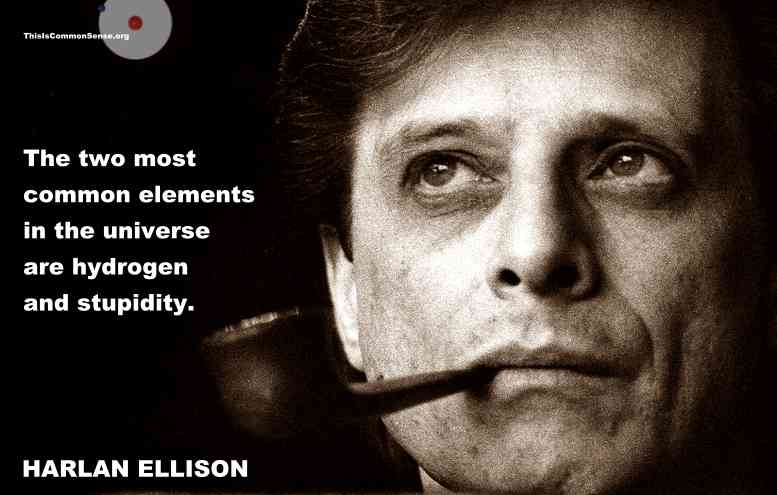
The two most common elements in the universe are hydrogen and stupidity.
Harlan Ellison, Introduction to Blast Off : Rockets, Robots, Ray Guns, and Rarities from the Golden Age of Space Toys (2001) by S. Mark Young, Steve Duin, Mike Richardson, p. 6, who went on to say that it was often misquoted: “I don’t so much mind that they pirated it, but what does honk me off is that they never get it right. They render it dull and imbecile by phrasing it thus: ’The two most common things in the universe are…’
Not things, you insensate gobbets of ambulatory giraffe dung, elements! Elements is funny, things is imprecise and semi-guttural. Things! Geezus, when will the goyim learn they don’t know how to tell a joke.’
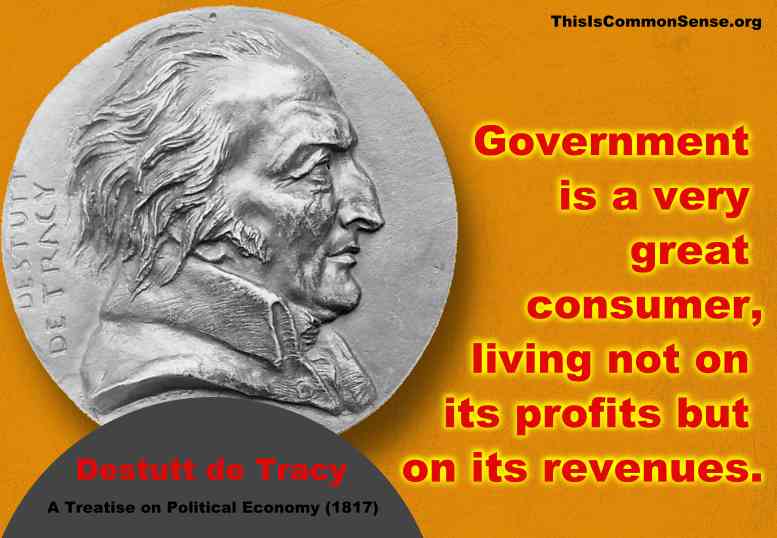
M. Destutt Tracy, Traité de la volonté, English translation titled A Treatise on Political Economy (Georgetown, D.C.: Joseph Milligan; W. A. Rind & Co. Printers, 1817).
Government is a very great consumer, living not on its profits but on its revenues.