
Categories
ideological culture national politics & policies

A Great Big “Request”

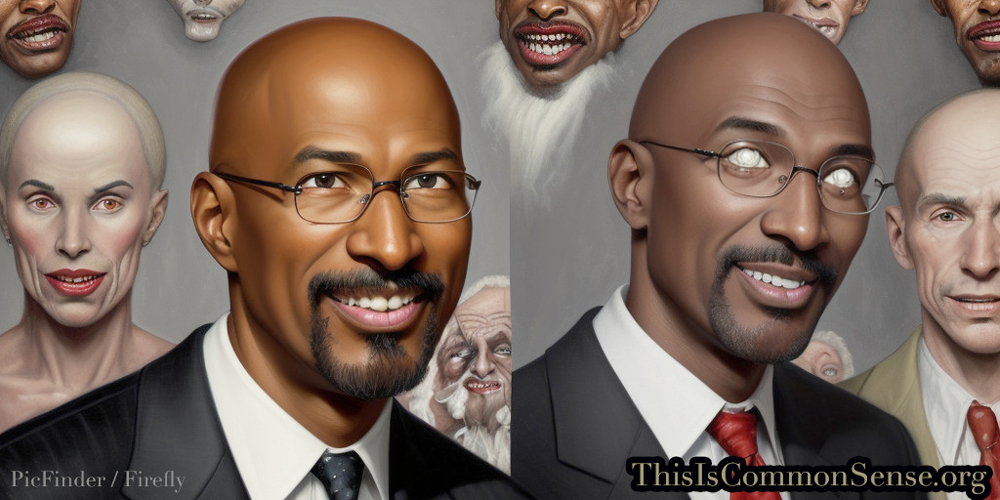
“You are witnessing the rise of an American demagogue,” said Van Jones.

He was not referring to himself.

The CNN talking head was reacting to something Vivek Ramaswamy said during the last Republican presidential candidates’ forum — another one lacking the main candidate, the overwhelming favorite Donald Trump.

Van Jones, who is African-American, called Vivek, who is Indian-American, “a very, very despicable person.”

At issue is something the Republican candidate discussed: “Great Replacement Theory,” which is the notion that politicians and other insiders are using a variety of means to discourage white people from having babies while encouraging brown people to have babies . . . and for non-Europeans to come into the country both legally and illegally. The idea is that with a white minority in America, a different (or same-old/same-old?) politics will emerge (solidify). 

The theory is plenty controversial, in no small part because a few racists have listed it as an excuse to “justify” mass shootings.

But also controversial? It looks like it is more than a theory, it is a plan.

Vivek pointed this out in a tweet. He produced a video from two years ago in which Van Jones himself outlined the “theory” as a strategy: “The request from the racial justice left: we want the white majority to go from being a majority to being a minority and like it. That’s a tough request, and change is hard.”

Yet Jones regards this “request” as something it would be demagogic — even racist — to refuse.

Jones’s leftism does not look like “racial justice” so much as a racial vendetta.

This is Common Sense. I’m Paul Jacob.


PDF for printing

Illustration created with PicFinder and Firefly

See all recent commentary
(simplified and organized)
See recent popular posts

Categories
national politics & policies regulation subsidy

The Great De-Platforming?

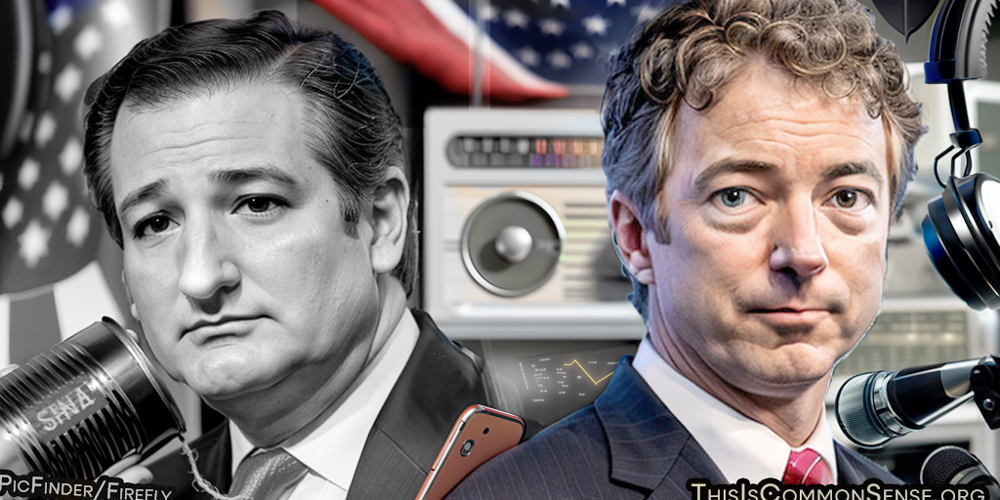
“There is a certain amount of irony in seeing Republicans come to the floor proposing mandates on business,” said Senator Rand Paul (R-Ky.) in the U.S. Senate, yesterday. Kentucky’s junior senator objected “to Republicans picking winners and losers.”

At issue is a bill pushed by Senator Ted Cruz (R-Tx.), the AM For Every Vehicle Act. Automobile manufacturers are phasing out amplitude modulation (AM) on radio receivers, and Cruz objects primarily on two rationales: 

  1. emergency roadway communications rely upon AM frequencies, and 
  2. since conservatives dominate AM talk radio, the move looks suspiciously like a sneaky way to decrease conservative and Republican political influence. 

“AM radio is where a lot of talk radio is found,” argues Cruz, “and talk radio is overwhelmingly conservative. And let’s be clear: Big business doesn’t like things that are overwhelmingly conservative.”

Technology and media change all the time, and as ostensible advocates for free markets, it’s no business of Republicans so much as to nudge the market in one direction or the other. Perhaps AM’s days are numbered. 

Shed a tear and move on.

Cruz characterizes the issue as one of free speech. Paul expresses incredulity: “The debate over free speech, as listed in the First Amendment, is that government shall pass no law. It has nothing to do with forcing your manufacturer to have AM radio.”

It gets messier: electric car manufacturers say that the AM band interferes with their batteries, and the technology to shield the batteries is expensive. So Cruz’s law would forbid companies from charging more for this tech.

If you ask me, the batteries being harmed by AM radio indicates a glaring defect not in a radio platform but in the platform of electric cars.

So it’s great that Rand Paul’s amendment to undermine Cruz’s mandate would also nix the electric car tax credit. 

This is Common Sense. I’m Paul Jacob.


PDF for printing

Illustration created with PicFinder and Firefly

See all recent commentary
(simplified and organized)
See recent popular posts

Categories
Accountability government transparency national politics & policies

If/Why

“This is about accountability, and about transparency,” said Rep. Andy Ogles (R-Tenn.), at yesterday’s House Oversight Committee’s bipartisan press conference on Unidentified Aerial Phenomena (UAP’s) — “about holding the Deep State to task for their refusal to declassify information that the American people need to know, that Congress needs to know.”

He paints the same picture of the UAP/UFO issue that has been rumored about for nearly 80 years: “Foreign objects are buzzing around in our airspace, and Joe Biden’s over 30 generals have not only been silent on the issue, but have yet to play ball with Congress.”

The tenor of the presser was summarized early by host Rep. Anna Paulina Luna (R-Fla.): “It is unacceptable that any mid-level, unelected bureaucrat staffers can tell members of Congress that we are not allowed to access information about UAP’s.” 

Senator Chuck Schumer (D-N.Y.) has pushed a disclosure procedure on the order of The President John F. Kennedy Assassination Records Collection Act of 1992, but these representatives scorned that notion, arguing there remains too much secrecy surrounding the 1963 event in Dallas. 

“So, whether it’s little green men, American technology, or worse — technology from the CCP — we need to know,” insists Rep. Ogles.

“I think the American people have a simple question,” Jared Moskowitz (D-Fla.) hazarded, “which is ‘if none of this exists, if this is all false, why, at every turn, are there people trying to stop the transparency and the disclosure? Why are folks who are in charge of committees, whether they are in the House or in the Senate, opposed to this disclosure?’ And it’s that point alone that piques the interest.”

Indeed it does. 

It’s time for the people to find out.

This is Common Sense. I’m Paul Jacob.


PDF for printing

Illustration created with PicFinder and Firefly

See all recent commentary
(simplified and organized)
See recent popular posts

Categories
First Amendment rights national politics & policies

Limits “Of” not “To”

When people talk about “limits to free speech,” do they know what they’re talking about?

“Is there a limit, in your opinion,” an audience panel member on Fox’s The Faulkner Focus asked former U.N. Ambassador and former South Carolina Governor Nikki Haley, “to free speech?” 

The questioner explained that “we all know you can’t go into an airport and shout ‘bomb,’ and yet, right now, you can chant, on college campuses, to ‘kill all the Jews. . . .’” She demanded to know what the limits are.

Freedom of speech is a term of art for the speech that liberty allows; speech involving actual crime — in planning — has always been (and should now be) illegal. 

But don’t demand limits to free speech. Instead enforce the limits of free speech. There is a logic to the notion.

How did presidential candidate Nikki Haley respond?

She said we never want to give up on free speech, but “the difference is when you are pushing violence.” Then Haley went to a more mainstream set of arguments blaming current ideological turmoil on misinformation online. Her response: End anonymity on the Internet

This struck many critics as rather extreme. In a “partial” walk-back, yesterday, Haley told CNBC, “I don’t mind anonymous American people having free speech; what I don’t like is anonymous Russians and Chinese and Iranians having free speech.”

But of course if all are not required to register to speak, name attached, then there is no way to catch the non-Americans.

As inheritors of a political and legal system that was achieved, in no small part, by pseudonymous speech — think Cato and Publius and the Federal Farmer — I suggest another kind of limit: caution.

This is Common Sense. I’m Paul Jacob.


PDF for printing

Illustration created with PicFinder and Firefly

See all recent commentary
(simplified and organized)
See recent popular posts
Categories
national politics & policies

It Is and It Isn’t

At least once a month the same hoary “meme” lands in my social media feed, an incensed objection to calling Social Security benefits “entitlements”: Why, Social Security isn’t an entitlement, it’s an earned benefit! We’ve been paying for it all our lives!

This old chestnut is a sad indicator that American education isn’t up to snuff and an even sadder indicator that people are especially confused about the country’s biggest wealth transfer program.

An “entitlement” is something one is owed. We are entitled to Social Security benefits, it is said, because we are forced to pay into the fund. That’s why it’s called an “entitlement program.” 

That being said, it sadly isn’t. Social Security has never been run soundly as a pension fund. From the beginning, and by design, politicians have used it as a way to buy votes, but — in typical politician fashion — they have lied about it. 

But the Supreme Court hasn’t. That body has made it quite clear that Social Security is not an entitlement program, but a mere “welfare” program, subject to the whims and wiles of tax-and-spend politicians.

Because of the lies and evasions, American voters remain perennially confused, and get very uncomfortable when the insolvency issue is brought up. Hence the issue’s long status as the “third rail” of American politics, with the frontrunners in the current presidential race each accusing the other of seeking to touch that rail.

Nevertheless, Eric Boehm notes at Reason, a few Republican challengers now talk about a major overhaul. Chris Christie wants means testing; Nikki Haley wants to raise the retirement age. Vivek Ramaswamy says we must act sooner rather than later, but Tim Scott said seniors shouldn’t take any cuts — which Boehm notes misses the true nature of the problem. 

So, is the GOP finally getting serious?

I wouldn’t bet my retirement on it.

This is Common Sense. I’m Paul Jacob.


PDF for printing

Illustration created with Firefly and PicFinder

See all recent commentary
(simplified and organized)
See recent popular posts

Categories
national politics & policies political challengers

Twelve-Point Play

How popular is President Joe Biden? 

Better to ask how unpopular; a substitute Democrat to be named later is more popular. 

Twelve points more popular.

“An unnamed ‘Democratic candidate’ shifts the race by 12 points on the margins,” Aaron Blake reports in The Washington Post, “turning a four-point Democratic deficit against Trump into an eight-point lead, 48 percent to 40 percent.”

Democrats are mulling all this over because their unpopular president, according to a recent New York Times-Siena College poll, trails former President Donald Trump “in five of the six most competitive battleground states”: Arizona, Georgia, Michigan, Nevada, and Pennsylvania. 

“I am concerned,” offered U.S. Sen. Richard Blumenthal (D-Conn.), “by the inexplicable credibility that Donald Trump seems to have despite all of the indictments, the lies, the incredible wrongdoing.”

Or is it, instead, the lack of credibility enjoyed by establishment politicians and media?

“What many missed about the poll is that a generic Democrat isn’t the only one significantly overperforming the actual candidate likely to lead the ticket,” Blake further explains.

“The poll also tested a race without Trump,” discovering that the “GOP’s lead goes from an average of four points with Trump to an average of 16 points without him, 52–36.”

Former South Carolina Gov. Nikki Haley polls best against Biden. 

Democrats, however, lack an “available alternative.” Vice-President Kamala Harris polls only a single point better than Biden, which is damning news for Biden. Would another Californian, Gov. Gavin Newsom, fare better? 

Or is the only good Democrat a mythical Democrat?

This is Common Sense. I’m Paul Jacob.


PDF for printing

Illustration created with PicFinder and Firefly

See all recent commentary
(simplified and organized)
See recent popular posts
Categories
deficits and debt national politics & policies

Of Stopgaps and Ladders

“By law, we have one job,” Rep. Tim Burchett (R-Tenn.) asserted the last time he opposed the “continuing resolution” (CR) on the federal budget. 

What is that “one job”? It is “to pass twelve appropriations bills and a budget. We aren’t doing that, which is why we are $33 trillion in debt.”

Katherine Mangu-Ward, at Reason, fleshed this out: “In theory, the president proposes a budget, Congress passes a budget resolution, and then various committees put together a dozen separate spending bills. They’re debated and voted on, and then the president signs them into law by October 1.”

The practice, however, is a bit different: “What happens instead is that the members of the House careen into each fall full tilt, screaming at each other until they throw together some kind of stopgap measure to fund the federal government for a little while longer until they can get their act together to generate a big, messy omnibus bill that no one will have time to read.”

But it’s worse: “When they can’t manage even that, we get a shutdown.”

To prevent a shutdown, but also not fall back into the usual iterations of the continuing resolutions, the new House Speaker, Rep. Mike Johnson (R.-La.) has floated the idea of a “laddered” CR. According to The Epoch Times, this plan “would spread the due dates over a period of time rather than having all the bills come due at once.” Think of it as an ultra-weak echo of the responsible budgeting process.

Will it work? Will Congress manage this merest hint of responsibility?

In ten days, it’s go time — or, no-go time — again.

This is Common Sense. I’m Paul Jacob. 


PDF for printing

Illustration created with PicFinder and Firefly

See all recent commentary
(simplified and organized)
See recent popular posts

Categories
ideological culture national politics & policies

A New Speaker Conjures

The new House Speaker was a dark horse in the mad rush to fill the position vacated after Kevin McCarthy’s ouster in a historic political play. But Mike Johnson (R.-La.) appears to be a thoughtful man, known more for his prayers than backstabbing, and sporting an interesting set of principles. They are listed on his congressional web page; he calls them the seven “core principles” of conservatism:

  1. Individual Freedom
  2. Limited Government
  3. The Rule of Law
  4. Peace Through Strength
  5. Fiscal Responsibility
  6. Free Markets
  7. Human Dignity

Inspiring, but the devil can bog us in details — under each rubric his elaborations sound more like fantasied ideals than anything like current practice. And for a man who got ahead by having “no enemies,” any real advancement would hardly conjure up consensus and comity.

Johnson acknowledges current government failure — at least in his fifth principle, which he explains entirely in terms of political fault: “Because government has refused to live within its means, America is facing an unprecedented debt and spending crisis. Federal debt now exceeds $33.5 trillion, and our current fiscal path is unsustainable and dangerous, jeopardizing our nation’s economic growth, stability and the security of future generations.” He goes on to express a congressional “duty to resolve the crisis.”

Yet, only standard Republican talking points are offered as back-up, with zero acknowledgment of the bipartisan difficulty of reducing spending even a smidgen.

Truth is, each of his principles is honored by the federal government only in the breach. While we may hope and pray that the new Speaker takes all of these serious enough to work to change course, we have to wonder: Does he have a prayer? 

This is Common Sense. I’m Paul Jacob.


PDF for printing

Illustration created with Firefly and PicFinder

See all recent commentary
(simplified and organized)
See recent popular posts

Categories
national politics & policies subsidy

Community Chest

When it’s time to go home, the circus manager has a trick up his sleeve, just to get people off the property: turn off the rides.

The U.S. is something of a circus today, so policymakers may want to take the cue.

This applies especially to illegal immigration on the southern border, which is increasingly being acknowledged as a major problem. While it may be interesting to learn, say, that this past month more Venezuelans than Mexicans were nabbed coming north (and, presumably, more not caught), the big picture truth is that since taking office President Joe Biden has presided over a huge increase in the overall illegal flow of economic migrants.

Switch off the subsidies and surely the rate would go down.

But what are the subsidies? 

A recent article in The Epoch Times explains: “Identification cards for illegal immigrants are increasingly being issued by non-government organizations (NGOs) to help [border-crossers] establish a foothold in U.S. cities and access services they can’t get through federal programs.”

The programs are mainly in blue cities and states, and thrive under the imprimatur of DEI: diversity, equity and inclusion programs. Often called “community IDs,” these instruments seemingly out of Monopoly, the board game, “are accepted by police departments, school districts, and food programs” across the country. 

What’s worrisome is that “the federal government grants billions of taxpayer funds to NGOs that help illegal immigrants who cannot usually access federal programs such as the Supplemental Nutrition Assistance Program (SNAP) and Children’s Health Insurance Program (CHIP).”

This makes the problem not one of “free immigration” but of subsidized immigration.

And that can, at least theoretically, be much more easily slowed. Stop giving money to NGOs to support this traffic. Existing taxpayers deserve at least that.

This is Common Sense. I’m Paul Jacob.


PDF for printing

Illustration created with Midjourney and Firefly

See all recent commentary
(simplified and organized)
See recent popular posts

Categories
insider corruption media and media people national politics & policies

The C-Word

It’s a truism of popular political discourse: corruption in Washington is endemic.

The fact that so many people who serve in Congress come out far richer than when they went in is testament to the corruption, not selfless service. Studies document how it is done, regulatory regimes monitor the money and a line of cases have put some of the easiest-to-nab offenders into the pokey.

Nevertheless, the corruption continues.

Yet, the festering congressional slime may be nothing compared to what’s in the White House.

How the corruption has worked may vary president by president, though. 

Remember that the Clinton clan’s Clinton Foundation was brought out into The Almost Open, in 2015, for all to see (if they wished), which certainly had something to do with the triumph of Donald Trump in 2016. 

The response of the insiders against Trump, however, showed corruption going much deeper. He was attacked throughout his term in office by “his own” agencies, for corruption. And now we know for certain that many of these attacks were without foundation. Just made up.

It is not with the billionaire who left office less wealthy than he entered that official corruption is revealed, but with the ghastly Biden family.

“Sen. Chuck Grassley has accused the FBI of trying to keep quiet,” explains a recent Epoch Times story, about the “information provided by 40 human sources about possible Biden family wrongdoing.”

Though none of this has been proven in a court of law, the brazenness of it all — the corporate board spots, the payments to multiple Biden family members — swamps the senses.  Still, the biggest part of the story remains — elusive. Not because there’s no evidence, but because major media and government agencies simply and continually deny the evidence as it stands, refusing to report or pursue the truth.

Allowing corruption to thrive.

This is Common Sense. I’m Paul Jacob.


PDF for printing

Illustration created with Picfinder

See all recent commentary
(simplified and organized)
See recent popular posts