Categories
ideological culture media and media people national politics & policies term limits

Cool Car and Hot Coffee for President Cool

The President of the United States claims to be very popular with “the zero to eight demographic.” The kids like his name, which they say in an unbroken string of syllables: Barackobama.

Politics is a lot like football.

Teddy Roosevelt was the coolest president . . . until Barackobama.

All this, and more, we learn from the latest episode of Comedians in Cars Getting Coffee, Jerry Seinfeld’s online interview show, in which Jerry drives a comedian to a coffee shop for a video-recorded chat.

In the recent Barack Obama episode, the comedian and the Commander in Chief drive inside the confines of the White House fences in a nice silver blue 1963 Corvette Stingray . . . and then go for a coffee inside the White House. Seinfeld’s excuse for this special episode is that the Prez has gotten off just enough funny lines to qualify.

Some of us wonder whether Mr. Obama could be planning an entertainment career after being ejected from office by the normal workings of presidential term limits. As this and other one-on-one interviews have shown, he gives great repartee.

But back to term limits. Aside from the football comment, Seinfeld’s chat did indeed yield a few substantive ideas. Such as:

JS: How many world leaders are completely out of their minds?

BO: A pretty sizable percentage.

And Obama knows why: “The longer they stay in office, the more likely [going bonkers] is to happen.”

“At a certain point,” Obama explains, “your feet hurt, your have trouble peein’, you have absolute power. . . .”

Good thing we have term limits!

Here’s to a future episode of Former Presidents in Limos Getting Lattes.

This is Common Sense. I’m Paul Jacob.


Printable PDF

Obama, Seinfeld, coffee, cool, Common Sense


Categories
Accountability Common Sense First Amendment rights free trade & free markets general freedom ideological culture nannyism national politics & policies responsibility too much government U.S. Constitution

re: Solutions

Today’s the traditional day for New Year’s “Resolutions,” but instead of resolutions, how about some solutions?

Sure, Thomas Sowell has sagely reminded: there are no solutions in social life, only trade-offs.

But, utopian perfection aside, let’s agree that some changes would be better than others, and, let us resolve to solve some nagging problems — or at least trade up. And since the really nagging problems are political . . .

For Republicans: this could be the year to give up on government as society’s chief moral agent, empowered to regulate everybody’s medicine cabinets and bloodstreams. End the failed War on Drugs, with legalizing marijuana the simplest first step. Vice will continue, as it always has. But it’s another kind of vice to think that force, policing and imprisoning folks, will “solve” the problem. Much less even reduce the availability of drugs.

For Democrats: this could be the year to give up on government as micromanager of markets — and people’s marketplace choices. Face it: folks will make decisions that liberals don’t like. They’ll eat at McDonalds and buy large sodas — and the wrong stocks. And guns! But adding to the mass of regulations doesn’t make consumers choose better, it makes stuff more expensive and business less open to competition. Indeed, almost all the regulations designed to help “the little guy” backfire, helping big business by hobbling their upstart competitors.

Our leaders, at present, cannot even balance budgets. They are addicted to debt. To pretend we must have more and more government to prevent our addictions or save us from personal debt is ludicrous.

Can we resolve to stop pretending that bigger government is always the solution?

This is Common Sense. I’m Paul Jacob.


Printable PDF

New Year, 2016, resolutions, Common Sense, illustration
Categories
Accountability general freedom ideological culture individual achievement national politics & policies political challengers responsibility

Virus and Host

Presidential candidate John McAfee is an adventurer. Best known for founding the first successful anti-computer virus company, he has also been shot at in tropical jungles, by men trained by U. S. forces, with American-bought guns. This range of experience makes him the most interesting presidential hopeful, bar none.

His big issue is cyber-security. He thinks Americans have placed themselves in a too-precarious position. As he sees it, the war on terror has served as a grand distraction from the real threat, a prime example of doing foreign policy and national security completely upside-down wrong.

He has a point.

But he’s neither a Democrat nor a Republican, and not long ago he realized that his own Cyber Party didn’t have the oomph to get him on the ballot in enough states.

So he has announced his candidacy for the Libertarian Party nomination.

Why? He’s obviously not a libertarian in any strict capital-L sense. But the septuagenarian insists that he has been a libertarian at heart since before the word entered common use.

This is what the Libertarians get for their most obvious success: obtaining and keeping ballot status in more states for more election cycles than any other “minor party.”

Think of the Libertarian Party as the host, and one-time Republicans like former Congressman Bob Barr and former New Mexico Governor Gary Johnson — and now McAfee — as viruses, aiming to commandeer the host’s operating system.

Of course, one might also view the LP as a virus attempting to do the same to the federal government.

Shall we root for the viruses, for once?

This is Common Sense. I’m Paul Jacob.


Printable PDF

John McAfee, libertarian, presidential race, president, candidate


Categories
Accountability folly free trade & free markets general freedom ideological culture moral hazard national politics & policies too much government

Collateral Damage Defines Socialist B.S.

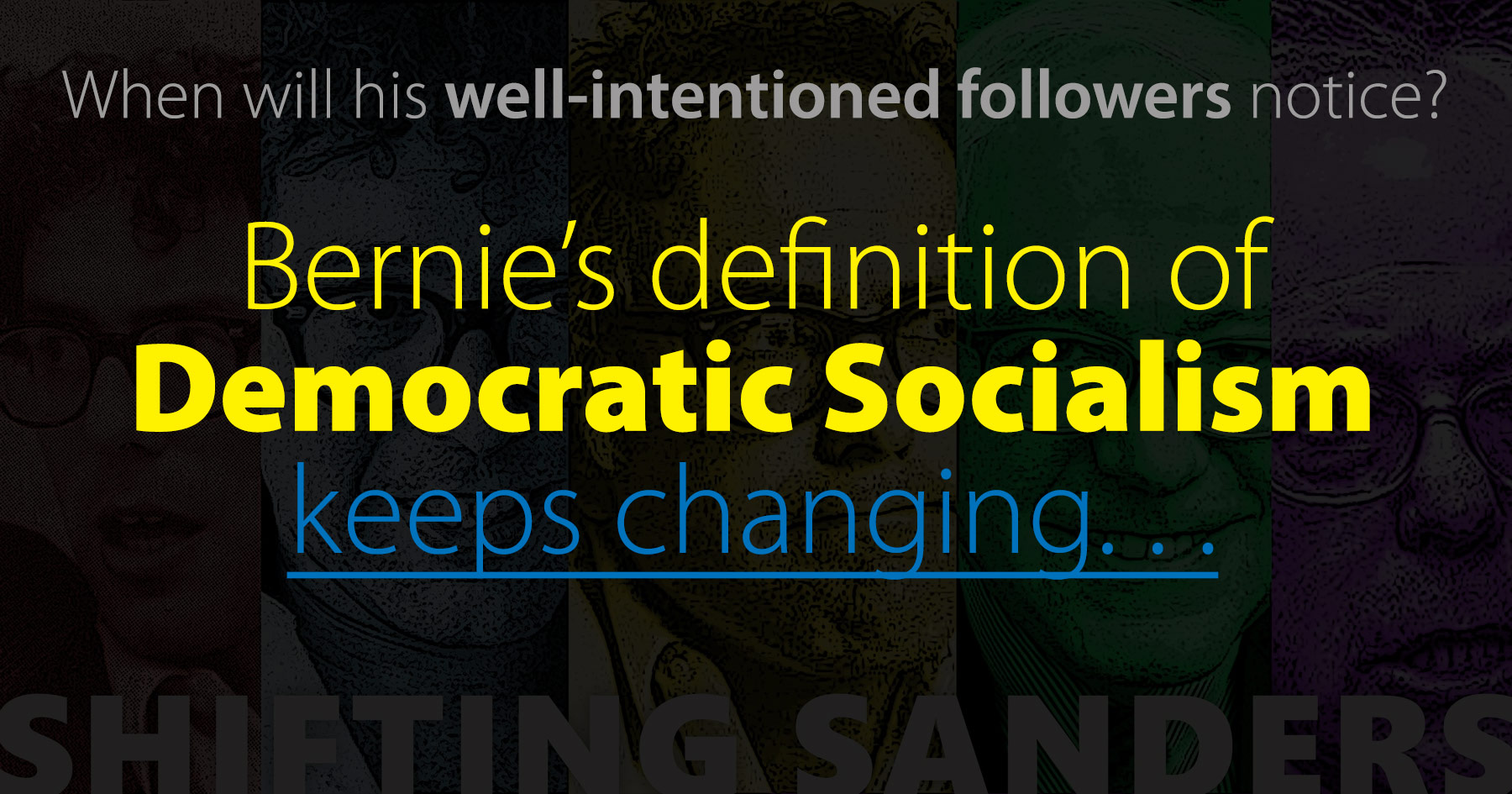
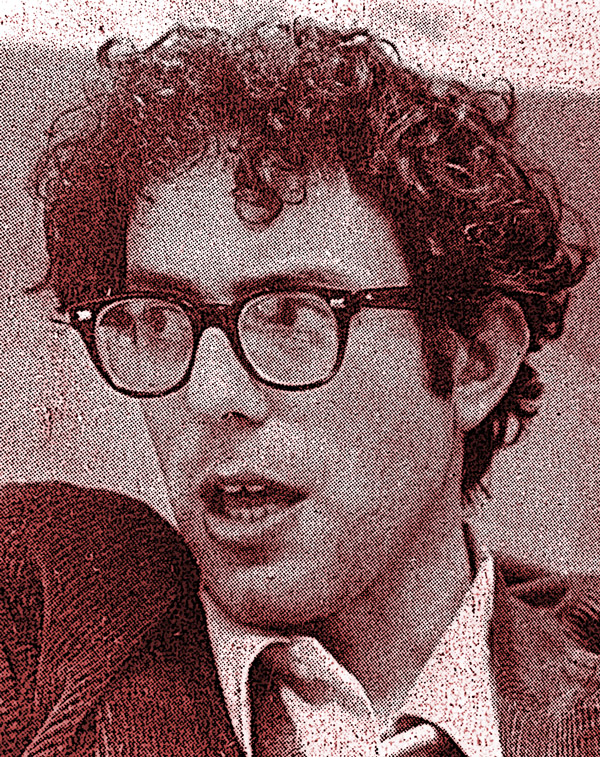
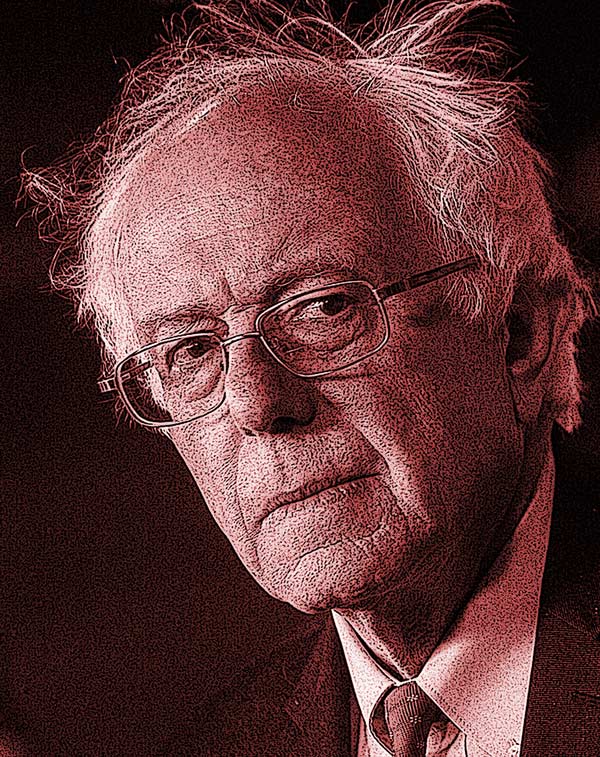
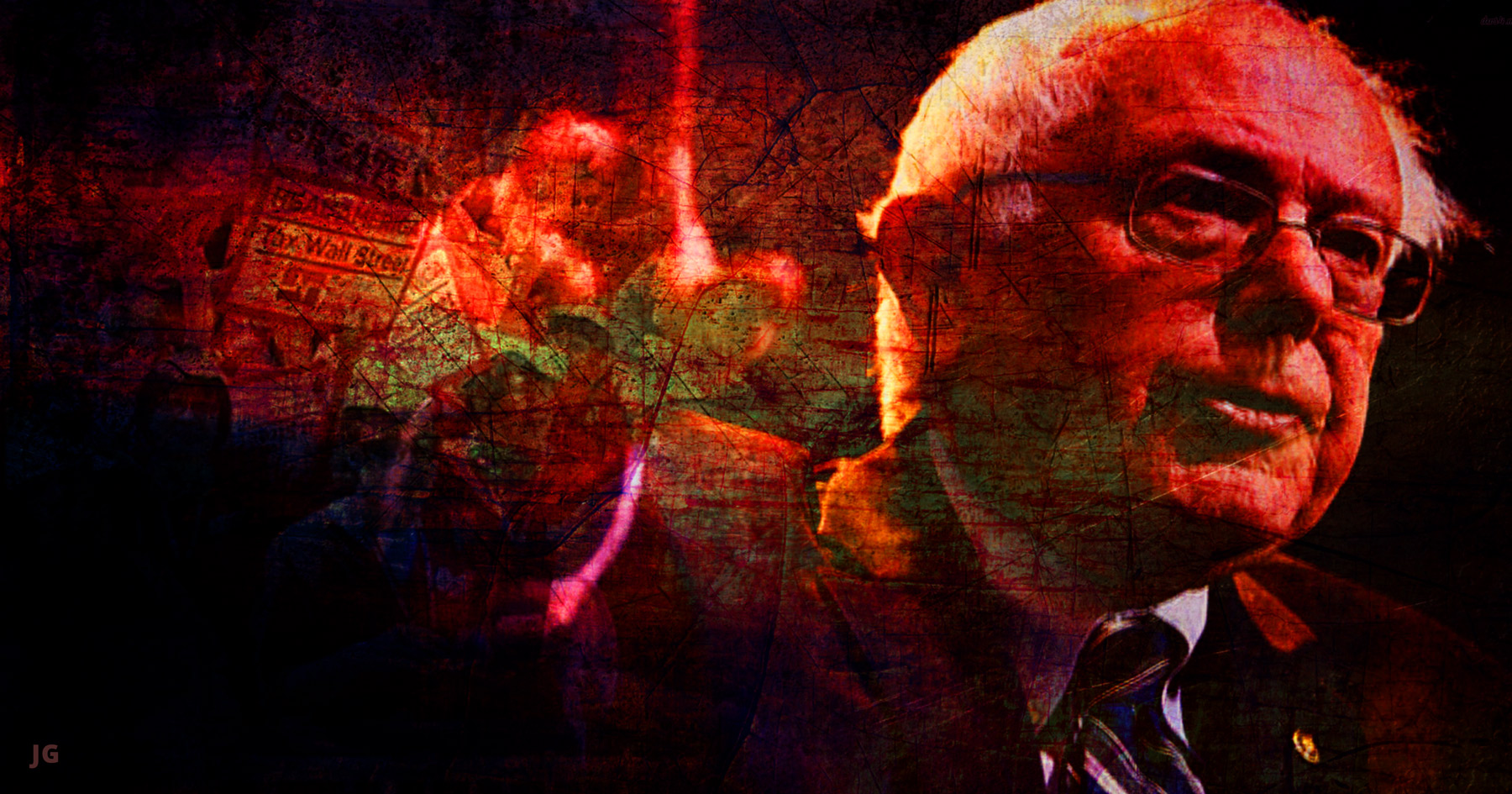
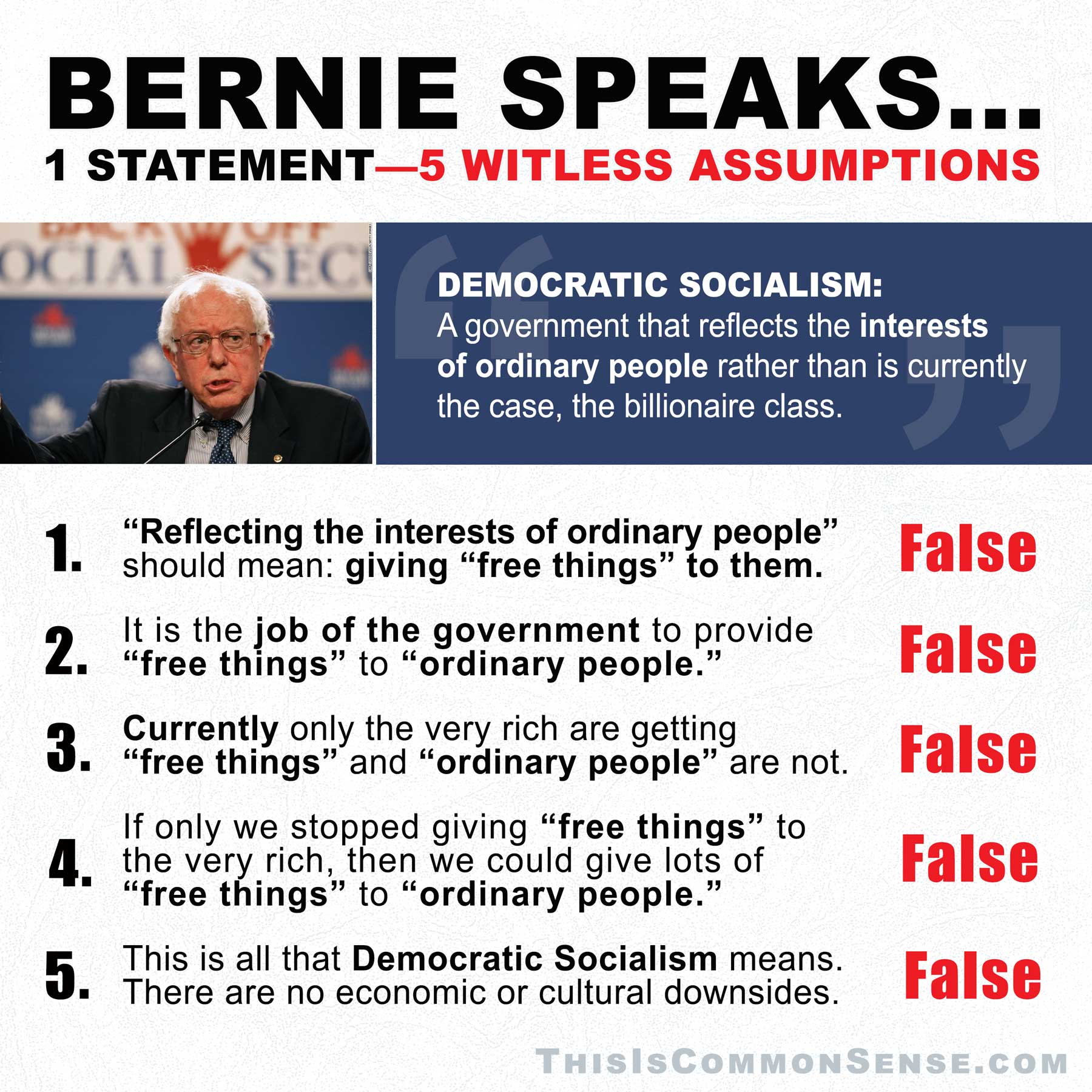
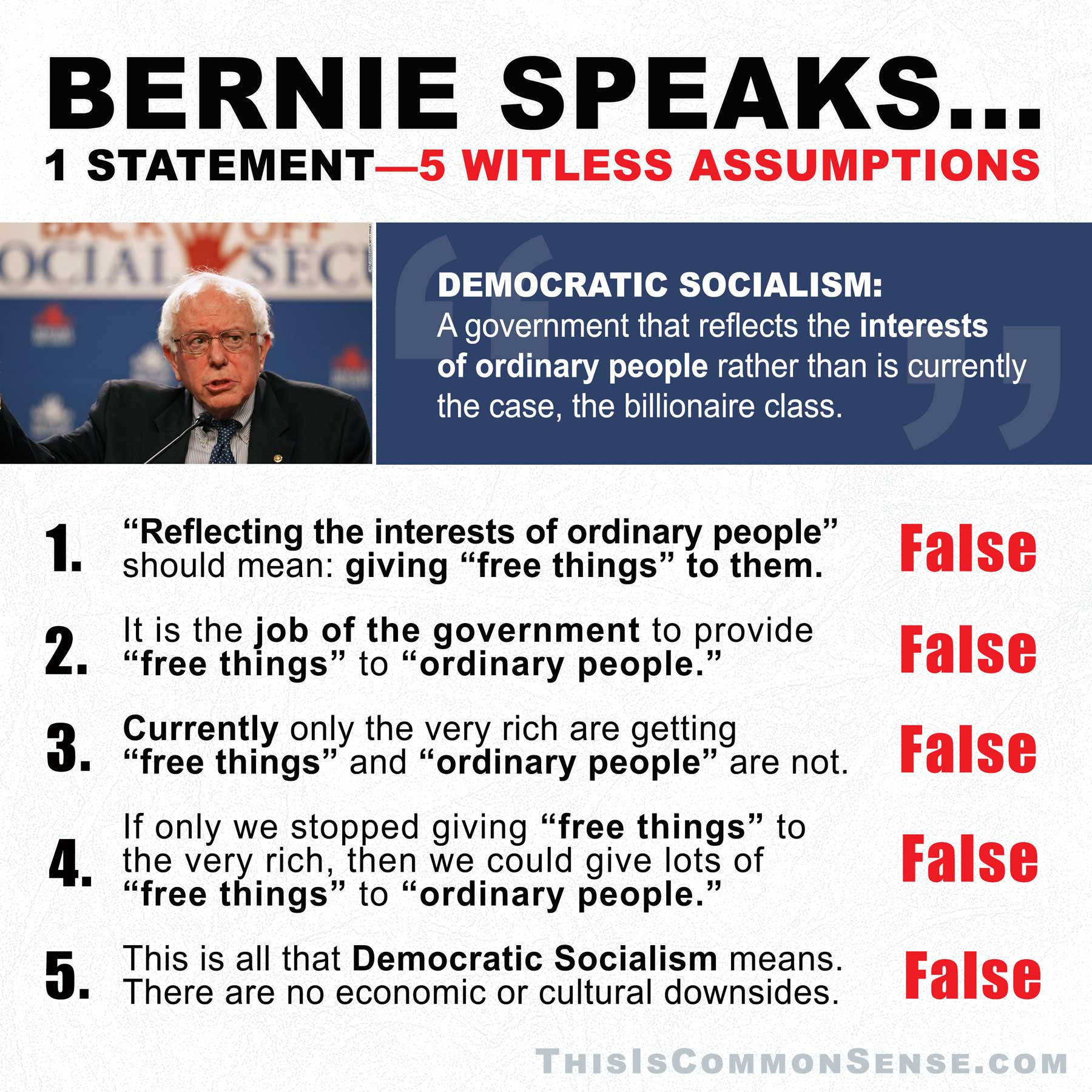
Senator Bernie Sanders gave us a big present last week. In one simple “tweet” he warbled out the essence of his socialism: “You have families out there paying 6, 8, 10 percent on student debt but you can refinance your homes at 3 percent. What sense is that?”

That’s what he broadcast. That’s what this self-proclaimed socialist wrote — or allowed his staff to write — on his official Twitter account, @SenSanders.

And it is not as if he had the excuse of haste. He was repeating a thought from his presidential campaign account in September: “It makes no sense that students and their parents pay higher interest rates for college than they pay for car loans or housing mortgages.”

To the earlier post, Twitter erupted in criticism. The gist? Have you never heard of collateral, sir?

Lenders can charge less on secured loans because, in case of default, the recourse is to take the collateral, the car or house, thereby recouping the loss.

But an unsecured loan? Well, by law one cannot easily slough off student loans — but one can simply not pay, or pay late. Hence the higher rates.

From its beginnings, socialism — and progressivism and Fabianism and fascism and social democracy, following — has been fueled by complaints about markets.

Without showing any understanding of the logic of markets.

Which is why, when put into practice, socialistic and interventionist programs produce such great amounts of negative collateral effects. Socialism is the philosophy of good intentions that yields collateral damage worse than the problems meant to be solved.

Oh, Bernie Sanders! Your initials say so much.

This is Common Sense. I’m Paul Jacob.


Printable PDF

Bernie Sanders, consequences, socialism, economics, illustration, Common Sense


Categories
folly ideological culture national politics & policies

This Is Not Politics

First, Hillary lied. She said that ISIS was using Trump in terrorism recruitment videos. The Donald responded with contemptuous ridicule, using a vulgar word for her 2008 defeat by Barack Obama.

Then, the Democratic Party presidential contender got all teary-eyed and said we had to treat each other with more respect, be nicer.

This is presidential politics?

Mrs. Hillary Clinton and Mr. Donald Trump are both addicted to telling whoppers. Their “stretchers” are now the everyday stuff of our nightly news.

Mrs. Clinton’s fact-less charge that Trump was being used in recruitment videos is all the more ridiculous considering that Mr. Clinton does star in such a video. Maybe she meant merely that Mr. Trump’s call for barring Muslim immigration will help ISIS paint America as anti-Muslim, telling the tall tale because, well, it “ seems true.” Even if it isn’t.

In this, she differs not a whit from Mr. Trump, who not too long ago “remembered” “seeing” “thousands” of “Muslims” in “New Jersey” celebrating the fall of the World Trade Center on 9/11/2001 — a video he cannot produce, either.

Politicians hyperbolize from bigotry to factoid all the time. What’s new is Trump’s foul calumny, in response, and Clinton’s painting of Trump as a bully for belittling her. That’s not how I remember politics. It seems new to adult debate.

But it isn’t new to our experience. It’s children bickering on the playground, then whining and lying all the way to Teacher. Or even Home.

Responsible adults don’t believe every charge lodged by little boys and little girls.

Like Donny and Hillary.

This is Common Sense. I’m Paul Jacob.


Printable PDF

Hillary Clinton, Donald Trump, politics, children, illustration, Common Sense


Categories
folly general freedom ideological culture too much government

Discreditable Credit

Capitalism can be rigged a hundred different ways, apparently. China’s is run by its Communist Party, and even current innovations bear the stamp of the Party.

Take “social credit.”

Not the quaint decentralist economic reform movement that was a minor deal in politics on the West Coast of the U.S. and Canada 60 or more years ago.

What I’m referring to is the innovative credit scoring system devised by a gaming company in cooperation with China’s commie-run government.

But it’s not quite like the credit scoring systems set up by competing companies in the U.S., which cook up “credit scores” based on going into debt and paying off debt. If you pay your bills, you get a higher score. If you don’t, it plummets.

The new “Sesame” credit scoring system is less interested in the debts you pay off and more in what you buy and what you put up on social media. The company has concocted a secret algorithm, and gives higher scores to good citizens — obedient people — and lower scores to lazy people (inferred from, say, if you play a lot of video games) or to folks who are rebellious free thinkers (posting pictures of Tank Man in Tiananmen Square, for example).

That is what it seems like, so far.

It rewards those Chinese who are industrious (yay?) and who kowtow to Communist Party expectations (yikes!) — and makes me extra glad I live in the U.S., where government is too chaotic and stupid to cook up anything quite this insidious.

This is Common Sense. I’m Paul Jacob.


Printable PDF

China Credit System, Sesame, China, Credit Rating, Common Sense


Categories
general freedom ideological culture

Spoiler Alert — Making Socialism Work

Despite the hoopla, I did not get a chance to watch Childhood’s End, the miniseries that aired this week on the SyFy channel.

But I didn’t really need to — and not just because it failed to receive critical or popular acclaim.

This is the age of the Internet, and — Spoiler Alert! — many cats get let out of many a bag. Facebook, Twitter, water coolers . . . we all hear things outside the designated venues.

Of course, many people knew the plot line of SyFy’s miniseries — simply because it’s based on a 1953 novel by Arthur C. Clarke.

So, when we notice that one of the show’s creators interprets the story’s stark ending as being more personal than cosmic, that it is about accepting the inevitability of death, we are not going to go into a snit about “spoilers.” We can all can handle it like . . . grown-ups.

Yes, the tale is in the “out there” branch of science fiction. Aliens come. They bring mankind a Golden Age, an era of plenty, curing disease and ending the need to work. And then, after a long stretch, they reveal themselves, in full-frontal corporeality: they look like devils, with huge horns, red gnarly skin, cloven hooves, wings and a tail. But finally the big truth dawns: the last generation of children becomes clairvoyant, ascend into the air, and, while destroying the planet, become “as one” in the universal Overmind.

Accepting death? Why not this interpretation: sure, socialism can work — but only by stripping us of our individuality and destroying humanity along with all life on the planet.

The devil, you say.

This is Common Sense. I’m Paul Jacob.


Printable PDF

Childhood's End, Arthur C. Clarke, science fiction, TV, internet, devil, socialism, Common Sense, illustration


Categories
education and schooling folly ideological culture responsibility

Anti-Lynch Lynch Mob

America’s worst racial and sexual injustices were institutionally addressed years ago, in the Sixties and soon after — by folks in the Civil Rights movement, everyday citizens, and their representatives.

So what do today’s earnest, Johnny-and-Jilly Come Lately “Social Justice Warriors” have left to complain about?

Why, building names, of course!

The local college in Annville, Pennsylvania, has been embroiled in a bizarre civil rights complaint about their Lynch Memorial Hall. Named after one Dr. Clyde A. Lynch, a Depression Era benefactor, some SJW students are demanding that it be changed, because of, get this, “associated racial connotations.”

“Lynch,” you see. It triggers them.

I kid you not.

Colin Deppen, writing last week on pennlive.com, explained how Dr. Lynch had nothing to do with the lynching of African-Americans in Jim Crow days. The extra-legal hanging tradition began much earlier, in the Revolutionary War, “with a Captain William Lynch of Pittsville, Virginia.” This fellow “headed a self-constituted court with no legal authority that persecuted suspected British loyalists.”

Lynching’s origins? White-on-white violence, not white-on-black.

SJW students, mostly ignorant and incurious, prefer coming off as whiners or moral scolds than learn something.

Or let a coincidence go.

The problem is this: the closer some people get to reaching their goals, they have less and less to do. Yet many “late adopters” covet the moral authority of their predecessors. So they pack all their frustration and passion into making more and more unreasonable demands.

But this may be self-correcting. They look like idiots. And they have obtained our attention. This Lynch Mob nonsense could be the sign of their end times.

This is Common Sense. I’m Paul Jacob.


Printable PDF

racism, political correctness, progressivism illustration, common sense, trigger warning, micro-aggression,


Categories
Accountability general freedom ideological culture national politics & policies responsibility

Finland on 800-Euros-a-Month

Some folks think the world owes them a living.

Must we appease them?

Should government hand every man, woman and child a check each month to make sure we’re all taken care of?

Finland is embracing this basic idea with a pilot program, providing everyone an “unconditional basic income” (UBI). Treating citizens equally is enshrined in Finland’s constitution, so every Finn will receive the same 800-euros a month without regard to income or lack thereof.

It sounds like Democrat George McGovern’s “guaranteed annual income,” which was mocked and ridiculed during the 1972 presidential campaign.

But you might be surprised who has supported the UBI: free-market economist Milton Friedman advanced the similar “negative income tax” back in 1962; Martin Luther King liked it; Austrian economist F. A. Hayek endorsed the concept; Charles Murray, author of Losing Ground, has developed a version of the proposal.

The rationale? Save money by consolidating duplicative welfare programs. After all, the U.S. government runs 79 means-tested benefit programs, each with its costly, redundant bureaucracy.

Counter-intuitively, perhaps, Finland’s social engineers think the move will increase employment. Why? Because welfare benefits currently can be withdrawn when Finns gain employment and the attendant income, which discourages folks from risking their secure base benefits.

That’s the case here, too.

The government passing out money — our money — stinks. Folks should take care of themselves, or depend on charity — not confiscatory taxation. Yet, if this version of a safety net does indeed encourage industry, employment, and good old-fashioned money-making amongst the poor . . . it may very well be a step in the right direction.

This is Common Sense. I’m Paul Jacob.


Printable PDF

Finland, Guaranteed Income, UBI, welfare, income, Common Sense, illustration


Categories
free trade & free markets general freedom ideological culture media and media people national politics & policies

Historic Paris Pact?

The climate change pact just completed at the United Nations conference in Paris is, the Washington Post informs us, “historic.”

The New York Times, LA Times, Chicago Tribune, and just about every other paper uses that very word in their headlines, too.

“The 12th of December, 2015, will remain a great date for the planet,” declared French President Francois Hollande, dubbing it “the most beautiful and the most peaceful revolution that has just been accomplished.”

“History will remember this day,” U.N. Secretary-General Ban Ki-moon predicted. President Obama called it a “turning point for the world.”

Chris Mooney, in a deeper analysis for the Washington Post, agreed that all the hoopla was “more than warranted.”

But Mooney also acknowledged that, “this document, by its very nature, depends on . . . Countries, companies and individuals all across the planet [doing] the right things — and very hard things, at that.”

How hard?

Essentially ending any emission of greenhouse gases in the next half-century.

“Achieving such a reduction in emissions would involve a complete transformation of how people get energy,” the New York Times reported, “and many activists worry that despite the pledges, countries are not ready to make such profound, costly changes.”

As the negotiator for the Federated States of Micronesia put it: “We’ve agreed to what we ought to be doing, but no one yet has agreed to go do it. It’s a whole lot of pomp, given the circumstances.”

“What’s more,” adds Mooney, “even if everyone plays by the rules, the standards and goals set out by the Paris agreement may not be enough to prevent the catastrophic effects of climate change.”

Historic? History will determine that.

This is Common Sense. I’m Paul Jacob.


Printable PDF

climate change, global warming, Paris, accord, Common Sense