Categories
Accountability general freedom moral hazard national politics & policies political challengers responsibility tax policy

Bankrupt Leadership

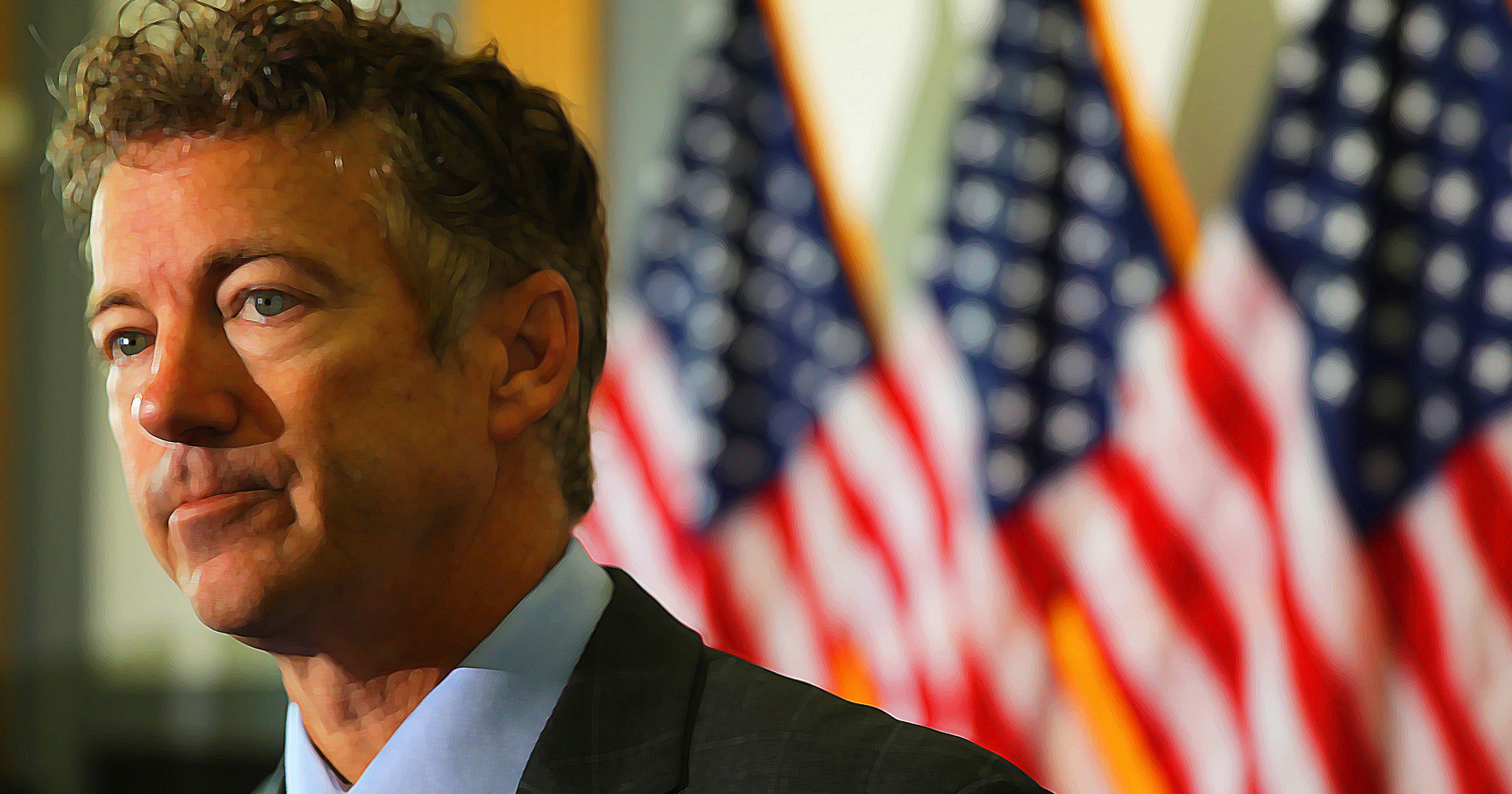
Sen. Rand Paul wasn’t the only thing absent from the GOP presidential stage last Thursday.

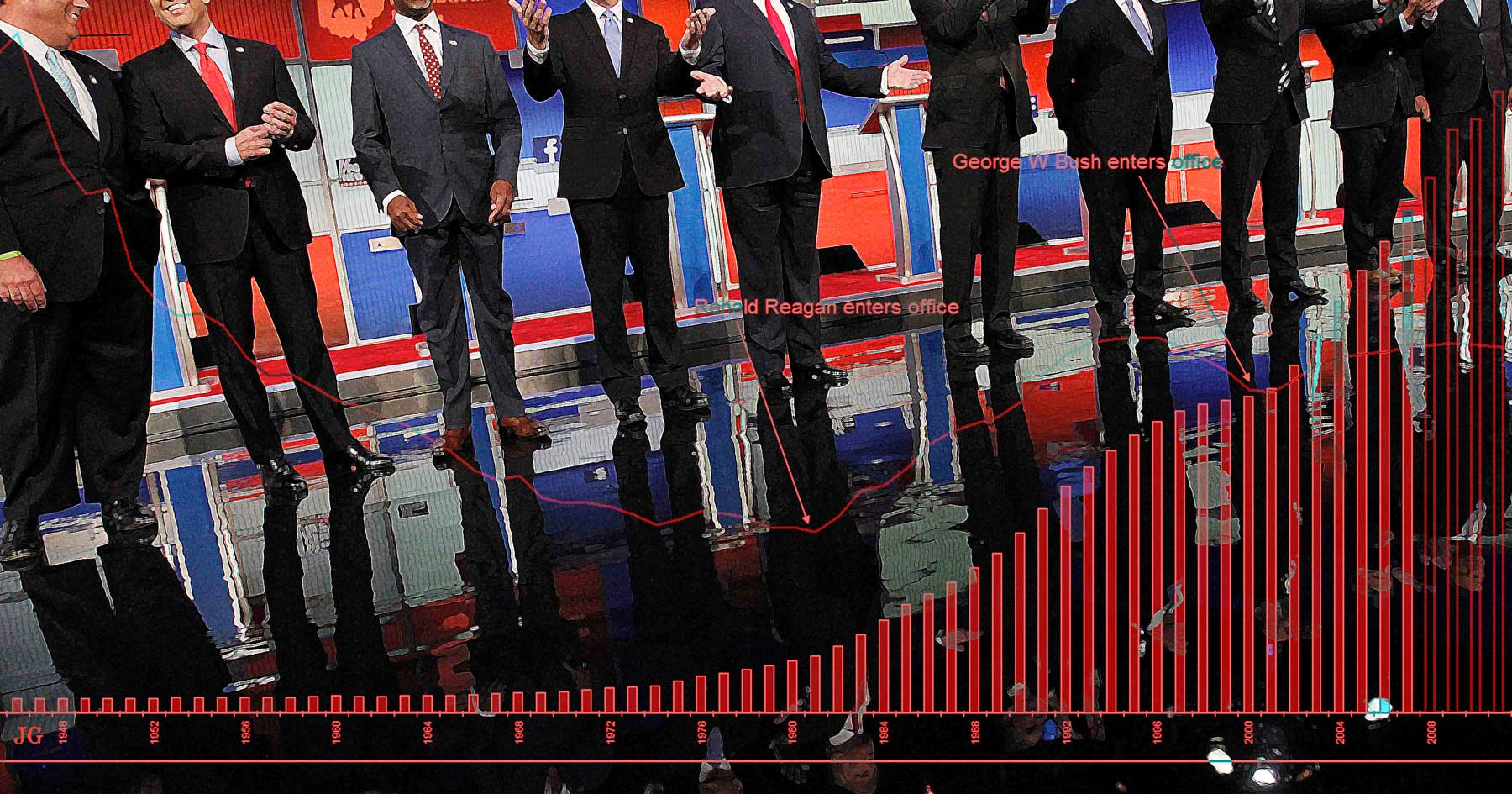
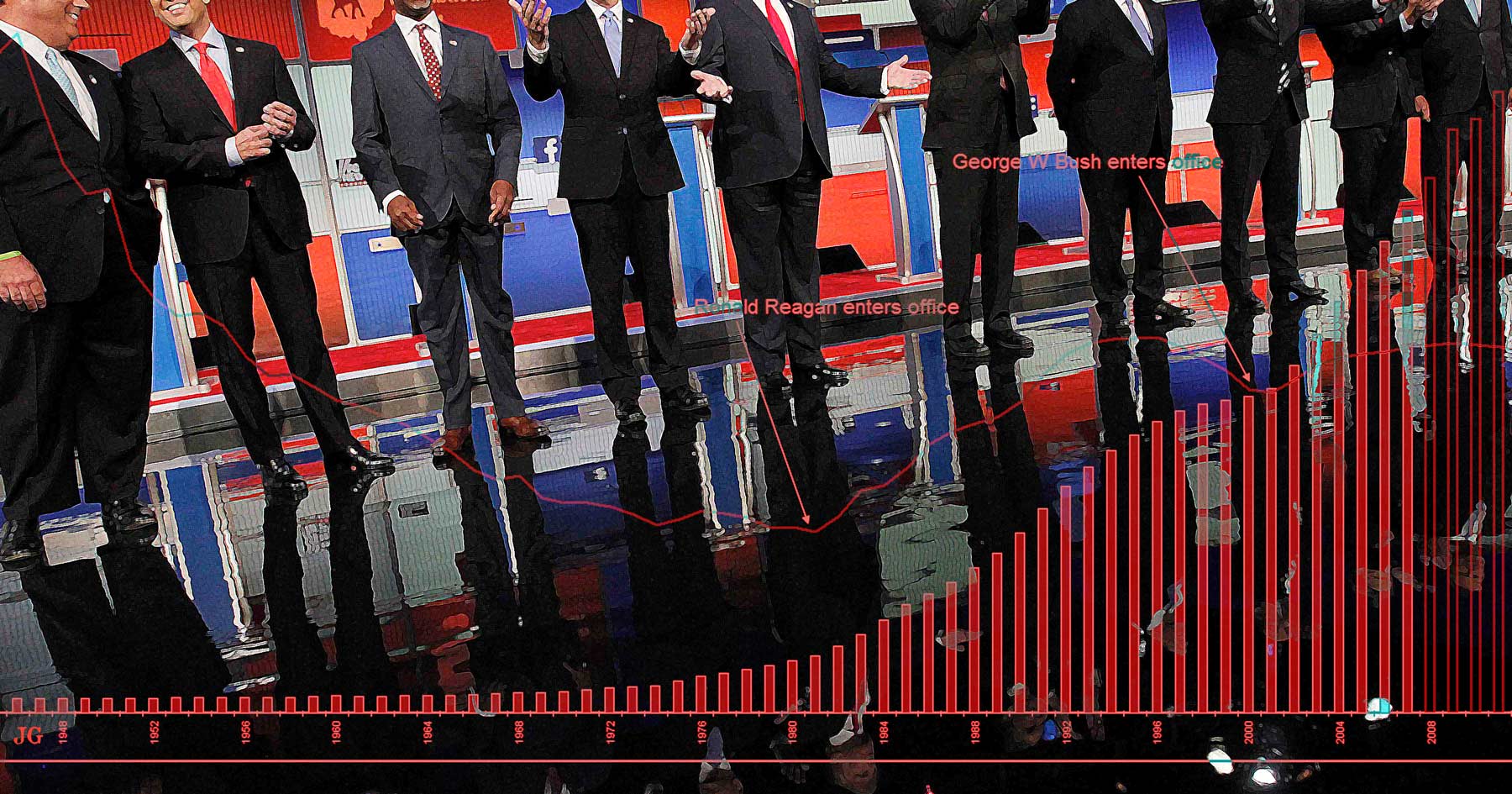
Also missing? Any meaningful talk about reducing federal spending and avoiding a sovereign debt crisis. The debt looms over all our heads. But you wouldn’t know it to listen to the GOP hopefuls. (And the same nearly goes without saying for the Democratic Party’s debt-denying presidential aspirants.)

Way back when the Bush Administration had lost America’s confidence, deficits and debts were a common concern. Much of the disgust that birthed the Tea Party movement was disgust at Republican over-spending, as well as at the bailouts that spurred the initial protests. And then came Obama, Obamacare, and a 70 percent increase in federal debt.

Why the silence now?

Nick Gillespie, of Reason, figures that Republicans don’t really care about deficits and debts.

Andrew Flowers, of FiveThirtyEightPolitics, wonders whether the GOP has abandoned the issue because Republicans don’t want to face the fact that Obama has, indeed, reduced deficits — though definitely not the debt, which has nearly doubled.

Alternative theory? Republicans have given up hope, because the last two Democratic presidents, Bill Clinton and Barack Obama, have successfully threatened government shutdown over even the itty bittiest spending cut, safe in the knowledge that the mainstream media’s full spin-cycle will be blaming conservatives.

This has made it easier for Big Government Republicans to embrace greater military funding and other spending programs, as Gillespie notes.

But real leadership recognizes the present danger of debt.

This is Common Sense. I’m Paul Jacob.


Printable PDF

national debt, debt, deficit, debate, Republican, Democrat, Tea Party, CommonSense


Categories
general freedom ideological culture national politics & policies too much government

The Great Ideological Divide?

When I was a kid, both Democrats and Republicans sported “conservative” and “liberal” wings as well as “moderate” leaders and representatives.

Now, conservatives have pretty much corralled themselves into the GOP, and liberals into the Democratic Party.

Why? Birds of a feather?

Ezra Klein offers some interesting observations in “This is what makes Republicans and Democrats so different”:

  • “Democrats are motivated by specific policy deliverables while Republicans are motivated by broader philosophical principles”;
  • “Democrats rely on more interest groups than Republicans” do;
  • “Democrats prefer politicians who compromise, and Republicans prefer politicians who stick to their principles”;
  • “Policymaking has a liberal bias — even when Republicans do it.”

Klein also draws on research by political scientists Matthew Grossmann and David Hopkins, who in their paper, “Policymaking in Red and Blue,” conclude that “the Republican Party is dominated by ideologues who are committed to small-government principles, while Democrats represent a coalition of social groups seeking public policies that favor their particular interests.”

Interest groups demanding that their “particular interests” be addressed with more “deliverables” from government would certainly explain a strong Democratic Party bias in favor of more government. Klein seems to be saying that Democrats are led, as if by an invisible hand, in the socialistic direction.

But why does a Republican Party supposedly “dominated” by those with “small-government principles” also advance policies that grow big government? “New policies usually expand the scope of government responsibility, funding, or regulation,” Grossmann and Hopkins point out.

Perhaps Republican politicians are more influenced by their own position in government than by the views of their base voters.

This is Common Sense. I’m Paul Jacob.


Printable PDF

Ideology, left, right, conservative, liberal, big government, Common Sense, illustration


Categories
folly general freedom ideological culture media and media people

Nazi by Association

Do haters of Charles and David Koch, the billionaire philanthropists, know no bounds of decency?

Monday’s New York Times squib, “Father of Koch Brothers Helped Build Nazi Oil Refinery, Book Says,” is a grand case in point. The article is basically pre-release gossip about a book that hasn’t been published yet: Dark Money, by Jane Mayer, a New Yorker writer. The author focuses on the Kochs and other rich folks who, the article says, served as “the hidden and self-interested hands behind the rise and growth of the modern conservative movement.”

As usual with “progressive” minds, she just assumes that all the billionaires and foundations who have supported her causes over the years cannot also (or: better) be described as “self-interested.”

Her main charge, that the Koch brothers’ father had helped build “the third largest oil refinery in the Third Reich, a critical industrial cog in Hitler’s war machine,” is nothing more than guilt by association. As Dave Robertson, President and Chief Operating Officer of Koch Industries, notes in his official response, the plant in question was built before Hitler had proven himself a tyrant. It’s ridiculous to insinuate that the business deal demonstrates that a family of limited government proponents were somehow in favor of the big government tyrant, Adolf Hitler.

Calumny!

But once made, we may return volley.

Partisans often accuse their enemies of their own worst faults. I’m sure Ms. Mayer is not a Nazi, as such, but her economic ideas are a lot closer to the actual policies of the National Socialist Party than are the Kochs’.

Hence her need to smear first.

This is Common Sense. I’m Paul Jacob.


Printable PDF

Koch brothers, Nazi, New York Times, shame, Common Sense, illustration


Categories
crime and punishment folly free trade & free markets general freedom nannyism too much government

Law in the Tooth

Why did Dr. Ben Burris give up his orthodontic license? Where did he go wrong?

Dr. Burris broke the law. He flagrantly violated the hallowed precepts of the Arkansas Dental Practices Act. Let me rinse and spit out the truth: This dentist illegally cleaned people’s teeth.

Not just once — he did it again and again. Often twice a year per patient — or victim, depending on your viewpoint.

Plus, brace yourself, he didn’t merely scrub their choppers, he did so — get this — at very low cost.

We need strong laws to stop such scoundrels.

That bastion of wisdom, the State of Arkansas, has no qualms about Dr. Burris’s qualifications to remove plaque from our incisors, canines and molars, having licensed him to practice dentistry. The problem is actually that Dr. Burris is over-qualified.

Especially to charge low prices!

Burris got licensed in a specialty: Orthodontia. You see, according to state law, a dentist so licensed “must limit his or her practice to the specialty in which he or she is licensed except in an emergency situation.”

Only after terrorist attacks or earthquakes can society risk allowing Orthodontists to daringly and brazenly polish people’s teeth. For less.

This particular statutory tyranny aims to close healthcare markets, minimize patient choice and keep dental costs artificially high. Luckily, beyond being maliciously wrongheaded, Arkansas’s dental law is absurdly foolish.

Dr. Burris dropped the federal court challenge being litigated by the Institute for Justice. Why? He discovered that by simply relinquishing his orthodontic license, he could legally practice orthodontics and clean people’s teeth at low cost.

He just can’t call himself an Orthodontist — but can call the law an ass.

This is Common Sense. I’m Paul Jacob.


Printable PDF

donkey, grinning, dentist, laws, Common Sense, illustration


Categories
folly general freedom ideological culture nannyism national politics & policies too much government

“Unacceptable,” He Sputtered

The King Canute Memorial Award for Clueless Legislation (Winter 2015-16) goes to Senator Bernie Sanders. He had stiff competition from ocean-lowering President Barack Obama, this season, but surely earned it these past few months.

Canute famously warned his advisors that he was no miracle worker. Standing by the sea and commanding the tide to turn only works on a regular schedule — set by natural forces, knowable in advance only after years of careful observation. All the hand-waving, incantations and official edicts cannot change the tide.

The award goes to those most in need of the Full Canute Object Lesson. Sanders’s latest ninnyism begs for just such a lesson: He wants to establish maximum fees for ATMs, down to $2 per transaction.

As everyone knows, some ATMs charge more than others. Why? It is not costless to provide electronic bank inquiries and withdrawals around the country . . . and the world. And profitability varies.

Supply and demand. Entrepreneurs do not offer these services out of charity. Close off profits in some areas, there will be corresponding effects.

From my experience, transaction fees range from about five bucks down to . . . Zero.

I usually pay nothing.

Outlawing fees above some arbitrary maximum will almost certainly ensure there will be fewer ATMs — particularly in low-use areas — and might even raise those zero-priced transactions to one- or two-buck fees.

Prices aren’t arbitrary, so no matter how loudly Bernie Sanders sputters “Unacceptable,” price ceilings aren’t magically going to produce the same service at less cost.

This is Common Sense. I’m Paul Jacob.


Printable PDF

ATM, Bernie Sanders, economics, fallacy, Common Sense, illustration


Categories
Accountability general freedom government transparency ideological culture initiative, referendum, and recall national politics & policies porkbarrel politics responsibility too much government

Ethics First

The biggest problem facing Americans? According to a Gallup poll, for the second year in a row, it’s our government.

Maybe I should say “the government.” Few think it represents us. Which is sort of a big problem for a representative government.

Presidential candidate Donald Trump says our leaders are “stupid.” Were that the case, it’d be easier to correct. The reality is worse.

We have an ethical problem in government. Those entrusted to represent us represent, instead, themselves. And their cronies. And special interests.

Charged with creating a level playing field where we can all succeed through hard work, our elected officialdom have tilted that field. Oh, they’re doing just swell. The rest of us? Not so well.

Elected officials from Washington to state capitols have hiked up their pay, finagled perks, per diems and other bennies, and rewarded themselves with lavish pensions. Meanwhile, most Americans lack even a 401K to help save for retirement, much less a pension beyond a meager (and politician-imperiled) Social Security safety net.

Transparency? Well, it’s not just Hillary Clinton who has conducted public business privately. Even with her scandal looming in the headlines, Defense Secretary Ash Carter confidently did likewise.

Let’s end pensions for politicians, nudging them to return to our world. And let’s change the rules so they work serving the public, not for private gain.

Can we count on our elected representatives to rectify their ethical lapses? Not on your life. We need to do it ourselves, using ballot initiatives to put ethics first.

This is Common Sense. I’m Paul Jacob.


Printable PDF

government, cronyism, crony, trust, worry, Common Sense, illustration


Categories
Accountability Common Sense First Amendment rights free trade & free markets general freedom ideological culture nannyism national politics & policies responsibility too much government U.S. Constitution

re: Solutions

Today’s the traditional day for New Year’s “Resolutions,” but instead of resolutions, how about some solutions?

Sure, Thomas Sowell has sagely reminded: there are no solutions in social life, only trade-offs.

But, utopian perfection aside, let’s agree that some changes would be better than others, and, let us resolve to solve some nagging problems — or at least trade up. And since the really nagging problems are political . . .

For Republicans: this could be the year to give up on government as society’s chief moral agent, empowered to regulate everybody’s medicine cabinets and bloodstreams. End the failed War on Drugs, with legalizing marijuana the simplest first step. Vice will continue, as it always has. But it’s another kind of vice to think that force, policing and imprisoning folks, will “solve” the problem. Much less even reduce the availability of drugs.

For Democrats: this could be the year to give up on government as micromanager of markets — and people’s marketplace choices. Face it: folks will make decisions that liberals don’t like. They’ll eat at McDonalds and buy large sodas — and the wrong stocks. And guns! But adding to the mass of regulations doesn’t make consumers choose better, it makes stuff more expensive and business less open to competition. Indeed, almost all the regulations designed to help “the little guy” backfire, helping big business by hobbling their upstart competitors.

Our leaders, at present, cannot even balance budgets. They are addicted to debt. To pretend we must have more and more government to prevent our addictions or save us from personal debt is ludicrous.

Can we resolve to stop pretending that bigger government is always the solution?

This is Common Sense. I’m Paul Jacob.


Printable PDF

New Year, 2016, resolutions, Common Sense, illustration
Categories
Accountability general freedom ideological culture individual achievement national politics & policies political challengers responsibility

Virus and Host

Presidential candidate John McAfee is an adventurer. Best known for founding the first successful anti-computer virus company, he has also been shot at in tropical jungles, by men trained by U. S. forces, with American-bought guns. This range of experience makes him the most interesting presidential hopeful, bar none.

His big issue is cyber-security. He thinks Americans have placed themselves in a too-precarious position. As he sees it, the war on terror has served as a grand distraction from the real threat, a prime example of doing foreign policy and national security completely upside-down wrong.

He has a point.

But he’s neither a Democrat nor a Republican, and not long ago he realized that his own Cyber Party didn’t have the oomph to get him on the ballot in enough states.

So he has announced his candidacy for the Libertarian Party nomination.

Why? He’s obviously not a libertarian in any strict capital-L sense. But the septuagenarian insists that he has been a libertarian at heart since before the word entered common use.

This is what the Libertarians get for their most obvious success: obtaining and keeping ballot status in more states for more election cycles than any other “minor party.”

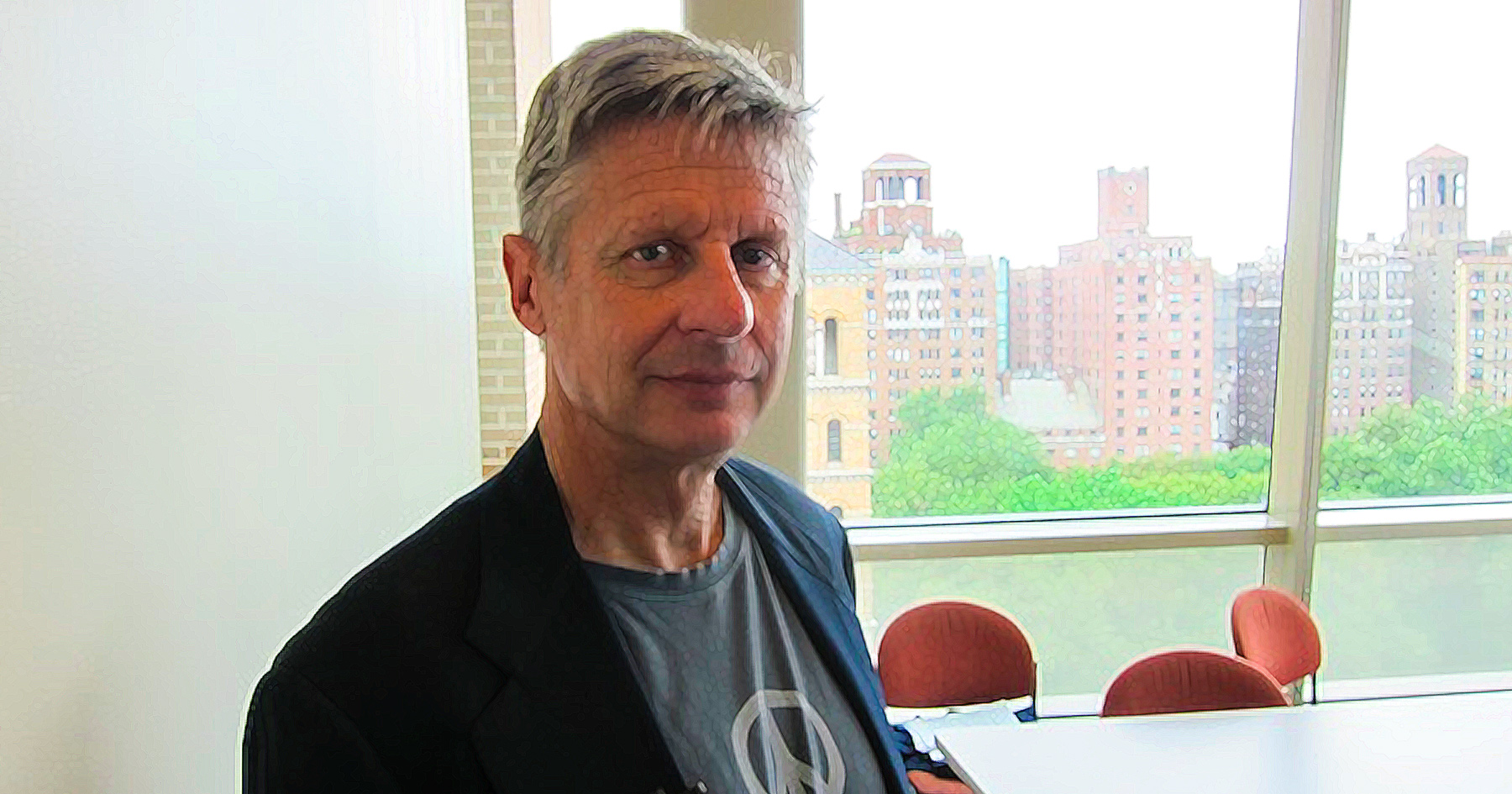
Think of the Libertarian Party as the host, and one-time Republicans like former Congressman Bob Barr and former New Mexico Governor Gary Johnson — and now McAfee — as viruses, aiming to commandeer the host’s operating system.

Of course, one might also view the LP as a virus attempting to do the same to the federal government.

Shall we root for the viruses, for once?

This is Common Sense. I’m Paul Jacob.


Printable PDF

John McAfee, libertarian, presidential race, president, candidate


Categories
Accountability crime and punishment folly general freedom moral hazard national politics & policies U.S. Constitution

Forfeiting Forfeiture

“The Department of Justice announced [last] week that it’s suspending a controversial program that allows local police departments to keep a large portion of assets seized from citizens under federal law and funnel it into their own coffers,” reports the Washington Post.

The Feds call the paused program “equitable sharing”; as I explained last month, I call it “equitable stealing.”

Even when state and local laws prohibit it, local police have been using this federal program to continue taking people’s money and property without ever convicting them of a crime.

The loophole? They split the loot with the Feds.

Now that has ended. According to the Post, this is the result of “budget cuts” in the recently passed omnibus spending bill; the Wall Street Journal calls it a “reallocation of funds.”

Either way, Happy Holidays!

Yet, sadly, the return to freedom, justice and the American Way may be short-lived.

“The Department does not take this step lightly,” wrote M. Kendall Day, the chief of DOJ’s Asset Forfeiture and Money Laundering Section. “We explored every conceivable option that would have enabled us to preserve some form of meaningful equitable sharing. . . .”

In his letter, he proclaiming a commitment to the principle of guilty-until-proven-innocent and to grabbing people’s stuff, telling state and local and tribal police departments, “We will take all appropriate and necessary measures to minimize the impact of the rescission and reinstate sharing distributions as soon as practical and financially feasible.”

As the Wall Street Journal editorialized, “Congress should make sure that never happens.”

Of course, Congress will likely need a mighty nudge from us.

This is Common Sense. I’m Paul Jacob.


Printable PDF

Asset, Forfeiture, police, crime, Department of Justice, DOJ, illustration, Common Sense


Categories
Accountability folly free trade & free markets general freedom ideological culture moral hazard national politics & policies too much government

Collateral Damage Defines Socialist B.S.

Senator Bernie Sanders gave us a big present last week. In one simple “tweet” he warbled out the essence of his socialism: “You have families out there paying 6, 8, 10 percent on student debt but you can refinance your homes at 3 percent. What sense is that?”

That’s what he broadcast. That’s what this self-proclaimed socialist wrote — or allowed his staff to write — on his official Twitter account, @SenSanders.

And it is not as if he had the excuse of haste. He was repeating a thought from his presidential campaign account in September: “It makes no sense that students and their parents pay higher interest rates for college than they pay for car loans or housing mortgages.”

To the earlier post, Twitter erupted in criticism. The gist? Have you never heard of collateral, sir?

Lenders can charge less on secured loans because, in case of default, the recourse is to take the collateral, the car or house, thereby recouping the loss.

But an unsecured loan? Well, by law one cannot easily slough off student loans — but one can simply not pay, or pay late. Hence the higher rates.

From its beginnings, socialism — and progressivism and Fabianism and fascism and social democracy, following — has been fueled by complaints about markets.

Without showing any understanding of the logic of markets.

Which is why, when put into practice, socialistic and interventionist programs produce such great amounts of negative collateral effects. Socialism is the philosophy of good intentions that yields collateral damage worse than the problems meant to be solved.

Oh, Bernie Sanders! Your initials say so much.

This is Common Sense. I’m Paul Jacob.


Printable PDF

Bernie Sanders, consequences, socialism, economics, illustration, Common Sense