Categories
Today

Natural Selection

On July 1, 1858, a joint reading at the Linnean Society of London of papers by Charles Darwin and Alfred Russel Wallace debuted a new explanation of speciation and biological evolution.

Linnean Society records record that eminent scientists Charles Lyell and Joseph Dalton Hooker “communicated” the papers of the two breakthrough theorists:

  • An extract from Darwin’s unpublished manuscript (written in 1844, part of his Essay).
  • An abstract of Darwin’s 1857 letter to Asa Gray, outlining his theory.
  • Wallace’s essay, “On the Tendency of Varieties to Depart Indefinitely from the Original Type” (written in 1858).

Though attended by about 30 prominent intellectuals and scientists of the day, conspicuously not in attendance were either Wallace (who was in the East Indies) or Darwin (whose son Charles Waring Darwin had died two days earlier).

The event proved to be one of the more significant scientific presentations in the history of western civilization.

Categories
ideological culture

Socialist Intifada

“Do you think that billionaires have a right to exist?” Meet the Press host Kristen Welker asked Zohran Mamdani, the likely winner of last week’s still undecided Democratic Party mayoral primary in New York City. 

“I don’t think that we should have billionaires,” was the democratic socialist’s reply. 

So, his answer to whether they have a “right to exist” was . . . NO! 

“Because, frankly, it is so much money in a moment of such inequality,” continued Mamdani, “and ultimately what we need more of is equality across our city and across our state and across our country.” 

Even equality at lower levels of wealth. By design and decree. 

But don’t worry your pretty little billionaire heads about being pilloried, prohibited, prevented from existing, because Mamdani generously offered: “I look forward to work with everyone, including billionaires, to make a city that is fairer for all of us.”

Ah, the rest of us . . . what does it all mean for us? Hmmm, could politicians aiming to tax, exploit, and totally end any such thing as “the rich” ever miss the mark and wind up hitting us of lesser wealth? And what if billionaires’ success is intimately tied to ours?

Still, New York City’s undesirables do not end with billionaires. Zohran Mamdani sees white people. (They’re everywhere.)

Welker confronted the Democrat state rep with a racially charged statement on his website: “Shift the tax burden from overtaxed homeowners in the outer boroughs to more expensive homes in richer and whiter neighborhoods.”

Why bring up skin color?

The democratic socialist assured his policy is “not driven by race,” adding, “It is not to work backwards from a racial assessment of neighborhoods or our city.”

Of course, that “racial assessment” appears to be precisely what he’s working from.

Mamdani was also questioned about the slogan “globalize the intifada,” which he declined to condemn. It looks like his intifada will be against billionaires and white people.

This is Common Sense. I’m Paul Jacob.


PDF for printing

Illustration created with Krea/Firefly

See all recent commentary
(simplified and organized)
See recent popular posts

Categories
Thought

Aquinas

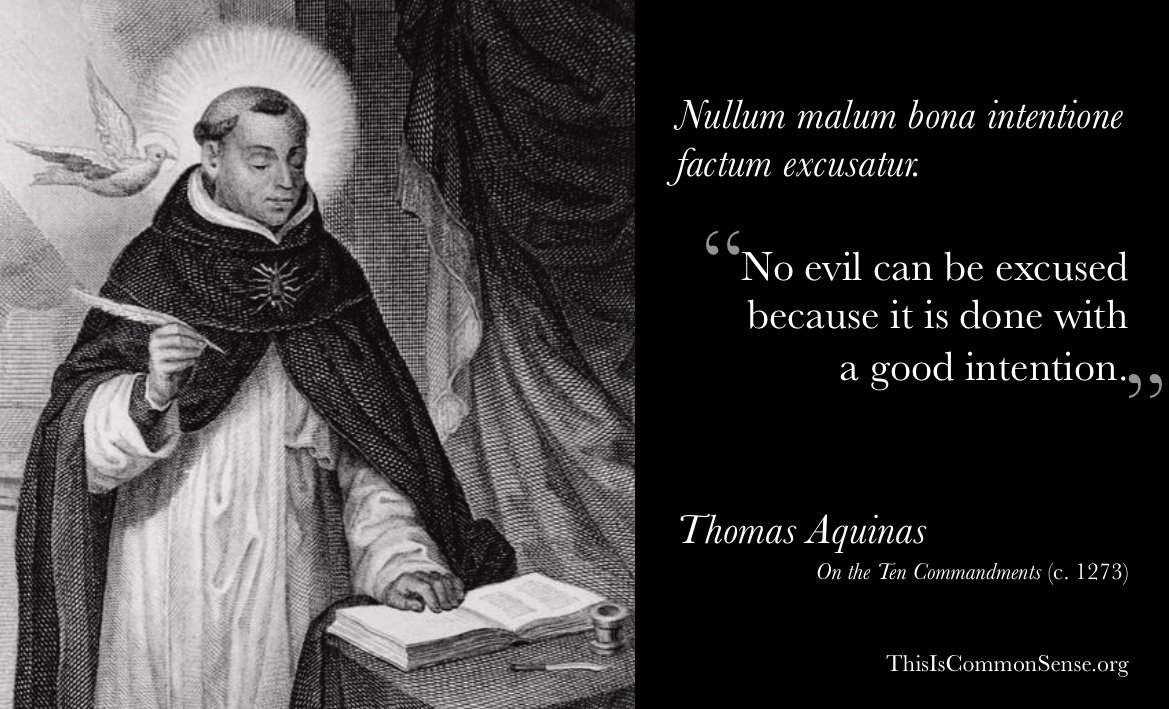
Nullum malum bona intentione factum excusatur.

No evil can be excused because it is done with a good intention.

Thomas Aquinas, On the Ten Commandments (c. 1273).

Categories
Today

An Assassin Hanged

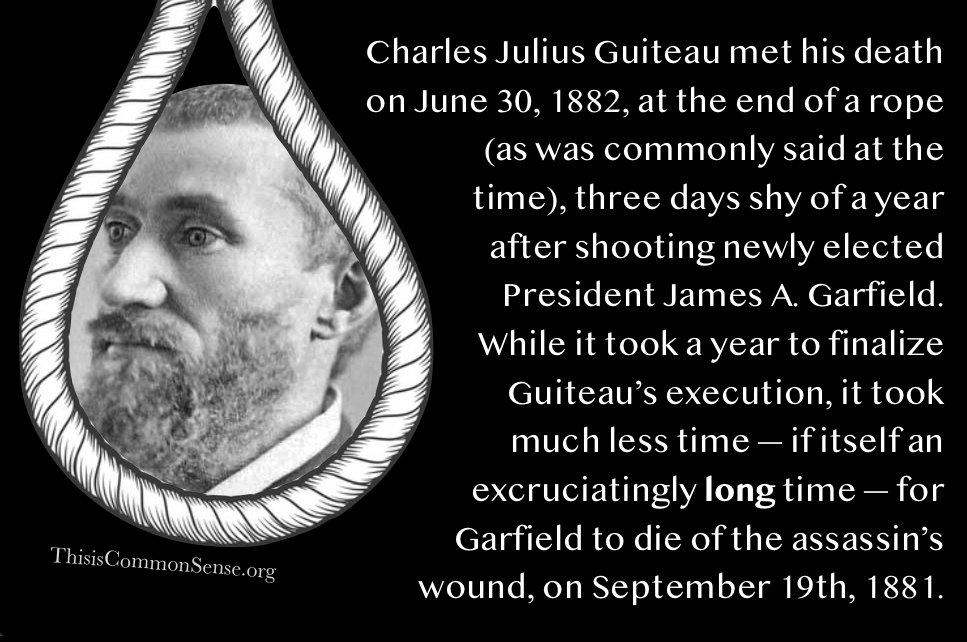
Charles Julius Guiteau met his death on June 30, 1882, at the end of a rope (as was commonly said at the time), three days shy of a year after shooting newly elected President James A. Garfield.

Guiteau was a member of the “Stalwart” faction of the Republican Party, devoted to the continuation of the kind of job-seeking corruption that Garfield, the reformer, opposed on principle. Despite being on the opposite team, so to speak, Guiteau was an ardent supporter of Garfield in the election campaign, and expected a diplomatic position in return. Failing to gain such a position in the new administration, Guiteau decided upon a sort of mad revenge as the apt response to Garfield’s “betrayal.”

While it took a year to finalize Guiteau’s execution, it took much less time — if itself an excruciatingly long time — for Garfield to die of the wound and the subsequent doctoring, on September 19th, 1881.

Categories
Update

Secret Weapon a Dud

One often heard the opinion, as recently as a year ago — sometimes as a whisper, sometimes as a boast of savvy opinion or special knowledge, or even daring prophecy — that Michelle Obama was the Democrats’ secret weapon, the most likely next “sure thing” candidate for the presidency.

Is anyone saying it now?

Michelle Obama’s candidacy is off the table. Comb through X — you’ll see almost no one thumping for Mrs. Obama.

Of course, it was never really on. She always denied any interest in it. But that did not prevent the sages of our age from repeating the notion. Until the election, Senator Ted Cruz talked up Michelle Obama as a potential unkillable candidate on his podcast, and historian Brion McClanahan did the same on his.

Now? Crickets.

But what made the savvy sages of our time drop the issue?

There are probably two issues:

I. The general collapse of Democratic Party cultural cachet after the debacle that was the Kamala Harris campaign. The Democrats have great trouble reaching a majority of Americans right now. It is the party’s issues. Michelle Obama would not solve this problem. (Or would she?)

II. The fizzle that was (or at least yawns induced by) “IMO with Michelle Obama & Craig Robinson.” It is not doing well on YouTube, and not creating much buzz outside of a narrow fan base. Or so it appears to those outside the fan base. Apple and Spotify say the podcast is a success.

But if success it be, Michelle Obama’s enduring popularity does not seem to be remotely political. This may reflect her own non-political outlook on life.

Almost certainly the lack of Michelle O. buzz has nothing to do with this:

Categories
Thought

William of Ockham

Logic is the most useful tool of all the arts. Without it no science can be fully known.

William of Ockham (c. 1287 – 1347) — he of “Occam’s Razor” — in Summa Logicae (c. 1323).

Categories
Today

Great War ab ovo

On June 29, 1914, the day after the shooting of the Archduke Ferdinand and his wife, Austrian interrogations confirmed — to the satisfaction of Gavril Princip’s interrogators and their government, anyway — that the Serbian state was behind the assassination. Serbia denied involvement.

Thus continued the series of events that led to “The Great War,” now known as “World War I.”

Categories
Update

CASA Beyond the “Dis”

Today’s “Thought” (see below) features Supreme Court Associate Justice Amy Coney Barrett dismissing fellow Justice Ketanji Brown Jackson. This passage from Justice Barrett’s write-up of the Trump v. CASA decision has been shared a great on social media since it came down yesterday.

The whole passage is worth reading (see links here), and may demonstrate some tension on the court. In social media, much has been made about the . . . sportive . . . or political . . . or even “catfight” . . . element of it all, or as a sign that Jackson is a “DEI hire” etc. But the actual decision is of no small moment, and worth reading.

The Epoch Times offers “five takeaways,” with the summary in the blurb: “By limiting the ability of judges to issue universal blocks, the court’s ruling is expected to affect other cases contesting Trump administration policies.”

ONE: Nationwide Injunctions Not Consistent With Nation’s History

“The universal injunction was conspicuously nonexistent for most of our Nation’s history,” Barrett said. “Its absence from 18th- and 19th-century equity practice settles the question of judicial authority.”

TWO: Broad Relief Still Possible

A key aspect of Barrett’s opinion indicated that broad relief was not necessarily bad but depended on who the plaintiffs in particular cases were. Courts, she said, could issue orders designed to provide “complete” relief for the parties before the court rather than other individuals in similar situations.

THREE: Unclear How Birthright Citizenship Issue Will Play Out

“No one disputes that the Executive has a duty to follow the law,” Barrett said. “But the Judiciary does not have unbridled authority to enforce this obligation—in fact, sometimes the law prohibits the Judiciary from doing so.”

Note that this quoted passage follows immediately after the oft-shared swipe at Justice Jackson.
FOUR: Dissenters Say Constitutional Rights in Danger

Sotomayor and Justice Ketanji Brown Jackson, who penned her own dissent, expressed their disagreement with Barrett and her majority opinion colleagues.

“No right is safe in the new legal regime the Court creates,” Sotomayor said. She added that while birthright citizenship might be under threat today, “tomorrow, a different administration may try to seize firearms from law-abiding citizens or prevent people of certain faiths from gathering to worship.”

Because the majority decision limited relief to parties before the court, it rendered “constitutional guarantees meaningful in name only for any individuals who are not parties to a lawsuit,” Sotomayor said.

Jackson, meanwhile, described the majority’s decision as “an existential threat to the rule of law.” Her separate dissent suggested that Barrett had focused too much on history and not enough on broader and more basic principles, like whether the judiciary can stop unlawful behavior.

FIVE: Majority Has Strong Words for Jackson

In multiple portions of Barrett’s majority opinion, she and her fellow justices leveled criticisms of Jackson’s dissent.

At one point, Barrett said that Jackson’s position was “difficult to pin down.” After briefly discussing Jackson’s dissent, Barrett adds that the majority “will not dwell on Justice Jackson’s argument, which is at odds with more than two centuries’ worth of precedent, not to mention the Constitution itself.”

The Epoch Times article ends with Barrett’s most generalized critique of Jackson’s dissent, where she says that Ketanji Brown Jackson’s position “would make even the most ardent defender of judicial supremacy blush.”

And this might be the biggest ideological takeaway. Progressives (which are what Jackson and fellow justices Sotomayor and Kagan most obviously are) have relied heavily on court rulings to advance their political agenda. They tend not to win on their issues through majority vote of the people. For good or ill, many of the major “progressive” achievements, such as regarding de-segregation and abortion, were achieved largely on the basis of key Supreme Court cases, such as Brown v. Board of Education and Roe v. Wade.

More recently, Democrats have relied heavily on injunctions of the lesser federal courts to “stop Trump.”

The ruling in Trump v. CASA limits this tactic somewhat.

Categories
Thought

Justice Barrett

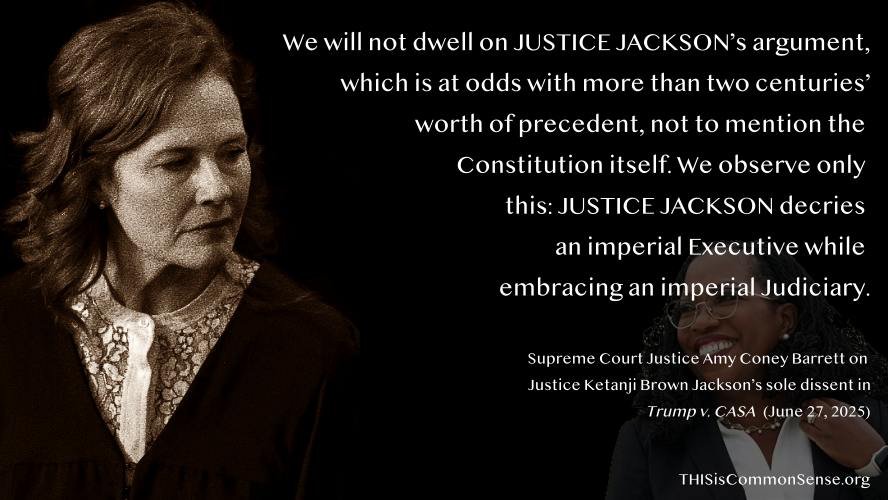
We will not dwell on JUSTICE JACKSON’s argument, which is at odds with more than two centuries’ worth of precedent, not to mention the Constitution itself. We observe only this: JUSTICE JACKSON decries an imperial Executive while embracing an imperial Judiciary.

Justice Amy Coney Barrett on Justice Ketanji Brown Jackson’s argument in Trump v. CASA (June 27, 2025), as quoted by Jonathan H. Adler, Volokh Conspiracy (June 27, 2025).
Categories
Today

The Archduke Shot!

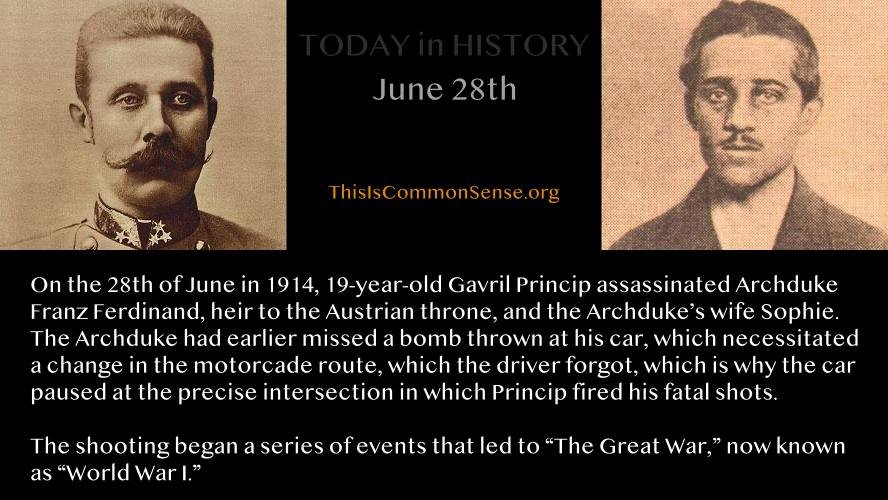
On the 28th of June in 1914, 19-year-old Gavril Princip assassinated Archduke Franz Ferdinand, heir to the Austrian throne, and the Archduke’s wife Sophie. The Archduke had earlier missed a bomb thrown at his car, which necessitated a change in the motorcade route, which the driver forgot, which is why the car paused at the precise intersection in which Princip fired his fatal shots.

The shooting began a series of events that led to “The Great War,” now known as “World War I.”