Categories
Today

Bells, Bells, Bells

July 8, 1776 — Church bells (possibly including the Liberty Bell, pictured) were rung after John Nixon (1733–1808) delivered the first public reading of the Declaration of Independence of the United States. He read it on the steps of Pennsylvania State House, now Independence Hall, in Philadelphia.

Categories
public opinion too much government

Vote Communist!

The world wants to be deceived, so let it be deceived!

Maybe, just sometimes, we let fools dig themselves deeper into their folly.

Take New Yorkers. The city’s government has been dysfunctional for ages. But now it’s potentially taking the starkest left turn yet, towards . . . communism.

Mayoral candidate Rep. Zorhan Mamdani may call himself a “democratic socialist” and quote Martin Luther King piously, but he also admits that seizing the means of production is the ultimate goal . . . just not politically acceptable. 

Yet.

That’s communism. Will New Yorkers vote for a commie?

Maybe running under the Democratic banner is cover enough for many voters. Seems safe. Seeking to help “the poor” by attacking “the rich” and “the whites” (as I wrote last Monday) is certainly not unfamiliar.

And neither is his reaction to rising food prices: blame something called “capitalism.” 

Then set up government-run grocery stores!

While our first instinct is to oppose him with everything we’ve got, comedian Steven Crowder counsels otherwise. “Maybe he’s exactly what New York City deserves,” says Crowder. Let Mamdani make New York an object lesson in what not to do. 

New Yorkers can vote in this “teachable moment” for the whole nation: pop the corn and watch the Big Apple rot under Mamdani — with food cheaper everywhere else, under Trump.

Or so Crowder argues.

Embrace the old motto, “mundus vult decipi” (the world wants to be deceived), and let one city run further down the length of rope . . . until they’ve done enough damage.

To learn. Finally.

If one city wants communism, let it have it. 

Good and hard.

This is Common Sense. I’m Paul Jacob.


Previously on This Is Common Sense:

July 3 — The Big Decommodification — a communist housing plan for socialist NYC.
July 1 — If Mamdani Wins — the likely results of electing a socialist mayor.
June 30 — Socialist Intifada — the problematic philosophy of NYC’s political phenom.


PDF for printing

Illustration created with Krea and Firefly

See all recent commentary
(simplified and organized)
See recent popular posts

Categories
Thought

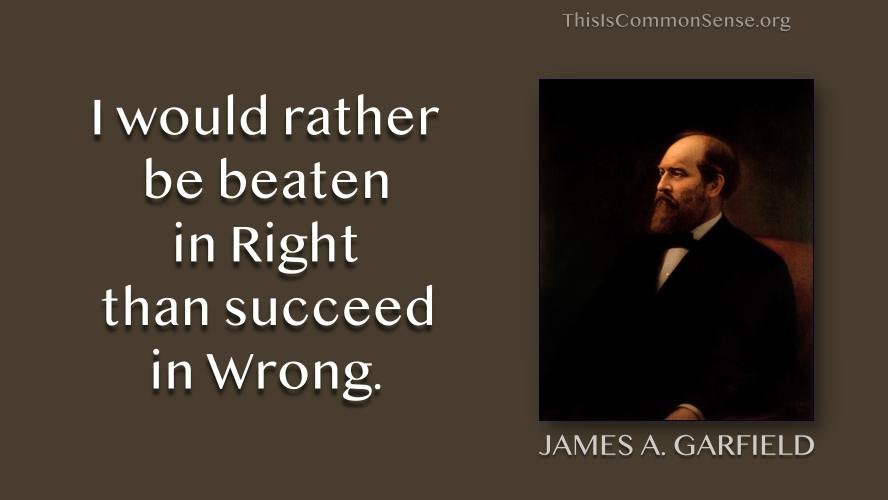
James A. Garfield

I would rather be beaten in Right than succeed in Wrong.

President James A. Garfield, Maxims of James Abram Garfield (1880), compiled by William Ralston Balch, p. 1.
Categories
Today

Seventh of July

In 1456, a retrial verdict acquitted Joan of Arc of heresy 25 years after her execution.

In 1928 on July 7, sliced bread was sold for the first time by the Chillicothe Baking Company of Chillicothe, Missouri.

On this date in 1958, U.S. President Dwight D. Eisenhower signed the Alaska Statehood Act into law.

Categories
Update

The Milei Counter-Example

“The year 2024 was transformative for both President Javier Milei and Argentina,” wrote Alejandro Werner in January. “After just one year in office, Milei has achieved significant milestones: eliminating the fiscal deficit, bringing inflation to moderate levels (see figure 1 [above]), reducing the gap between the official and the parallel exchange rate (a free but illiquid market), and implementing the most ambitious liberalization and deregulation program Argentina has seen this century.”

As we Americans endure information-free debates about our president’s reforms and bills — at least one being “Big” and “Beautiful,” according to presidential ballyhoo — it’s worth remembering that in South America one politician is making significant changes indeed.

“The upcoming mid-term elections in October will be a test of his political strength, so the first challenge is securing a strong performance in these elections,” Werner’s article for the Peterson Institute for International Economics goes on. “With half of the seats in the lower house of Argentina’s Congress and a third of the Senate up for renewal, the stakes are high. Currently, Milei’s political party, La Libertad Avanza, has minimal representation in Congress. A favorable mid-term outcome, buoyed by Milei’s consistent approval ratings, could cement his party as the dominant political force ahead of the 2027 presidential elections.” So note: Milei has accomplished a lot more than Trump with much more opposition than Trump has within his own government, with his own political party boasting of majorities in both the House and the Senate.

The view from Cato Institute is worth considering: “Argentine President Javier Milei has lowered inflation, drastically reduced government spending, and dismantled large parts of the federal bureaucracy,” explains Ian Vasquez for Cato. “But one of the most far-reaching efforts by his administration has been its deregulation push. . . .”

This push may remind Americans of Trump’s first term, and perhaps also of DOGE, but Milei has been much more successful.

Since coming to power, Milei has made wide-ranging cuts to Argentina’s bureaucracy. In his first year, he reduced the number of ministries from 18 to 8 (eliminating some and merging others), fired 37,000 public employees, and abolished about 100 secretariats and subsecretariats in addition to more than 200 lower-level bureaucratic departments.

The president has also aggressively pursued deregulation. Using a conservative methodology, my colleague Guillermina Sutter Schneider and I calculated that during Milei’s first year in office, he implemented about two deregulations per day. Roughly half of the measures eliminated regulations altogether, while the rest modified existing regulations in a generally market-oriented direction.

Milei has implemented these reforms legally and constitutionally, and they have resulted mainly from two broad measures. First, Milei began his administration by issuing an emergency “megadecree” that consisted of 366 articles. Emergency decrees are consistent with Argentine law if they meet certain conditions. They are also reviewable by Congress, which has the right to reject the orders within a specified period of time. Since the legislature did not object, most of the deregulations in the megadecree went into effect.

“Deregulation in Argentina: Milei Takes “Deep Chainsaw” to Bureaucracy and Red Tape,” Spring 2025.

A request for more information from Grok, this morning, elicited an important context from the AI:

Milei’s deregulation is driven by a consistent libertarian ideology aiming to dismantle the state, while Trump’s ismore pragmatic, focusing on economic competitiveness and political appeal, often paired with protectionistpolicies that contradict free-market principles.

If your general impression is that Trump’s much less impressive than Milei in curbing government bloat, Grok concurs: “Trump’s rhetoric suggests continued deregulation, but specific actions in 2025 are less documented, with DOGE’s efforts described as ‘meager’ compared to Milei’s.”


Categories
Thought

Matt Walsh

There’s always been art with immoral messages. The differences is that, in modern times, our immoral art is produced by the most tiresome collection of monotonous, talentless idiot hacks to ever walk the Earth. . . . These depraved attention mongers can’t even manage to be offensive in an interesting way. Instead they simply recycle the same shock tactics over and over again. And we’ve seen it all by now. As it turns out, there are only so many ways to be a satanic whore. After a while it gets repetitive, and we are way past that point today.

Matt Walsh, “Proof for Your Liberal Friend: The Music Industry Is Demonic & Evil,” The Matt Walsh Show, compilation (July 5, 2025).
Categories
Today

Tyranny

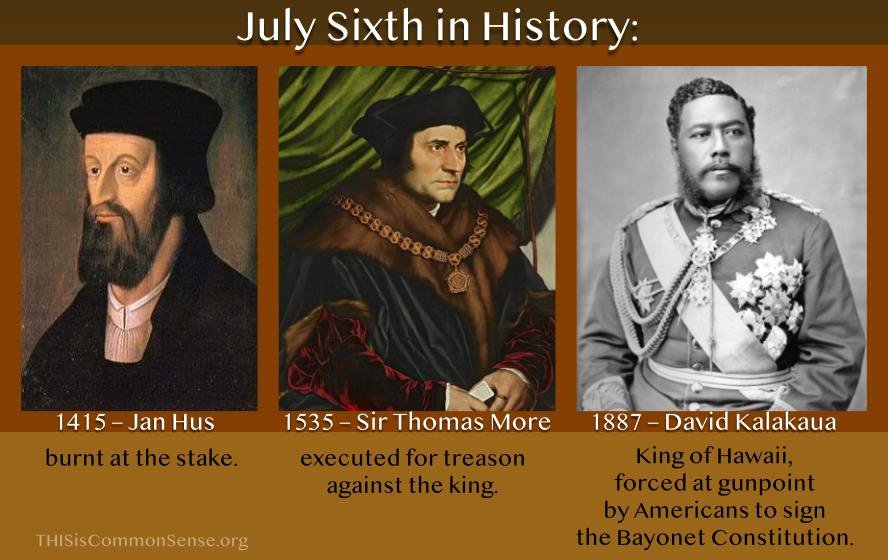
The Sixth of July serves better as a “Today in Tyranny” marker than anything positive, at least when you consider these events:

  • 1415 – Jan Hus was burnt at the stake.
  • 1535 – Sir Thomas More was executed for treason against King Henry VIII of England.
  • 1887 – David Kalakaua, monarch of the Kingdom of Hawaii, was forced at gunpoint by Americans to sign the Bayonet Constitution giving Americans more power in Hawaii while stripping Hawaiian citizens of their rights.
  • 1939 – The Nazi “Third Reich” closed the last remaining Jewish enterprises in Germany.
Categories
FYI Update

Minds Broken, Minds Healed

The difference between a “liberal” and a “leftist” is lost on many, especially on the political right. But understanding is coming. A liberal is a person ostensibly for an “open society” and against treating “the other” badly, but is also for the basic structures of society. A leftist, on the other hand, sees the causes of “the marginalized” and “the poor” and anyone not hyper-obviously benefitting from the current order as an excuse to tear down that order. “Fundamentally transform America” might be a slogan to excite a liberal, but a leftist sees it as a demand with immediate consequences. 

Leftists do wish for a fundamental transformation of America!

Liberals might still think that free speech, for example, is a good thing. Whereas a leftist sees it as a barrier to that fundamental transformation.

Rumination on this subject is all over YouTube. Consider Styx:

Of Democrats and their institutional liberalism, he says, “I find it very funny that Reagan broke their minds so much that they began trying to absorb far leftists . . . and now Trump is breaking their minds again.”

The problem with the liberal is an inability to deal with substantive challenge.

And leftists are proving to be just as much a challenge as Trump, now, especially with the recent anti-ICE riots (the subject of Styx’s talk), so liberals are trying to distance themselves from the left. But, Styx says, that isn’t working.

Author Andrew Doyle, in a recent book, is trying to understand whither “the woke.” He sees the woke as “unprecedented” for being authoritarian and successful at it while pretending to be powerless:

Doyle is the creator of the infamous “Titania McGrath” persona and Twitter account, and his new book is called The New Puritans. He expects that the new puritans of wokeness will wither quickly as a movement, because of the fundamental contradiction. The “unprecedented” contradiction.


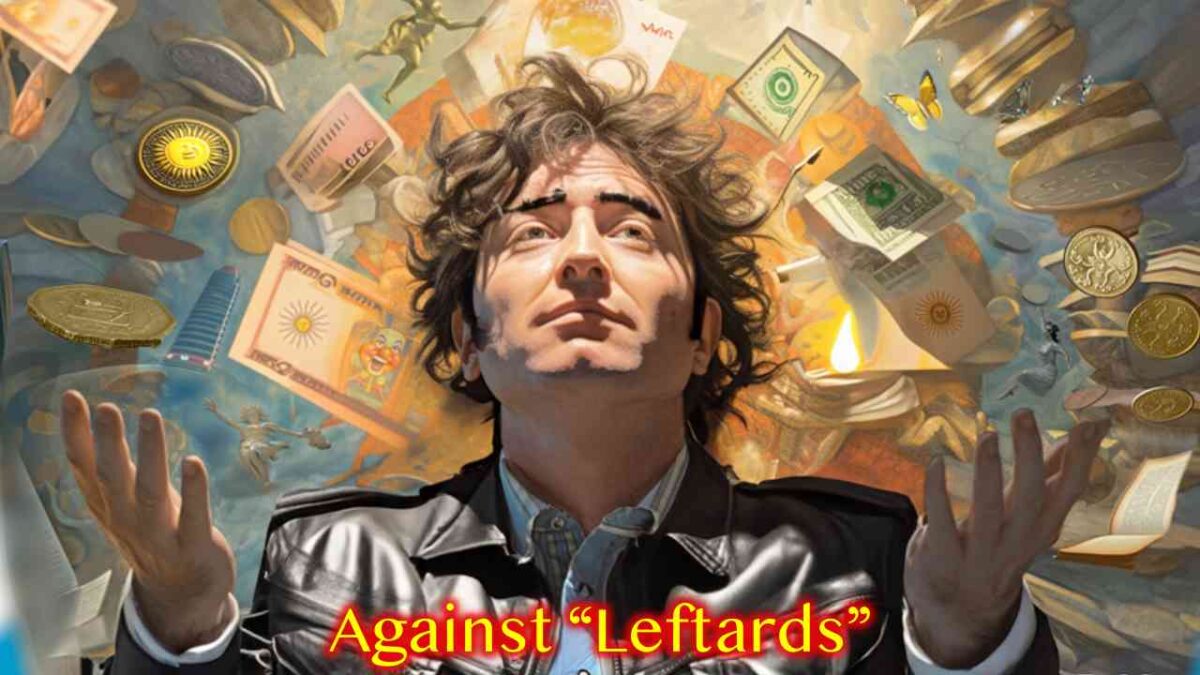
The only big success in opposing leftist policies, on the other hand, is not in the U.S., it is far, far south. Hence the seemingly random placement of a Milei image at top. More updates to come on him and his Argentine movement.

Categories
Thought

Thomas Sowell

When someone removes a cancer, what do you replace it with?

Economist Tom Sowell, in conversation with Peter Robinson of the Hoover Institution’s Uncommon Knowledge, upon being asked what would be established to replace the Federal Reserve.
Categories
Common Sense general freedom obituary

Waiting for the Day

Towards the end of their lives, former President John Adams asked former President Thomas Jefferson whether he would live his life over again. 

The third president answered in the affirmative: “I think with you, that it is a good world on the whole; that it has been framed on a principle of benevolence, and more pleasure than pain dealt out to us.”

Not everyone agrees, of course. Jefferson called these people “gloomy and hypochondriac minds,” who “always count that the worst will happen because it may happen.”

Jefferson has a challenge to those whom we today call “the black-pilled”: “How much pain have cost us the evils that have never happened!” Jefferson confessed to lacking hope sometimes, but not as often as the perpetually gloomy.

Those of us who follow the news often have occasion for gloom — or alarm. But on July Fourth it is appropriate to remember the council of these two leaders of Independence. 

In 1826, as Jefferson and Adams approached their inevitable demises, both struggled — and succeeded — in their final goals: to make it to Independence Day. 

On the Third, Jefferson inquired, more than once, about whether it was the Fourth yet, wrote Albert Jay Nock at the end of his Jefferson (1926), “and when told at last that it was, he appeared satisfied. He died painlessly at one o’clock in the afternoon, about five hours before his old friend and fellow, John Adams; it was the only time he took precedence of him, having been all his life ‘secondary to him in every situation,’ except this one.”

According to Adams family lore, when Adams died a few hours later, he said, “Jefferson survives.” 

Wrong, as a point of fact. But in spirit?

On Independence Day, we should ask ourselves what of the founding survives.

Unlike the actual lives of those who made our Independence, and, to paraphrase Tom Paine, we can start Independence anew. And as John Adams definitely said on his last day, “Independence forever!”

This is Common Sense. I’m Paul Jacob.


PDF for printing

Illustration created with Krea and Firefly

See all recent commentary
(simplified and organized)
See recent popular posts