The Young Turks take note of an ominous sign from the party the progressives think is theirs. A leftist take on the Democratic Congressional Campaign Committee’s smoke-filled room machinations.
“Yay, democracy: once you get in you never get out!”
Ana Kasparian spoke the line quoted in the title, above; John Iadarola spoke, sarcastically, the words used here as caption to the video, directly above. Francesca Fiorentini also comments on this news story.
I own no Bitcoin; it’s not my thing. The blockchain concept Bitcoin is based upon seems clever, sure, but I often curse at my “devices,” so only my politics prevents me from full-blown Luddism.
Besides, when I think “the people’s money” I don’t think “private fiat currency.” Which is what Bitcoin sure looks like to me.
But to quote from these very pages, “When times get tough, the tough . . . switch currencies.”
And times cannot get much tougher than in Venezuela right now. No wonder “many are turning to digital assets such as Bitcoin as an alternative to the Venezuelan bolivar,” writes Matthew Di Salvo for the BBC.
“Critics say Bitcoin and other cryptos — there are more than 1,600 globally — are unstable, use too much energy, and are used by money launderers or those wanting to buy illicit goods on the web,” Di Salvo explains.
These points need addressing. I’ll try:
A wannabe money will be as unstable as investor demand. When actually used as money, though, we may expect more stability. And Bitcoin is deflationary, so it should be more stable than government money.
As if our banks and ATMs don’t use energy!
Used by bad people? Well, you can say that about cash. But if we get rid of cash — as many experts want to — you can kiss any hope for freedom goodbye.
Venezuelans, by turning to keeping “their money in a digital wallet in the form of Bitcoin, Litecoin, Dash or any of the others,” are grabbing at something much better than what their malign inflation-happy government provides.
It is a pity that the “free-market” alternative is called “crypto” — meaning secret.
Aucun homme n’a recu de la nature le droit de commander aux autres. La liberté est un présent du ciel, et chaque individu de la meme espèce a le droit d’en jouir aussitòt qu’il jouit de la raison.
No man has received from nature the right to give orders to others. Freedom is a gift from heaven, and every individual of the same species has the right to enjoy it as soon as he is in enjoyment of his reason.
Denis Diderot, L’Encyclopédie (1751-1766), Political Authority, Vol. 1, (1751) as quoted in Selected Writings (1966) edited by Lester G. Crocker.
On March 22, 1630, the Massachusetts Bay Colony outlawed the possession of cards, dice, and gaming tables. Exactly eight years later, the colony expelled Anne Hutchinson for religious dissent.
In 1812 on this date, Stephen Pearl Andrews was born. Andrews would go on to become an important American abolitionist, free love advocate, and theorist of “individual sovereignty,” promulgating the reforms of Josiah Warren.
Joona Räsänen is a Finn and a “bioethicist” who teaches philosophy at the University of Oslo. But we are not going to talk ontology or mereology or modal logic, here — not intentionally, anyway. The subject is “trans-ageism.”
A hotter topic in philosophy?
Räsänen has had a paper published in the Journal of Medical Ethics, a peer-reviewed academic publication. Entitled “Moral case for legal age change,” it hasattractedattention.
To be expected when you write something this absurd: “Should a person who feels his legal age does not correspond with his experienced age be allowed to change his legal age?”
Well, the question answers itself.
No.
But Räsänen answers yes, “in some cases people should be allowed to change their legal age.” He lists those cases as when
“the person genuinely feels his age differs significantly from his chronological age”
“the person’s biological age is recognised to be significantly different from his chronological age”
“age change would likely prevent, stop or reduce ageism, discrimination due to age, he would otherwise face.”
Witness how far the idiocies of post-structuralist, post-modernist, post-somethingist intersectionalism have brought us: to insisting that the State should adapt to our feelings rather than merely acknowledge simple facts.
Hopefully, the author carefully explains the difference between “legal age” and “chronological age.” That latter sounds like a pleonasm, to me, a redundancy. But then, I haven’t even read Henri Bergson, the philosopher who made hay with “dureé.”
We can only hope Räsänen takes care, here, because we certainly won’t read it, right?
If you think I need to read the whole article to comment on it, hey: I’ve trans-read it.
On March 21, 1965, Dr. Martin Luther King, Jr. led 3,200 people on the start of the third and finally successful civil rights march from Selma to Montgomery, Alabama.
Nearly two decades earlier, the Twenty-second Amendment (Amendment XXII) of the United States Constitution, passed Congress. The date was March 21, 1947. The amendment, ratified on February 27, 1951, set a term limit for election and overall time of service to the office of President of the United States. This was an obvious reaction to Franklin Delano Roosevelt’s more than three terms in office.
The first section of the amendment reads as follows:
No person shall be elected to the office of the President more than twice, and no person who has held the office of President, or acted as President, for more than two years of a term to which some other person was elected President shall be elected to the office of the President more than once. But this Article shall not apply to any person holding the office of President, when this Article was proposed by the Congress, and shall not prevent any person who may be holding the office of President, or acting as President, during the term within which this Article becomes operative from holding the office of President or acting as President during the remainder of such term.
A stronger affection to be displayed by child for parent in later life, must be established by a closer intimacy between parent and child in early life. . . . When the minds of children are no longer stunted and deformed by the mechanical lessons of stupid teachers — when instruction, instead of giving mutual pain gives mutual pleasure, by ministering in proper order to faculties which are eager to appropriate fit conceptions presented in fit forms — when among adults wide-spread knowledge is joined with rational ideas of teaching, at the same time that in the young there is an easy unfolding of the mind such as is even now shown by exceptional facility of acquisition — when the earlier stages of education passed through in the domestic circle have come to yield, as they will in ways scarcely dreamed of at present, daily occasions for the strengthening of sympathy, intellectual and moral, then will the latter days of life be smoothed by a greater filial care, reciprocating the greater parental care bestowed in earlier life.
Herbert Spencer, Principles of Sociology, Vol. I, Part III: Domestic Institutions, from the concluding paragraph (1898).
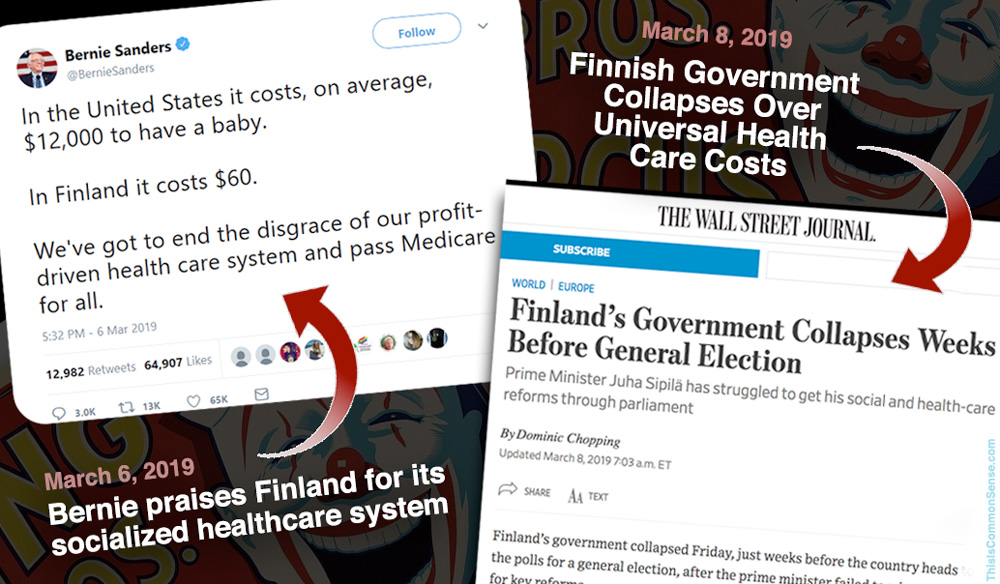
Finland’s government-run health care system is a mess.
This normally wouldn’t faze me much. I have to navigate our American mess, er, system. But Finland’s medical service delivery system is relevant to Americans — as is Denmark’s and Norway’s and Sweden’s — because the current crop of Democratic presidential hopefuls tout these “Scandinavian socialist” programs as models to follow.
Yet Finland’s program is in crisis.
How bad is it?
Bad enough for Finland’s government to fold early, before an election, with Prime Minister Juha Sipilä throwing in the towel earlier this month. He had been struggling “to get social and health-care reforms that he made the cornerstone of his government’s four-year term through parliament,” The Wall Street Journalinforms us. Finland’s health care system is somewhat decentralized, and that quality of service varies district by district. Silipä had been trying to centralize administration while also allowing for some privatization.
Left-leaning parties have balked at this, hence the impasse.
So, what is the lesson? A medical delivery system should be anti-fragile, capable of functioning despite incompetents or corrupt officials in government, despite voting blocs at loggerheads. A vast segment of the service industry should not be held in hock to the political machinations of special-interest groups.
Behind all of it, though, is the looming demographic crisis: the population of Finland, like here in America and throughout the First World, is aging. This puts heavy stressors on welfare-state systems run on a Ponzi-like re-distributive basis.* Of course costs will increase and service levels will fall, given how it’s all set up.
But once in place, government-run medical systems do not heal themselves.