On October 4, 2004, SpaceShipOne became the first private craft to fly into space, thereby winning for Mojave Aerospace Ventures the Ansari X Prize for private spaceflight.
Categories
SpaceShipOne

On October 4, 2004, SpaceShipOne became the first private craft to fly into space, thereby winning for Mojave Aerospace Ventures the Ansari X Prize for private spaceflight.

This was most clearly demonstrated in 2019, during one of those huge panels of presidential hopefuls on the Democratic side, all raising their hands on whether they supported giving tax-funded medical assistance to illegal aliens.
Yesterday I quoted Rep. Maxine Waters (D-Calif.) on how Democrats want to “save people.”
What I didn’t quote was the question she was asked — “Do Democrats want to prioritize the healthcare for illegal aliens over a government shutdown?” — or how she initially responded: “Excuse me; stop it right there. We’re not prioritizing; what we’re doing is saying, simply, we wanna keep the government open and we wanna work with the Republicans and have a bipartisan agreement to keep this government open and healthcare is at the top of our agenda.”
Whew. While denying she’s prioritizing what’s at “the top” of her “agenda” — what prioritization means — her desire for a “bipartisan agreement” is just as fake, for what she and her fellow Democrats demand is that the Republicans completely agree with their most extreme agendum: subsidized medical assistance for all comers.
That’s not “bipartisan.” There’s no compromise. It’s a tactic of intransigence.
Nassim Nicholas Taleb wrote about this in terms of an “intransigent minority rule,” positing that in complex systems — such as societies, markets, or Congress — a small, highly committed minority (as little as 3-4 percent) can impose its preferences on a flexible majority due to an asymmetry of choice.
Meaning that the opponents of “limitless” subsidies (socialism) must become intransigent themselves to win.
This is Common Sense. I’m Paul Jacob.
Illustration created with Krea and Firefly
See all recent commentary
(simplified and organized)
See recent popular posts

The tone in which an Englishman expresses anger would, in Italy, be only a mark of surprise.
Étienne Bonnot de Condillac, as quoted in David Booth, The principles of English composition (1831), p. 8.

On October 3, 1789, George Washington proclaimed Thursday November 26, 1789, a Thanksgiving Day. On the same date in 1863, U.S. President Abraham Lincoln declared the last Thursday in November as Thanksgiving Day.
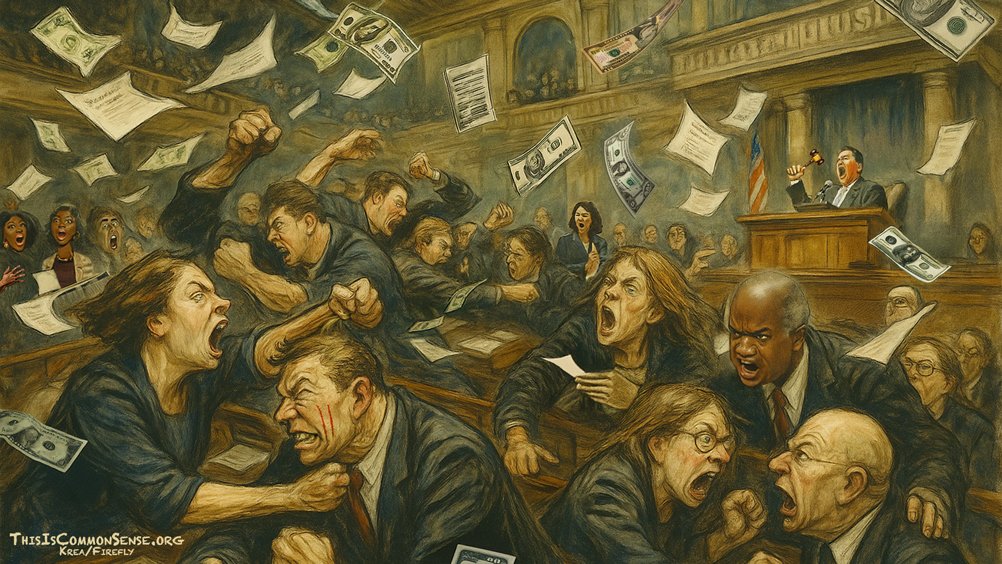
But it is Congress and its two political parties squabbling, and it’s the American voter playing the part of parent. Whose fault is it? Both make plausible cases, sort of, but neither sounds believable. Why can’t these two get along? And where’s my coffee? Where’s my gin?
The subject is the budget.
Not the actual voted-on budget, which though prescribed by the U.S. Constitution hasn’t been seen in quite a while. Congress offers up these makeshifts instead.
“Hours into a government shutdown, the Senate again blocked a pair of rival stopgap bills to fund the government, amid a partisan standoff that shows no signs of easing,” writes Jackson Richman at The Epoch Times. “The federal government shut down Wednesday morning after Congress failed to pass a Republican plan to fund operations through Nov. 21.”
Welcome to Fiscal Year 2026.
Republicans call the failure a “Democrat Shutdown”; Democrats counter with “Trump Shutdown.”
The key concept here is CR — Continuing Resolution, the now-standard budget machinery. Congress must approve funding for federal agencies either through twelve individual appropriations bills or a temporary CR to bridge gaps while negotiating those bills. No full FY2026 appropriations have so far been enacted, and competing CR proposals from Republicans and Democrats both failed in the Senate on September 30, 2025, triggering the lapse under the Antideficiency Act, which prohibits spending without authorization.
Democrats insist on re-authorizing Obamacare subsidies, including healthcare for those in the country illegally — which Rep. Maxine Water (D-Ca.) nearly admits to, insisting upon “healthcare for everybody; we want to save lives.”
Republicans balk at that, their compromise being to regurgitate past CR specs. Which annoys Rep. Thomas Massie (R-Ky). “Republicans passed a line-by-line continuation of Biden’s last budget, including Doge-identified waste. BUT Democrats refused to vote for Biden’s last budget, thereby shutting down the government.”
Happy New Year!
This is Common Sense. I’m Paul Jacob.
Illustration created with Krea and Firefly
See all recent commentary
(simplified and organized)
See recent popular posts

Some books are to be tasted, others to be swallowed, and some few to be chewed and digested; that is, some books are to be read only in parts; others to be read, but not curiously; and some few to be read wholly, and with diligence and attention.
Francis Bacon, “Of Studies,” Meditationes sacræ (1597).
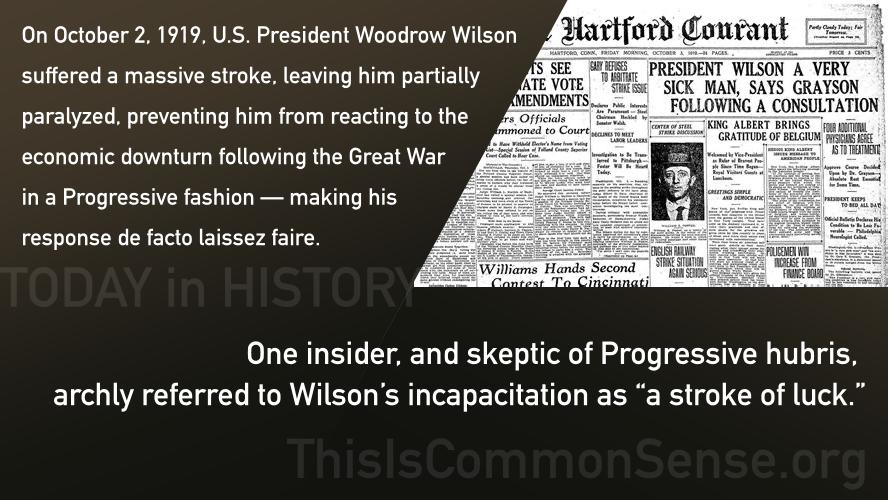
On October 2, 1919, U.S. President Woodrow Wilson suffered a massive stroke, leaving him partially paralyzed, preventing him from reacting to the economic downturn following the Great War in a Progressive fashion — making his response de facto laissez faire. One insider, and skeptic of Progressive hubris, archly referred to Wilson’s incapacitation as “a stroke of luck.”
His successor in office, President Warren G. Harding, would go on to massively cut spending as well as taxes, and take on regulation as well. He also released Woodrow Wilson’s domestic war prisoners — ranging from journalists, ordinary folk to socialist presidential candidate Eugene V. Debs — who had dissented from Wilson’s involvement in the war.
The Depression of the early 1920s, though as deep as the early 1930s, proved remarkably brief, thanks to Harding . . . and a stroke of luck.
On October 2, 1789, George Washington sent the proposed Constitutional amendments (the United States’ Constitution’s Bill of Rights) to the States for ratification.

It has a fake part and a real part.
The fake part itself has two parts: 1) how to learn whether voters support term limits, and 2) how to learn how a legislative body can function unless incumbents, whose advantages over challengers enable them to return to office sporting reelection rates exceeding 90 percent, may remain in place until ousted by death or scandal?
The answer to the first everyone knows. The answer to the second is to write down procedures and give tutorials and guidebooks on how the legislature works to newcomers in legislative halls.
The real mystery, though, is how to overthrow term limits given voters’ massive continuing support?
The answer?
This is where they get “clever”! Their plan appears to be: concoct the fake mystery and set up investigations premised on it.
And maybe sacrifice lambs and the first-born to the gods, hoping and praying and hoping some more that something turns up . . . anything to enable downtrodden entrenched legislators to cling to power for all eternity.
Regardless of popular support for term limits — support, after all, that has been confirmed in polls on the question conducted over the past four decades as well as in election after election.
This all explains why North Dakota legislators are paying $220,000 to Gary Consulting to find out how voters — who in 2022 passed term limits of eight years on the state house and eight years on the state senate — feel about term limits and how lawmakers feel about term limits.
I’ll tell you for free: voters love them; incumbents hate them.
This is Common Sense. I’m Paul Jacob.
Illustration created with Krea and Fireflly
See all recent commentary
(simplified and organized)
See recent popular posts

La culture est un instrument manié par des professeurs pour fabriquer des professeurs qui à leur tour fabriqueront des professeurs.
Culture is an instrument wielded by professors to manufacture professors, who, when their turn comes, will manufacture professors.
Simone Weil, The Need for Roots, part 2: “Uprootedness,” chapter 1: “Uprootedness in the Towns” (1949).

Prudens quaestio dimidium scientiae.
To ask the proper question is half of knowing.
Roger Bacon, as cited in LIFE (September 8, 1958), p. 73.