Categories
crime and punishment Fourth Amendment rights general freedom

Fourth Amendment Dead?

Unconstitutional actions are constitutional.

A federal judge doesn’t say so explicitly, but that’s what his ruling amounts to.

The case, which we discussed previously, involves U.S. Private Vaults, a Beverly Hills company that the Federal Bureau of Investigation raided last year. The company has been fined $1.1 million for money laundering because it let dealers anonymously keep cash in its safe deposit boxes.

Judge Gary Klausner concedes that the FBI lied to obtain a warrant, planning to seize the property of all boxholders whether or not there was any evidence of a crime against a given boxholder. And to this day, “specific criminal conduct has not been alleged against customers.” Nevertheless, Klausner ruled that despite the lie, it was constitutional for the FBI to grab the boxes’ contents.

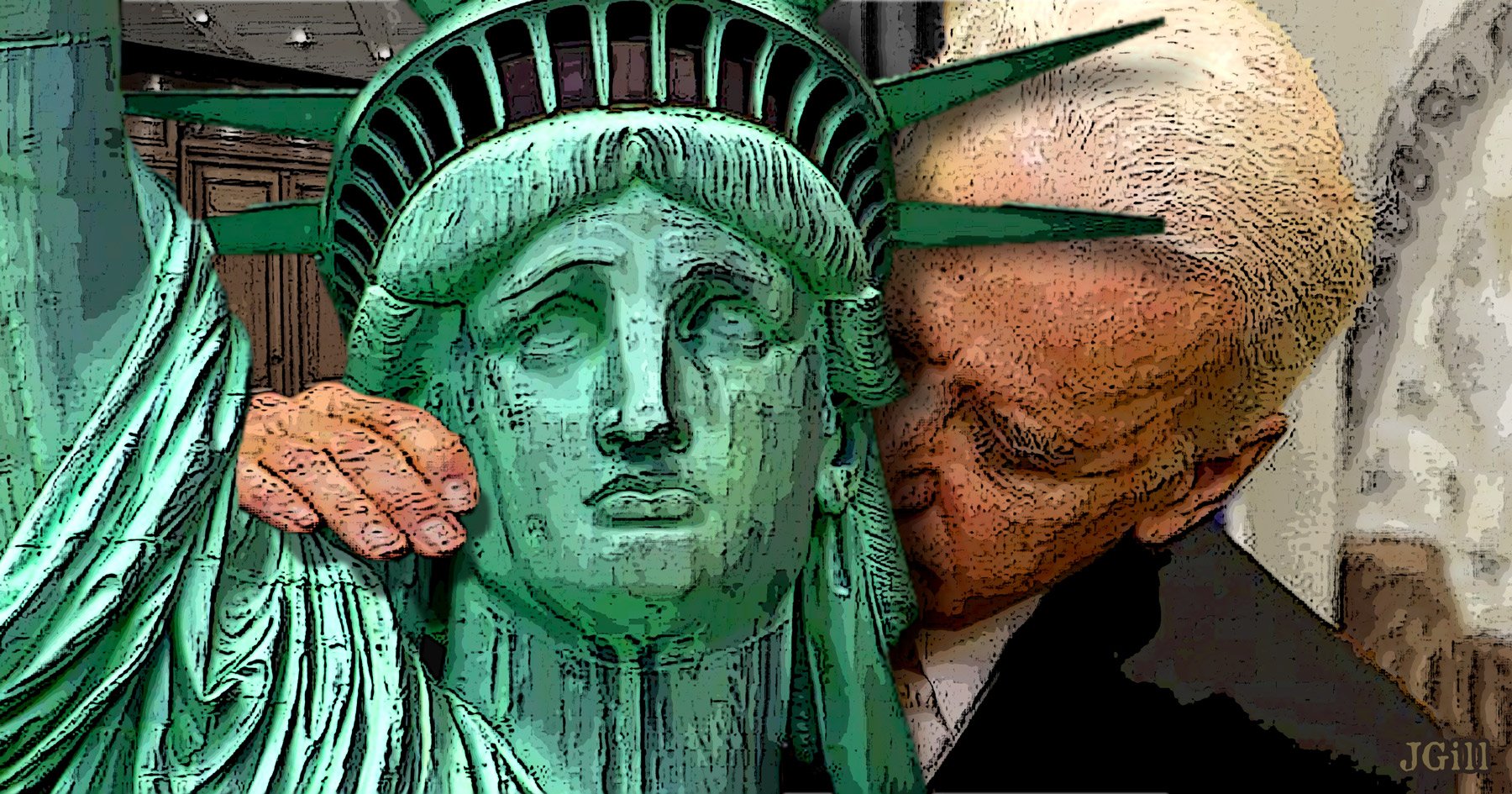
Of course, if the warrant authorizing the FBI to ignore Fourth Amendment protections against unreasonable searches and seizures had been honestly solicited, that still would not have transmuted unconstitutional actions into constitutional ones.

“The court does not deny that the government had an improper motive when it applied for its warrant,” observes Rob Johnson, an attorney with the Institute for Justice, which is representing the boxholders.

“But it says that fact is irrelevant unless the improper investigatory motive was the only reason that the Government opened the safety deposit boxes. . . . If today’s shocking decision stands, it will set a dangerous precedent that will allow the FBI and other law enforcement agencies to bypass the Fourth Amendment.”

Thankfully, the Institute for Justice doesn’t regard the case as closed. It will appeal.

This is Common Sense. I’m Paul Jacob.


PDF for printing

Illustration created with DALL-E

See all recent commentary
(simplified and organized)
See recent popular posts
Categories
Thought

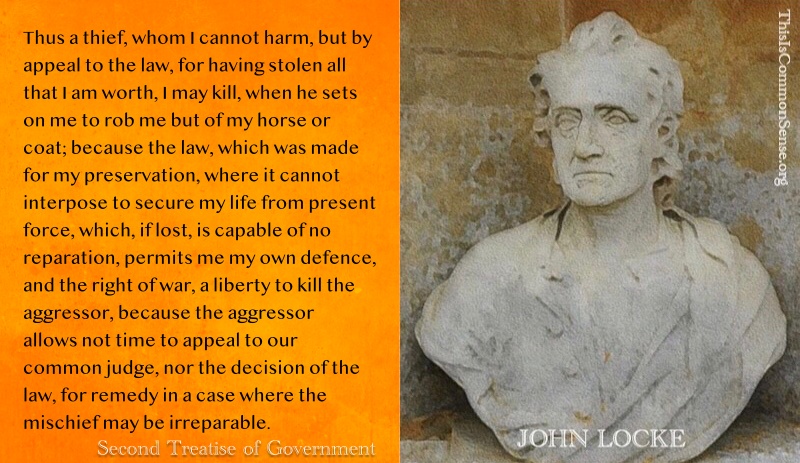
John Locke

Men living together according to reason, without a common superior on earth, with authority to judge between them, is properly the state of nature. But force, or a declared design of force, upon the person of another, where there is no common superior on earth to appeal to for relief, is the state of war: and it is the want of such an appeal gives a man the right of war even against an aggressor, tho’ he be in society and a fellow subject. Thus a thief, whom I cannot harm, but by appeal to the law, for having stolen all that I am worth, I may kill, when he sets on me to rob me but of my horse or coat; because the law, which was made for my preservation, where it cannot interpose to secure my life from present force, which, if lost, is capable of no reparation, permits me my own defence, and the right of war, a liberty to kill the aggressor, because the aggressor allows not time to appeal to our common judge, nor the decision of the law, for remedy in a case where the mischief may be irreparable. Want of a common judge with authority, puts all men in a state of nature: force without right, upon a man’s person, makes a state of war, both where there is, and is not, a common judge.

John Locke, from the Second Treatise on Civil Government (Thomas Hollis Edition. [London: A. Millar et. al.] 1764), Chapter Three: “Of the State of War.”
Categories
Today

SpaceShipOne

On October 4, 2004, SpaceShipOne became the first private craft to fly into space, thereby winning the Ansari X Prize for private spaceflight.

Categories
First Amendment rights national politics & policies

Public-Private Censorship Partnership

When government pays people to help censor critics of its policies and talking points, this makes it even more obvious that it’s acting to repress speech and violate the First Amendment.

Thanks to a recent lawsuit against the Biden administration, we have been seeing emails confirming that government officials routinely ask Big Tech to censor this and that.

Now, Just the News reports that government agencies and liberal groups such as Common Cause and the Democratic National Committee worked with a consortium of private groups — the Election Integrity Partnership — during the 2020 election season to target and censor social media posts.

The EIP “set up a concierge-like service in 2020 that allowed federal agencies like Homeland’s Cybersecurity Infrastructure Security Agency and State’s Global Engagement Center to file ‘tickets’ requesting that online story links and social media posts be censored or flagged by Big Tech.”

About 35 percent of the many posts EIP flagged in 2020 were sanctioned in some way by Big Tech.

Millions of tax dollars have been funneled to consortium members to fund these efforts to censor “misinformation,” i.e., speech that government officials disapprove of.

The EIP remains active in 2022.

Of course, politically controversial speech is just the kind of speech that the Founders were concerned to protect. Madison and Mason didn’t expect that the ability to publicly debate whether Bach is better than Beethoven or the best way to shingle a roof would ever be in great jeopardy.

This is Common Sense. I’m Paul Jacob.


PDF for printing

Illustration created with DALL-E

See all recent commentary
(simplified and organized)
See recent popular posts

Categories
Thought

Denis Diderot

No man has received from nature the right to give orders to others. Freedom is a gift from heaven, and every individual of the same species has the right to enjoy it as soon as he is in enjoyment of his reason.

Denis Diderot, “Political Authority” (as quoted in Selected Writings [1966] edited by Lester G. Crocker), L’Encyclopédie (Volume 1, 1751).
Categories
Today

Buchanan & Vidal

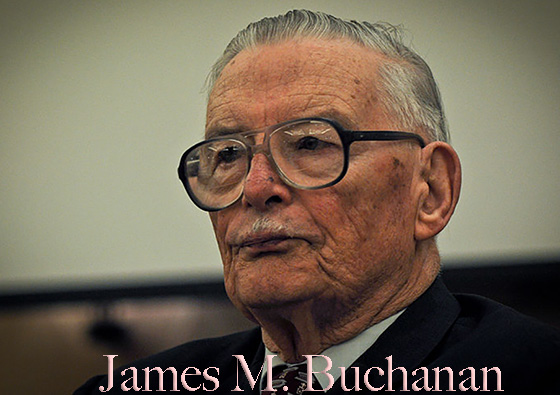
On October 3, 1919, James M. Buchanan was born. Buchanan would develop the theory of “Public Choice,” and receiving the 1986 Nobel Memorial Prize in Economic Sciences for his work. His books include Cost and Choice, The Calculus of Consent (with Gordon Tullock), and The Limits of Liberty: Between Anarchy and Leviathan. Some of his most interesting research was into the realm of constitutional theory and practice.

He died January 9, 2013.


In 1925, on this date, Gore Vidal was born. Vidal would go on to become one of the leading post-WWII liberal essayists as well as a major novelist and screenwriter. His most famous novels include Burr, 1876, and Lincoln, installments in his American history series; his collection of essays, The United States, was one of his many bestsellers. Vidal was an elitist who expressed sympathy for populism and socialism, but also was a radical civil libertarian, and may occupy the extreme of the “liberal” quadrant in American political ideology: great on personal liberties but quite bad on market/property liberties.

He died on July 31, 2012.

Categories
by Paul Jacob video

Watch: The Biden (What IS It? What Are Its Goals?)

Not Joe Biden — he’s obviously off his rocker. And not “the Biden Administration” exactly. The title refers to whoever is running the show.

Categories
Thought

Eric Frank Russell

Appearances aren’t always what they seem.

Eric Frank Russell, “Basic Rights,” Astounding Science Fiction (April 1958).
Categories
Today

Stroke of Luck

On October 2, 1789, George Washington sent the proposed Constitutional amendments (the United States’ Constitution’s Bill of Rights) to the States for ratification.

On the same date in 1919, U.S. President Woodrow Wilson suffered a massive stroke, leaving him partially paralyzed, preventing him from reacting to the economic downturn following the Great War in a Progressive fashion, making his response de facto laissez faire. One insider, and skeptic of Progressive hubris, archly referred to Wilson’s incapacitation as “a stroke of luck.”

His successor in office, President Warren G. Harding, would go on to massively cut spending as well as taxes, and take on regulation as well. He also released Woodrow Wilson’s domestic war prisoners — ranging from journalists, ordinary folk to socialist presidential candidate Eugene V. Debs — who had dissented from Wilson’s involvement in the war.

The Depression of the early 1920s, though as deep as the early 1930s, proved remarkably brief, thanks to Harding . . . and a “stroke of luck.”

Categories
audio podcast

Listen: The Biden

Who really is running the show? Not Biden, surely. But who?