Categories
Today

David Ricardo

April 18 marks the 1772 birthday of David Ricardo, English political economist and one of the most influential thinkers in economic theory. An advocate for free trade and the abolition of slavery, Ricardo’s most famous work is his Principles of Political Economy and Taxation (1817).

Categories
Thought

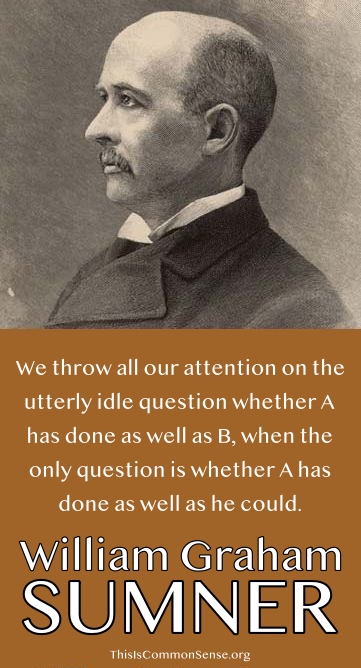
William Graham Sumner

We throw all our attention on the utterly idle question whether A has done as well as B, when the only question is whether A has done as well as he could.

William Graham Sumner, “The New Social Creed,” Earth-Hunger and Other Essays, p. 210 (1913).
Categories
Today

Hamowy

April 17 marks the 1937 birth of Ronald Hamowy, Canadian historian, who first came to international prominence for his writings in the short-lived but influential New Individualist Review. Hamowy died in 2012.


April 17, 1907 — The Ellis Island immigration center processed 11,747 immigrants, more than on any other day.

April 17, 1942 — French prisoner of war General Henri Giraud escaped from his castle prison in Königstein Fortress.

April 17, 1969 – Communist Party of Czechoslovakia chairman Alexander Dubček was deposed.

Categories
crime and punishment free trade & free markets tax policy

What Pfizer Pfolks Got

Yesterday, a whole lot of people paid a whole lot of taxes. It was Tax Day — filing day — for most Americans.

Truth is, American workers pay income tax with every paycheck. And they pay other taxes too.

Somehow, though, Pfizer — one of the world’s most profitable companies — did much better than we did. “Drugmakers make big profits in the U.S.,” explains Sydney Lupkin at NPR. “But many pay taxes far below the 21% corporate tax rate. Pfizer’s effective tax rate is so low it’s getting a big refund despite booking $59 billion in revenue.”

Did you get a big refund on top of a huge wage hike? No?

Well, you should lobby Congress more.

Now, Pfizer’s long had a cushy/pushy relationship with the U.S. Government. The company’s had to pay loads of legal penalties for malfeasance, but it’s also received subsidies, immunities, and government-forced clientele — in the rollout of its most famous product. But through thick and thin it faces our byzantine tax code with ease, for it’s that tax complexity that really gives Big Pharma the advantage, compared to smaller companies.

I have never argued for more taxes. I wonder if corporations should even be taxed based on income, which gets complicated to figure since it’s based on profits and losses and investments etc., thus opening the door to corrupt insider politics. Plus, those taxes simply get passed on to us. 

But if corporations are taxed, how indecent that small companies tend not to get huge refunds on years in which they make stellar returns.

Though I suppose if Congress keeps on awarding more to the bigger, that’s a problem that sort of solves itself. 

With the smaller companies just dying out.

This is Common Sense. I’m Paul Jacob.


PDF for printing

Illustration created with Picfinder and Firefly

See all recent commentary
(simplified and organized)
See recent popular posts

Categories
Thought

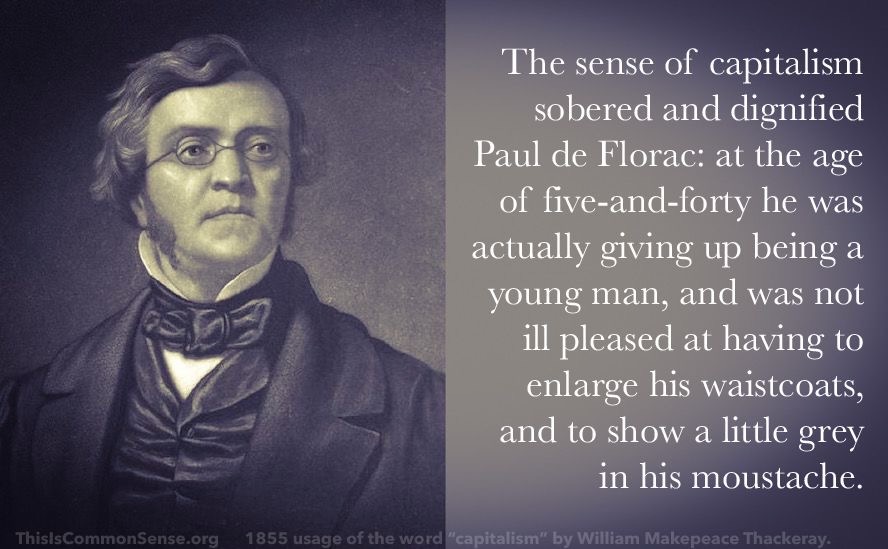
William Makepeace Thackeray

The sense of capitalism sobered and dignified Paul de Florac: at the age of five-and-forty he was actually giving up being a young man, and was not ill pleased at having to enlarge his waistcoats, and to show a little grey in his moustache. His errors were forgotten: he was bien vu by the Government. He might have had the Embassy Extraordinary to Queen Pomaré; but the health of Madame la Princesse was delicate. He paid his wife visits every morning: appeared at her parties and her opera box, and was seen constantly with her in public.

William Makepeace Thackeray, The Newcomes: Memoirs of a Most Respectable Family (1854-1855), Chapter XLVI: “The Hotel de Florac.” Perhaps the very first use of the word “capitalism” in English literature.

Categories
Today

From Birmingham Jail

Dr. Martin Luther King, Jr., penned his Letter from Birmingham Jail while incarcerated in Birmingham, Alabama, for protesting segregation, on April 16, 1963.

Categories
Common Sense national politics & policies regulation subsidy

Electric Class Warfare

Star Trek may have adversely affected American politics. Its techno-communist utopian militarism was one thing, its attitude towards engineering? Perhaps worse.

In how many episodes did Captain Kirk demand that Scotty push the warp drives further, or decrease the time required for a task — arbitrarily according to his need, not actual possibility?

And, because television: presto, it was done; just in time for the finale!

We see that in the push for electric vehicles (EVs). 

The EV mandates, explains The Epoch Times, “will likely cause a sizable wealth transfer from rural red regions of the United States to urban blue sections, and to wealthy Democrats who reside in them. . . .”

For while Democrats say they’re trying to “save the planet” from an increase in atmospheric carbon, really, analyst Robert Bryce counters, “it’s a type of class warfare that will prevent low- and middle-income consumers from being able to afford new cars.”

How? The EPA’s new “rules are the strictest in history and will effectively force carmakers to have one-third of new car sales be plug-in EVs by 2027 and more than two-thirds by 2032.” But according to the Texas Public Policy Foundation, “as much as $48,000 of the cost of the average EV sold in the United States is paid not by the owner but in the form of ‘socialized costs’ that are spread out among taxpayers and electricity consumers over a 10-year period.”

So the new rules will reduce the supply of gas-powered vehicles, driving up costs. And the increased number of already-subsidized vehicles will also be paid by taxpayers at large, while the benefits go to . . . mostly Democrats in the bluest counties of the bluest states, as statistics show.

In recent years, Democrats have prided themselves that their “blue states” subsidize “red states,” mocking the “rugged individualist” pretensions of the hapless bubbas in flyover country. But now such boasts ring hollow. 

This is the far-flung future? 

Subsidy and regulation spoil the Star Trek promise.

This is Common Sense. I’m Paul Jacob.


PDF for printing

Illustration created with PicFinder and Firefly

See all recent commentary
(simplified and organized)
See recent popular posts
Categories
Thought

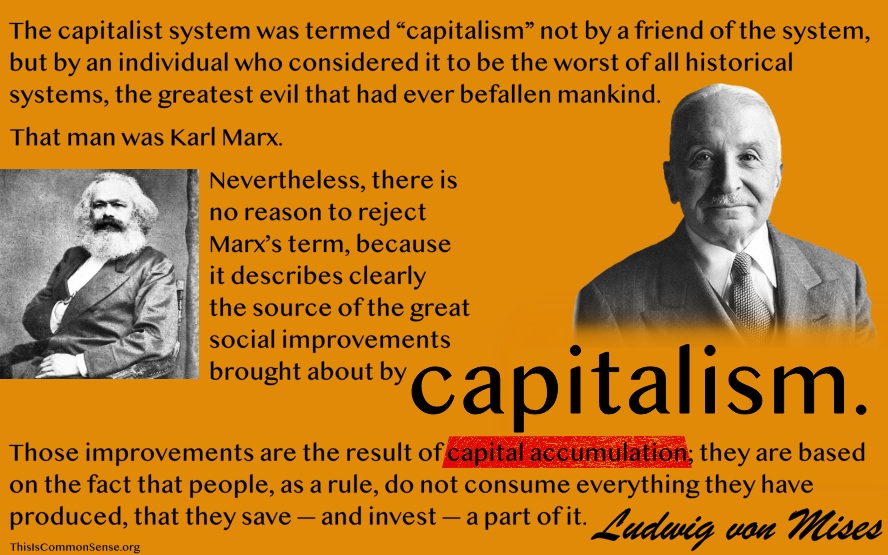
Ludwig von Mises

The capitalist system was termed “capitalism” not by a friend of the system, but by an individual who considered it to be the worst of all historical systems, the greatest evil that had ever befallen mankind. That man was Karl Marx. Nevertheless, there is no reason to reject Marx’s term, because it describes clearly the source of the great social improvements brought about by capitalism. Those improvements are the result of capital accumulation; they are based on the fact that people, as a rule, do not consume everything they have produced, that they save — and invest — a part of it.

Ludwig von Mises, Economic Policy: Thoughts for Today and Tomorrow (1979; Third Edition: 2006),
Categories
Today

Bergen-Belsen Liberated

On April 15, 1945, the Bergen-Belsen concentration camp was liberated.

Categories
FYI

Read Ludwig von Mises, Says Fighter, with Fury and Expletives

“I love America. I love the Constitution. I love the First Amendment. I want to carry . . . fucking guns. I love private property. And let me tell something: if you care about your fucking country, read Ludwig von Mises and the Six Lessons of the Austrian Economic School, motherfuckers.”

This rant by Brazilian fighter Renato Moicano, after a UFC victory, Joe Rogan in the ring officiating, went viral this weekend. But what does the fighter mean? What are the “six lessons” that Mises listed? Mises wrote a lot, after all.

A lot more than six lessons!

Turns out, “Money Moicano” is referring to the short book Ludwig von Mises wrote that is entitled, in America, Economic Policy. The book consists of six lectures, which is why, in Brazil, the book is called Six Lessons:

  1. Capitalism
  2. Socialism
  3. Interventionism
  4. Inflation
  5. Foreign Investment
  6. Politics and Ideas

The lessons of each section could be listed like this:

  1. A country becomes more prosperous in proportion to the rise in the invested capital per unit of its population.
  2. Economic calculation, and therefore all technological planning, is possible only if there are money prices, not only for consumer goods but also for the factors of production.
  3. The idea of government interference as a “solution” to economic problems leads, in every country, to conditions which, at the least, are very unsatisfactory and often quite chaotic.
  4. Inflation is a policy. And a policy can be changed.
  5. What is lacking in order to make the developing countries as prosperous as the United States is only one thing: capital — and, of course, the freedom to employ it under the discipline of the market and not the discipline of the government. 
  6. Ideas and only ideas can light the darkness. These ideas must be brought to the public in such a way that they persuade people. We must convince them that these ideas are the right ideas and not the wrong ones.

Moicano’s rant has conjured up quite a bit of interest and appreciation: