Categories
media and media people partisanship Voting

Spilt Ink

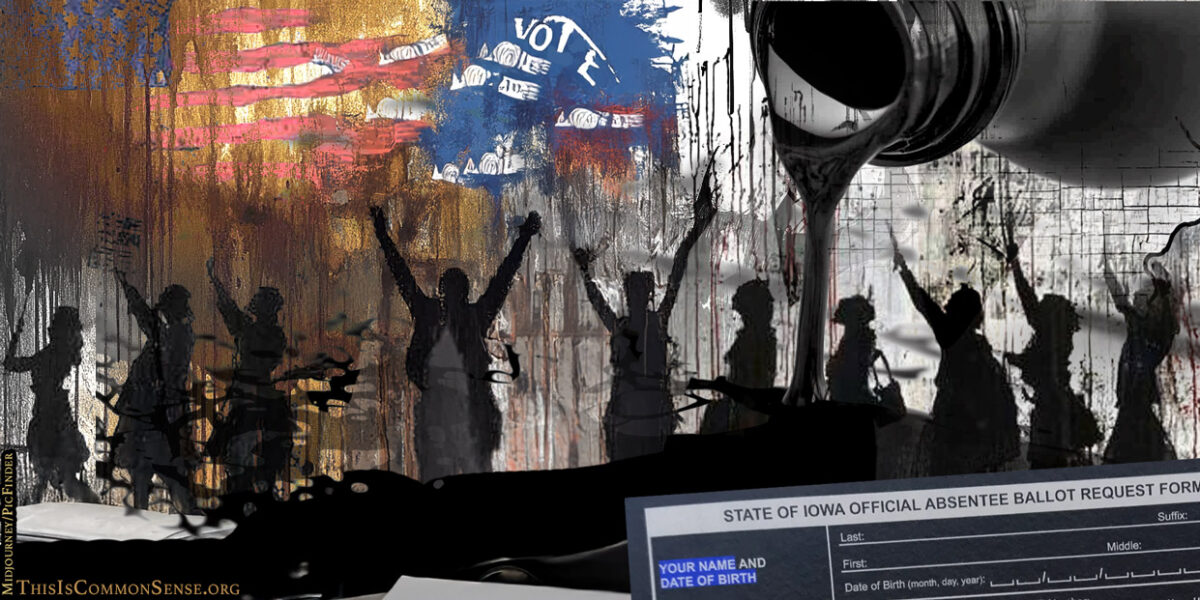
“Iowans should vote no,” argues a Des Moines Register editorial, because defeating the Citizen Only Voting Amendment on the statewide ballot would “send a message — to legislators, to our neighbors at home and to the rest of the nation and world — that Iowans reject exclusion and suspicion and instead put a premium on inclusion and trust.”

Let’s unpack.

Ballotpedia summarizes Amendment 1 as prohibiting “state and local governments from allowing noncitizens to vote and allow 17-year-olds who will be 18 by the general election to vote in primary elections.”

Nothing suspicious there. But there is an exclusion, of course. The measure would exclude noncitizens from voting in state and local elections.

“The context,” or what the TDS-afflicted newspaper has apoplectically convinced themselves is the context, “is repeated assertions by President Donald Trump” and other Republicans “that immigrants without citizenship frequently register to vote and vote (more often for Democrats).”

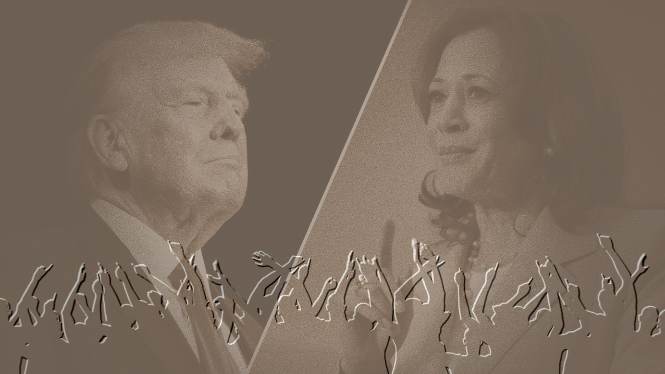
The actual context is simply whether the state constitution should proclaim that only U.S. citizens are eligible to vote. A policy that Donald Trump and Kamala Harris are unsuspiciously excluded from voting on, but which would have prevented the 19 U.S. cities now allowing noncitizens to vote, including in most cases those here illegally, from doing so.

The Register nonetheless declares that “a higher standard is called for when the enduring language of the state Constitution is involved. That document should emphasize what unites Iowans.”

Yet nothing has united legislators more than this Citizen Only Voting Amendment, which passed each chamber of the Legislature twice without a single dissenting vote. 

Bemoaning that “seven states have already, in the past six years, made identical or similar changes in their state constitutions,” The Register further complains that “this fall, Idaho, Kentucky, Missouri, North Carolina, Oklahoma, South Carolina and Wisconsin join Iowa in voting on similar amendments.” 

The objection? “That’s a lot of ink spilt to enshrine imaginary protections against imaginary problems.”

These imaginative editors acknowledged, in the same piece, that “[e]xperts say it ties lawmakers’ hands from ever passing laws to permit residents without citizenship to vote in certain local or state elections, such as for school boards.”

Passing Amendment 1 means politicians at the capitol in Des Moines will have to go back to Iowa voters if they want to allow noncitizen voting.

No crying here over spilt ink.

This is Common Sense. I’m Paul Jacob.


PDF for printing

Illustration created with Midjourney and Firefly

See all recent commentary
(simplified and organized)
See recent popular posts
Categories
Thought

Ludwig von Mises

Ownership means full control of the services that can be derived from a good. This catallactic notion of ownership and property rights is not to be confused with the legal definition of ownership and property rights as stated in the laws of various countries. It was the idea of legislators and courts to define the legal concept of property in such a way as to give to the proprietor full protection by the governmental apparatus of coercion and compulsion, and to prevent anybody from encroaching upon his rights. As far as this purpose was adequately realized, the legal concept of property rights corresponded to the catallactic concept.

Ludwig von Mises (1881–1973), Human Action: A Treatise on Economics, Scholar’s Edition (1998), first edition published in 1949. “Catallactic” derives from “Catallactics,” a term invented by Richard Whately (1787–1863) as an improvement on “Political Economy”; “catallactic” means “pertaining to exchanges” (trade).
Categories
Today

Harding Spoke Out

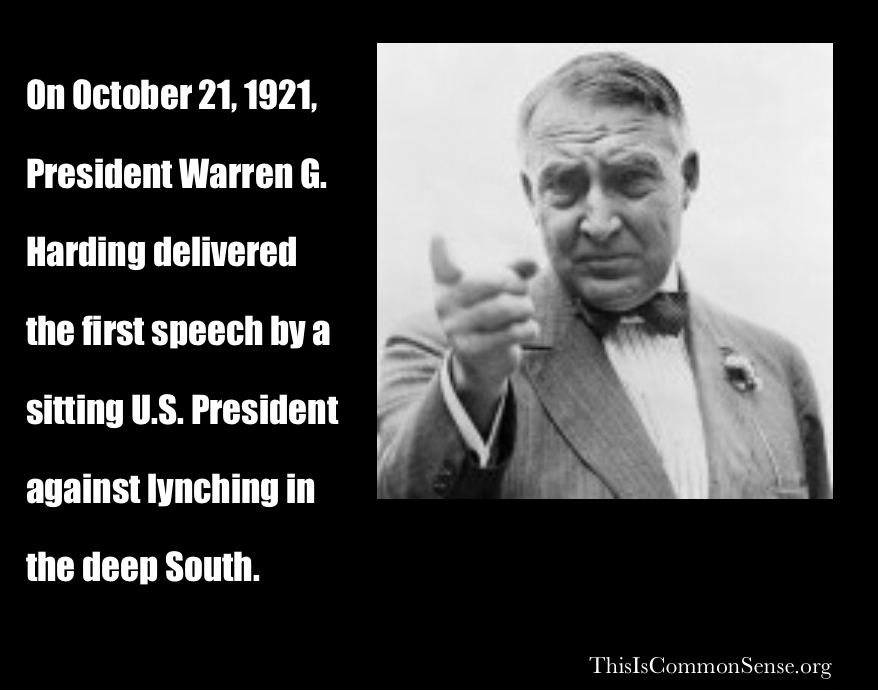
On October 21, 1921, President Warren G. Harding delivered the first speech by a sitting U.S. President against lynching in the deep South.

Categories
Update

Fearing an Excuse?

“David Becker, who funneled millions of ‘Zuckbucks’ into the 2020 election, is super certain that former President Donald Trump will raise concerns about noncitizens voting in the 2024 election,” writes Logan Washburn at The Federalist. “And he’s even more certain he doesn’t want you paying attention when it happens.”

Washburn argues this is a strategy. “Becker claimed those with election integrity concerns about noncitizen voting — potentially a widespread issue entering November — are simply setting the stage for Trump to blame an election loss on noncitizens voting for Kamala Harris.”

But is it “simply”? Is the concern with non-citizens voting only an excuse for a Trump loss?

Readers of Common Sense with Paul Jacob are more than familiar with the reality of Democrat politicians and activists pushing for (and allowing) non-citizens to vote, and know the arguments against such a practice.

Could hyper-partisans like Becker have more on their minds?

You have to admit, though, that merely asking the question makes people’s heads hurt. Getting noncitizens in America to vote is bad itself, but accusing those interested in it only as preparing an excuse could itself be a cover-up-in advance for . . . an illegal election strategy? Or a way to focus on last time’s election rigging and gaming, but not this time? (Meaning, of course, not “a steal,” exactly, more like “underhandedly tilting.”)

Democrats’ fear of excuse making last month, when the article in The Federalist ran, and this month, when Donald Trump has leaped ahead in the polls, casts very different light on all such talk.

Categories
Thought

George Santayana

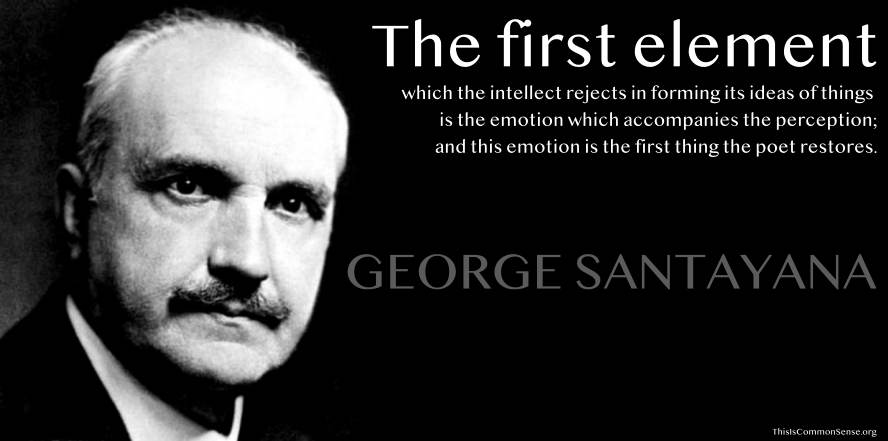
Out of the neglected riches of this dream the poet fetches his wares. He dips into the chaos that underlies the rational shell of the world and brings up some superfluous image, some emotion dropped by the way, and reattaches it to the present object; he reinstates things unnecessary, he emphasizes things ignored, he paints in again into the landscape the tints which the intellect has allowed to fade from it. If he seems sometimes to obscure a fact, it is only because he is restoring an experience. The first element which the intellect rejects in forming its ideas of things is the emotion which accompanies the perception; and this emotion is the first thing the poet restores.

George Santayana, “The Elements of Poetry,” in L. Pearsall Smith, editor, Little Essays Drawn from the Writings of George Santayana, as reprinted in Modern Essays (1921), Christopher Morley, editor.
Categories
Today

Boundaries

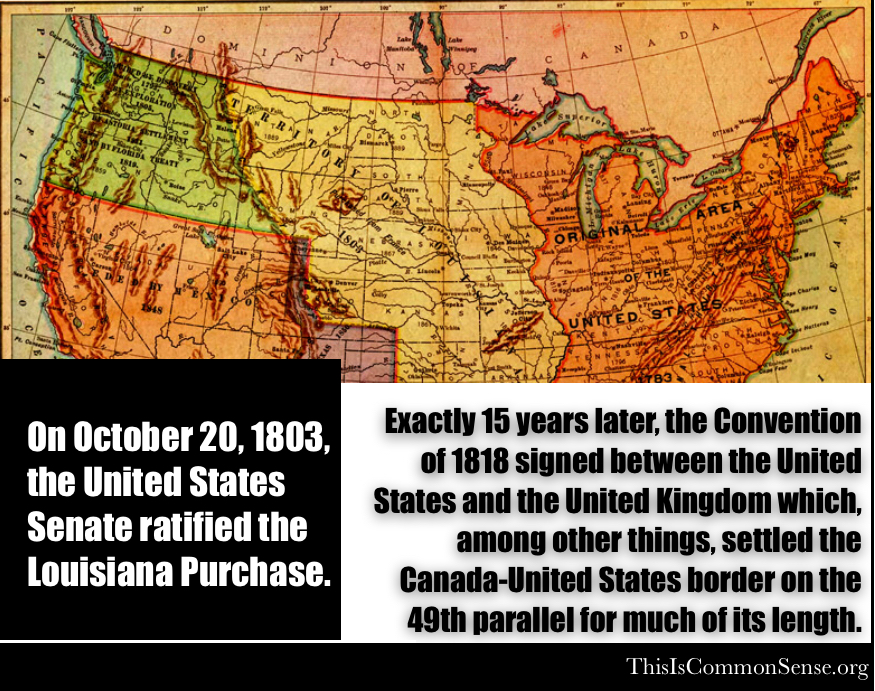
On October 20, 1803, the United States Senate ratified the Louisiana Purchase.

Exactly 15 years later, the Convention of 1818 signed between the United States and the United Kingdom which, among other things, settled the Canada-United States border on the 49th parallel for much of its length.

Categories
Update

Factmanship

We might call the game “smug-upmanship,” where participants in a debate “fact-check” their opponents in the most smug way, pretending they have “the facts” on their side when, in reality, the facts are uncertain, filled with errors, or merely lies. In cases where the facts are dubious at best, the element of smugness helps. It’s a form of self-consciousness and -confidence. And when someone, in debate, exudes so much confidence in a fact or argument, and — during the course of the debate — you cannot readily demonstrate the opposite as true, it’s easy to be bowled over.

On July 30, in “Crime’s Ups and Downs,” Paul Jacob considered what became the Democrats’ smuggest fact-check of the year, the “fact” that the violent crime rate has gone down, not up. Trump said it was up. The FBI said it was down. End of debate?

Jacob Sullum at Reason repeated the Democrats’ take on “the facts,” blaming Trump for crime rising, briefly, on his watch. But Paul Jacob saw a few problems:

Crime spiked in the “Summer of Love” as a result of the mass protests against George Floyd’s death, the left’s demands to “defund the police,” and the climate of approved (“mostly peaceful”) violent riot. Trump’s enemies caused all this. Much of it may have been fueled by pandemic anxieties, but there was another factor: the Democrats’ anarcho-tyranny push to pry Trump out of office in annus horribilis 2020.

Since then crime, which is usually under-reported, now appears to be increasingly under-reported for systemic reasons. Some crimes, such as theft, have been demoted in the law books, allowing theft to run rampant in several major American cities — not just San Francisco — thereby disallowing the uptick in crime to even hit the stats.

What if bad data is the consequence of such policy? 

Meaning the perception of an increase in crime is true … at least in some places.

Paul Jacob, “Crime’s Ups and Downs,” July 30, 2024.

Well, now the stats have been revised. 

John R. Lott, Jr., argues in his Real Clear Investigations exposé “Stealth Edit: FBI Quietly Revises Violent Crime Stats,” that the initial report of 2.1 percent drop in crime in 2022 depended entirely on under-reporting by cities of actual crimes — and the FBI not adequately figuring for the lack of data. And then not telling us even as it has later accounted for the actual data:

[T]he FBI has quietly revised those numbers, releasing new data that shows violent crime increased in 2022 by 4.5%. The new data includes thousands more murders, rapes, robberies, and aggravated assaults.

The Bureau — which has been at the center of partisan storms — made no mention of these revisions in its September 2024 press release

RCI discovered the change through a cryptic reference on the FBI website that states: “The 2022 violent crime rate has been updated for inclusion in CIUS, 2023.” But there is no mention that the numbers increased. One only sees the change by downloading the FBI’s new crime data and comparing it to the file released last year.

John R. Lott, Jr., “Stealth Edit: FBI Quietly Revises Violent Crime Stats,” Real Clear Investigations, October 16, 2024.

The FBI may have merely erred in its initial report — though that’s unlikely — but it lied in the correction, failing to disclose the magnitude of the original error. The correction was a cover-up.

The Democrats, for their part, engaged in typical smug rhetoric.

And Reason got the chance to stick it, once again, to Donald Trump. 

But this seems clear: anyone with a nose for how governments lie, routinely and in partisan fashion, should have caught at least a whiff of this.

Categories
Thought

Hillary Clinton

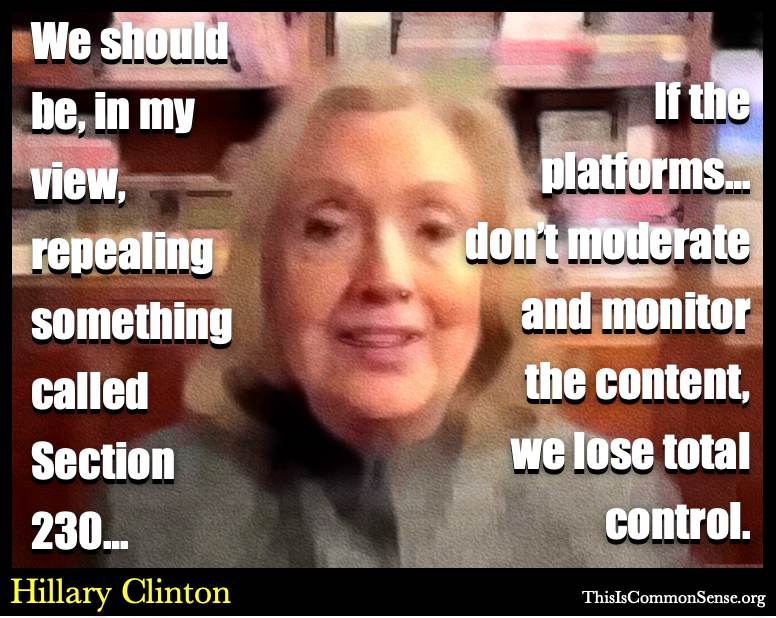
We should be, in my view, repealing something called Section 230, which gave, you know, platforms on the internet immunity because they were thought to be just pass-throughs, that they shouldn’t be judged for the content that is posted.

But we now know that that was an overly simple view, that if the platforms, whether it’s Facebook or Twitter/X or Instagram or TikTok, whatever they are, if they don’t moderate and monitor the content, we lose total control.

Hillary Clinton, talking to Smerconish on CNN about the need for online censorship,
Categories
Today

The Surrender of Cornwallis

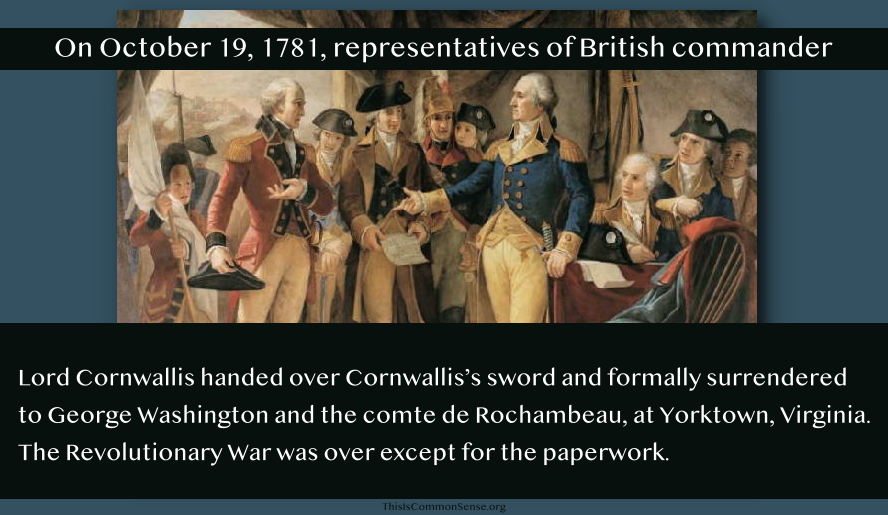
On October 19, 1781, representatives of British commander Lord Cornwallis handed over Cornwallis’s sword and formally surrendered to George Washington and the comte de Rochambeau, at Yorktown, Virginia. The Revolutionary War (or War for Independence, or Colonial Rebellion, or whatever you wish to call it) was over except for the paperwork.

Categories
media and media people national politics & policies partisanship

Something Pathological

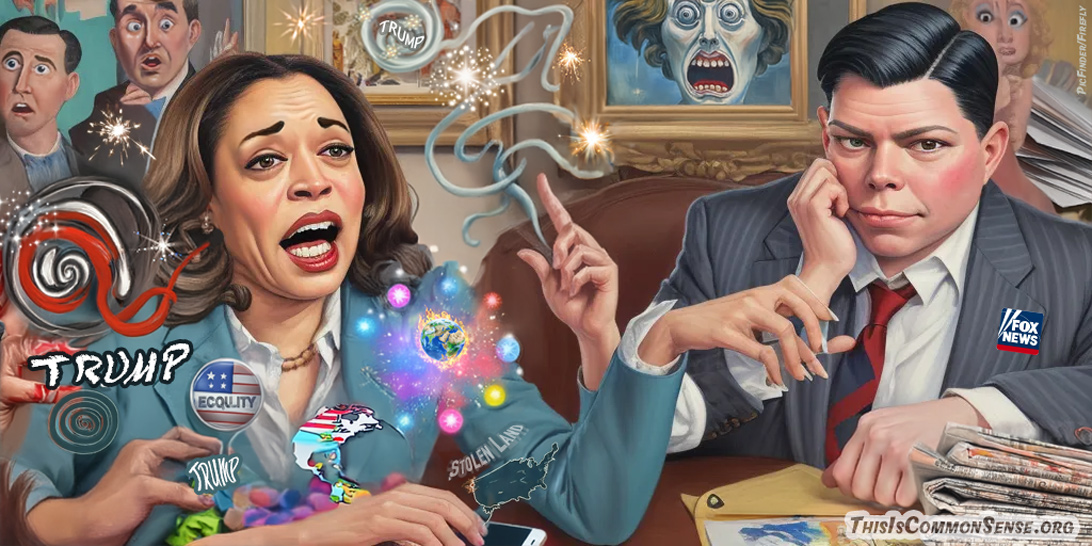
Fox News’s interview with Kamala Harris itself made news. The betting markets had Ms. Harris tanking; we await post-interview polls. Bret Baier did more than a competent job, pressing the Democratic candidate like Sam Donaldson used to press President Ronald Reagan. 

Harris came to the interview “fashionably” (strategically?) late, which added some frisson to the affair. But what stuck out to me was a repeated evasion, which to Kamala no doubt felt natural, but to this onlooker, anyway, seemed bizarre.

Trump.

When challenged about Biden Administration failures of policy, leadership, or efficacy, candidate Harris — in addition to insisting that she will lead in a totally new direction, mostly unspecified — kept on blaming, somehow, Donald Trump.

Republican Vice Presidential candidate J. D. Vance noted this, saying “something pathological is going on.”

That pathology is TDS: Trump Derangement Syndrome.

“You’ve been in office for three-and-a-half years,” Baier challenged in the interview’s most memorable exchange, eliciting from the Democrat an immediate response: “And Donald Trump has been running for office since . . .” A stunned, incredulous Baier watched Harris rant on against Trump, declaring that “he is unfit to serve, that he is unstable, that he is dangerous, and that people are exhausted with someone who professes to be a leader who spends full time demeaning and engaging in personal grievances, and it being about him instead of the American people.”

This is her appeal to the middle, to non-partisan voters: not for her or her policies, but against Trump.

Democrats need their devil. Without him could they win a national election?

And we should inquire whether the reverse is also true.

This is Common Sense. I’m Paul Jacob.


PDF for printing

Watch the entire interview is here.

Illustration created with PicFinder and Firefly

See all recent commentary
(simplified and organized)
See recent popular posts