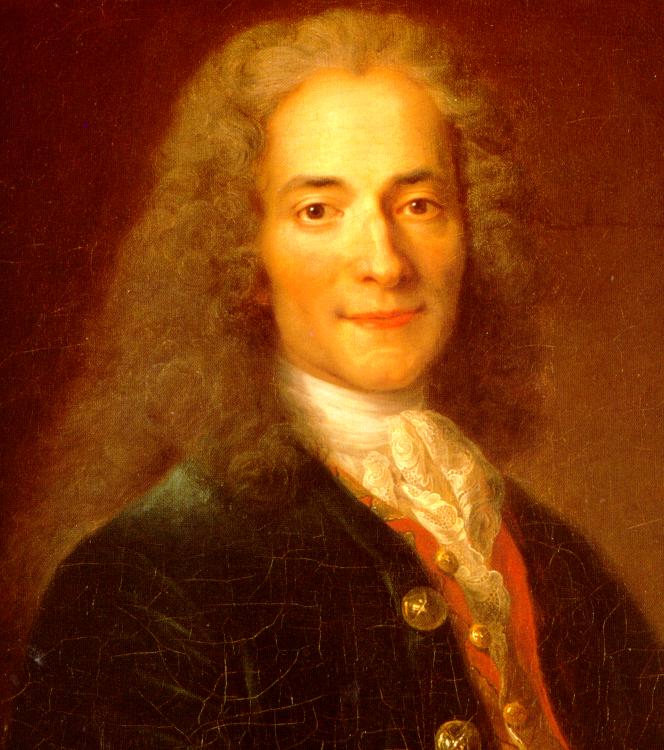
 It is forbidden to kill; therefore all murderers are punished unless they kill in large numbers and to the sound of trumpets.
Author: Redactor
Almost everything is imitation. The idea of The Persian Letters was taken from The Turkish Spy. Boiardo imitated Pulci, Ariosto imitated Boiardo. The most original minds borrowed from one another. Michel Cervantes makes his Don Quixote a fool; but pray is Orlando any other? It would puzzle one to decide whether knight errantry has been made more ridiculous by the grotesque painting of Cervantes, than by the luxuriant imagination of Ariosto. Metastasio has taken the greatest part of his operas from our French tragedies. Several English writers have copied us without saying one word of the matter. It is with books as with the fire in our hearths; we go to a neighbor to get the embers and light it when we return home, pass it on to others, and it belongs to everyone.
There’s apparently more than one way to mess up money.
Canada’s new plastic banknotes don’t work in all vending machines, I hear . . . and there’s a less practical problem with the new C$20 note: It has the “wrong” maple leaf on it.
Some botanists are complaining that the stylized leaf logo is not Canada’s native species, but one hailing from Norway.
 I’ve not seen one of these bills up close (donations would be appreciated, though), but from the photo, the thing I’d be worrying about is that the Queen, on the basis of her appearances on bank notes, looks more like Dwight D. Eisenhower every year.
Here in America, our Washington insiders mess up money both symbolically and substantively.
In the old days, before president-worship had become something of the country’s official religion, Liberty was represented by female representatives or Indians. (The fact that the U.S. government killed off and hounded remaining populations of native Americans in that time put the latter practice into some cognitive dissonance.) Now, both coins and notes feature dead presidents. Frankly, I think we should junk the presidents and go back to stylized, classical representations of Liberty.
The biggest symbolic problem is having Andrew Jackson, America’s most successful and vehement anti-central banking president, placed on our central bank’s $20 note.
That’s an insult, not an honor.
Another way to mess up money is to devaluate it by over-printing.
Or creating too much credit. Or good old-fashioned seignorage. With the Quantitative Easing and “trillion dollar coin,” we’ve got these last two covered. Alas.
This is Common Sense. I’m Paul Jacob.
Categories
C.F. Volney
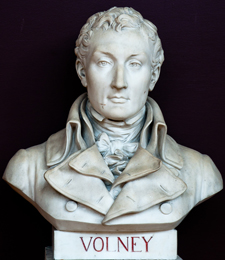 All the social virtues are only the habitude of actions useful to society and to the individual who practices them; That they refer to the physical object of man’s preservation; That nature having implanted in us the want of that preservation, has made a law to us of all its consequences, and a crime of everything that deviates from it; That we carry in us the seed of every virtue, and of every perfection; That it only requires to be developed; That we are only happy inasmuch as we observe the rules established by nature for the end of our preservation; And that all wisdom, all perfection, all law, all virtue, all philosophy, consist in the practice of these axioms founded on our own organization:
Preserve thyself; Instruct thyself; Moderate thyself; Live for thy fellow citizens, that they may live for thee.
The looming debt load will some day come a-crashing. But politicians are doing nothing — or nest to nothing — to stop the growth of the debt, and thus keep on piling on the extent and severity of debt.
So click on over to Townhall.com, to read this weekend’s column by Yours Truly, the purveyor of Common Sense, and then come back here for further reading.
Categories
Video: Shame on Them
Gathering children to his “against guns” cause, the president continues to kill children — including American children — with his drone program. And his supporters continue to support their man and his murderous and self-contradictory stance:
Categories
Lysander Spooner
 Vices are those acts by which a man harms himself or his property. Crimes are those acts by which one man harms the person or property of another. Vices are simply the errors which a man makes in his search after his own happiness. Unlike crimes, they imply no malice toward others, and no interference with their persons or property. In vices, the very essence of crime—that is, the design to injure the person or property of another—is wanting. It is a maxim of the law that there can be no crime without criminal intent; that is, without the intent to invade the person or property of another. But no one ever practices a vice with any such criminal intent. He practices his vice for his own happiness solely, and not from any malice toward others. Unless this clear distinction between vices and crimes be made and recognized by the laws, there can be on earth no such thing as individual right, liberty, or property, and the corresponding coequal rights of another man to the control of his own person and property.
Categories
George J. Stigler
 A famous theorem in economics states that a competitive enterprise economy will produce the largest possible income from a given stock of resources. No real economy meets the exact conditions of the theorem, and all real economies will fall short of the ideal economy—a difference called “market failure.” In my view, however, the degree of “market failure” for the American economy is much smaller than the “political failure” arising from the imperfections of economic policies found in real political systems. The merits of laissez-faire rest less on its famous theoretical foundations than on its advantages over the actual performance of rival forms of economic organization.
Categories
Making the Rounds
The “trillion-dollar” coin proposal hit big in the last few months, even garnering a smile, a wink, and a nod from Paul Krugman. The idea was for the government to mint a high face-value platinum hunk of token money and sell it to the Federal Reserve — to weasel around congressional approval for raising the debt limit.
Something very much like it was floated by Populist and inflationist Bo Gritz back in the early ’90s, when he was running for the presidency.
Though the current president has dismissed the notion, people like it so much — perhaps because of its “just so goofy it might work” aspect — that the whole meme is still making the rounds.
As a technical matter, a one trillion dollar coin would probably be too unwieldy. If actually given the go-ahead, the Treasury and the U.S. Mint would likely opt for smaller amounts, cranking out a batch of them — a big batch, to cover the federal government’s rising debt.
My modest proposal? Mint coins at the legal tender amount of $666 million each.
The effigy of Liberty could sport a 666 tattoo on her forehead, and a neat UPC symbol on her wrist, which she could hold up instead of a torch.
That would indicate, by commonly understood symbology, just how dangerous America’s debt really is, and how anti-American the whole idea of the high face-value coinage debt ceiling workaround would be.
Another way to go would be to carve each coin out of coprolite. Another fitting symbol for the last days of our fiat currency.
This is Common Sense. I’m Paul Jacob.
Categories
C.-F. Volney
Q. Are courage and strength of body and mind virtues in the law of nature?
Constantin-François de Chassebœuf (1757–1820), Comte de Volney, The Law of Nature, Chapter VIII.
A. Yes, and most important virtues; for they are the efficacious and indispensable means of attending to our preservation and welfare. The courageous and strong man repulses oppression, defends his life, his liberty, and his property; by his labor he procures himself an abundant subsistence, which he enjoys in tranquillity and peace of mind. If he falls into misfortunes, from which his prudence could not protect him, he supports them with fortitude and resignation; and it is for this reason that the ancient moralists have reckoned strength and courage among the four principal virtues.”