Categories
free trade & free markets national politics & policies regulation

Egg Prices Crisis

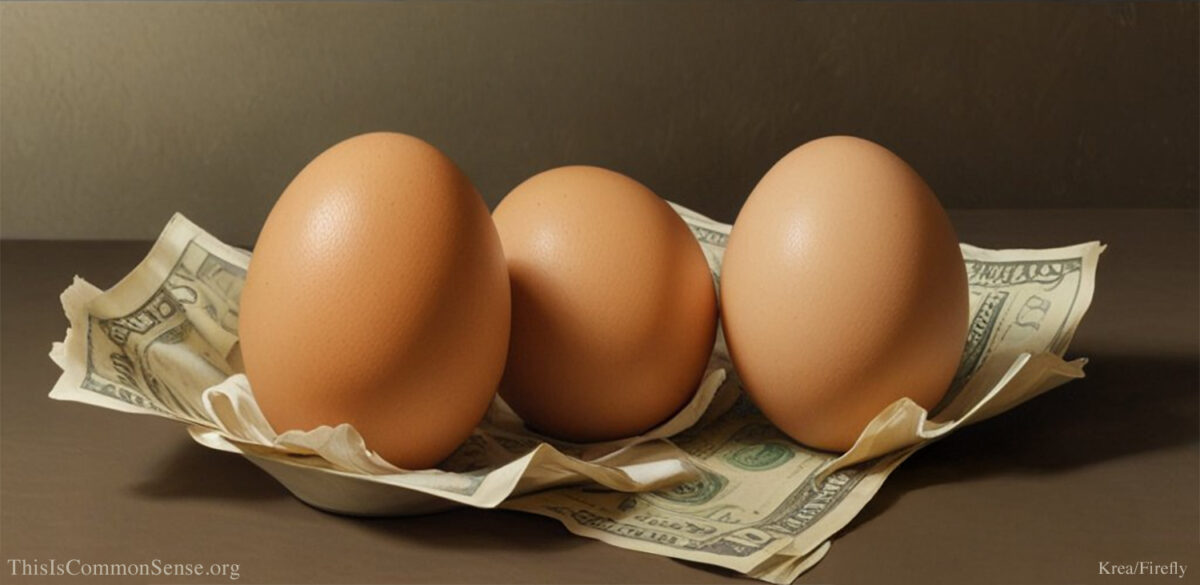
“Get used to high egg prices,” The Atlantic blurbed Annie Lowry’s February 27 article, “it was a miracle they were low in the first place.” 

Titled “It’s Weird That Eggs Were Ever Cheap,” it appears to have an agenda: prepare us for yet higher prices, or worse: no eggs.

“Consumers are furious,” explains Ms. Lowry, emphasizing that eggs are a very, very popular food. “Or at least they were, until a highly pathogenic form of bird flu spread to American flocks in 2022. Today, the Department of Agriculture is tracking 36 separate outbreaks across nine states. The disease has led to the death or culling of 27 million laying hens — nearly 10 percent of the nation’s commercial flock — in the past eight weeks alone.”

The culling of flocks — and which birds are selected — could potentially be the most controversial element of the story. Donald Trump, on the campaign trail last year, complained about the cull orders and promised to bring down egg prices fast. 

But his administration’s new five point plan is no quick fix:

  • subsidize on-farm biosecurity upgrades
  • compensation to farmers forced to cull their flocks
  • investing in bird-flu vaccines and therapeutics
  • nixing some regulations
  • increasing foreign imports. 

That comes to $1.5 billion spending increases to lower egg prices!

But it was a jokey comment by USDA Secretary Brooke Rollins that sent Trump critics into paroxysms. “I think the silver lining in all of this is, how do we solve for something like this?” said the Department of Agriculture head. “And people are sort of looking around, thinking, ‘Maybe I could get a chicken in my backyard,’ and it’s awesome.”

Ha ha. 

But taking the joke as a serious proposal? The yolk’s on them.  

This is Common Sense. I’m Paul Jacob.


PDF for printing

Illustration created with Krea and Firefly

See all recent commentary
(simplified and organized)
See recent popular posts
Categories
Thought

Thomas Jefferson

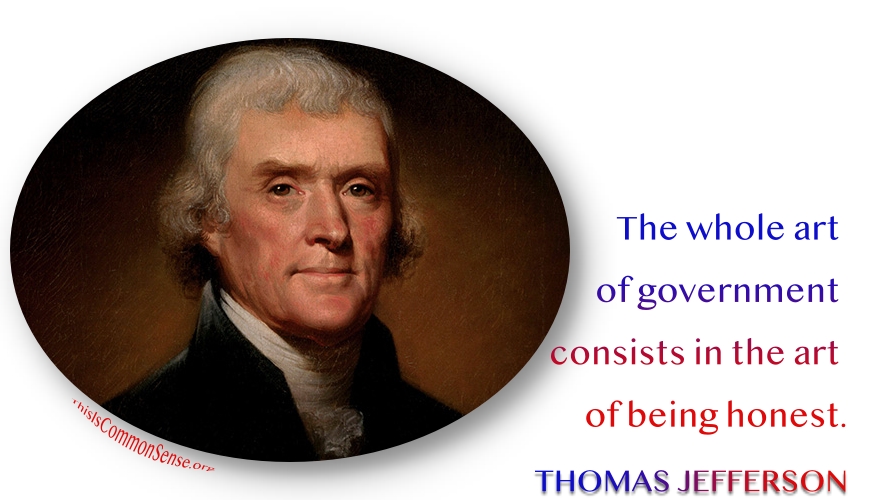
The whole art of government consists in the art of being honest.

Thomas Jefferson, A Summary View of the Rights of British America (1774).
Categories
Today

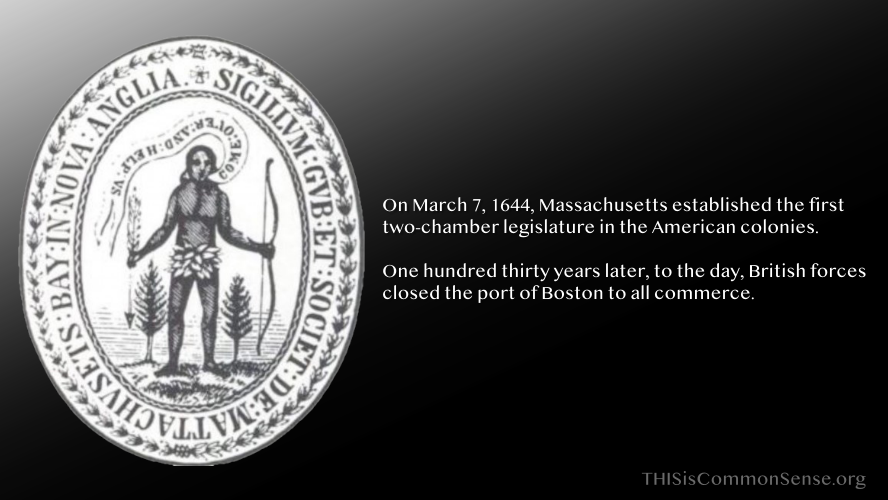
The First American Bicameral

On March 7, 1644, Massachusetts established the first two-chamber legislature in the American colonies.

One hundred thirty years later, to the day, British forces closed the port of Boston to all commerce.

Categories
free trade & free markets international affairs tax policy U.S. Constitution

Legal Trade War

Donald Trump’s imposition and changing of tariffs, all by his lonesome — without Congress — vexes more than a few critics.

His authority to do this, however, derives directly from laws passed by Congress.

The U.S. Constitution gives Congress the power to “lay and collect Taxes, Duties, Imposts and Excises” under Article I, Section 8, which includes tariffs, since they are taxes on imported goods. But Congress has legislated hand-offs to presidents, allowing significant flexibility on tariffs.

The idea seems to be that, as Commander-in-Chief, the president should handle trade because . . . like war, it has to do with foreign countries.

Laws allowing presidential discretion include Section 232 of the Trade Expansion Act, Section 301 of the Trade Act of 1974, and the International Emergency Economic Powers Act of 1977. 

The first says that the president has broad discretion to define as threats to national security all sorts of things and then impose tariffs and other trade restrictions in response.

The 1974 legislation authorizes further along Trump’s favored line, the power to retaliate against “unfair” foreign trade practices.

The IEEPA grants sweeping powers in a declared national emergency.

So if free traders and others are alarmed at Trump’s seemingly dictatorial powers regarding tariffs, it isn’t new. It has been built into the Imperial Presidency. While Congress could take its constitutional authority back, there is certainly no groundswell to do so.

Also not new?

What setting up high tariffs have historically done: elicit similar tariffs in retaliation. 

Yikes: the kind of trade war that made the Great Depression “great.”

This is Common Sense. I’m Paul Jacob.


PDF for printing

Illustration created with Krea and Firefly

See all recent commentary
(simplified and organized)
See recent popular posts
Categories
Thought

Bill Murray

When I read Wired, the book written by (what’s his name?) Woodward, about Belushi — I read like five pages of Wired — and I went, “Oh, my God: they framed Nixon.” . . . If this is what he writes about my friend that I’ve known for half of my adult life, which is completely inaccurate — talking to people of the outer, outer circle, getting the story — what the hell could they have done to Nixon?

Bill Murray in conversation with Joe Rogan on the Joe Rogan Experience (March 1, 2025), #2282.
Categories
Today

Stalin’s Daughter Defected

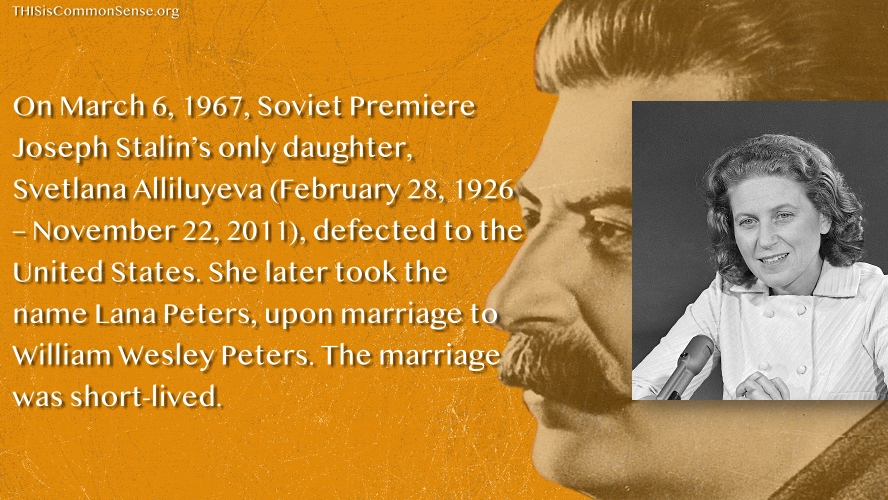
On March 6, 1967, Soviet Premiere Joseph Stalin’s only daughter, Svetlana Alliluyeva (February 28, 1926 – November 22, 2011), defected to the United States. She later took the name Lana Peters, upon marriage to William Wesley Peters. The marriage was short-lived.

The March 6 date also marks term limits advocate and initiative organizer Paul Jacob’s birthday. He was born on the anniversary of the births of Michaelangelo, Cryano de Bergerac, and Alan Greenspan. He is also, obviously, the main reason that this site, ThisIsCommonSense.org, exists.

Categories
Internet controversy regulation

Back Door Demand

As expected, Apple will withhold its most advanced data protection from customers of the iPhone in the United Kingdom rather than obey a UK order to provide a worldwide back door to such encryption.

This is probably Apple’s least worst choice given the alternatives confronting it. But that means British users of the iPhone won’t have this encryption at all.

Had Apple obeyed, the back door would have been installed on encryption-equipped iPhones worldwide, not just in the iPhones of persons residing in the sceptered isle.

The mandated back door would, of course, have been exploitable by cyberhackers contracted by enemy governments as well as by members of “good” governments claiming really good reasons for needing to rummage through your iPhone at will.

Members of the United Kingdom’s current horrific government are being coy, not even deigning to say whether they have ordered Apple to thus jeopardize Apple customers. 

The order is, after all, supposed to be a secret.

But the Starmer government isn’t denying the order’s existence either. If major media reports were accusing me of issuing such an order, one that I had nothing to do with and regarded as wrong in principle, I would deny the deed hotly. But that’s me.

What should happen now?

Many things. For a starters, an end of the Starmer government. Release of the documentation of its order. Universal repudiation of the kind of reasoning that says the best way to ensure everybody’s security is to make everybody’s security impossible.

This is Common Sense. I’m Paul Jacob.


PDF for printing

Illustration created with Krea and Fireflly

See all recent commentary
(simplified and organized)
See recent popular posts
Categories
Thought

Thomas Jefferson

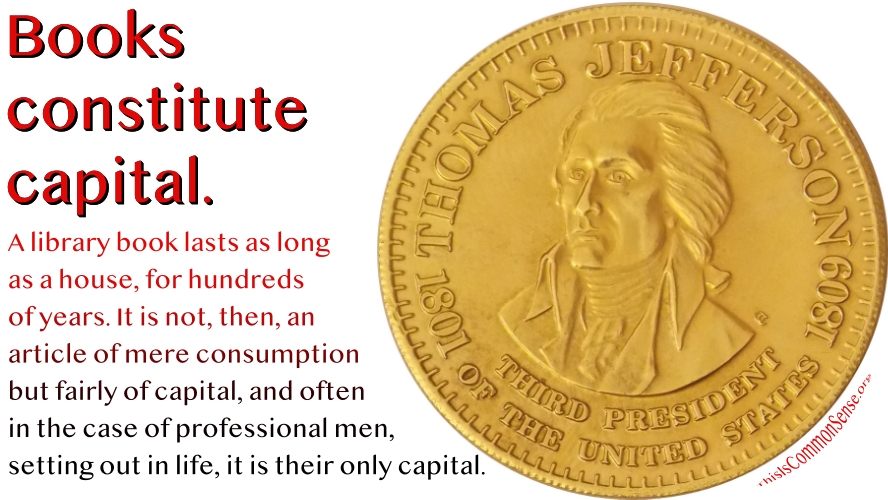
Books constitute capital. A library book lasts as long as a house, for hundreds of years. It is not, then, an article of mere consumption but fairly of capital, and often in the case of professional men, setting out in life, it is their only capital.

Thomas Jefferson to James Madison, letter (September 16, 1821).
Categories
Today

Indexed!

On March 5, 1616, Nicolaus Copernicus’s book, De revolutionibus orbium coelestium, was placed on the Catholic Church’s Index of Forbidden Books.

This censorship notwithstanding, the Earth continued to revolve around the Sun.

The book had been first published in 1543 in Nuremberg.


| In 1770, the Boston Massacre took place on March 5.

| Joseph Stalin, the longest serving leader of the Soviet Union, died at his Volynskoe dacha in Moscow on this date in 1953, after a cerebral hemorrhage.

| March 5 is magician Penn Jillette’s birthday.

Categories
education and schooling

Not College Material?

His grade point average was 4.42. His SAT score was 1590. Right out of high school, he was hired as a software engineer.

It wasn’t good enough. In the words of The College Fix, this super-smart kid was “perfect on paper but rejected due to his ethnicity” — by 16 out of the 18 colleges to which he had applied, including five University of California schools.

By then, Stanley had already proved his mettle as a programmer by designing an alternative to DocuSign called RabbitSign. According to Amazon’s Well-Architected Review, RabbitSign was “one of the most efficient and secure accounts” that it had ever seen. Amazon highlighted Stanley’s work in a case study.

After Google engineers assessed his skills, the company gave Stanley a job offer in 2023 — beating Amazon to the punch. He had just turned 18.

This kind of recognition of Mr. Zhong’s abilities probably made it a little easier to cope with the flood of rejections of his college applications. He obviously does not need a college degree to succeed. But he’s not just putting all that nonsense behind him. He and his dad, Nan Zhong, are suing the University of California for their racially discriminatory — and illegal — admissions policies.

The fight is for Stanley but not just Stanley, says his father, who reports on the case at the SWORD website. SWORD stands for Students Who Oppose Racial Discrimination.

“What we’re trying to get out of this is a fair treatment of Asian applicants. Including my other kids and my future grandkids.”

And ours.

This is Common Sense. I’m Paul Jacob.


PDF for printing

See all recent commentary
(simplified and organized)
See recent popular posts